

Enterprise Security Architecture: Framework & Principles

Most enterprises do not lack security controls; they lack a design. Firewalls, endpoint agents, identity providers, and scanners accumulate one purchase and one incident at a time, until the estate runs dozens of tools that overlap in some places and leave seams in others. Enterprise security architecture is the discipline that replaces that accumulation with intent: a deliberate design for how the pieces fit together across the whole organization, traceable back to the risks the business actually carries.
This post defines the discipline, explains why it matters more as environments fragment, and walks through its core principles, its layers, the frameworks that structure it, and a process for designing one. It closes with how knowledge graphs give architects something the discipline has always lacked: a living, queryable model of the environment the architecture is supposed to describe.
What is enterprise security architecture?
Enterprise security architecture is the practice of designing how an organization’s security controls, policies, and technologies work together to protect its assets and support its business objectives. Where enterprise cybersecurity names the whole defensive discipline, security architecture is its design layer: the decisions about which controls exist, where they sit, what each is allowed to trust, and how they compose into a coherent whole rather than a pile of point solutions.
It helps to separate it from three adjacent practices. Enterprise architecture describes the structure of the business and its technology as a whole; security architecture is a domain within it, inheriting its methods of modeling current state, target state, and the roadmap between them. Security engineering builds and hardens individual systems; architecture decides which controls should exist and how they relate before engineering builds them. Security operations runs the resulting environment day to day, against the control surface the architecture defined.
The output is not a single diagram. A working security architecture produces reference models for common problems (authentication, segmentation, data protection), approved patterns that project teams reuse without a bespoke review, and a roadmap from the environment as it is to the environment as designed. The test of a good one is traceability: for any control, the architecture can say which risk justifies it, and for any material risk, which controls answer it.
Why security architecture matters in modern enterprises
The environment that made architecture optional no longer exists. When applications lived in one data center behind one perimeter, the design was implicit in the network topology. Today the estate spans multiple clouds, SaaS applications, on-premises systems, and a remote workforce, with identity rather than the network deciding who reaches what. No individual tool decision adds up to a defensible posture in that environment; something has to define how the pieces compose.
The spending makes the stakes concrete. Gartner forecasts worldwide end-user spending on information security will reach $213 billion in 2025, up from $193 billion in 2024 (Gartner, July 2025). Without an architecture, that spend buys overlapping tools in some layers and unexamined gaps in others, and the gaps are expensive: the IBM Cost of a Data Breach Report 2025 put the global average cost of a breach at $4.44 million, with the United States average at a record $10.22 million. The surface is no longer bounded by what the enterprise builds itself, either; the Verizon 2025 Data Breach Investigations Report found third-party involvement in 30% of breaches, roughly double the prior year, so the design has to account for vendors and integrations the enterprise does not control.
Architecture also carries the structural changes that individual projects cannot. A zero trust migration, a new regulatory regime, or a merger that doubles the estate overnight all change the assumptions every control was deployed under, and only a design-level view can replan the whole rather than patching each system in isolation. The alternative to doing this deliberately is doing it by accident, one incident retrofit at a time, which is the most expensive way to arrive at a design.
The core principles of enterprise security architecture
The principles below predate every current product category; most trace to Saltzer and Schroeder’s 1975 design principles, and they have survived because they are properties of good design rather than of any technology generation. An architecture is the mechanism that applies them consistently instead of leaving them to each team’s judgment.
Least privilege. Every identity, human or machine, gets the minimum access its function requires, and access is reviewed and revoked as functions change. At enterprise scale this is the highest-leverage principle, because permissions grow by default and rarely shrink, and most real attack paths run through an identity that had more access than it needed.
Defense in depth. No single control is load-bearing. Segmentation, endpoint protection, identity policy, encryption, and monitoring each assume the others can fail, so one phished credential or one misconfiguration does not decide the outcome. Architecture is where the layers are planned so they reinforce each other rather than duplicating the same check five times.
Zero trust. No request is trusted for where it comes from; every access is authenticated and authorized on its own merits, regardless of network location. NIST SP 800-207 (2020) is the reference formulation. Zero trust is an architectural posture: it relocates the primary boundary from the network edge to identity and data, which changes where every other control belongs.
Secure by design and by default. Security is designed into systems from the start and enabled in their default configuration. The architectural form of this principle is the approved pattern: when the paved road is the secure road, project teams inherit good decisions without relitigating them.
Separation of duties. No single actor can both perform a sensitive action and approve it, and no single compromise should yield both the data and the keys. The principle shapes everything from deployment pipelines to key management, and it only holds if someone decided where the boundaries sit.
Fail securely, and keep it simple. When a control fails, it should fail into a safe state rather than an open one, and the design should stay simple enough to reason about. Complexity is a security cost in itself: an architecture no one can fully explain is an architecture no one can fully verify.
None of these principles is controversial, and none is self-executing. The difference between an enterprise that states them and one that has them is an architecture: a design that encodes them into patterns, placements, and defaults, so they hold across thousands of systems without depending on every team remembering them.
Layers of enterprise security architecture
Layers mean two different things in this discipline. Frameworks like SABSA layer the architecture by abstraction, from business context down to components and operations; that sense belongs to the next section. The more common operational sense layers the environment by control surface, the domains where controls are placed so that an attacker must defeat several unrelated defenses to reach anything valuable:
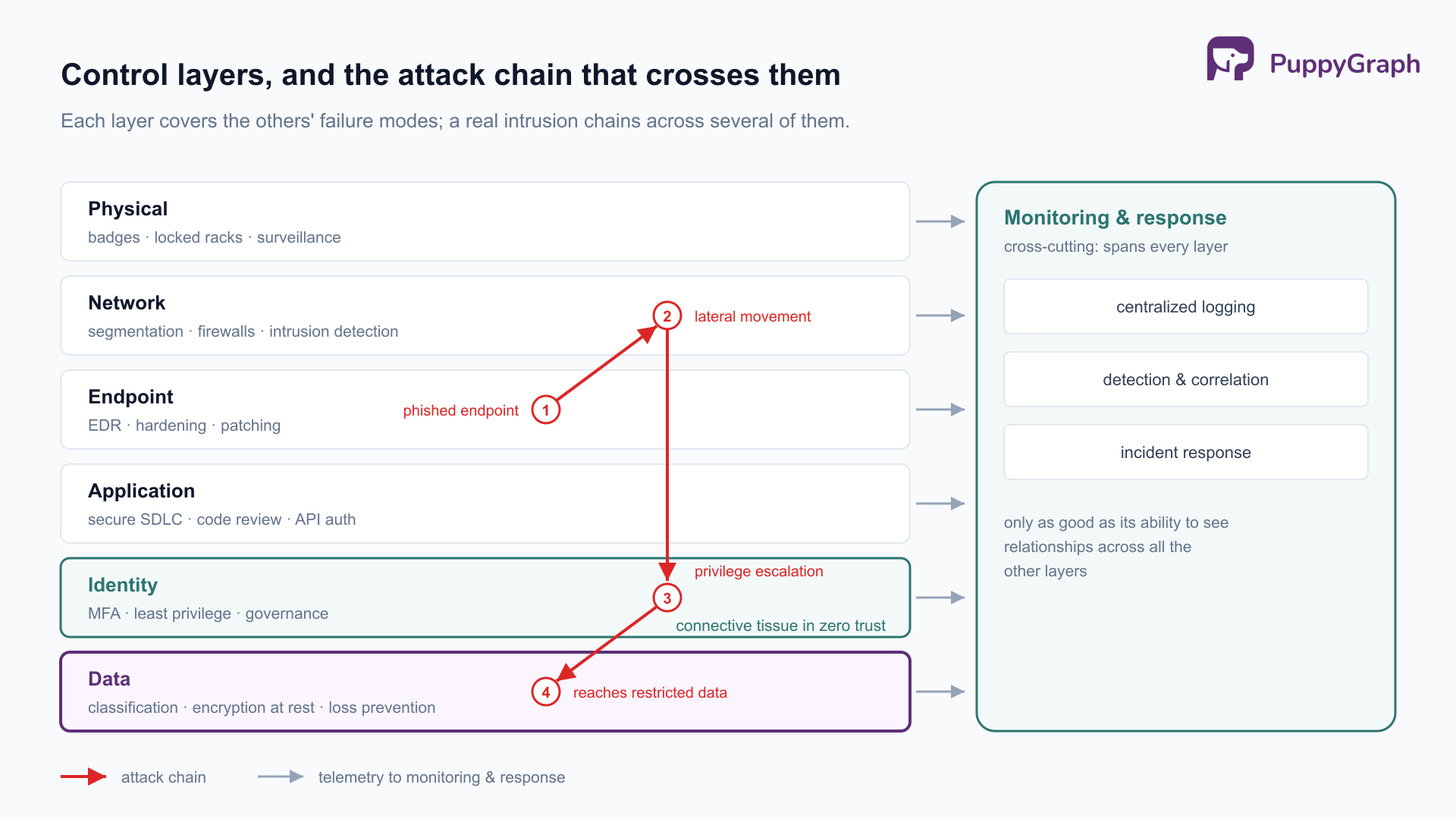
The table reads as a checklist, but the layers are not independent, and that is the architectural point. A real intrusion chains across them: a phished endpoint, a traversal the network should have blocked, an identity with more reach than its owner needed, a data store whose classification never happened. Architecture is the work of placing controls so the layers cover each other’s failure modes. Two layers deserve particular attention: identity, which in a zero trust posture stops being one layer among seven and becomes the connective tissue the others consult, and monitoring and response, which is only as good as its ability to see relationships across all the rest.
Security architecture frameworks and standards
No framework designs an architecture for you, but the established ones each answer a question an architect must answer anyway. The practical approach is to know what each is for and compose them, rather than adopting one as a totalizing method.
SABSA (Sherwood Applied Business Security Architecture) is the discipline’s native framework. It layers the architecture across six views, contextual, conceptual, logical, physical, and component, plus an operational view that cuts across the others, each asking what, why, how, who, where, and when from its altitude. Its enduring contribution is traceability: every control at the bottom should justify itself against a business attribute at the top.
TOGAF, The Open Group’s enterprise architecture framework, is not a security framework, but it is the method many enterprise architecture functions already run, and its development cycle is where security gets integrated into business, data, application, and technology architecture rather than bolted on beside them. SABSA and TOGAF are commonly used together for exactly that reason.
NIST Cybersecurity Framework 2.0 (published February 2024) organizes the program by outcome across six functions: govern, identify, protect, detect, respond, and recover, with govern new in 2.0. It is the common language for assessing coverage and communicating posture upward.
ISO/IEC 27001 specifies an information security management system and is the standard an enterprise certifies against. For architects it is the auditable floor: the control catalog the design must demonstrably satisfy.
NIST SP 800-207 defines zero trust architecture: the tenets, logical components, and deployment models for identity-centric access decisions. It is the reference to design against when the target state removes implicit network trust.
CIS Critical Security Controls are a prioritized set of defensive safeguards. They sit at a lower altitude than the frameworks above, which is their value: a concrete starting sequence for the roadmap once the design exists.
The composition matters more than any single choice: SABSA for traceability to business risk, TOGAF to keep security inside the enterprise architecture process, NIST CSF to assess and communicate, ISO 27001 to certify, SP 800-207 to shape the trust model, and CIS Controls to sequence the work. Frameworks that look like competitors are mostly answering different questions.
Designing an enterprise security architecture
The design process is a lifecycle, not a project. Treating it as a one-time deliverable is how enterprises end up with a beautiful target-state document describing an environment that stopped existing a year ago.
Establish business context and risk appetite. Start from what the business does, which assets and processes it cannot afford to lose, and how much risk leadership is prepared to carry. Every later decision traces back to this; an architecture that skips it optimizes controls against risks nobody prioritized.
Assess the current state. Inventory the assets, identities, data stores, controls, and trust relationships that actually exist, not the ones the last diagram claims. This is reliably the hardest step, because the evidence is scattered across cloud consoles, identity providers, scanners, and spreadsheets that disagree with each other.
Define the target state. Express the destination as principles applied to this business (where zero trust boundaries sit, how data classes map to protections, which patterns are approved) rather than as a shopping list of products. Product choices then become consequences of the design instead of substitutes for it.
Run the gap analysis and build the roadmap. Compare current to target, and sequence the gaps by risk reduction per unit of effort. This is where the CIS Controls’ prioritization earns its keep, and where dependencies surface: segmentation before micro-segmentation, identity governance before least-privilege enforcement.
Implement as patterns and guardrails. Architecture scales through reuse. Publish the approved patterns, encode them as defaults and policy-as-code where the platform allows, and reserve bespoke review for the genuinely novel cases.
Validate continuously. The environment changes daily, so validation cannot be annual. Verify continuously that segmentation holds, that privileges match the design, that new assets land inside approved patterns, and that the attack paths the design closed stay closed. This is where architecture stops being documentation and becomes a testable claim about the environment.
The lifecycle loops: validation findings feed the next current-state assessment, and material business changes reopen the context step. The architectures that decay are the ones where the loop broke, usually at validation, because checking design conformance across a large estate by hand does not scale. That validation problem is where the next section picks up.
How knowledge graphs help security architecture
A security architecture is, at bottom, a claim about relationships: which identities can reach which systems, which systems can talk to each other, which controls stand between the internet and the data. The traditional tooling for expressing those relationships is diagrams and spreadsheets, and both go stale the week they are finished. The facts themselves have not disappeared. They sit in the enterprise’s own data: cloud configuration exports, identity provider records, vulnerability scans, asset inventories, network policies. What is missing is a representation that makes the relationships queryable.
That is what a knowledge graph provides. Model the estate as nodes (assets, identities, roles, data stores, vulnerabilities, controls) and typed edges (authenticates to, assumes, can reach, grants read on, protected by), and the architecture’s central questions become graph traversals. Which internet-facing assets have a path to restricted data? Does the mandated segmentation actually hold, or does a forgotten peering connection bypass it? Which service accounts accumulated privileges the target state never granted them? Each is a multi-hop relationship question, exactly the shape that joins across separate tools answer poorly and a graph answers directly. It is the same property that makes graphs effective for security event correlation on the operations side; here it verifies the design rather than the detection.
Attack path analysis is the clearest example. The question “can an external attacker reach sensitive data” is a path query across layers that no single tool sees end to end:
MATCH path = (a:Asset {internet_facing: true})
      -[:RUNS_AS]->(:ServiceAccount)
      -[:ASSUMES*1..3]->(:Role)
      -[:GRANTS_READ]->(d:DataStore {classification: "restricted"})
WHERE (a)-[:HAS_VULNERABILITY]->(:Vulnerability {exploitable: true})
RETURN a.name, d.name, path
A result set here is a list of design violations, each one a concrete chain the architecture said should not exist. The same graph validates least privilege (identities whose reachable set exceeds their function), segmentation (paths that cross a boundary the design closed), and inventory coverage (assets with no controls attached at all).
The practical obstacle has been the plumbing: standing up a dedicated graph database means building ETL pipelines from every security and infrastructure source into yet another copy of the data, which is its own architecture violation waiting to happen. PuppyGraph removes that step. It is a graph query engine, not another database: it connects directly to the SQL databases, warehouses, and lakes where this data already lands, including direct reads of open table formats like Iceberg and Delta Lake, and lets teams define a graph schema over the existing tables. The data stays where it lives; PuppyGraph provides the graph compute on top, queryable in openCypher and Gremlin. To be clear about the boundary: it is not a SIEM, a scanner, or a control plane, and it does not enforce security controls. It complements the tools the architecture governs by making the relationships between their outputs traversable. The pattern maps to several of the security use cases PuppyGraph is positioned for, including unified asset inventory systems, threat and exposure management platforms, and SIEM graphs, and it is used by security organizations including Palo Alto Networks, Datadog, Netskope, and Trend Micro.
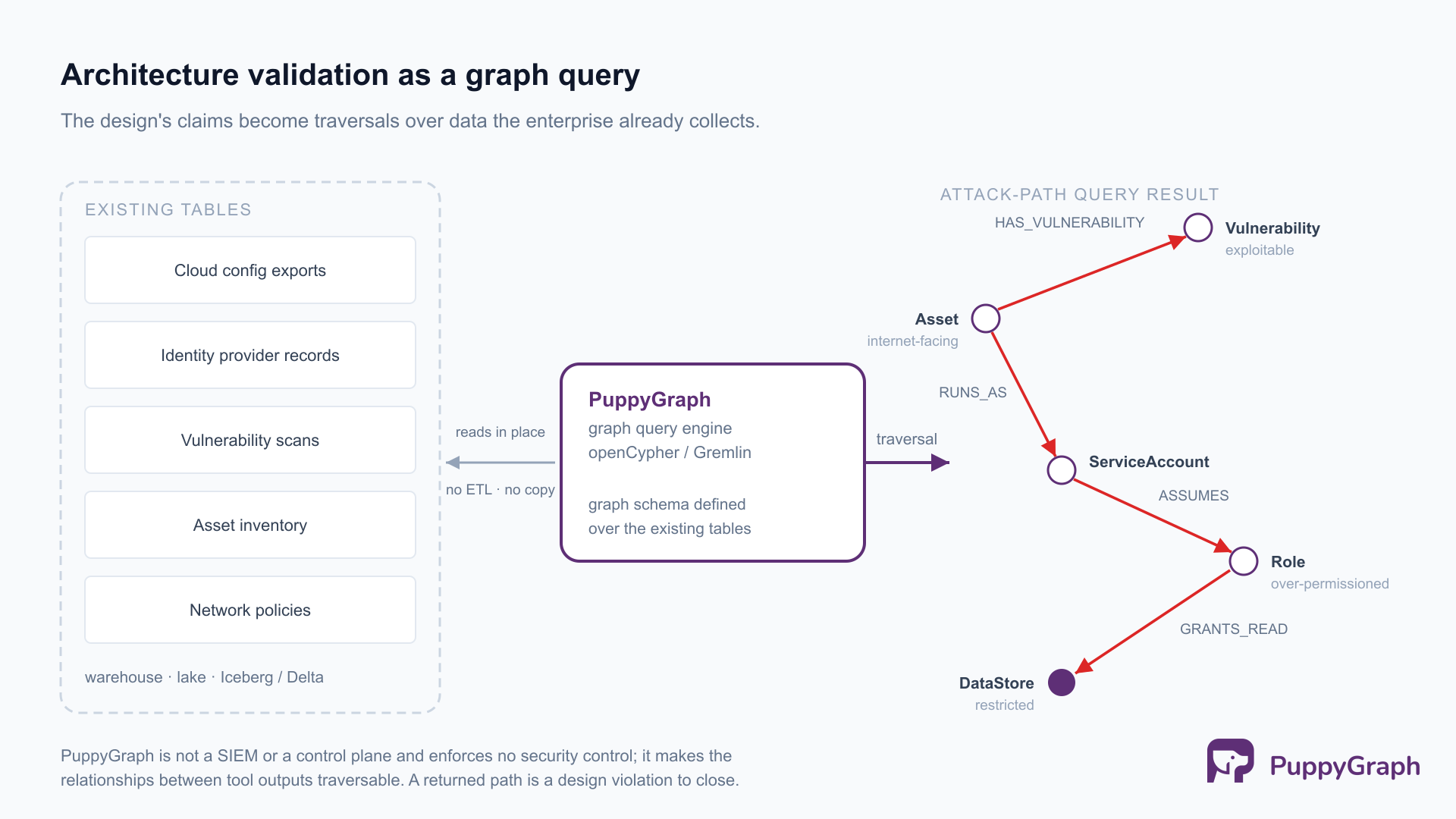
For the architect, the graph closes the validation loop from the previous section. The design’s claims stop being assertions in a document and become queries that run against the environment as it is today, on data the enterprise already collects.
Conclusion
Enterprise security architecture is the difference between owning controls and having a design: a traceable line from business risk to principles, from principles to control placement across the layers, and from placement to a roadmap the organization can execute. The frameworks divide the labor, and the principles have been stable for fifty years. The part that has changed is validation: in an environment that reconfigures itself daily, an architecture is only as credible as its ability to check its own claims, and relationship-shaped claims are best checked as graph queries over the data the enterprise already holds.
Try the forever-free PuppyGraph Developer Edition and book a demo with the team to see how openCypher and Gremlin queries over warehouse and lakehouse tables, with no graph-specific ETL, turn attack path and least-privilege validation into single traversals.

Sa Wang is a Software Engineer with exceptional mathematical ability and strong coding skills. He holds a Bachelor's degree in Computer Science and a Master's degree in Philosophy from Fudan University, where he specialized in Mathematical Logic.


