

Types of AI Models: A Guide to Different AI Models
Choosing an AI model starts with the output your application needs. Predicting whether a shipment will arrive late, grouping similar support tickets, and generating a response to a customer require different objectives and evaluation methods. A model that handles one well may be poorly suited to another.
The terminology can obscure those choices. Machine learning, supervised learning, and deep learning describe overlapping categories, so they do not form a list of mutually exclusive alternatives. This guide explains how the categories fit together, how models are created, and how to connect model selection to an application's data and operating requirements.
What is an AI model?
An AI model is a computational representation used to turn inputs into predictions, generated content, or decisions. In machine learning, the model acquires its behavior through training on data. That learned behavior might estimate delivery time from order details or produce a text response from a prompt.
It helps to distinguish the training algorithm from the trained model. The algorithm is the procedure that learns from examples. The model is the resulting artifact, such as a set of regression coefficients, decision trees, or neural network weights. Running that artifact on new inputs is called inference. Google's supervised learning introduction explains this progression from training to evaluation and inference.
The model also sits inside a larger application. A support assistant needs an interface, access to relevant records, and rules for handling its output. The language model generates text; the surrounding software determines which records it receives and whether a proposed action is allowed. Evaluating the model alone therefore answers only part of the question of whether the application works.
How do you create an AI model?
Creating a model involves defining a task, preparing data, fitting or adapting a model, and checking its behavior on examples it has not learned from. An application can also use an existing pretrained model without creating new weights.
- Define the target and the cost of errors. For shipment prediction, specify whether the output is estimated arrival time or the probability of missing a delivery window. Choose a metric tied to that output. Also decide what the application will do with the result: notify a customer, reprioritize an order, or request human review.
- Build a representative dataset. Collect inputs that will actually be available when the prediction runs. A delivery estimate made at checkout cannot use the eventual dispatch timestamp. Define labels consistently, inspect missing values, and check whether important customer groups, locations, or operating conditions are represented.
- Separate training, validation, and test data. Fit the model on training data, select settings using validation data, and reserve a test set for the final assessment. Match the split to deployment: forecasting needs a separation across time; evaluating unseen customers may require a separation by customer. Fit learned preprocessing on training data only. Scikit-learn's data leakage guidance explains why information crossing these boundaries produces misleading scores.
- Establish a baseline and train candidates. Compare against a simple reference, such as a historical average or an existing business rule. Then test suitable model families. For image or language tasks, adapting a pretrained network can reuse representations learned elsewhere; TensorFlow's transfer learning guide demonstrates both feature extraction and fine-tuning.
- Evaluate and operate the whole prediction path. Check task quality, latency, resource use, and errors on relevant subsets. Deploy the preprocessing alongside the model, record versions, and monitor outcomes when labels become available. Define when a failed prediction falls back to a rule or a person.
A successful training run is an intermediate result. The useful deliverable is a reproducible path from the application's inputs to an output that meets its acceptance criteria.
The different types of AI models
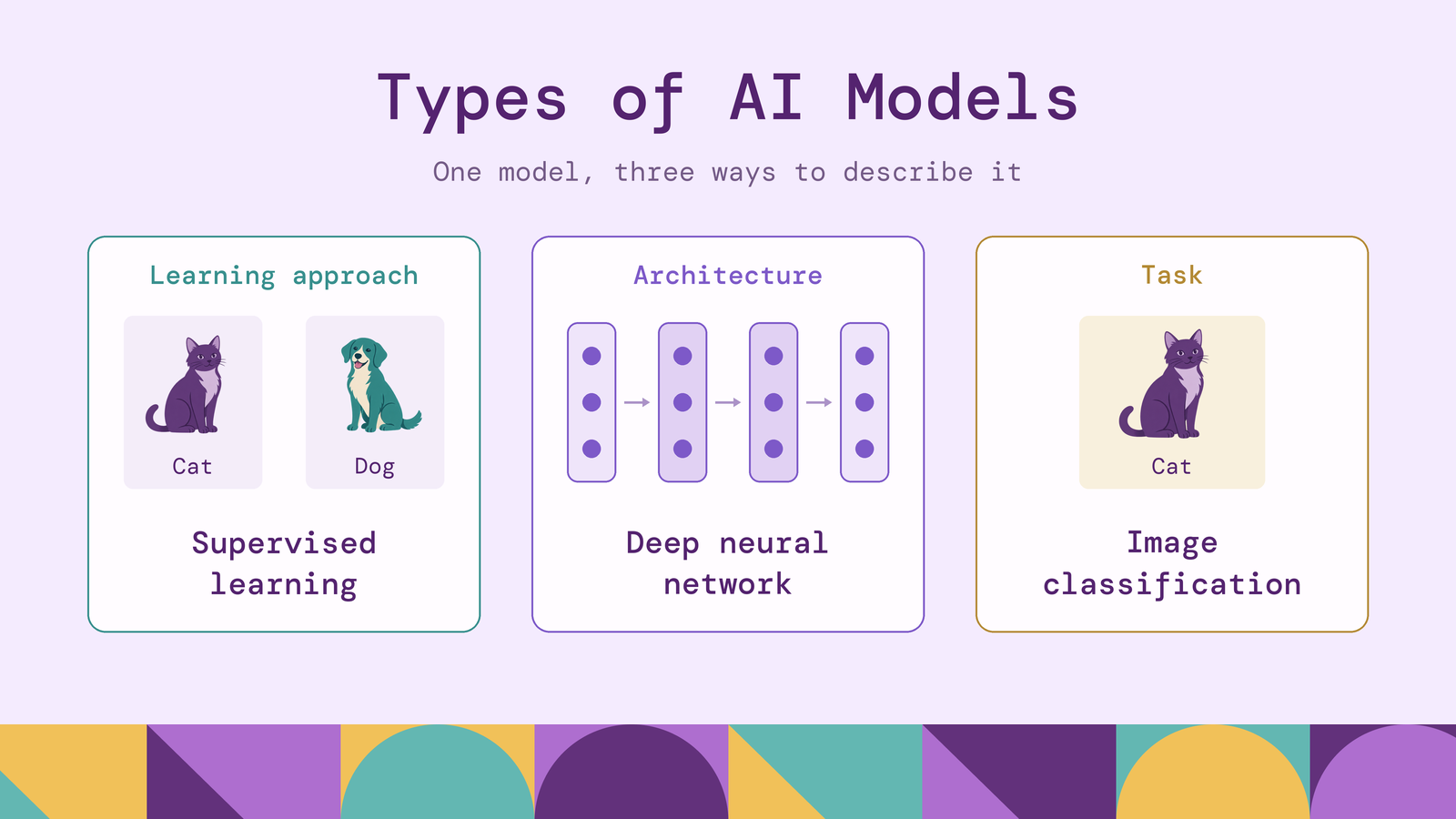
Three questions separate the terminology: how does the model learn, how is it built, and what does it produce?
Machine learning is the broad field covering models learned from data. Deep learning sits within it and uses neural networks with multiple layers of learned representations. Supervised and unsupervised learning describe training approaches that can involve either deep or non-deep models.
Two other approaches are also relevant. Self-supervised learning derives training targets from the data itself, such as predicting hidden words in text. Reinforcement learning learns behavior from reward signals associated with actions and their consequences. Generative AI describes models used to create content; it is not a separate alternative to machine learning.
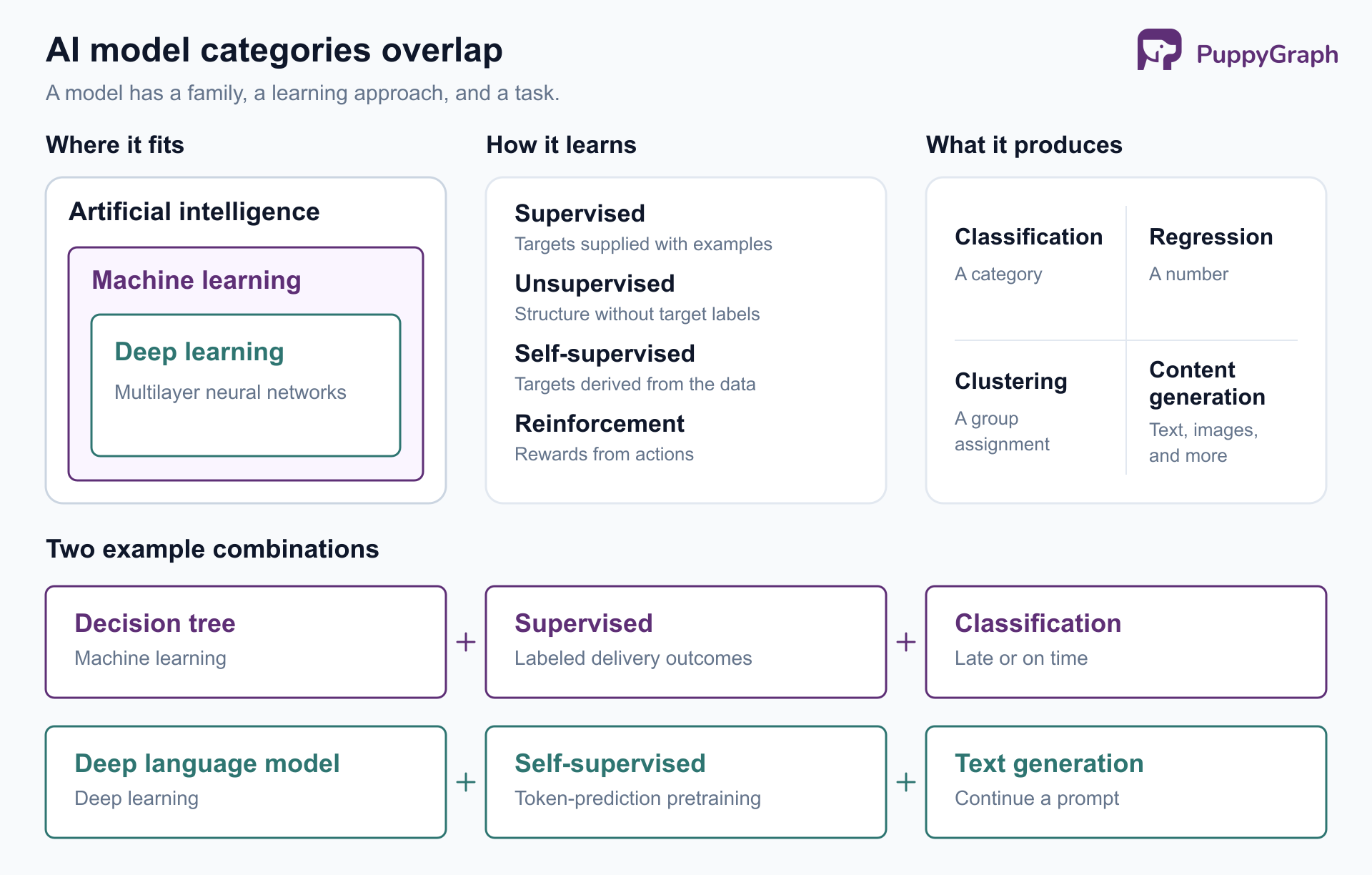
A model can carry several labels at once. A deep neural network trained on labeled images is both supervised and deep learning. Keeping these dimensions separate makes comparisons meaningful.
Machine learning models
Machine learning models learn patterns from examples instead of requiring developers to enumerate every relationship between inputs and outputs. Google's introduction to machine learning describes prediction and content generation as two broad uses of this process.
For structured application data, useful starting points include linear models, decision trees, and ensembles. A linear model combines input features through learned coefficients. A decision tree divides the input space through successive tests. An ensemble combines multiple models: random forests aggregate randomized trees, while gradient boosting adds models in stages to reduce the chosen loss. Loss measures the model's errors against its chosen training objective. These mechanisms are covered in scikit-learn's linear model and ensemble documentation.
The input representation deserves as much attention as the family name. In a delivery application, candidate features might include destination region, shipping method, order size, and queue length at checkout. Each has a definition and an availability time that must remain consistent between training and deployment.
Start with a small set of plausible candidates and compare them on the same evaluation data. A more elaborate architecture earns its place when it improves a requirement that matters, after accounting for the cost of serving and maintaining it.
Supervised learning models
Supervised learning uses examples paired with target outputs, called labels. The model learns a mapping from the inputs to those targets. The two common task types are classification and regression.
Classification predicts a category. A shipment model might distinguish deliveries expected to arrive on time from those expected to arrive late. A classifier can produce a score that the application converts into a decision using a threshold. Changing that threshold can change which shipments trigger an intervention.
Regression predicts a numerical value. A model might estimate delivery duration or demand for a product. Choose an error measure that reflects the use case: an average absolute error describes typical error magnitude, while a squared-error measure gives larger mistakes more weight. Scikit-learn documents these regression metrics alongside classification measures.
The evaluation must reflect the consequences of mistakes. If late shipments are uncommon, a classifier that always predicts on-time delivery can look accurate while finding none of the cases requiring attention. Precision and recall answer more useful questions: what fraction of flagged shipments were actually late, and what fraction of late shipments were flagged?
Labels also encode the process that produced them. Consider a support model trained to reproduce historical ticket priorities. If those priorities were assigned inconsistently, matching them more closely does not necessarily improve routing. Agree on what the target represents before treating a higher score as evidence of a better application.
Unsupervised learning models
Unsupervised learning looks for structure in data without labeled answers for the task. It is useful when the immediate goal is to discover groups, summarize variation, or investigate unusual observations.
Clustering groups similar examples. A team could group support tickets using text representations to explore recurring issues. K-means assigns examples to a chosen number of clusters around learned centers. Its distance-based objective favors compact groups and can be a poor fit for irregular shapes, as the scikit-learn clustering guide explains. Feature scaling and the chosen representation affect what counts as similar.
Dimensionality reduction compresses representations. Principal component analysis, or PCA, finds orthogonal directions capturing the greatest variance. Keeping fewer components can support visualization or downstream modeling. High variance does not necessarily identify the information most useful for a particular prediction target.
Anomaly detection identifies unusual cases. An unsupervised detector can flag observations that differ from the patterns it learned. A shipment with an unusual route or duration might warrant investigation, but unusual does not establish incorrectness. A legitimate new service can also depart from historical patterns.
These outputs need interpretation and evaluation. Check whether clusters persist across samples and whether they support a useful action. For anomaly detection, measure the value of the review queue, including how many flagged cases turn out to need attention. The absence of training labels does not remove the need to test usefulness.
Deep learning models
Deep learning uses neural networks with multiple layers to learn representations of data. Earlier layers transform the inputs into intermediate representations that later layers combine. This lets a model learn features as part of training, a central distinction explained in the Deep Learning textbook.
Convolutional neural networks apply learned filters across local regions of an input. In image applications, this supports learning spatial patterns that can contribute to classification or detection. TensorFlow's CNN tutorial demonstrates an image classifier built from convolutional layers. A product inspection system might adapt a pretrained convolutional network using labeled images of acceptable and defective items.
Transformers use attention to combine information across positions in a sequence. The architecture introduced in Attention Is All You Need supports language tasks without the recurrent structure of earlier sequence models. Different transformer designs support different outputs, including text representations and generated text.
The training approach remains a separate choice. A language model can learn from targets derived from raw text and later be adapted using labeled examples. An image network can learn directly from labeled images. Deep learning therefore does not imply that training is unsupervised or that the output is generative.
For application teams, the choice is often how to reuse a network. Feature extraction keeps the pretrained network fixed and uses its representations in another model. Fine-tuning updates some or all of its weights on additional data. Evaluate both against the target task: training a large network from scratch is only one route to a deep learning application.
Examples of common AI models
The following examples connect concrete model families to outputs and practical evaluation questions. Several can serve the same application, depending on its data and constraints.
Despite its name, logistic regression is a classification method. Random forests and gradient-boosted trees can support both classification and regression; the training objective and output determine the task.
BERT is a transformer language representation model that can be fine-tuned for downstream tasks. It illustrates why a language model does not necessarily function as a conversational text generator. Denoising diffusion models provide a different generative example: they learn a process for reversing progressive corruption and can generate images by denoising sampled noise.
Use this list to define experiments, not to rank models universally. A comparison is useful when candidates receive equivalent information and are judged against the same application requirement.
Apply AI to your application development goals
Translate the product requirement into an output, an evaluation set, and a data contract. For a delivery application, predicting lateness requires labeled outcomes. Discovering recurring delay patterns may call for clustering. Explaining affected orders to a customer may involve a language model supplied with the relevant records.
That last case introduces a separate decision: how the application obtains facts. Retrieval-augmented generation combines a generative model with retrieved information. Supplying order records at inference time gives the model context for an answer; it does not require those records to become model weights.
Some questions depend on relationships across records. To explain which customers are affected by a supplier delay, the application may need to follow suppliers to components, components to products, and products to open orders. Define those relationships explicitly and retrieve the matching records before asking the language model to summarize the impact.
PuppyGraph lets teams define a graph schema over existing tables and query those relationships through openCypher and Gremlin. The underlying data stays in supported SQL databases, warehouses, or lakes and lakehouses, including direct reads of open table formats such as Iceberg and Delta Lake. The default direct-query path requires no graph-specific ingestion or persistent duplicate dataset.
That schema functions as an ontology of entities, relationships, and properties. PuppyGraph's ontology enforcement validates queries before execution and returns structured feedback for invalid references, enabling an agent to correct its query. The graph schema describes the domain; the trained AI model uses query results as context. The application still needs to evaluate whether the retrieved evidence answers the question and whether the generated explanation represents it accurately.
Try the forever-free PuppyGraph Developer Edition and book a demo with the team to see how openCypher and Gremlin queries traverse relationships across warehouse and lakehouse tables, with no graph-specific ETL, to supply context for AI applications.
Frequently asked questions
What are the main types of AI models?
Common families include linear models, decision trees, ensembles, and neural networks. Supervised, unsupervised, self-supervised, and reinforcement learning describe training approaches. Deep learning describes multilayer neural models, while generative AI describes their use in producing content. These categories overlap.
What is the difference between machine learning and deep learning?
Deep learning is a subset of machine learning. It uses neural networks with multiple layers of learned representations. Machine learning also includes methods such as linear regression, decision trees, and clustering algorithms.
Is a large language model supervised or unsupervised?
Its training can involve several approaches. Pretraining often uses self-supervised targets, such as predicting tokens from context. Later stages may use supervised examples or reinforcement learning. The label depends on which training stage you mean.
Do I need to train a model from scratch?
No. You can use a pretrained model, extract features from it, or fine-tune it for a task. You can also supply retrieved context without changing its weights. Choose based on measured task performance, available data, and deployment constraints.

Hao Wu is a Software Engineer with a strong foundation in computer science and algorithms. He earned his Bachelor’s degree in Computer Science from Fudan University and a Master’s degree from George Washington University, where he focused on graph databases.


