


Agentic Graph Systems: How They Work and Why They Matter

Agentic graph systems give agents queryable relationship evidence to guide an investigation. An AI agent investigating a failed deployment needs to connect the changed service to its dependencies, identify affected customers, and find the team responsible for recovery.
The value depends on what the graph represents and how the agent uses it. This article explains the operating loop, architecture, benefits, and trade-offs, then outlines how to build a system whose decisions can be checked against the data behind them.
What is an agentic graph system?
In this article, an agentic graph system means an AI application in which an agent uses graph-structured knowledge to investigate a task and choose subsequent steps. The agent interprets the goal, selects tools, and assesses results. The graph represents entities, relationships, and properties that those tools can query.
Two different graphs may appear in the same application. A knowledge graph models the subject being investigated: services, teams, customers, and dependencies. A workflow graph models execution: retrieve evidence, inspect results, request approval, and perform an action. A workflow graph alone does not give an agent knowledge of business relationships.
For example, LangGraph's Graph API represents application behavior through shared state, nodes that perform work, and edges that determine subsequent execution. That orchestration graph can call a separate knowledge graph through a tool. The two graphs serve different purposes even when one application uses both.
Graph retrieval also does not automatically make a system an agent. A fixed pipeline can retrieve connected evidence and generate an answer. An agent can dynamically direct its investigation and tool use based on the evidence returned. This follows Anthropic's architectural distinction between workflows and agents.
How do agentic graph systems work?
Consider a hypothetical operations assistant asked: Which customers might be affected by a failure in the identity service, and who should investigate? Its graph includes services, customer accounts, and ownership records.
Interpret the task. The agent identifies the starting service and the required outputs: potentially affected accounts, dependency paths, and responsible teams. It resolves the service name to a stable identifier. If multiple environments contain the same name, it requests clarification or uses an explicitly supplied environment.
Retrieve connected evidence. A graph tool follows incoming dependency relationships to find services that rely on the identity service. It connects those services to customer usage and ownership records. The application bounds the traversal and returns the relevant paths with source references and observation times.
Inspect and extend. Suppose the result includes a customer-facing application but no owner. The agent can query a separate ownership registry or retrieve a service catalog document. This second step responds to a gap in the first result. A successful query does not mean the investigation is complete.
Form a conclusion. The agent distinguishes potential exposure from observed impact. A dependency path establishes a possible route for disruption; telemetry is needed to determine whether the customer experienced failure. Its answer should preserve that distinction and identify missing evidence.
Act within the workflow. The system may prepare an incident ticket or propose notifications. Application policy determines whether those actions execute automatically or require review. The investigation ends when its evidence requirements are met, a resource limit is reached, or further progress requires a person.
The graph supplies explicit relationships at each retrieval step. The agent decides which additional evidence would help answer the question. Neither responsibility makes the other unnecessary.
What problems do agentic graph systems solve?
Questions that span several relationships. A support case may involve a customer, a subscription, a deployed service, and a shared dependency. A graph can represent the connecting path directly, giving an agent a reusable way to investigate the relationship. SQL joins and purpose-built APIs can answer these questions too; graphs are useful when relationship patterns vary across investigations.
Relevant documents without sufficient context. A runbook may describe authentication failures without naming every dependent application. Document retrieval can locate that runbook, while a graph traversal supplies the surrounding service context. Graph and text retrieval therefore have complementary roles. Microsoft's GraphRAG query documentation illustrates this combination through local search using structured graph data and source text, alongside global search over community reports.
Inconsistent identity across sources. Monitoring may use a deployment identifier while a service catalog uses an application identifier. A curated entity model can connect both to the same service. The graph makes that reconciliation reusable, but ingestion or modeling logic must establish that the records actually refer to the same entity. Similar names alone are insufficient.
Evidence lost between investigation steps. An agent can retain entity identifiers, checked relationships, unresolved questions, and source references as investigation state. Later tool calls can build on that evidence without relying entirely on a prose conversation summary. Keeping this state is an application design choice; a graph connection does not create durable memory automatically.
These problems share a need for explicit connections among facts. If the task is simply to summarize one document or call a known API, introducing a knowledge graph may add maintenance without improving the answer.
Architecture of an agentic graph system
A practical architecture separates data modeling, retrieval, agent execution, and action controls. The boundaries let teams locate errors: a missing dependency belongs to the data layer, while repeated unnecessary searches belong to the investigation logic.
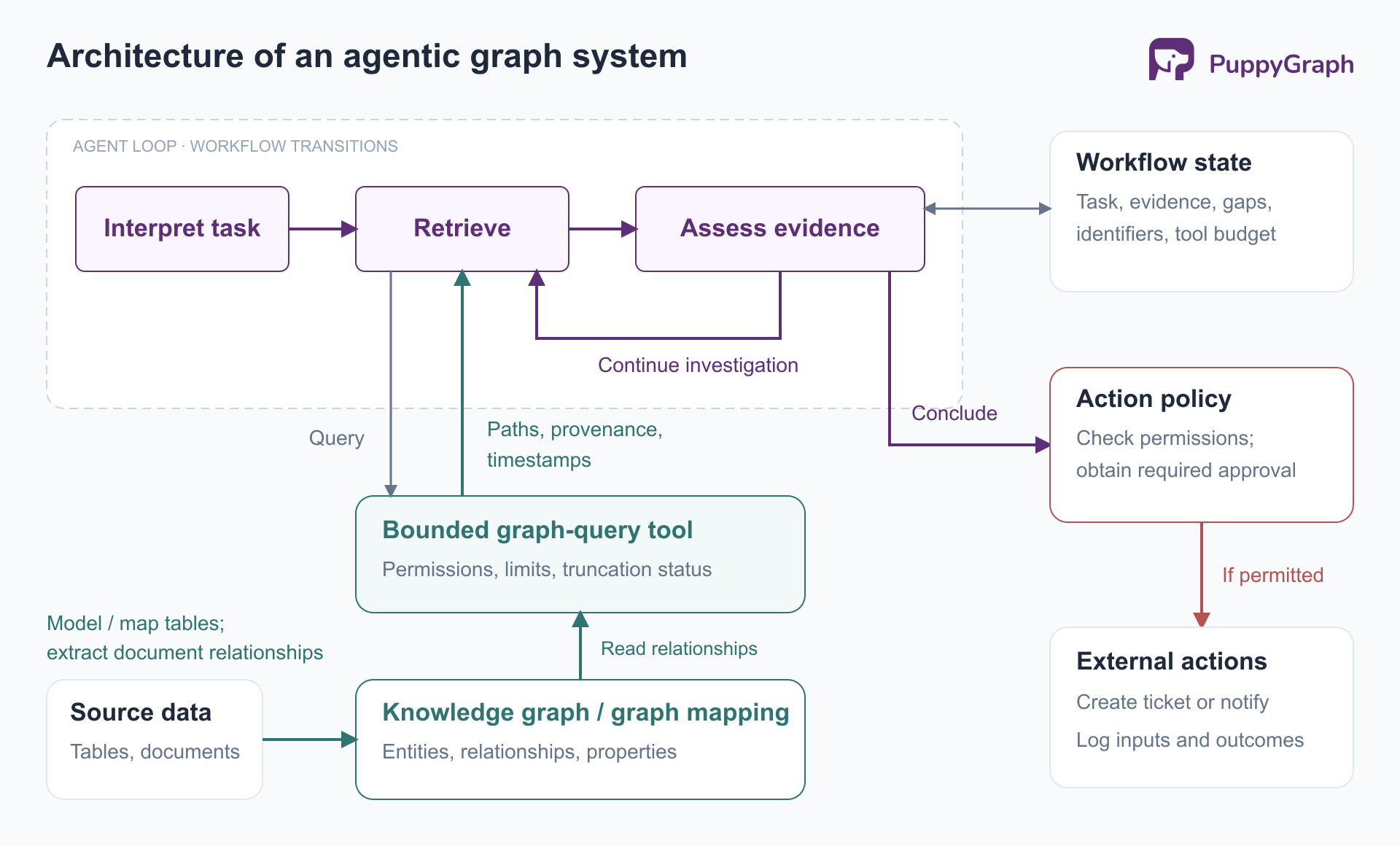
Sources and entity model. Define which records represent entities and which establish relationships. For the operations example, Service, Team, and Customer are entity types; DEPENDS_ON, OWNED_BY, and USES describe different connections. Record the direction and meaning of each relationship. Decide how deletions, renamed services, and conflicting ownership records affect the model.
Graph storage and query access. A dedicated graph database can store the modeled data. Another approach defines a graph over existing tables. Choose based on where authoritative records live, required update behavior, and the queries the workload needs. In either design, an operational dependency graph should include timestamps or validity information so the agent can assess whether an edge is still relevant.
Retrieval tools. Give the agent a documented interface with clear inputs and bounded outputs. An illustrative application tool such as find_dependents(service_id, max_hops) can expose this interface. Its implementation should enforce allowed relationship types, timeouts, result budgets, and caller permissions. Return whether results were truncated, since a partial result cannot support an exhaustive claim.
Agent runtime and state. Keep the task, resolved identifiers, collected evidence, remaining questions, and tool budget in explicit state. The runtime selects the next tool call and decides when to stop. A workflow framework can organize this execution, but the application still needs a definition of sufficient evidence and rules for handling unsuccessful calls.
Action controls and observability. Separate data-reading tools from tools that modify external systems. Log tool inputs, returned evidence, approval decisions, and action outcomes. Schema validation can catch invalid references; authorization determines access; approval policy governs consequential actions. These checks address different failure modes and should be tested independently.
A retrieved path is part of the evidence record, not a transcript of the model's internal reasoning. Preserve the data needed to review the conclusion, including facts that contradicted the proposed explanation.
Benefits of agentic graph systems?
More targeted context. Traversal can gather the entities and relationships relevant to a question before the model receives them. For the identity-service investigation, that might mean a small set of dependency paths and ownership records. The benefit depends on selectivity: unrestricted expansion can produce more irrelevant context than a document search.
Checkable relationship claims. When an answer names an affected application, a reviewer can inspect the dependency path used to include it. Source references and observation times make the claim easier to challenge. This supports review of the evidence, although a valid path still does not prove that the agent interpreted it correctly.
Reusable domain knowledge. A shared service model can support incident investigation, change planning, and ownership lookup. Each application can query the same definitions instead of independently reconstructing relationships. The return comes from maintaining those definitions consistently as sources change.
More deliberate follow-up actions. Connected evidence helps an agent identify the next useful check. Missing ownership suggests a registry lookup; an old dependency suggests revalidation. The system can turn gaps into explicit follow-up tasks instead of silently filling them with plausible prose.
These are architectural opportunities, not guaranteed improvements in accuracy or cost. Measure whether the graph improves task completion and evidence quality enough to justify modeling effort, query latency, and ongoing data maintenance.
Agentic graph systems vs traditional AI agents
Here, traditional AI agents means agents that use tools, documents, or databases without an explicit knowledge-graph retrieval layer. Both designs can plan, retain state, request approval, and perform multi-step work. The comparison concerns how they obtain connected context, not whether they are autonomous.
The graph moves some relationship knowledge into a maintained data model. It does not remove the need for effective tools or careful synthesis. A strong API that already returns dependency paths may provide the context an agent needs without introducing a separate graph layer.
Use the same model, permissions, task set, and source data when comparing the approaches. Otherwise, an apparent graph advantage may come from better data coverage or more capable tools rather than the representation itself.
How to build an agentic graph system
Start with a bounded investigation and expand only after the system can produce a useful answer with inspectable evidence.
- Define the task and baseline. Choose a question such as identifying potential downstream impact from a failed service. Record what a successful answer must contain, including dependency evidence and uncertainty. Build or retain a baseline using existing search and APIs so the graph's contribution can be measured.
- Model the necessary relationships. Begin with service dependencies, customer usage, and team ownership. Define stable identifiers, edge direction, source authority, and freshness expectations. Inspect sample records manually. A traversal through an incorrectly merged service can look convincing while answering the wrong question.
- Implement bounded retrieval. Start with reviewed query templates exposed through typed tools. Add generated queries only when the task requires more flexibility, and validate them against the exposed schema. Distinguish an empty result from an invalid query, unavailable source, access denial, or truncated response. Each outcome calls for different behavior.
- Connect the investigation loop. Let the agent retrieve, assess evidence, and choose a permitted follow-up. Limit retries, traversal depth, and total tool use. Store evidence references separately from tentative conclusions. Route unresolved ambiguity to a person instead of allowing repeated guesses to become the final answer.
- Evaluate before enabling actions. Test known dependency chains, cycles, missing edges, duplicate names, stale records, and denied access. Measure affected-service precision and recall, source attribution, unsupported conclusions, latency, and tool usage. Then test action behavior separately, including approval requirements and duplicate execution after retries.
For teams whose relationship data already resides in tables, PuppyGraph lets the agent query a graph model over existing data. Its graph schema maps tables to nodes, edges, and properties. It queries SQL databases, data warehouses, and data lakes or lakehouses, including direct reads of open table formats such as Iceberg and Delta Lake. The default direct-query path requires no graph-specific ingestion or persistent duplicate dataset.
The graph schema functions as an ontology of the entities and relationships available to the agent. PuppyGraph's ontology enforcement validates queries against that model before execution and returns structured, LLM-readable feedback for invalid references. An agent can use that feedback to revise a query. This grounds query construction; it does not establish that every stored relationship is correct or that an action is authorized.
PuppyGraph supports openCypher and Gremlin. It compiles graph queries into node and edge operators in its own distributed engine, issuing simple projection and filter SQL when reading SQL stores. Graph-specific execution supports multi-hop investigations while the underlying tables remain in their existing storage systems. The application supplies the agent loop, evidence requirements, and action policy around that query layer.
Conclusion
Agentic graph systems give agents explicit relationships to investigate and evidence to carry between steps. They are most useful when a task depends on paths across entities and sources. Their reliability rests on a maintained model, bounded retrieval, and conclusions that distinguish observed facts from possible consequences.
Build around one measurable investigation, compare it with existing tools, and expand autonomy only when the evidence and action controls hold up in testing.
Try the forever-free PuppyGraph Developer Edition and book a demo with the team to see how openCypher and Gremlin queries connect warehouse and lakehouse tables, with no graph-specific ETL, to supply relationship evidence for agent investigations.

Hao Wu is a Software Engineer with a strong foundation in computer science and algorithms. He earned his Bachelor’s degree in Computer Science from Fudan University and a Master’s degree from George Washington University, where he focused on graph databases.

Get started with PuppyGraph!


Developer Edition
- Forever free
- Single noded
- Designed for proving your ideas
- Available via Docker install
Enterprise Edition
- 30-day free trial with full features
- Everything in developer edition & enterprise features
- Designed for production
- Available via AWS AMI & Docker install