

LLMOps: What It Is, Components, Tools & Best Practices
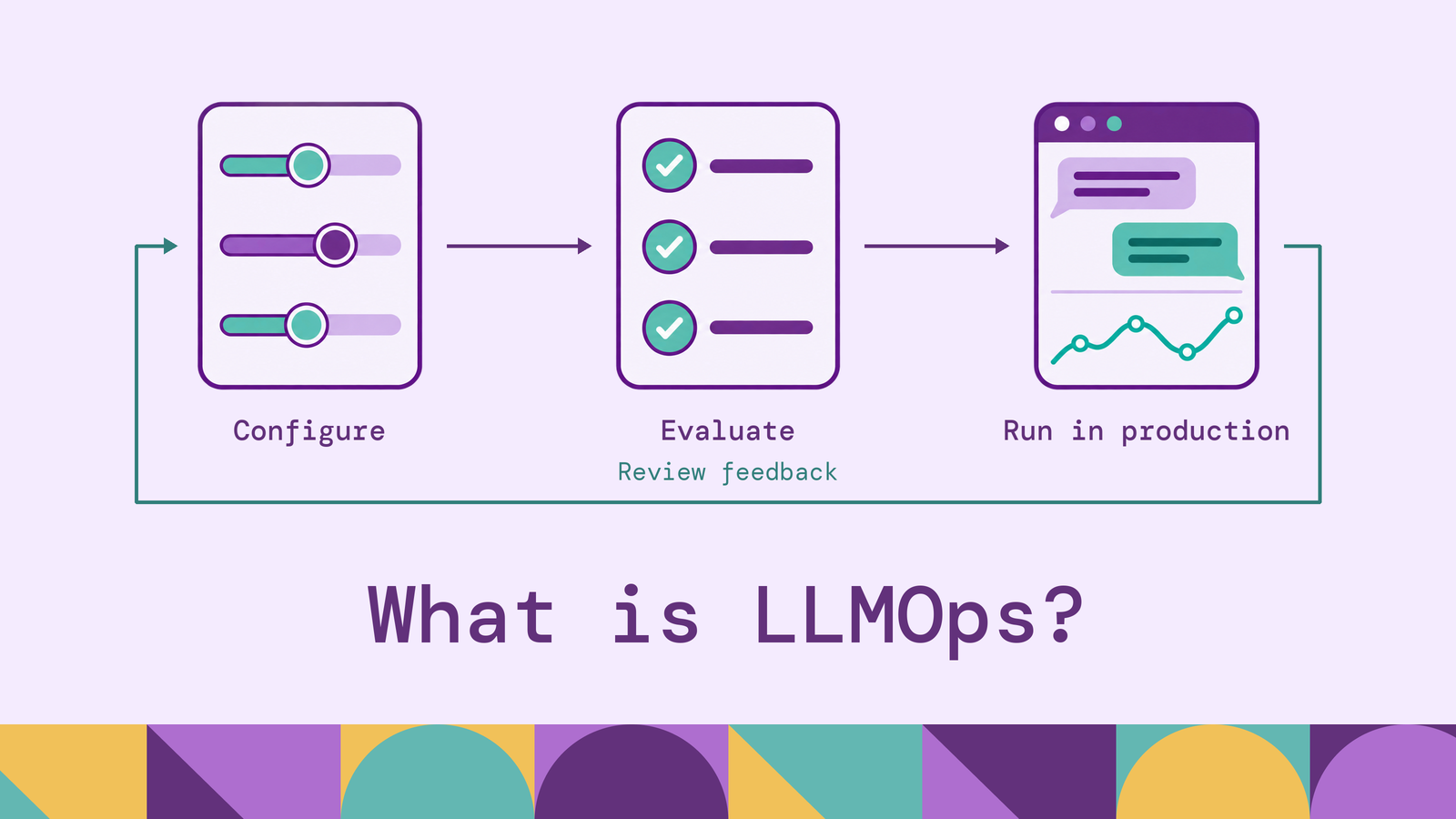
Releasing an LLM application means managing more than model availability. A prompt edit, a changed retrieval index, or a new tool permission can alter what the application says and does. Teams need a way to evaluate those changes, trace failures, and restore a working configuration.
This article explains how LLMOps provides that discipline, which components and tools support it, and how to build an operating process around measurable application behavior.
What is LLMOps?
LLMOps, short for large language model operations, is the set of practices used to develop, evaluate, deploy, monitor, and maintain LLMs and the applications built around them. It adapts machine learning operations to systems whose behavior depends on prompts, runtime context, and sometimes external tools. IBM's LLMOps overview places these practices across the model lifecycle.
For an application team, that scope can include selecting a hosted model, versioning prompts, operating retrieval pipelines, evaluating answers, and managing releases. Teams that train or fine-tune models also need to manage training data, experiments, and model artifacts. Training is optional; operational ownership begins when people depend on the application.
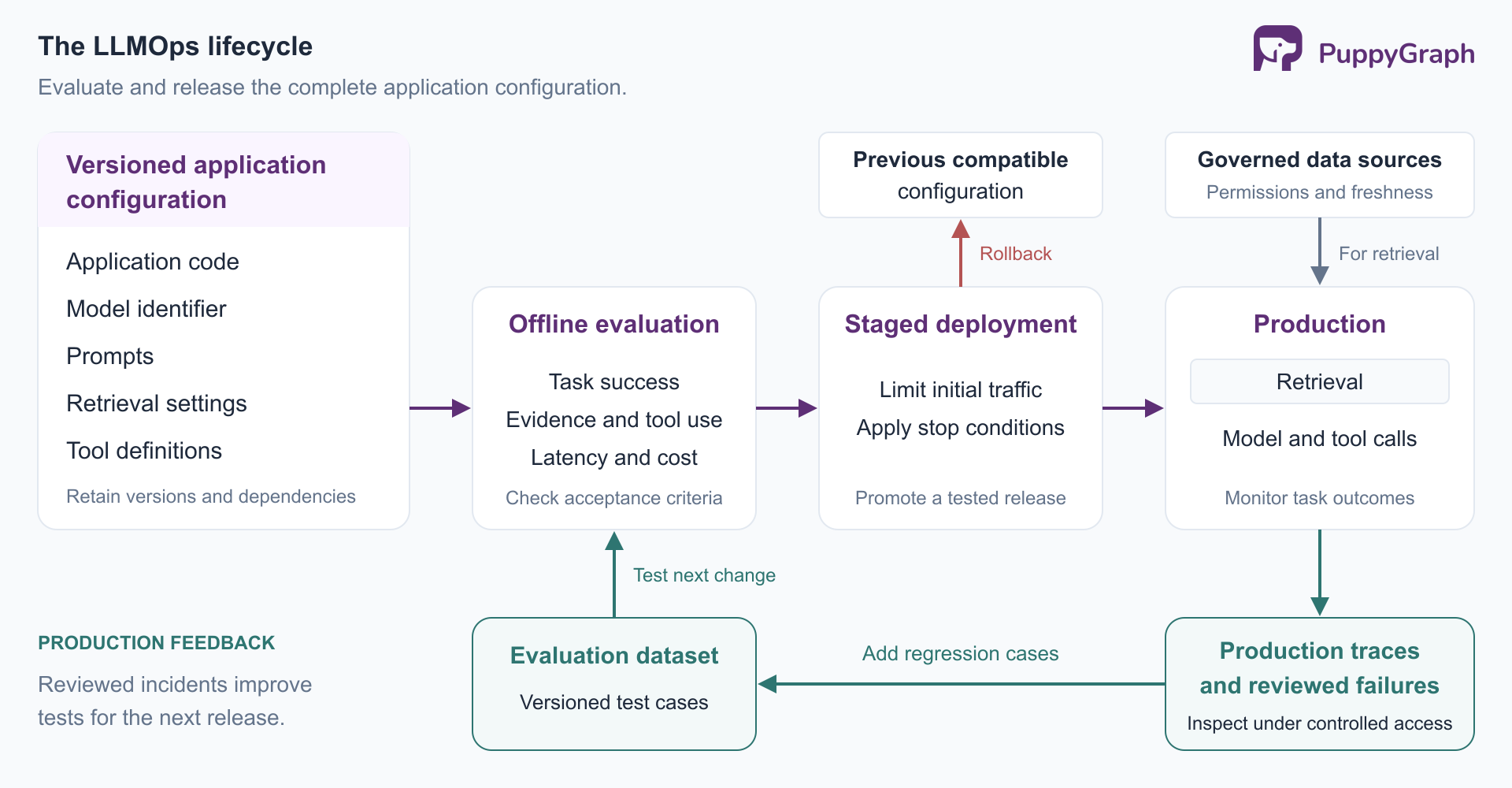
The unit you release is therefore the working application configuration: code, model identifier, prompts, retrieval settings, and tool definitions. Keeping that configuration inspectable gives an incident responder something concrete to investigate.
Why do we need LLMOps?
Consider a support assistant that explains refund eligibility. After a policy update, it continues citing an older document. The model endpoint is healthy, requests return successfully, and latency looks normal. The failure is in the evidence used to answer the question.
A separate prompt change might make responses friendlier while weakening instructions to escalate ambiguous cases. A retry policy might improve request completion while increasing cost. Each change needs a different test, even though users experience them through the same assistant.
Google Cloud's guidance on operating generative AI applications accordingly treats prompts, retrieval stores, application chains, and model adaptations as artifacts that require lifecycle management.
LLMOps connects those artifacts to evidence about their behavior. Before a release, the team compares candidate configurations against known cases. After release, it inspects failures, measures outcomes, and adds useful examples to the test set. That makes improvement accountable: a change should solve an observed problem without breaking behavior users already rely on.
Core components of LLMOps
The components below form a feedback loop from development to production and back. Their implementation depends on whether you call a hosted model, operate model infrastructure, or combine both.
Data and context management. Track the inputs that shape behavior: training examples when applicable, evaluation datasets, retrieved documents, and structured records. For retrieval-augmented generation (RAG), track source ownership, document versions, chunking, embedding configuration, and refresh behavior. Keep evaluation examples separate from tuning data. An application should distinguish missing evidence from evidence that contradicts the user's assumption.
Define a freshness expectation for each source. A policy update may need to trigger reindexing, while account status may require a lookup at request time. Record the source identifiers returned during retrieval so a reviewer can connect an answer to the evidence available when it was generated.
Model and prompt management. Compare candidate models on your task, then record the chosen model identifier, generation settings, prompt template, and tool schemas. Store changes with their evaluation results. If you fine-tune, also retain the dataset version and training configuration. MLflow's prompt evaluation workflow illustrates linking prompt versions to results so teams can compare changes systematically.
Evaluation and release testing. Build cases with explicit success criteria. For the support assistant, test policy selection, answer accuracy, citation support, and escalation behavior separately. Combine deterministic checks, expert review, and model-based scoring where appropriate. LangSmith's evaluation documentation distinguishes offline testing on curated datasets from online evaluation of production behavior. Both matter: a test suite measures known cases, while production reveals cases it missed.
For example, give a test customer a subscription governed by a specific policy revision. First check that retrieval returns that revision. Then check that the answer applies its conditions correctly and cites supporting text. Finally, remove the necessary account information and verify that the assistant asks for clarification or escalates. These checks isolate different failures: a wrong source calls for a retrieval fix, while a wrong conclusion from the correct source calls for investigation of generation behavior.
Deployment and runtime controls. Package the tested configuration, promote it through environments, and retain a rollback path. Hosted APIs require timeout, quota, retry, and provider-failure handling. Self-hosting adds responsibility for model loading, hardware capacity, and serving infrastructure. For applications that call tools, enforce permissions and execution limits in application code. Test fallback models against the same acceptance criteria before routing traffic to them.
Observability and feedback. Connect a user request to its retrieval steps, model calls, tool results, and final response through a trace. Capture latency, token usage, errors, and version identifiers, with appropriate handling of sensitive content. Langfuse's tracing documentation describes this request-level view. Add outcome signals such as corrected answers, escalations, and user-reported failures; a trace explains execution, while evaluation assesses whether it succeeded.
Security and governance apply across these components. Decide who can change prompts, access source data, inspect traces, and approve releases. Define retention and redaction rules before production traffic enters the logging system. Trace collection creates another place where sensitive inputs can persist. Minimize captured content and mask sensitive fields before export where appropriate; Langfuse's masking documentation describes that control. Preserve enough identifiers and timing information to investigate failures without routinely exposing complete customer records.
How LLMOps differs from traditional MLOps
LLMOps builds on MLOps practices such as versioning, automated delivery, monitoring, and governance. AWS's MLOps overview describes that shared foundation. The differences below compare common predictive ML workflows with LLM application workflows, rather than defining hard boundaries between them.
Recovery in either workflow may require checking for changed external dependencies. LLM tasks such as classification can use familiar metrics. The practical distinction is where changes happen. A team may significantly alter an LLM application's behavior without training a new model, so its release process must cover the surrounding components.
Who needs LLMOps?
Teams need LLMOps when an LLM feature becomes a service with users, dependencies, and an owner. The responsibilities can fit within an existing engineering team.
Application engineers own prompts, orchestration, and task behavior. ML engineers handle model experiments and fine-tuning where needed. Platform engineers and SREs own deployment, capacity, and incident response. Data teams own retrieval sources and freshness. Domain experts define acceptable answers, while security teams review permissions and data handling.
A small team can assign several responsibilities to one person. A larger organization may centralize model access and tracing while leaving evaluation criteria with product teams. In either case, name an accountable owner for application quality: shared infrastructure cannot decide whether a refund explanation is correct.
Use cases for LLMOps
The workload determines which failures and outcomes deserve attention.
Customer support. An assistant retrieves policies and account context to draft answers. Evaluate correct policy selection, supported claims, appropriate escalation, and handling of incomplete account information. Compare configurations before exposing a changed policy or prompt to customers.
Enterprise knowledge search. An internal assistant answers questions over technical documents and business records. Test retrieval coverage, source attribution, freshness, and access boundaries. Include cases where the available evidence is insufficient or sources disagree.
Document processing. An extraction workflow converts invoices or forms into structured records. Measure field-level accuracy, required-field completeness, and validation failures. Route ambiguous records for review before they enter downstream systems; valid JSON alone does not establish that an amount or account identifier is correct.
Software and operational assistance. An assistant proposes code changes or investigates a service incident. Evaluate the relevant outcome, such as passing tests or identifying a dependency supported by telemetry, and inspect tool use separately. An explanation of a proposed change needs different acceptance criteria from an action that modifies a system.
These workloads share operational components, but their success criteria differ. Start with the outcome the user needs, then choose the measurements that expose failures along the way.
Tools supporting LLMOps
Choose tools by the responsibility they cover. The examples below overlap in scope; a team does not need a separate product for every row.
Managed model services can take responsibility for serving infrastructure. Self-hosting gives your team more control over deployment and more infrastructure to operate. In both cases, application evaluation and release decisions remain your responsibility.
Enterprise retrieval also needs an interface to the underlying data. For a support question about which customers depend on an affected service, the useful context may be a path through customer, subscription, and service records.
PuppyGraph lets an application query a graph schema defined over existing SQL databases, data warehouses, and data lakes or lakehouses, including direct reads of open table formats such as Iceberg and Delta Lake. The default direct-query path requires no graph-specific ingestion or persistent duplicate dataset. Applications query the modeled entities and relationships in openCypher or Gremlin.
That schema functions as an ontology. PuppyGraph's ontology enforcement validates queries before execution. It returns structured, LLM-readable feedback for invalid entity or relationship references, enabling an agent to correct its query. In an LLMOps workflow, this supplies a grounding layer for structured retrieval. The application still needs to evaluate the evidence returned and the answer generated from it, and enforce user authorization separately.
Challenges and future of LLMOps
Evaluation remains an engineering problem. Open-ended answers can be correct in several forms, and automated graders can disagree with experts. Anthropic's engineering guidance on agent evaluation recommends combining automated evaluation, production monitoring, and human review. Calibrate a model-based grader against expert judgments before treating its scores as a release gate.
Dependencies complicate reproduction. A saved prompt does not preserve a changed document corpus or an external tool's response. Record the inputs and versions needed to explain an incident, subject to privacy and retention constraints. Reproduction may require replaying captured tool results rather than calling a live system again.
Quality, cost, and latency compete. Additional retrieval, model calls, and validation steps each consume part of the request budget. Evaluate them under realistic traffic and input sizes. A configuration that performs well on short test questions may struggle with long conversations or repeated tool failures. Choose an explicit operating budget and decide what useful response remains possible when that budget is exhausted.
Security extends beyond the response. Retrieved content can carry instructions that redirect a model. OWASP's prompt-injection guidance recommends layered controls, restricted tool access, and validation of tool calls against user permissions. A fluent answer or a syntactically valid tool call does not establish authorization.
For teams expanding from answer generation into tool-using agents, the operational scope grows to include sequences of actions, state changes, and recovery. This points toward more evaluation of complete workflows and closer integration between application traces and release decisions. The durable investment is a process that can assess new models and architectures against your own evidence.
Best practices for LLMOps
Start with a bounded task and make each release answer a specific operational question.
Define acceptance criteria before optimizing. For the support assistant, require a supported policy answer, appropriate escalation when evidence is missing, and acceptable response time. Separate quality, latency, and cost thresholds so a cheaper configuration cannot conceal an unacceptable quality regression.
Version the configuration and the evaluation. Record code, prompts, model identifiers, retrieval settings, tool schemas, and the dataset used for comparison. Pin versions where supported and record provider-managed dependencies that remain outside your control. Keep the grader configuration too: changing the grader can change scores without changing the application.
Test failures deliberately. Include empty retrieval results, conflicting documents, denied access, malformed tool responses, timeouts, and requests outside the supported task. Assess important cases over repeated runs where output variation matters. Keep a held-out evaluation set and refresh coverage as production exposes new failure patterns.
Deployment and operation need equally explicit controls.
Roll out gradually and rehearse recovery. Expose a candidate configuration to limited traffic with defined stop conditions. Retain the previous configuration and verify that its dependencies still work. Reverting a prompt cannot undo an external action, so consequential tool operations need their own approval, deduplication, and recovery design.
Measure cost per successful task. Track total request cost, including retries, retrieval, and tool calls, against a defined success measure. Include failed attempts in the cost total: dividing only the cost of successful requests by their count hides the expense of failures. For self-hosted models, account for allocated infrastructure cost as well as usage. Also monitor tail latency and error rates. Bound context size, retry count, and tool iterations; evaluate any routing or caching change for its effect on answer quality and freshness.
Turn reviewed incidents into regression cases. Inspect traces under controlled access, identify the failing component, and add a case that would have caught the problem. Keep production feedback out of training pipelines until it has been reviewed for correctness and suitability. The objective is a testable improvement, with evidence showing why the next release is better.
Conclusion
LLMOps makes application changes inspectable and measurable. Its foundations are a versioned configuration, task-specific evaluation, production visibility, and an owner who can act on failures. For applications using enterprise data, the retrieval model belongs within that operating process.
Try the forever-free PuppyGraph Developer Edition and book a demo with the team to see how openCypher and Gremlin queries traverse relationships across warehouse and lakehouse tables, with no graph-specific ETL, to supply structured context for LLM applications.
Frequently asked questions
Do you need LLMOps if you use a hosted model API?
Yes. A hosted API transfers model-serving responsibilities to a provider, but your team still owns prompt changes, retrieval, permissions, evaluation, and user-facing behavior. The operational process can be small, provided it covers those responsibilities.
Is fine-tuning required for LLMOps?
No. Start by measuring whether the task can be handled with prompting, retrieval, and application logic. Consider fine-tuning when evaluation identifies a persistent behavior or task-performance gap and you have suitable training data. It is one component you may operate, not a prerequisite.
What is the difference between RAG and LLMOps?
RAG supplies retrieved information to a model as context for generation. LLMOps manages the lifecycle of the application, including its retrieval pipeline when one exists. It covers testing, deployment, monitoring, and improvement of both retrieval and generation.
How do you measure LLM application quality?
Use criteria tied to the task: extraction accuracy, evidence-supported answers, successful tool outcomes, or appropriate escalation. Combine automated checks with expert review, and measure latency and cost separately. For RAG, test whether retrieval found the necessary evidence and whether the answer used it correctly.
Can LLMOps eliminate hallucinations?
No. Retrieval, validation, evaluation, and monitoring can help detect and reduce unsupported outputs, but they do not guarantee factual correctness. Define when the application should abstain, request clarification, or escalate, and test those behaviors alongside successful answers.

Hao Wu is a Software Engineer with a strong foundation in computer science and algorithms. He earned his Bachelor’s degree in Computer Science from Fudan University and a Master’s degree from George Washington University, where he focused on graph databases.


