


AI Graph Database: How Graphs Power AI Systems
Graph databases have quietly become one of the most debated topics in AI infrastructure. Mention "AI memory" in any data engineering forum and the graph-vs-vector argument ignites within minutes. This guide cuts through the vendor noise: what an AI graph database actually is, why graph structure matters for AI, when you need a dedicated graph database, and when you don't. By the end, you'll have a clear framework for making the right architectural call for your workload.
What Is an AI Graph Database?
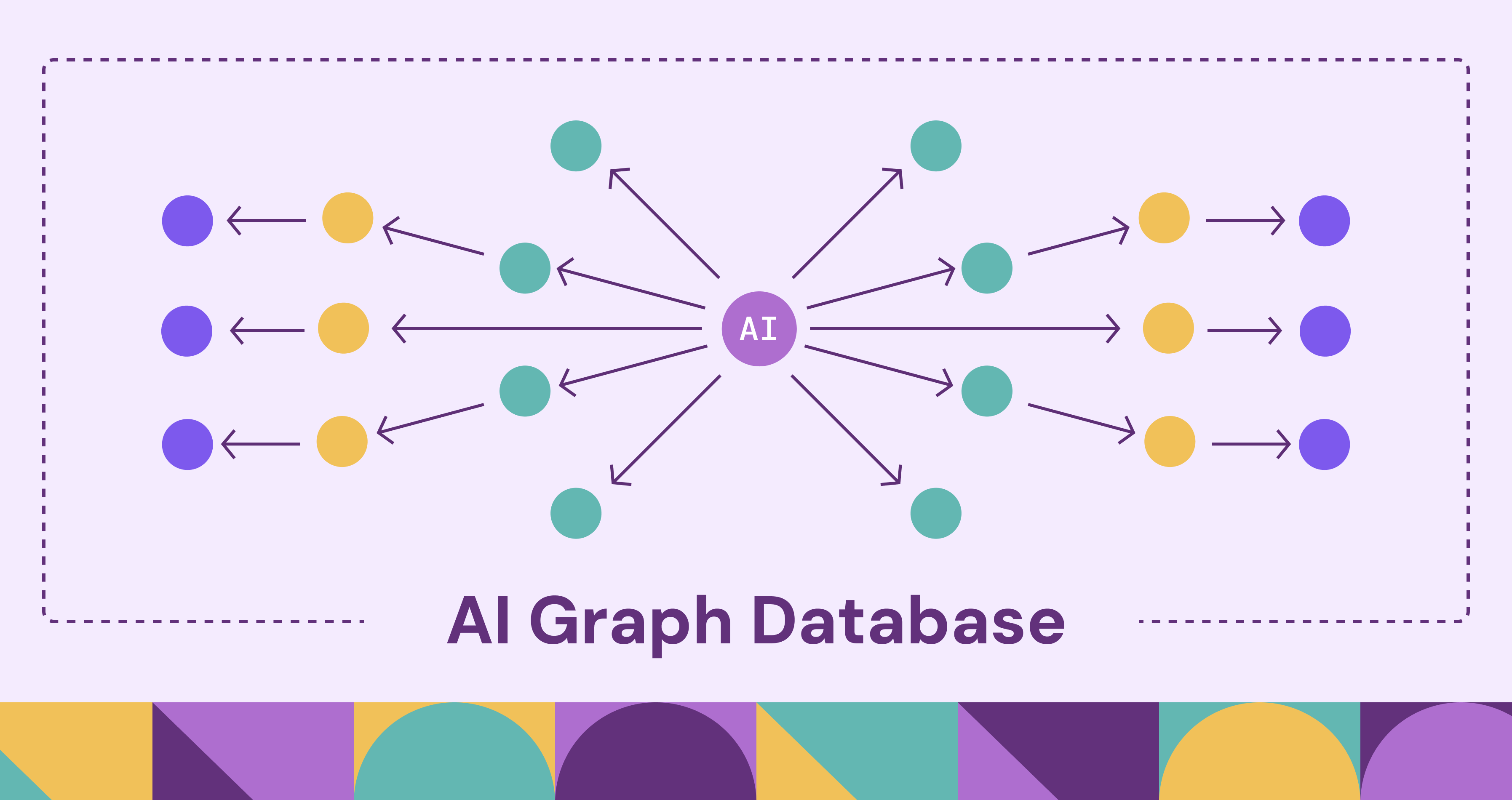
An AI graph database is a database that stores and queries data as a network of nodes (entities) and edges (relationships), optimized to support AI workloads such as retrieval-augmented generation, agent memory, and machine learning pipelines.
Unlike relational tables or document stores, graph databases natively model relationships as first-class citizens. A knowledge graph of customers, products, and transactions isn't a join across three tables; it's a traversal across a connected structure. That distinction matters enormously for AI systems that need to reason across multi-hop relationships, trace provenance, or ground a language model's output in structured facts.
Why AI Systems Need Graph Databases
AI systems, particularly large language models, are powerful pattern recognizers but poor relationship reasoners. They hallucinate. They lose context. They can't explain their own conclusions. Graph databases address each of these failure modes in concrete ways.
Hallucination Reduction and Grounding
LLMs generate plausible-sounding text even when the underlying facts are wrong. Grounding model outputs in a structured knowledge graph constrains generation to verified, queryable facts. Instead of asking a model to recall that Entity A is related to Entity B, you retrieve that relationship directly from the graph and inject it into the prompt. The model then reasons over facts rather than reconstructing them from training weights.
Microsoft's GraphRAG architecture (introduced in their 2024 research paper) formalizes this pattern: a knowledge graph is built from source documents, and queries traverse graph communities before hitting the LLM. Benchmark results showed measurably better factual accuracy compared to naive vector RAG, particularly on questions requiring synthesis across multiple documents.
Multi-Hop Reasoning and Explainability
Vector databases excel at finding semantically similar content. They struggle when the answer requires following a chain of relationships: Who approved the loan that was flagged by the fraud model that was trained on data from which customer segment? That's a four-hop traversal. A graph database handles it in a single query. A vector store requires you to engineer around it.
Explainability follows naturally. When a recommendation, risk score, or diagnostic emerges from a graph traversal, you can show the exact path of relationships that produced it, a chain of evidence rather than a black-box similarity score. Regulated industries (finance, healthcare, insurance) increasingly require this.
Agent Memory and Context
AI agents executing multi-step tasks need persistent, structured memory. A flat conversation history doesn't capture the relational structure of what an agent has learned: which tools it used, which entities it encountered, which sub-goals succeeded or failed.
Graph memory solves this by representing agent state as a connected structure. The emerging CodeGraphContext pattern applies the same idea to codebases: an agent navigating a large repository builds a graph of files, functions, imports, and call relationships, enabling precise retrieval rather than brute-force embedding search over thousands of files.
Graph Databases vs. Vector Databases for AI
This is the live debate in practitioner communities right now, and the honest answer is: they're not substitutes. They solve different retrieval problems.
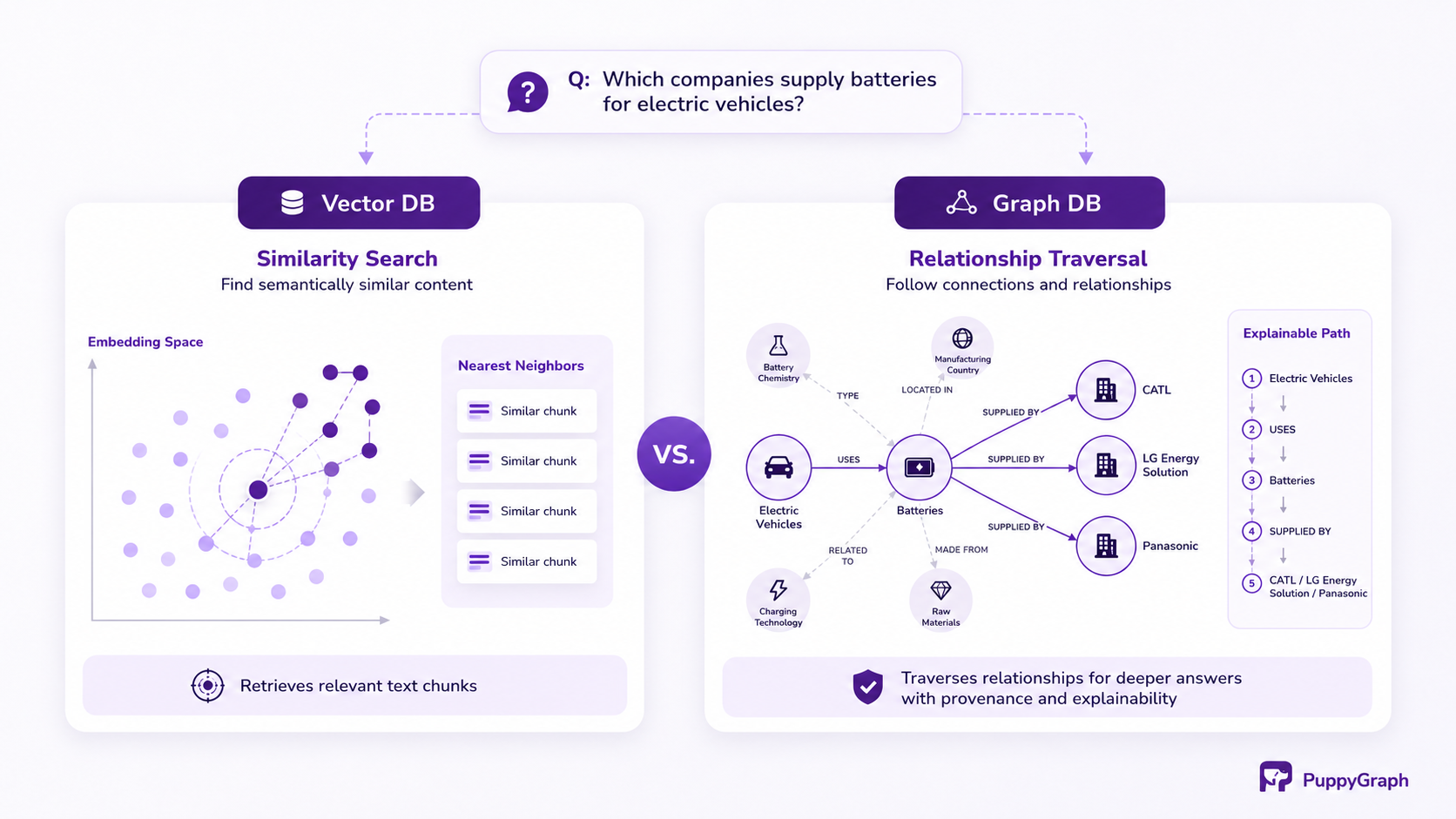
The most capable production RAG systems today use both: a vector index for initial retrieval (find the most relevant documents) and a graph for context expansion (traverse relationships from those documents to enrich the prompt). Neither replaces the other. For a deeper breakdown, see our vector vs graph database comparison.
Key AI Use Cases for Graph Databases
GraphRAG and Retrieval
GraphRAG is the highest-signal use case driving graph database adoption in AI right now. The pattern: ingest documents → extract entities and relationships → build a knowledge graph → at query time, traverse the graph to retrieve structured context → pass that context to the LLM.
The improvement over naive RAG is most pronounced on global questions that require synthesizing information scattered across many documents, the kind of question where a vector similarity search returns a bag of loosely related chunks. Graph traversal finds the connective tissue.
PuppyGraph's GraphRAG architecture documentation covers how to build this pattern on top of existing relational data, without migrating to a dedicated graph store.
AI Agent Memory and Codebase Graphs
Agents need memory that is both persistent and queryable. A graph is a natural fit: nodes represent entities the agent has interacted with (users, APIs, files, tasks); edges capture the relationships and outcomes. On retrieval, the agent can query its memory graph for relevant context rather than scanning a flat log.
For software engineering agents specifically, a codebase graph, where nodes are functions, classes, and modules, and edges represent imports, calls, and inheritance, enables precise navigation of large codebases. This outperforms embedding-based retrieval for questions like "which functions call this method?" or "what changed in the dependency chain of this module?"
Fraud Detection and Entity Resolution
Fraud is a graph problem. Fraudulent networks share phone numbers, addresses, devices, and bank accounts across multiple identities. Those connections are invisible in row-based storage; they're immediately obvious in a graph traversal. Graph databases have been the standard tool for entity resolution and fraud ring detection for over a decade. AI makes the pattern detection more powerful, but the graph structure remains the enabling layer.
PuppyGraph customer Coinbase uses graph queries over crypto transaction data to surface these relationship patterns at scale.
AI Observability and Root-Cause Analysis
As AI systems become more complex, with multi-model pipelines, chained agents, and tool-calling loops, AI observability becomes a serious infrastructure problem. Understanding why a particular output was produced requires tracing a chain of events across models, tools, and data sources.
A graph is the natural representation for this trace: nodes are model calls and tool invocations; edges are the data flows between them. Graph queries can answer "which upstream component contributed to this anomalous output?" in a way that flat log analysis cannot. See our guide on AI observability for production patterns.
How to Choose a Graph Database for AI
Choosing a graph database for AI workloads requires evaluating different criteria than for transactional graph applications. The questions to ask:
Evaluation Criteria
Query language and ecosystem. The ISO GQL standard is being finalized; Cypher (openCypher) and Gremlin (Apache TinkerPop) are the dominant open options today. LangChain, LlamaIndex, and most AI orchestration frameworks have native graph integrations. Check which query languages your toolchain supports before picking a database.
Read vs. write profile. AI workloads are typically read-heavy (retrieval at inference time) with batch writes (graph construction at index time). Databases optimized for OLTP graph transactions may not be the right fit.
Multi-hop query latency. Test with your actual hop depth. A database that handles 2-hop queries in milliseconds may degrade significantly at 5–10 hops. For agent memory and GraphRAG, 5+ hop traversals are common.
Scale. Graph databases vary enormously in their ability to handle petabyte-scale graphs. Evaluate against your actual data volume, not benchmark toy graphs.
Ecosystem and operability. Managed cloud options (Neptune on AWS, Cosmos DB Gremlin/API on Azure) reduce operational overhead. Self-hosted options (Neo4j, Memgraph, TigerGraph, FalkorDB) give more control.
The landscape of purpose-built graph databases (Neo4j, TigerGraph, Memgraph, FalkorDB, Amazon Neptune) is covered in detail in our best graph databases compared roundup.
Do You Even Need a Graph Database? The Zero-ETL Alternative
Here's the position no vendor homepage will take, but that engineers evaluating their options deserve to hear: a graph database is not always the right answer.
Graph databases are optimized for write-heavy transactional graph workloads: continuously updated social graphs, real-time fraud networks, dynamic knowledge bases. If that describes your system, evaluate them seriously.
But most enterprise AI workloads don't start from scratch. The data already exists: in Postgres, MySQL, Snowflake, Apache Iceberg, Databricks. Moving that data into a dedicated graph store means ETL pipelines to build, schemas to migrate, data freshness to manage, and a new operational surface to maintain. For teams that need graph query capabilities over existing data, that migration cost is often unjustifiable.
PuppyGraph is built for this architecture. It's a zero-ETL graph query engine that exposes your existing relational and lakehouse data sources as a unified graph, with no migration, no separate store, and no ETL pipelines. You define the mapping from your relational schema to a graph model, and PuppyGraph handles Cypher and Gremlin queries against your existing infrastructure.
For AI teams, this means:
- GraphRAG on existing data: Run graph queries over your Postgres or Snowflake tables to build knowledge graph context for LLM prompts, without moving data.
- Petabyte scale: PuppyGraph supports 10-hop queries in seconds across data volumes that would require significant engineering effort to migrate into a dedicated graph store.
- ~10-minute deployment: Docker-based setup; connect to existing data sources and start querying.
- Familiar infrastructure: Your relational data stays where it is, governed and managed as it already is.
This is the architecture PuppyGraph customer Netskope uses for its correlation platform: graph queries over existing enterprise data, without the overhead of maintaining a parallel graph database.
The two architectures, side by side:
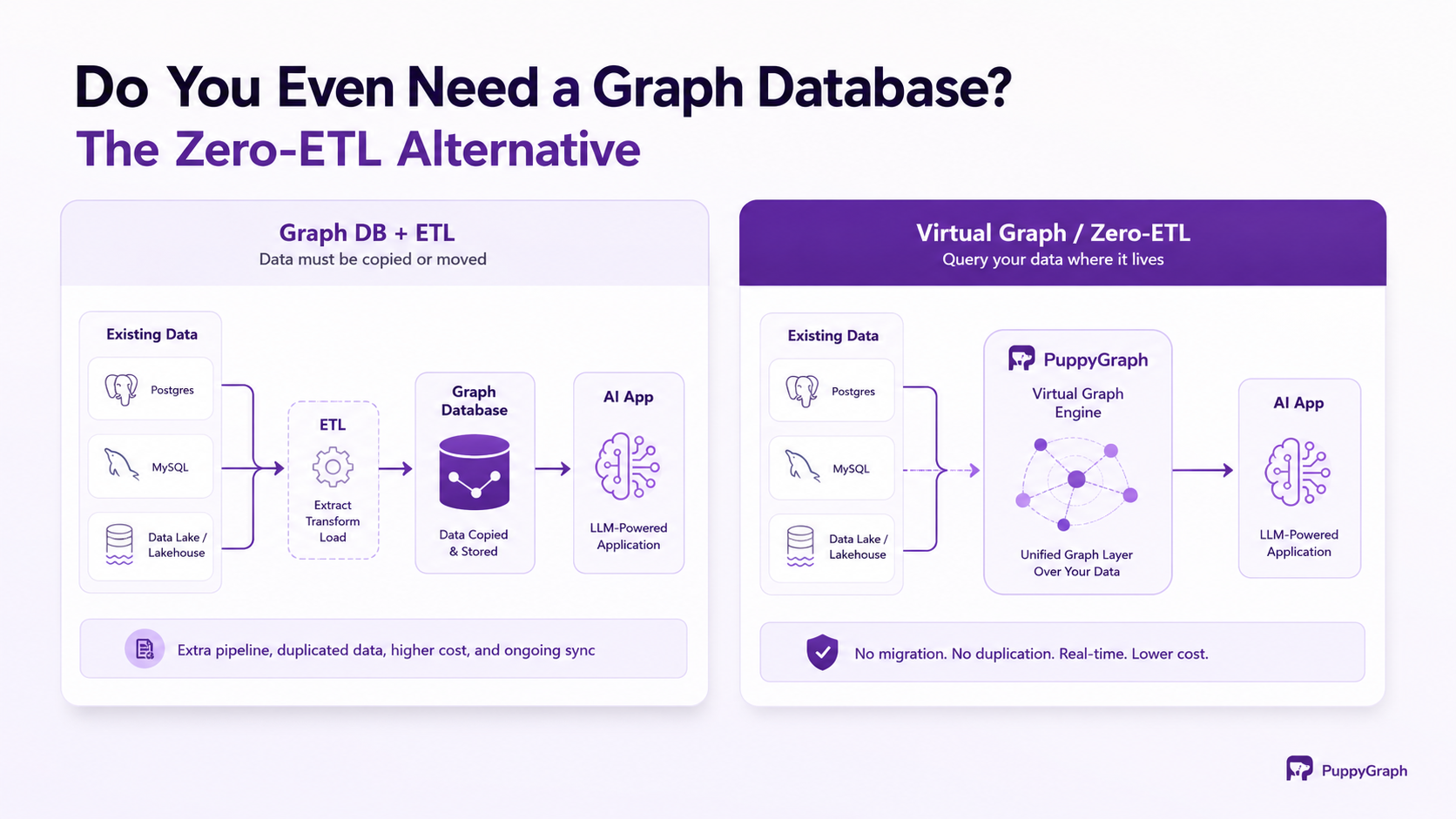
Architecture A (Dedicated Graph DB): AI application → ETL pipeline → graph database (separate store, migration required, operational overhead)
Architecture B (Virtual Graph / Zero-ETL): AI application → graph query engine (PuppyGraph) → existing relational/lakehouse data (no migration, no separate store)
For AI workloads where the source data already lives in relational systems, Architecture B is almost always faster to deploy and cheaper to operate. A virtual graph layer delivers graph semantics without the infrastructure cost.
FAQ
Does AI use a graph database?
Not always, but increasingly, yes. Many production AI systems, particularly those using retrieval-augmented generation (RAG) or multi-agent architectures, incorporate graph databases or graph query layers to handle relationship-aware retrieval, agent memory, and knowledge grounding. The core pattern is using graph traversal to find structured context that vector similarity search would miss.
Which AI tool is best for graph analysis?
It depends on the workload. For graph-native AI workloads requiring deep traversal and explainability, purpose-built graph databases (Neo4j, TigerGraph, Memgraph) are mature options. For AI teams that need graph queries over existing relational or lakehouse data, PuppyGraph offers graph capabilities without migration. For hybrid RAG workloads, LangChain and LlamaIndex both offer graph integrations that work with multiple backends.
What are the top 5 graph databases?
The most widely used options as of 2026 are Neo4j (largest ecosystem, Cypher-native), TigerGraph (analytics at scale), Amazon Neptune (managed, cloud-native), Memgraph (in-memory, real-time), and FalkorDB (Redis-based, lightweight). Each has different performance profiles and use-case strengths. See our best graph databases compared guide for a full breakdown.
Is Neo4j better than SQL?
They solve different problems. SQL (relational databases) excels at structured data with well-defined schemas and set-based operations. Neo4j excels at highly connected data where relationship traversal is the primary query pattern. For AI workloads with complex entity relationships, graph databases often outperform relational stores on multi-hop queries. For most transactional and analytical workloads, relational databases remain the right default.
Conclusion
Graph structure, including nodes, edges, relationships, and traversal, is what AI systems need to reason reliably, reduce hallucination, and maintain context across complex workflows. Whether that structure lives in a dedicated graph database or in a virtual graph layer over your existing data is an architecture choice, not a given.
Dedicated graph databases are the right call when your workload is write-heavy, transactional, and graph-native from the ground up. A zero-ETL graph query engine like PuppyGraph is the right call when your data already lives in relational or lakehouse systems and you need graph capabilities without the migration tax.
The graph is essential. The database is optional. Explore the forever-free PuppyGraph Developer Edition, or book a demo to see how PuppyGraph brings graph-powered AI to your existing data stack.

Hao Wu is a Software Engineer with a strong foundation in computer science and algorithms. He earned his Bachelor’s degree in Computer Science from Fudan University and a Master’s degree from George Washington University, where he focused on graph databases.

Get started with PuppyGraph!


Developer Edition
- Forever free
- Single noded
- Designed for proving your ideas
- Available via Docker install
Enterprise Edition
- 30-day free trial with full features
- Everything in developer edition & enterprise features
- Designed for production
- Available via AWS AMI & Docker install