


Data Federation vs Data Virtualization: Key Differences
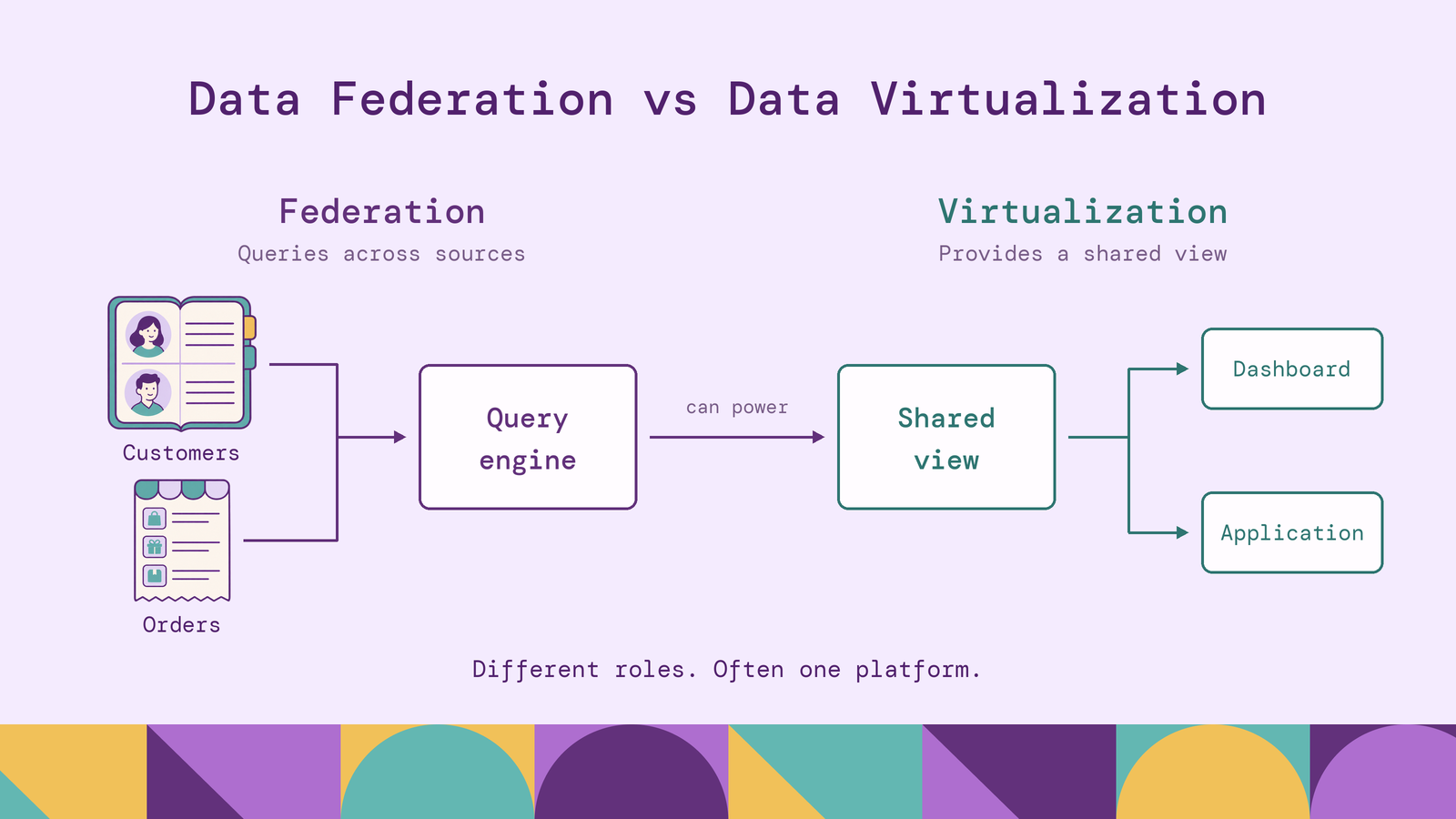
Choosing between data federation and data virtualization starts with separating two requirements: executing queries across distributed sources and giving consumers a consistent way to use that data. Federation addresses the first requirement. Virtualization addresses the broader access layer, often using federation underneath. A platform can provide both, so treating them as mutually exclusive options can lead to an unnecessary architecture decision.
This article compares their architecture, benefits, limitations, and use cases. It also explains how to evaluate performance and where a graph model can help when the questions depend on relationships across existing datasets.
What is data federation?
Data federation lets a query access data across multiple sources through a common query interface. The underlying systems retain their data, while a federated engine coordinates access and combines results. IBM's federation documentation describes distributed requests that reach multiple sources within a single SQL statement.
Consider a retailer with customer records in PostgreSQL and order history in a lakehouse. An analyst wants last month's orders for customers in a particular region. Federation allows the analyst to join those datasets without first building a pipeline that copies both into another analytical store. The integration still needs working connections, compatible identifiers, and permission to read the relevant records.
The engine plans the query, identifies the required sources, and assigns work according to their capabilities. Some operations can execute at the source; others execute in the federated engine. In Trino's architecture, for example, a coordinator plans queries and manages workers, which fetch data through connectors, process it, and exchange intermediate results.
This provides a practical benefit when the question is known but the data is distributed. Teams can investigate a new dataset or bridge systems during a migration without making permanent consolidation a prerequisite.
Federation still moves data during execution. Rows or intermediate results must reach the engine or other processing locations. BigQuery's federated query documentation explicitly describes returning external query results in a temporary table. Avoiding an ingestion pipeline therefore does not eliminate network traffic, temporary storage, or source-system work.
The engineering task is to make that distributed query efficient and reliable. A connector establishes access; the execution plan determines how much work that access creates.
What is data virtualization?
Data virtualization provides a logical interface over underlying data sources, allowing consumers to work with published data models without managing each source's location and schema. AWS describes data virtualization as separating data operations from physical storage through a metadata-driven layer.
Return to the retailer. A virtualized customer view might expose a standard customer identifier, region, and order total. Reports query that view instead of independently reconstructing the joins and mappings. If a source table moves, engineers can update its mapping while preserving the view's interface, provided the replacement can still supply the promised information.
That interface needs deliberate design. Does an order total include refunds? Which address determines a customer's region? How are duplicate customer records handled? Virtualization gives teams a place to encode those decisions, but it does not decide their business meaning automatically.
An implementation typically combines source connections, metadata, logical views, query execution, and consumer interfaces. Platforms can also include access policies and caching. Denodo's architecture description combines reusable views with federation, optimization, governance, and a choice of live or materialized access.
The main benefit is reuse. Multiple applications can consume an agreed definition rather than maintaining separate interpretations. The trade-off is ownership: someone must maintain the mappings, test changes, document semantics, and manage the service that consumers now depend on.
Virtualization also has a boundary. Renaming columns or casting types can reconcile representation, but a missing customer identifier still requires a matching rule or upstream correction. A shared interface makes integration logic reusable; the quality of that logic still determines the quality of the answer.
Data federation vs data virtualization: key differences
The most useful distinction is scope. Federation focuses on distributed query execution; virtualization focuses on the logical interface consumers use. Product boundaries overlap, and a federated engine can provide views, security controls, and caching. The table compares architectural responsibilities rather than exclusive feature lists.
The extra abstraction becomes valuable when many consumers need the same interpretation. If every dashboard joins customer and order tables differently, federation has solved access while the organization still needs to standardize meaning. Publishing a maintained logical model addresses that separate problem.
Architecture and governance. Federation does not inherently lack a logical schema or centralized controls. IBM's federation documentation includes both security administration and local caching. Conversely, describing a platform as virtualization does not establish which policies it enforces. During evaluation, trace the identity used to read each source and test which rows and columns each consumer can receive.
Performance. Neither label guarantees faster queries. Trino's pushdown documentation explains that supported operations depend on the connector and underlying system. A filter executed near the data can reduce transferred rows. A join that must execute in the query engine still needs its inputs delivered there. Adding logical views does not by itself settle where either operation runs.
Freshness and caching. Live access avoids waiting for a separate ingestion schedule, but the answer still reflects what each source exposes. Caching introduces a refresh policy that must match the workload. Denodo explicitly supports combining live access with caching or materialization. Check the actual configuration before describing a virtualized dataset as current.
Cost and operational effort. Compare the complete workload: query compute, source compute, network transfer, cached storage, and engineering maintenance. For the retailer, a rarely used reconciliation query and a dashboard refreshed throughout the day can justify different serving strategies even when they use the same tables. Evaluate each against its own latency and freshness requirements.
Can data federation and data virtualization work together?
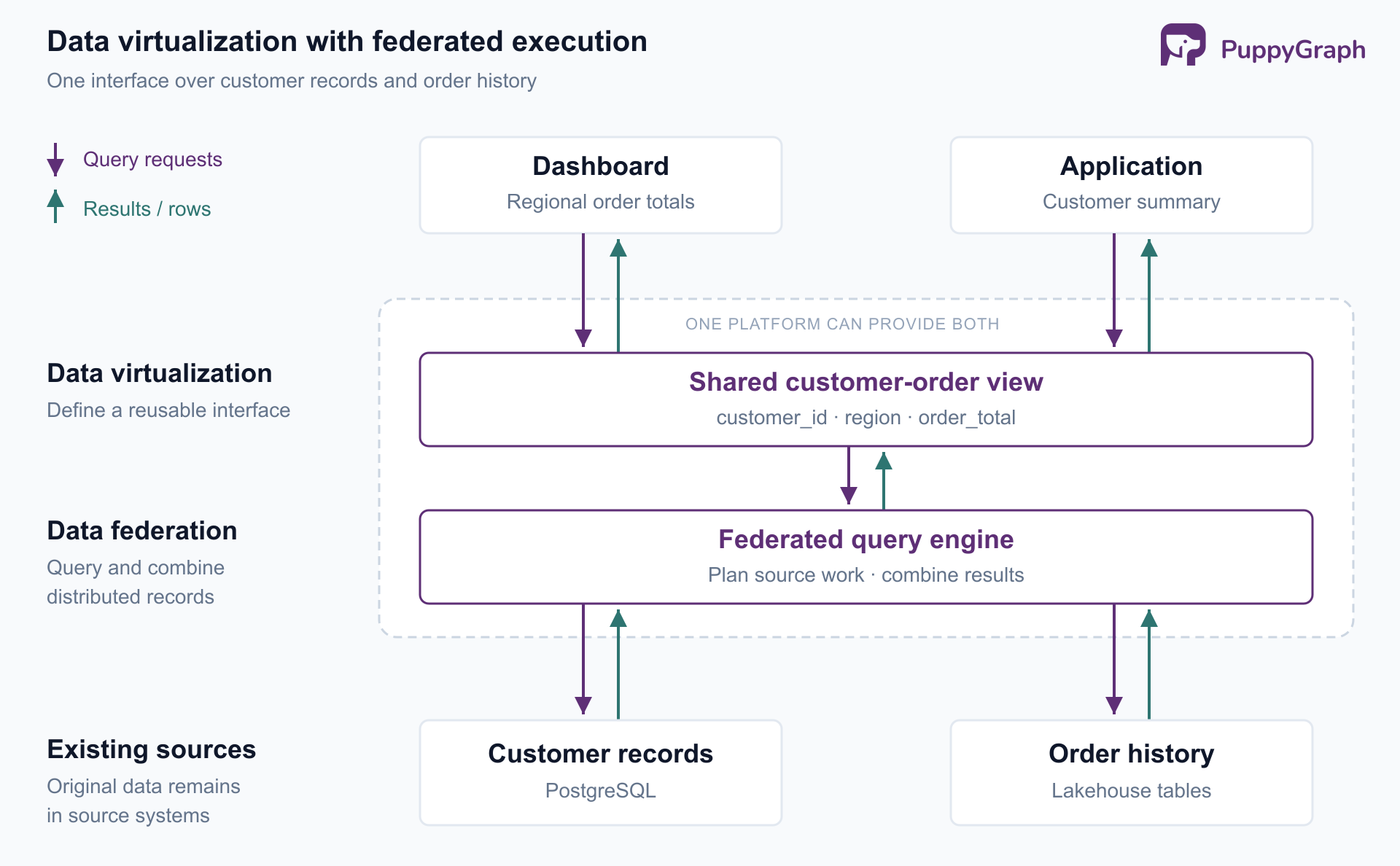
Yes. A virtualization layer can publish a logical view whose execution uses federation to retrieve and combine data. These responsibilities may live within one platform; combining them does not necessarily require buying or operating two separate systems.
For the retailer, the arrangement could work as follows:
- Engineers connect the customer database and order lakehouse to a query service.
- They define a customer-order view with agreed identifiers, refund treatment, and region rules.
- A dashboard requests regional order totals through that view.
- The query engine resolves the view, applies supported source-side operations, and combines the remaining results.
- The service returns the result under the configured access and freshness rules.
The logical view answers what the dataset means. Federation supplies an execution path to the distributed records behind it.
Keep ownership clear even when the software is shared. A source owner manages the original records. The model owner defines customer and order semantics. The query-service owner manages execution and availability. A change to the refund definition needs a different response from a database timeout.
Before publishing the view, agree on expected behavior when a source is unavailable or a cache is older than permitted. Consumers need to know whether they will receive an error or an explicitly identified older result. That behavior belongs in the service design.
When to use data federation vs data virtualization
Choose according to how the data will be consumed, how often it will be queried, and who will maintain the integration.
Use federation for focused cross-source analysis. An engineer investigating unmatched orders may need a temporary join between payment records and order history. A federated query can establish whether the data is useful before the team invests in a recurring pipeline. Start with selective filters and a bounded investigation period so the diagnostic query has a manageable scope.
Use federation to bridge a transition. During a database migration, old and new systems may coexist. Common query access can support reconciliation across them. Define which system is authoritative for each record and how overlapping records are identified. Query access alone cannot resolve duplicate business events.
Use virtualization for repeated consumption of shared definitions. If finance, operations, and customer support all need the same order-status dataset, publish a maintained interface with clear field meanings. The investment makes sense when it replaces repeated mapping work and gives consumers a defined place to report semantic errors.
Use virtualization to stabilize access during source changes. A team replacing an order-management system can preserve a logical order interface while changing the mappings underneath. Test compatibility using representative consumer queries. Keeping a column name unchanged is insufficient if its unit, granularity, or business meaning changes.
Consider materialization for demanding repeated workloads. A dashboard that repeatedly scans extensive order history may justify a prepared analytical dataset. Google documents that BigQuery federation waits for external query execution and data transfer, and that source databases may be poorly suited to complex analytics. A logical interface can still sit above materialized data; federation can remain available for less frequent lookups.
These choices can coexist. The same organization might use federation for investigations, virtualization for shared reporting definitions, and persisted analytical tables for recurring historical analysis. Choose the execution path per workload while keeping the consumer-facing definitions consistent where they represent the same business concept.
Data federation vs data virtualization: which is best?
Federation is a useful starting point when the immediate requirement is querying distributed records. A broader virtualization layer is useful when multiple consumers need maintained models and stable access. Evaluate platforms against those requirements rather than treating the category name as a capability guarantee.
A practical evaluation should include a selective lookup, a cross-source join, and a repeated analytical query. Measure response time, source load, and transferred data under expected concurrency. Run with both cold and warm caches where applicable, and record the age of the data returned. Then change a source schema or make a source unavailable to test how the interface behaves. Set acceptance criteria before comparing results.
The consumer's data model also matters. A regional sales total fits naturally into a tabular view. An investigation that follows a supplier through components, finished products, and affected customer orders benefits from explicit relationships. For that workload, evaluate a graph query layer alongside the broader access strategy.
PuppyGraph is the first and only zero-ETL graph query engine that queries existing relational data as a unified graph without requiring a separate graph ingestion pipeline. Its connections cover SQL databases, warehouses, and lakes or lakehouses, including direct reads of open table formats such as Iceberg and Delta Lake. The default direct-query path leaves the source tables in their existing systems and requires no persistent duplicate dataset. This gives teams a way to add relationship analysis to data already used for reporting.
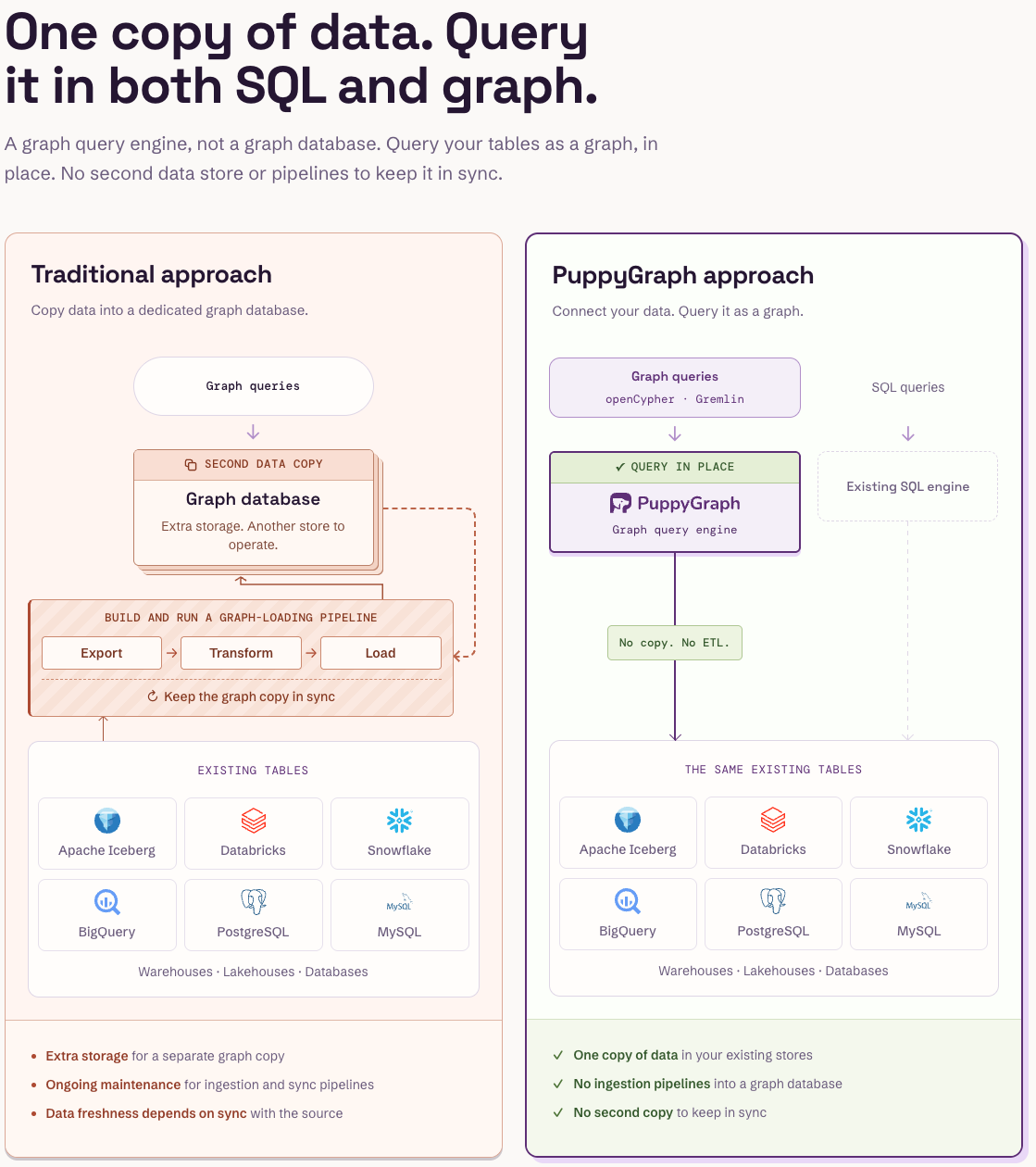
Teams define a graph schema that maps tables to entities, relationships, and properties, then query it with openCypher or Gremlin. For the supplier investigation, the model could connect suppliers to components, components to products, and products to orders. This applies the abstraction principle discussed above to a relationship model: analysts work with defined business connections while the underlying records remain available to existing SQL workflows. The mappings and identifiers still need deliberate design.
PuppyGraph compiles a graph query into a plan of node and edge operators that runs in its own distributed engine. When reading SQL stores, it issues simple projection and filter SQL. This execution architecture lets the engine optimize specifically for multi-hop traversals. It fits the part of the federation and virtualization decision concerned with querying connected data across existing stores. Teams can retain their reporting interfaces and evaluate graph queries for investigations whose paths extend across several relationships.
Conclusion
Data federation coordinates queries across sources. Data virtualization provides a logical interface that consumers can reuse, often with federation underneath. Choose based on the work you need to support: distributed access, consistent definitions, predictable serving, or a combination. Validate the execution plan, freshness rules, and operational ownership against representative workloads.
For relationship analysis, include the graph model and traversal engine in that evaluation. Try the forever-free PuppyGraph Developer Edition and book a demo with the team to see how openCypher and Gremlin queries connect entities across warehouse and lakehouse tables, with no graph-specific ETL, for investigations that span existing data sources.

Hao Wu is a Software Engineer with a strong foundation in computer science and algorithms. He earned his Bachelor’s degree in Computer Science from Fudan University and a Master’s degree from George Washington University, where he focused on graph databases.

Get started with PuppyGraph!


Developer Edition
- Forever free
- Single noded
- Designed for proving your ideas
- Available via Docker install
Enterprise Edition
- 30-day free trial with full features
- Everything in developer edition & enterprise features
- Designed for production
- Available via AWS AMI & Docker install