


Data Lake Security: Challenges, Benefits & Best Practices
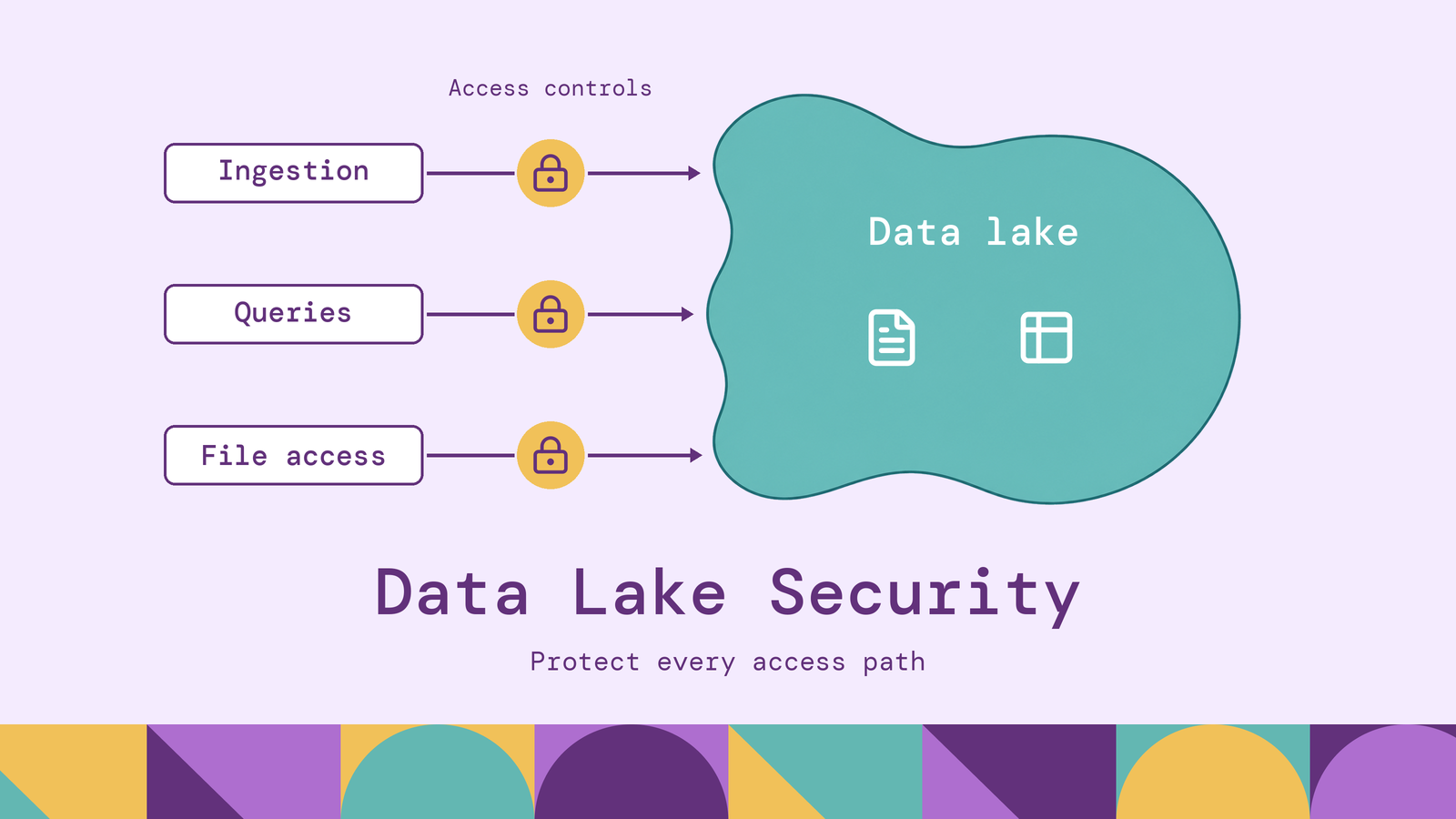
A data lake's security depends on every route to its data: ingestion jobs, storage APIs, catalogs, query engines, and exported results. Restricting a table in one engine leaves a gap if the same user can download its underlying files with a different credential. Protecting the lake means making those access paths follow the same policy.
This guide explains the controls that make that possible, how to turn them into an operating plan, and where security analytics fits. It also distinguishes data lake security from a security data lake, two related concepts with different responsibilities.
What is data lake security?
Data lake security is the combination of policies, technical controls, and operating practices that protects data throughout its lifecycle in a lake. It covers confidentiality, integrity, and availability, from collection and ingestion through processing, sharing, retention, and deletion.
The protected environment includes more than storage. Catalog metadata can reveal sensitive dataset names. Processing jobs hold credentials and create temporary files. Query engines produce results that may outlive the original session. Each component needs an owner, an access policy, and a way to detect misuse.
For example, a customer analytics lake might contain raw support messages, transaction tables, and aggregated reports. The reporting team may need the aggregates without access to the messages or payment details. A useful security design preserves that distinction across SQL queries, notebooks, direct file reads, and exports.
Why is data lake security important?
Centralizing data changes the consequences of an access mistake. A service account originally created for one ingestion pipeline may accumulate permissions across customer, employee, and operational datasets. Compromise of that account can expose information that was separated in the source systems.
Confidentiality is only one concern. Unauthorized writes can corrupt financial reporting or training data. Deleting table metadata can interrupt workloads even when the underlying files remain intact. Losing access to an encryption key can make otherwise healthy storage unusable.
Consider a notebook job that needs to read transaction records and write a daily summary. Granting it permission to delete the raw archive adds a failure mode without helping the job. Separating those actions limits both accidental damage and what an attacker could do with the job's credentials.
Security therefore protects the usefulness of the lake as well as its contents. Analysts need data they can trust, and platform teams need a recovery path when a control or workload fails.
What is a security data lake?
A security data lake is a repository organized for security telemetry and investigation. It brings together sources such as authentication events, cloud audit logs, endpoint activity, and asset inventories so multiple analytics tools can work from shared data.
Normalization makes those sources easier to correlate. For example, Amazon Security Lake uses the Open Cybersecurity Schema Framework (OCSF) and Apache Parquet for security data stored in the customer's AWS account. Its custom-source requirements require producers to supply data in the expected schema and format, making that conversion part of the ingestion design.
The distinction is purpose: data lake security protects the platform and its contents; a security data lake supplies data for security work. That repository needs its own protection because logs can contain personal identifiers, internal addresses, and details about privileged activity.
Security data lake vs. SIEM
A security information and event management (SIEM) platform supplies detection, investigation, and incident workflows. A security data lake supplies a storage and data-access foundation. Products can combine these responsibilities, so evaluate the capabilities separately rather than assuming the labels describe mutually exclusive purchases.
Microsoft Sentinel's SIEM documentation illustrates the detection, investigation, and response responsibilities. Those capabilities still need staffing and configuration, regardless of where telemetry is stored.
A combined design can retain investigation history in a lake while a SIEM handles operational detections and cases. The engineering question is which layer owns each responsibility, including alert latency, historical queries, and access control. Our security data lake vs. SIEM comparison explores that architectural choice in more detail.
Key components of data lake security
Identity and authorization. Identify human users and workloads separately, then grant only the operations each needs. Use roles or attributes to express access policy. Where supported, row filters and column masks provide more selective access than an entire table grant.
Classification and governance. Record dataset owners, sensitivity, permitted uses, and retention requirements. Track derived datasets and exports so a restricted source does not quietly become an unrestricted downstream table. Classification needs to influence permissions and handling, not merely appear in a catalog.
Encryption and key management. Encrypt stored data and use TLS for network connections. Control who can administer keys, use them for decryption, or disable them. Encryption protects particular storage and transport boundaries; an authorized query can still return readable data to its caller.
Network and workload protection. Restrict reachable endpoints, constrain outbound destinations, and harden the compute that processes sensitive records. Include notebook environments, ingestion workers, and temporary storage. Private networking reduces exposure, but requests still need identity checks and authorization.
Monitoring and recovery. Collect access and configuration events, route actionable detections to responders, and maintain recoverable data and metadata. Give audit archives and backups permissions that prevent ordinary data-processing identities from deleting them.
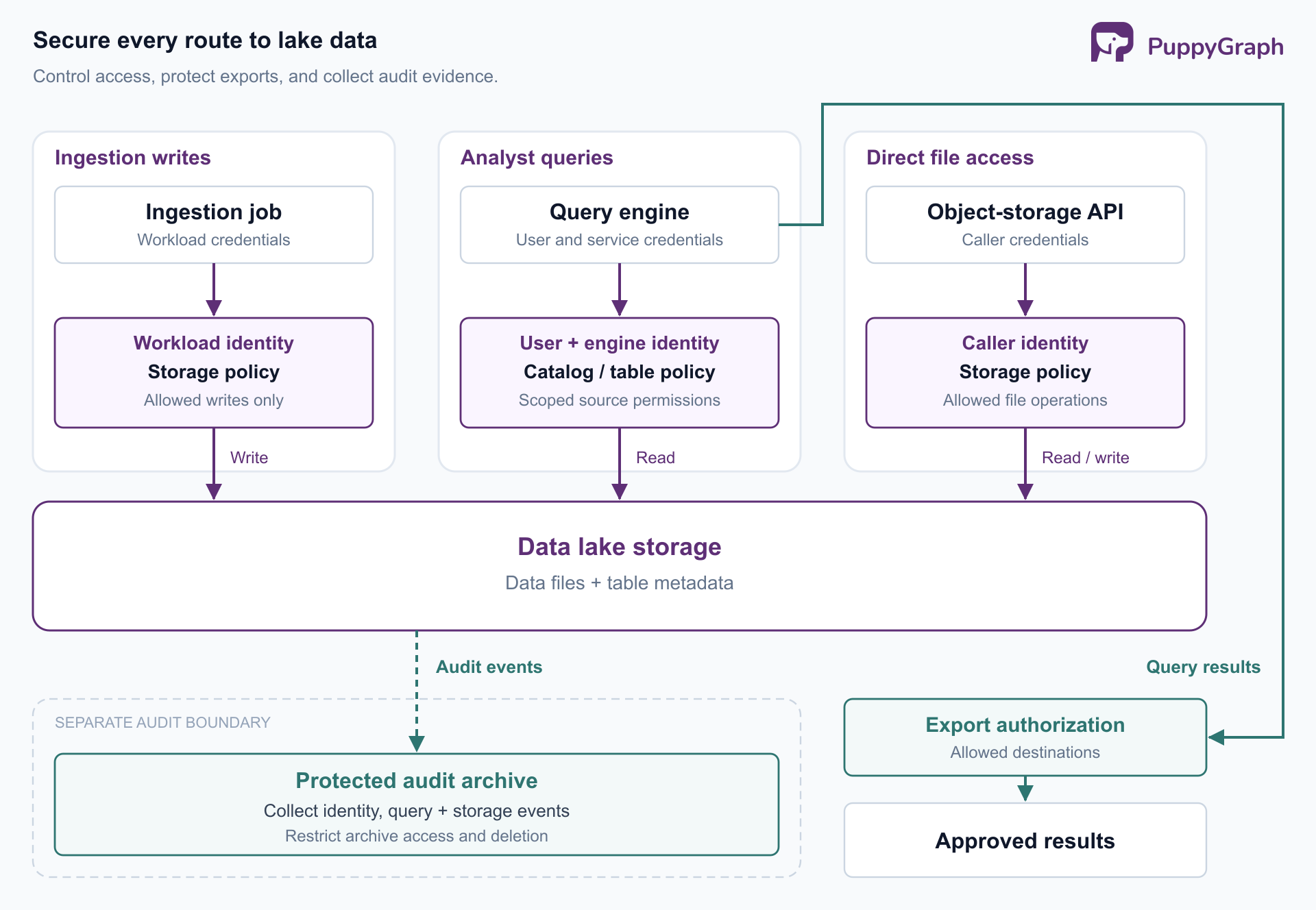
These controls work together along an access path. A masked query result provides little protection if the same identity can retrieve the unmasked source file.
Creating a data lake security plan
Start with a small set of decisions that teams can implement and verify. NIST's Cybersecurity Framework 2.0 organizes security outcomes around Govern, Identify, Protect, Detect, Respond, and Recover. Use those functions to check that the plan covers operations as well as prevention.
- Map data and access paths. Inventory sources, sensitive fields, storage locations, catalogs, compute identities, external consumers, and exports. Include development environments and cross-account sharing. Assign a data owner who can explain why each dataset is retained.
- Prioritize failure scenarios. Assess plausible events such as a stolen pipeline credential, unauthorized sharing, destructive writes, or an ingestion outage. Connect each scenario to affected workloads and data, then prioritize by impact and exposure.
- Assign controls and owners. Specify who approves access, manages keys, monitors activity, restores service, and handles deletion requests. Separate the right to operate a platform from routine permission to read its sensitive contents.
- Define acceptance evidence. Require denied-access tests, sample audit records, restore results, and documented exceptions before onboarding a sensitive dataset. Set recovery objectives and an escalation path for failures.
The deliverable should let an engineer identify the control, its owner, and the evidence that it works. A policy such as “sensitive data requires approval” needs an actual approval path and an enforced default denial.
Data lake security challenges
Policies span multiple systems. A catalog, object store, and query engine may evaluate different credentials. AWS explicitly notes that Lake Formation permissions do not prevent direct S3 access when IAM or S3 policies independently allow it. Central policy administration therefore requires coordinated enforcement.
Data changes faster than classifications. A new nested field can introduce personal information into an established feed. Schema evolution and derived tables need security review as well as compatibility checks. Otherwise, yesterday's harmless dataset can retain yesterday's permissions after its contents change.
Workload identities obscure accountability. Shared service accounts make it difficult to distinguish a scheduled transformation from an interactive download. A broad engine credential can also grant more source access than the human user should receive. Trace the initiating user through the service identity wherever the platform supports it.
Deletion spans historical copies. Removing rows from the current table does not necessarily remove older data files. Apache Iceberg's maintenance documentation explains that snapshots retain references needed for time travel and rollback until expiration. Retention design must account for table history, object versions, exports, and backups together.
How to ensure data lake security
Implement controls against a representative sensitive dataset, then test the routes a real user or workload could take.
Begin with the storage boundary. Block unintended public access, restrict cross-account grants, require protected transport, and verify the identity allowed to write or delete data. Amazon S3's security guidance covers these storage controls. Apply equivalent checks to the object store in your environment.
Next, test authorization through each supported engine and through direct file access. A denied table query should not become a successful file download for the same person. Databricks documents this boundary for external tables: when external systems access cloud storage without going through Unity Catalog authorization, cloud-level policies and credentials must enforce the intended restrictions.
Verify the audit trail by generating known reads, writes, denied requests, and permission changes. On AWS, CloudTrail data events, including S3 object operations, are not logged by default in trails and event data stores. Select the required events deliberately and confirm they reach the monitoring system.
Finally, rehearse containment and recovery. Disable a test identity, restore a sample table with its metadata, and verify that restored permissions remain correct. Record the actual result and elapsed recovery time against the plan's objectives.
Data lake security best practices
Make secure configuration repeatable. Define storage policies, logging, and access grants in reviewed configuration where possible. Detect drift from that baseline. Require an owner and expiration date for exceptions so temporary access does not become permanent by neglect.
Reduce standing privilege. Prefer federation for people and short-lived workload credentials over embedded access keys. Require MFA for human access, especially administration. These practices align with AWS's IAM security recommendations. Review unused permissions and roles after teams, pipelines, or business purposes change.
Minimize sensitive data before it spreads. Remove unnecessary identifiers and secrets at collection, and use masked or tokenized datasets where full values are unnecessary. Protect any token-to-original mapping separately. Carry handling requirements into derived tables, query-result stores, and approved exports.
Test the controls continuously. Add authorization checks to changes that introduce a new engine, connector, schema, or sharing path. Exercise incident playbooks and restore procedures on a schedule matched to the dataset's risk. Include failure of the logging pipeline itself in monitoring.
Track measures that expose operational gaps: sensitive datasets without owners, workloads using long-lived credentials, overdue access reviews, and unsuccessful recovery exercises. A low incident count cannot establish that controls work if the team lacks the telemetry needed to see incidents.
Data lake security benefits
Well-scoped access makes self-service analytics easier to support. Teams can publish approved views and reusable access roles with clear boundaries, reducing the need to negotiate permissions for every new analysis.
Reliable logging and ownership also improve investigations. Responders can connect a suspicious operation to the credential, dataset, and responsible team, then assess which downstream copies need attention. Protected backups and tested restoration reduce uncertainty during destructive incidents or accidental deletion.
Finally, classification and lifecycle controls make the lake easier to maintain. Unneeded data can be removed under an agreed policy, and audit evidence can be collected as part of routine operations. The benefits follow from controls that are enforced and exercised; buying a security product alone does not produce them.
Data lake security and compliance
Compliance requirements depend on the data, organization, jurisdiction, and contractual obligations. Map each applicable requirement to a control, an owner, and evidence from the actual deployment.
GDPR. For processing subject to GDPR, the European Commission's guidance on data-protection principles emphasizes purpose limitation, data minimization, storage limitation, and appropriate security. A lake design should record why personal data is held and how long it is needed, then implement controlled access and an appropriate deletion or review process.
HIPAA. The HIPAA Security Rule applies to electronic protected health information handled by covered entities and business associates. It requires administrative, physical, and technical safeguards. For a lake, assess access control, audit controls, integrity, authentication, and transmission security alongside risk analysis and operating procedures.
PCI DSS. For environments within its scope, PCI DSS addresses protection of stored account data, restricted access, logging, monitoring, and security testing. Prevent unnecessary payment data from entering general analytics datasets, and evaluate how ingestion or sharing changes the environment's scope.
Retention needs particular care: operational logs, business records, and compliance documentation can have different obligations. Agree on those schedules with the relevant owners, including legal holds and deletion requirements. Neither encryption nor a vendor's compliance statement establishes compliance for the entire lake.
Data lake security solutions
Choose solutions by the control they enforce and the evidence they produce. Start with identity, storage, key management, and monitoring capabilities already available in the platform. Add specialized tools where a specific gap remains.
For policy administration, AWS Lake Formation manages catalog permissions and underlying storage access for integrated engines. Databricks Unity Catalog provides access controls, lineage, and auditing within its supported environment. In either case, test the engine and storage paths used by your deployment. Discovery and data security posture management tools can help identify sensitive datasets and excessive access; evaluate whether they merely report findings or also support remediation.
Investigation adds a different requirement: understanding relationships across the lake's inventories, identity records, and events. An analyst may need to connect a workload to its assumed role, a sensitive bucket, and the reads observed during an incident window.
PuppyGraph lets teams define that model of entities and relationships over existing warehouse and lakehouse tables. Its graph schema maps tables to nodes and edges, queried with openCypher and Gremlin. Supported sources include direct reads of Iceberg tables, so the default direct-query path requires no graph-specific ETL or persistent duplicate dataset. The resulting semantic model lets investigators follow relationships in their domain's vocabulary.
This complements access controls and SIEM workflows by adding relationship analysis over the available evidence. Source permissions and observed activity must be modeled accurately: a graph connection alone does not establish effective authorization. Scope the engine's credentials and test its access boundaries as you would for any other consumer of sensitive tables.
Frequently asked questions about data lake security
Is a data lake less secure than a data warehouse?
Neither architecture guarantees security. When a lake exposes storage and query engines through separate interfaces, their access controls must be coordinated. Warehouses that query external storage can require the same coordination. Compare the actual access paths, controls, logging, and recovery capabilities of the deployments.
Does encryption prevent unauthorized data access?
Encryption protects data within its storage or transport boundary. If a compromised identity can read data through a service that decrypts it, encryption alone will not stop that access. Authorization, credential protection, and monitoring remain necessary.
Can a security data lake replace a SIEM?
Only if the surrounding implementation also supplies the required detection, alerting, investigation, and response workflows. Storing telemetry does not provide those capabilities by itself. A lake and SIEM can instead serve different layers of the same architecture.
What should a team secure first?
Identify sensitive datasets and the identities able to read, change, or delete them. Close unintended public and cross-account access, verify logging on those datasets, and test recovery. Use the resulting exposure map to prioritize the remaining work.
Try the forever-free PuppyGraph Developer Edition and book a demo to explore relationships among the identities, resources, and access events already stored in your lake, without building a separate graph-data pipeline.

Hao Wu is a Software Engineer with a strong foundation in computer science and algorithms. He earned his Bachelor’s degree in Computer Science from Fudan University and a Master’s degree from George Washington University, where he focused on graph databases.

Get started with PuppyGraph!


Developer Edition
- Forever free
- Single noded
- Designed for proving your ideas
- Available via Docker install
Enterprise Edition
- 30-day free trial with full features
- Everything in developer edition & enterprise features
- Designed for production
- Available via AWS AMI & Docker install