


Security Data Lake vs SIEM: Key Differences
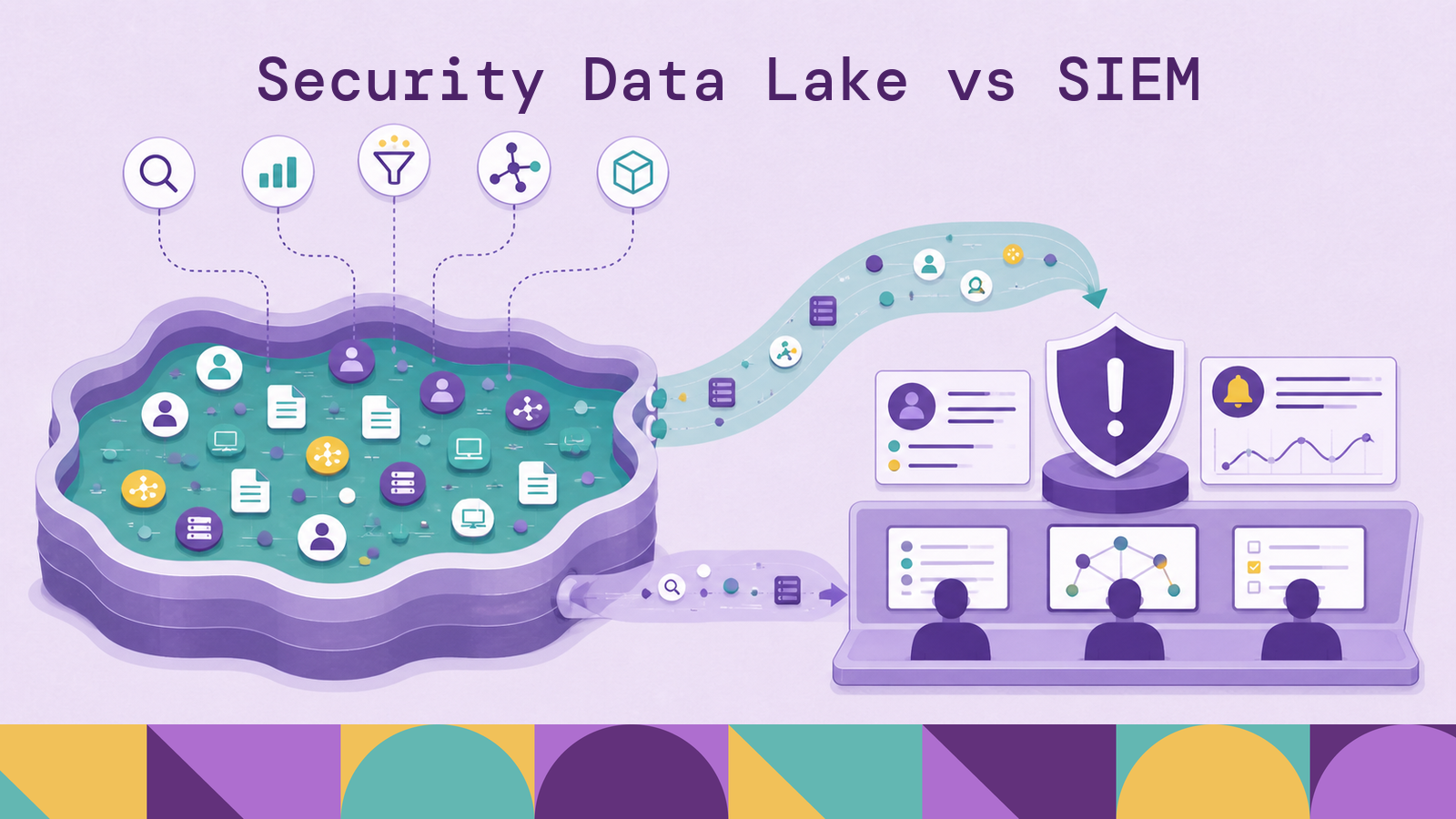
A SIEM is a product you buy; a security data lake is an architecture you adopt. The two get compared as if they were interchangeable because both centralize security telemetry, and because vendors on each side increasingly claim the other’s territory. But they answer different questions. The SIEM question is who detects threats and what workflow carries an analyst from alert to resolution. The security data lake question is where security data lives, in what format, at what cost, and which engines are allowed to read it.
This post defines each on its own terms, compares them across the dimensions that decide real deployments, describes when each one is the right center of gravity, and walks through the architecture where they run together, which is the direction both vendors and mature security programs are moving.
What is a security data lake?
A security data lake is a centralized repository for security telemetry (logs, events, alerts, asset and identity context) built on data-lake architecture: data lands in open formats on low-cost storage, compute is decoupled from that storage, and any engine the team points at the data can read it. It applies the general data lake pattern to a specific domain, and inherits its economics: retaining a year of full-fidelity telemetry stops being a budget negotiation, because object storage and warehouse storage are priced well below a detection platform’s ingest-based licensing.
Two properties separate a security data lake from a general-purpose lake that happens to hold security logs. The first is a normalized schema. Security telemetry arrives in dozens of native formats, and it cannot be correlated until sources share field names. An emerging standard is OCSF (Open Cybersecurity Schema Framework), an open-source, vendor-neutral schema for security events launched by AWS, Splunk, and a coalition of other security and cloud vendors, which lets a “failed login” look the same whether it came from Windows, Okta, or a cloud control plane. The second is intent: the lake is deliberately positioned as the system of record for security data, with detection tools, investigation tools, and analytics engines all treated as consumers of one copy rather than owners of their own.
The category is no longer hypothetical. Amazon Security Lake normalizes AWS sources into OCSF, ingests third-party sources already in that schema, and stores the result as Parquet in the customer’s S3 buckets, managed as Apache Iceberg tables that subscribing engines can query. Microsoft Sentinel now includes a data lake tier that keeps high-volume telemetry in low-cost storage under the SIEM’s analytics tier. And a class of detection platforms, Panther and Hunters among them, can run detection against a security data lake in the customer’s own warehouse account rather than requiring a vendor-hosted store.
What a security data lake does not include, by itself, is the security logic. It stores and serves; the detection rules, the alert triage, and the response workflow have to come from tools layered on top. That division of labor is exactly where the comparison with SIEM gets interesting.
What is SIEM?
Security information and event management (SIEM) is the discipline of centralizing security-relevant events, normalizing them into a shared schema, correlating across sources to detect suspicious activity, and giving analysts the workflow to investigate and respond. The term merges two older categories: security information management (SIM), long-term storage and compliance reporting, and security event management (SEM), real-time monitoring and alerting. A modern SIEM is both a detection system and a system of record for security events.
A SIEM platform covers a stack of capabilities. Ingestion and normalization pull events from endpoints, identity providers, cloud control planes, and network sensors into a common schema. Correlation and detection run rules, statistical baselines, and machine-learning models across that stream to surface incidents no single log would reveal. Alerting and case management turn detections into work items for a SOC, often with SOAR (security orchestration, automation, and response) actions such as isolating a host or revoking a session wired in. Reporting and retention produce the audit artifacts that regimes like PCI DSS, HIPAA, and SOC 2 require. Splunk Enterprise Security, Microsoft Sentinel, Google Security Operations, Elastic Security, and IBM QRadar are examples of platforms in this category.
What makes a platform a SIEM is not the log store underneath; every one has one, and how that store differs from general-purpose log tooling is covered in our comparison of SIEM and log management. It is the security-specific layer above the store: the detection content, the correlation engine, the case workflow, and the compliance packs. That layer is what the rest of this post means by SIEM.
Security data lake vs SIEM: key differences
The two overlap in the mechanics of centralizing and normalizing events, but they sit at different layers of the stack and carry different economics.
The pattern in the table is that the two sit at different layers of the stack. The SIEM bundles storage, detection, and workflow into one opinionated product, and charges for the bundle. The security data lake unbundles them: it makes storage a solved, cheap, open problem and leaves detection and workflow as explicit choices. Comparing them head to head really means comparing a bundled platform against an architecture that must be assembled, and the honest trade-off runs through that difference rather than through any single feature.
When to choose a security data lake
A security data lake is the right center of gravity when the economics of telemetry or the breadth of its consumers outgrow a single platform.
Retention and volume dominate the requirement. Ingest-priced platforms force a choice between coverage and cost: high-volume sources like VPC flow logs, DNS queries, and firewall and proxy logs are exactly what gets sampled or dropped when the bill climbs. A lake absorbs those sources at storage rates and keeps them for the years that compliance regimes require, and for investigations whose trail reaches back further than any hot window a budget allows.
Detection engineering is a software practice. Teams that write detections as code, version them, test them, and run them as queries or streaming jobs get more from an open substrate than from a vendor’s rule editor. The lake gives them the same telemetry every other engineering system reads, in formats their tooling already understands.
Security data has more than one consumer. Threat hunting, incident response, ML-based anomaly detection, compliance analytics, and increasingly AI agents all want the same underlying telemetry. When each tool owns its own copy, the copies drift and the storage bill multiplies. A lake serves them all from one governed copy, and swapping a tool stops meaning migrating the data.
Lock-in is a live concern. Telemetry stored in a proprietary platform effectively belongs to that platform; re-platforming means re-ingesting history or losing it. Open formats keep the data portable while engines compete above it.
The trade-off is assembly. A lake ships with no detection content, no alert queue, and no compliance packs; a team choosing this path is signing up to build or buy that layer separately, and the lake’s failure mode (a well-organized archive that detects nothing) is real.
When to choose SIEM
A SIEM is the right center of gravity when the organization needs working detection and response sooner than it can build them.
A SOC works alerts full time. Analysts need the alert queue, incident timelines, case management, and playbooks a SIEM ships with. Recreating that workflow on top of raw query engines is significant custom work that most teams underestimate.
Detection content must exist on day one. SIEM vendors maintain rule libraries, behavioral baselines, and framework mappings that reflect current attacker behavior. A team without dedicated detection engineers gets more coverage from that maintained content than from an empty, open substrate.
Compliance reporting is a standing obligation. Audit-ready report packs for PCI DSS, HIPAA, SOX, and similar regimes are tedious to build from scratch and easy to defend when they come from an established platform.
Cross-source correlation must run in real time. A brute-force login followed by an unusual data download and an MFA change is an incident only if something joins those events within minutes. A SIEM’s correlation engine is built for exactly that stateful, streaming evaluation.
The trade-off is cost and coupling. Ingest-based pricing turns every new high-volume source into a budget decision, which quietly narrows coverage, and history accumulated inside the platform raises the cost of ever leaving it.
Can a security data lake and SIEM work together?
Yes, and the tiered pattern that combines them is increasingly common in mature security programs, a deliberate design rather than a compromise. The lake sits at the bottom as the system of record: every source lands there, normalized to a shared schema, retained for years at storage rates. The SIEM sits above it as the detection and workflow layer, ingesting or querying the security-relevant subset that needs real-time correlation and analyst attention. Investigations that outgrow the SIEM’s hot window reach back into the lake, through federated search or direct queries, instead of forcing the SIEM to retain everything.
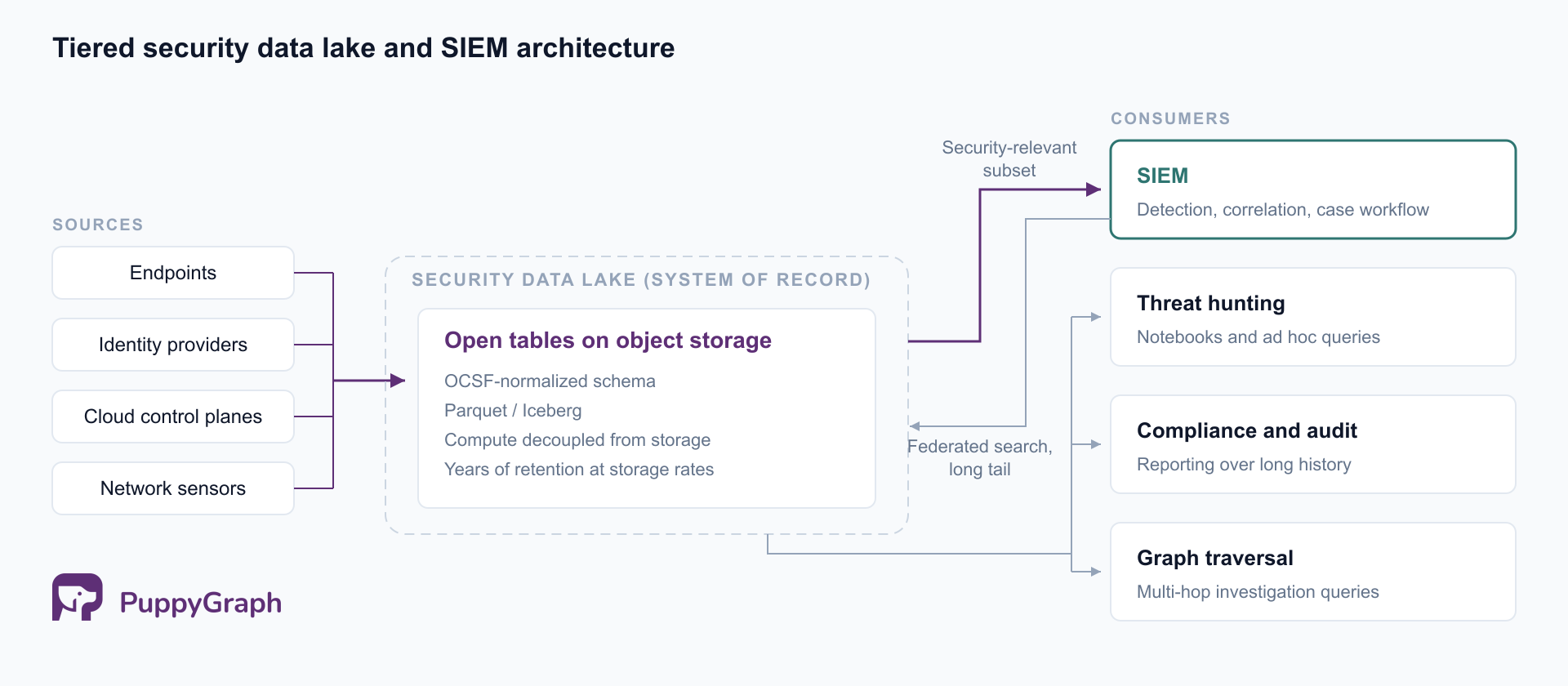
The vendors themselves are converging on this shape. Microsoft’s data lake tier keeps long-tail telemetry under Sentinel’s analytics layer at lake economics; Amazon Security Lake feeds subscribing detection tools from OCSF tables it manages on the customer’s storage; Panther and Hunters can run their detection layer directly on a lake the customer owns. The direction of travel is consistent: the proprietary store stops being what a SIEM sells, and the detection content, correlation, and workflow above the store become the product.
Once security telemetry sits in open tables, it can also be read through more than one lens. Investigation questions are largely relationship questions: which identities touched a compromised host, what an exposed credential can reach two hops out, which seemingly unrelated alerts share an entity. On flat tables those questions become chains of self-joins that grow with every hop; the SIEM answers them within its own store. PuppyGraph adds a graph lens over the lake itself: it defines a graph schema over the warehouse or lakehouse tables the security data lake already maintains (including direct reads of open table formats like Iceberg and Delta Lake) and runs multi-hop traversals in its own engine, queried in openCypher and Gremlin, with no ETL into a separate graph database. It does not ingest events or run detection rules; it complements the SIEM by making the entities that events reference, the accounts, hosts, credentials, and alerts already sitting in the lake, traversable as a graph during an investigation.
The combined architecture pays off precisely because the copies stop multiplying: one governed set of tables serves the SIEM’s detection layer, the hunters’ notebooks, and the compliance queries an auditor asks for, and each layer does the work it is actually built for.
Conclusion
A security data lake and a SIEM are answers to different questions, which is why the strongest deployments use both. The lake settles where security telemetry lives: in open formats, under the organization’s control, cheap enough to keep everything and normalized enough to correlate it. The SIEM settles who acts on it: detection content, real-time correlation, and the workflow that carries a SOC from alert to closed incident. Teams with heavy data volumes, engineering-led detection practices, and many consumers of the same telemetry anchor on the lake; teams that need mature detection and response from day one anchor on the SIEM; and a growing number of programs layer the SIEM’s judgment over the lake’s economics rather than choosing between them.
Try the forever-free PuppyGraph Developer Edition and book a demo with the team to see how openCypher and Gremlin queries traverse warehouse and lakehouse tables, with no graph-specific ETL, turning the identities, hosts, and alerts already in your security data lake into a graph an investigation can follow.

Sa Wang is a Software Engineer with exceptional mathematical ability and strong coding skills. He holds a Bachelor's degree in Computer Science and a Master's degree in Philosophy from Fudan University, where he specialized in Mathematical Logic.

Get started with PuppyGraph!


Developer Edition
- Forever free
- Single noded
- Designed for proving your ideas
- Available via Docker install
Enterprise Edition
- 30-day free trial with full features
- Everything in developer edition & enterprise features
- Designed for production
- Available via AWS AMI & Docker install