


Graph Data Modeling: All You Need To Know

Understanding graph data modeling is essential for anyone working with complex, interconnected datasets. This powerful approach to data organization offers advantages for data management and analysis, especially in fields like computer science, cybersecurity, and scientific research. While graph structures and data modeling may be familiar concepts, applying them effectively takes a deeper understanding.
A graph data model goes beyond simply storing data points—it focuses on the relationships between them. In this approach, emphasis is placed on how things are connected, mirroring the interconnected nature of real-world systems. This makes graph data modeling invaluable for use cases where relationships drive the insights you want to uncover.
This blog aims to demystify graph data modeling and explore its core components: nodes, relationships, labels, and properties. We'll cover how these elements work together to provide a flexible and powerful way to represent data. You'll learn about the advantages of graph data models, how to utilize them effectively, and real-world examples of their successful implementation. Whether you're a data analyst, IT professional, or simply curious, this blog will equip you to harness the power of a graph data model in your work.
First, let's answer the fundamental question: "What is graph data modeling?"
What is Graph Data Modeling?
The process of graph data modeling involves converting a conceptual view of data into a logical representation focused on the relationships between entities. Think of it as creating a blueprint for how your data elements are connected. This adaptable process can change based on your use case and the specific questions you want the data to answer. As you might sketch concepts on a whiteboard before building a formal model, graph data modeling allows for this same flexibility and ease.
At the core of graph data modeling are nodes representing individual entities with a unique identity (think people, products, locations). Each node can hold properties, key-value pairs that provide additional descriptive information. Relationships between nodes are represented as edges, serving as the bridges that illustrate how entities interact. Edges can be directional and may hold their own properties for added context. To help organize nodes within the graph, labels are used to categorize them, making queries more efficient.

Graph data modeling requires a thoughtful, iterative approach. It's essential to consider your specific use case and the questions you want to answer. This analysis will help you determine what will add meaningfulness to your visualization while avoiding unnecessary complexity.
The final step in creating a well-designed graph data model is creating unique identifiers for each node. This accuracy is crucial for referencing and accurately visualizing patterns, ensuring that your model doesn't lead to misinterpretations of the data. Since entities in real-world data may lack unique properties, an essential challenge of graph data modeling is identity resolution, which might involve creating new attributes to distinguish them within the model.
When it comes to building a graph data model, the focus on the adaptability of the model and the ease of building queries is crucial. Regarding adaptability, a graph data model should be designed to evolve alongside your needs. This means adding/removing nodes or relationships, and defining new properties as business requirements shift or you ask new questions of your data. When it comes to querying, once built, the final structure of the model should empower you to query the graph easily and extract specific insights.
How Does Graph Data Modeling Work?
The first step in graph data modeling is identifying nodes, the entities or objects within your dataset that have a unique identity. To group similar nodes, we use labels. Labels in graph data models categorize nodes into groups, allowing for more efficient querying and analysis of the dataset; for example, labeling nodes as "Person" or "Product" makes it easier to focus on specific parts of the graph. Relationships (aka edges) come next, illustrating the connections between nodes and indicating how entities interact. These relationships are directional, with a defined source and target node.
Properties in a graph data model are name-value pairs that provide additional information about nodes or relationships. This gives you the power to answer specific questions about the data. When creating a graph data model, thinking about how you might sketch things on a whiteboard to visualize the connections is essential. This informal step helps you translate your conceptual model into a structured database.
Graph data models are designed to evolve alongside your needs. This means as time goes on, developers may need to think about:
- Adding or removing nodes to reflect changes in your data
- Adding or removing relationships to map new connections
- Adding or removing labels for more precise categorization.
- Adding or removing properties to ensure you can always ask the right questions of your data
When representing a graph data model, consider relationships as the verbs that link the nouns (nodes) together. For instance, the phrase "A person posts an article" can be represented by a graph relationship: (:Person)-[:POSTS]->(:Article). A graph data model allows for a much more natural representation of complex relationships than traditional relational models.
Understanding the different types of relationships within a graph data model is also essential. These semantics define the nature of the connection between nodes. Common relationship types include "HAS A" (for composition), "IS A" (for inheritance), and others that map a node to another single node. Keep these relationships as streamlined as possible to avoid complicating the model - they should always serve a clear, valuable purpose.
In complex datasets, relationships between entities are often complex and multi-layered. Compared to a relational model, a graph data model offers the flexibility to represent these nuanced connections, allowing you to navigate the data more naturally and answer the more profound questions that drive valuable insights.
Types of Graph Data Modeling
While there are various types of graph data models, one of the most widely used is the Labeled Property Graph (LPG). A labeled property graph data model offers a straightforward way to represent data, consisting of:
- Nodes: Individual entities or objects within the dataset.
- Edges: Connections between nodes, indicating relationships. Edges can hold properties for additional context.
Unlike some other modeling frameworks (like RDF), LPGs typically use simple identifiers local to the dataset rather than globally unique URLs. This offers flexibility but also means the interpretation of the data is left to the consumer. A key advantage of a labeled property graph data model is how easily metadata can be added to edges, enabling you to represent weighted relationships, time-based connections, and other qualifiers.
It's important to note that LPGs may face challenges when scaling extremely large datasets. The lack of a formal structure for traversing data within the graph can create maintenance issues. The initial flexibility that makes LPGs approachable might become a limitation in some enterprise use cases where strict schemas and well-defined knowledge graphs are required.
Choosing the Right Model
The most suitable graph data model depends on your needs and use case. When it comes to deciding which graph model is best for your data, consider these factors when making your decision:
- Flexibility vs. Structure: LPGs offer flexibility, but you may need a model with more formal rules for stricter requirements.
- Semantic Descriptions: A model closely tied to semantic web standards (like RDF) might be more suitable if your use case demands rich descriptions of the data's meaning.
- Scale: Consider how large your dataset will become and whether the chosen model can efficiently handle its future growth.
Ultimately, choosing a graph data model depends on balancing flexibility, scalability, and the need for precise definitions within your data. Understanding these trade-offs is essential for building an effective model. In the next section, we'll explore the key advantages that graph data models offer and why they are preferred for many complex data analysis tasks.
Advantages of Graph Data Models
Graph data models offer a compelling alternative to traditional SQL and NoSQL databases when managing complex, interconnected datasets. They excel in several key areas:
- Performance for Relationships: A graph database shines when navigating relationships and handling queries that rely heavily on connected data. Unlike relational models, their performance remains consistent even as your dataset grows, making them a clear winner for tasks heavily reliant on relationship analysis.
- Flexibility: Graph data models offer a significant advantage in their adaptability. The structure and schema of the model can often be modified without impacting existing applications or the core functionality of the graph database. This flexibility makes adapting your model alongside evolving business needs or changing data sources much easier. Think of it as a future-proof approach to data management.
- Relationships as the Core: One of the most significant strengths of a graph data model is its treatment of relationships. Unlike traditional models, where relationships are secondary, graph models elevate them to the forefront. This aligns flawlessly with the real world, where understanding connections between entities is often the key to unlocking valuable insights.
Specific Strengths of Graph Databases
Beyond the general advantages offered by graph data modeling, graph databases themselves boast specific capabilities that enhance their value:
- Transactional Integrity & Operational Availability: Designed with enterprise-grade reliability in mind, graph databases are well-suited for transactional systems, ensuring that your data remains consistent and accessible.
- Native Graph Storage & Processing: Unlike solutions that rely on less-optimized technologies, dedicated graph databases utilize specialized graph-focused storage and processing engines. This leads to improved performance and scalability for large datasets and complex queries.
Ideal Use Cases for Graph Data Models
Specific applications can significantly benefit from the strengths of a graph data model and graph database. Here are some prime examples:
- Cybersecurity Threat Investigation: In modern SOCs, graph models help correlate logs, alerts, user behaviors, and threat intelligence into a unified view. This makes it easier to trace lateral movement, uncover credential abuse, or map relationships between indicators of compromise across systems.
- Observability & Telemetry Analysis: Graph-based views of infrastructure components and their metrics help teams quickly identify anomalies, trace root causes across services, and understand upstream/downstream impacts. This is especially useful in distributed, microservice-based environments.
- Identity and Access Management: Managing intricate networks of user permissions and access relationships becomes considerably easier with graph models. Their ability to visualize connections simplifies administration and strengthens security protocols.
- Network Optimization: Network resources, whether physical or computational, can be effectively modeled with graphs to optimize utilization and identify bottlenecks. Graph models provide a clear picture of how different parts of the network connect and interact, allowing for more intelligent resource allocation.
- Fraud Detection: Uncovering hidden connections within data is essential for identifying patterns of fraudulent activity. Graph models excel in revealing these intricate relationships, making them a powerful tool for fraud detection and prevention teams.
As you can see, graph databases provide a powerful and adaptable solution for managing dynamic systems where relationships and interconnectedness are central. Their advantages in performance, flexibility, and intuitive representation make them a valuable tool for handling real-world data scenarios where traditional models struggle.
What Are Some Graph Data Modeling Examples?
The power of graph data models becomes evident when we look at real-life applications. Let's explore four key examples, connecting them to the concepts we've discussed so far:
Cybersecurity: Powering SIEM and Threat Graphs
Cybersecurity teams often struggle to make sense of siloed data from logs, alerts, cloud events, and user activity. Graph data models are particularly effective for stitching this information together into SIEM graphs, threat graphs, or cloud security graphs—all of which represent a connected view of potential threats and relationships across systems.
In a graph model, nodes might represent users, endpoints, IP addresses, cloud assets, or identities, while edges capture actions like logins, file transfers, privilege escalations, or alert correlations. This enables teams to:
- Build SIEM graphs that correlate disparate alerts into unified incidents
- Use threat graphs to investigate adversary behavior across systems
- Visualize access patterns across cloud accounts and identity providers in real time
For example, a cloud security team can use a graph to trace suspicious activity from a login in one region, to a configuration change in another, to data exfiltration from a storage bucket—all without needing to stitch together dozens of queries. This approach improves detection fidelity and accelerates investigations.
Observability & Telemetry: Connecting Metrics, Logs, and Dependencies
In complex systems with microservices, containers, and cloud-native infrastructure, understanding system behavior requires connecting signals from many sources. Graph data models shine here by linking services, logs, metrics, alerts, and infrastructure components.
Nodes can represent services, containers, pods, or hosts; relationships can model service dependencies, communication flows, and deployment hierarchies. Logs and metrics become connected artifacts tied to those entities.
This graph model helps observability teams:
- Trace cascading failures across dependent services
- Detect patterns of degradation across versions or environments
- Visualize upstream/downstream impacts of alerts or performance anomalies
For instance, a spike in latency in one service can be traced through its graph relationships to the downstream services it affects, helping teams prioritize fixes and prevent outages.
Fraud Detection: Uncovering Hidden Patterns
In fraud detection, nodes can represent individuals, transactions, or devices. Relationships might indicate shared addresses, phone numbers, or patterns of activity. Properties add further details to these entities. This graph structure allows for identifying anomalies and suspicious networks. Graph algorithms can help find:
- Connected Rings: Fraudsters often create interconnected entities to obfuscate activity.
- Unusual Activity: Actions deviating from a user's usual patterns, detected by analyzing the graph.
- Unexpected Flows: Tracking the movement of funds or goods, revealing suspicious paths.
Social Networks: Analyzing Connections
In social networks, graph data models provide an intuitive way to represent users as nodes. The connections between these nodes become the edges or relationships that indicate friendships, followers, or memberships in groups. Labels help categorize users based on demographics, interests, or other attributes. This graph representation allows for a variety of powerful analyses:
- Key Individuals: Graph models can identify influential users within a network by analyzing their position and the number of connections they have.
- Clusters: Algorithms can detect tight-knit groups of users with similar interests or connections, offering insights into community structures.
- Closeness: Calculating the 'distance' between two users reveals how closely related they are within the network.
- Recommendations: Analyzing a user's connections and those of similar users suggests potential new connections, driving social recommendations.
Crucially, a graph database can excel at complex queries that traverse multiple levels of connections, a task difficult for traditional relational databases. The dynamic nature of social networks, with frequent updates and new connections, aligns perfectly with the flexibility of graph data models.
Recommendation Systems: Powering Personalized Suggestions
Graph data modeling plays a vital role in modern e-commerce recommendation systems. Products become nodes, with relationships representing purchase histories, browsing behavior, or product similarities. User preferences and interactions are also encoded in the graph, often as properties attached to either product or user nodes. Labels help cluster products into meaningful categories (e.g., clothing, electronics).
This representation allows for various recommendation techniques:
- Collaborative Filtering: The core assumption is that users with similar connections (purchase histories, interests) are likely to have shared preferences, even if those preferences can't be easily predicted from user or product data alone.
- Graph Factorization: These techniques identify latent features and connections within the dataset, even those not explicitly stated. This helps uncover hidden interests and suggest unexpected but relevant products.
- PageRank & Importance Ranking: Algorithms inspired by web search principles can be adapted to rank products or suggestions based on their importance and connections within the graph.
Network Infrastructure Management: Visualizing & Optimizing
Physical or virtual networks are ideal candidates for graph representation. Nodes become devices (routers, servers), while edges depict network links. Labels identify device types, and properties track their status or configuration. This representation brings numerous benefits:
- Visualization: Complex network topologies become easily understandable, aiding in troubleshooting.
- Dependency Analysis: Identifying devices that depend on others reveals critical points of failure
- Resource Optimization: Graph analysis can suggest changes for better performance or resilience.
Graph data models shine in scenarios where relationships within the data are as important as the data itself. Their flexibility, ease of visualization, and ability to handle complex queries allow us to derive insights unobtainable in traditional models. This power applies across social media, commerce, cybersecurity, and infrastructure domains.
Conclusion
A graph data model offers an intuitive way to work with complex, connected data—ideal for use cases like social networks, recommendations, and cybersecurity threat detection. It simplifies analysis, scales with your data, and adapts to evolving needs.
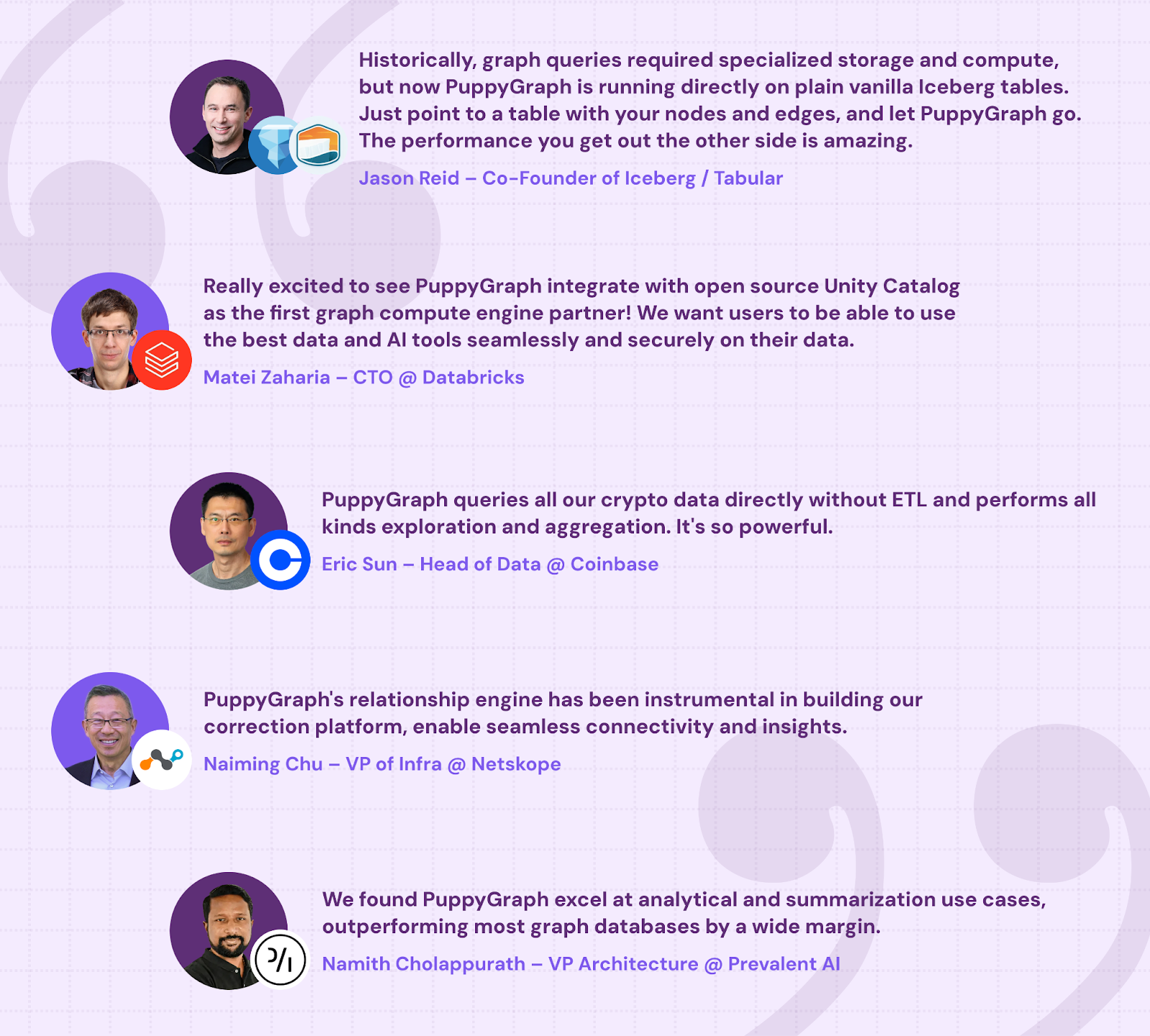
With PuppyGraph, you can explore graph modeling without the complexity of traditional graph databases or ETL. Just connect to your existing data and start querying. PuppyGraph is already used by half of the top 20 cybersecurity companies, as well as engineering-driven enterprises like AMD and Coinbase. Whether it’s multi-hop security reasoning, asset intelligence, or deep relationship queries across massive datasets, these teams trust PuppyGraph to replace slow ETL pipelines and complex graph stacks with a simpler, faster architecture.
Download the forever free PuppyGraph Developer Edition, or book a free demo today with our graph expert team.

Matt is a developer at heart with a passion for data, software architecture, and writing technical content. In the past, Matt worked at some of the largest finance and insurance companies in Canada before pivoting to working for fast-growing startups.

Get started with PuppyGraph!


Developer Edition
- Forever free
- Single noded
- Designed for proving your ideas
- Available via Docker install
Enterprise Edition
- 30-day free trial with full features
- Everything in developer edition & enterprise features
- Designed for production
- Available via AWS AMI & Docker install