


SPARQL vs Cypher: Key Differences Explained

SPARQL and Cypher are the query languages of the two dominant graph data models, and that is the real subject of any comparison between them. SPARQL is the W3C standard for querying RDF, the triple-based model built for merging data across organizations and the open web. Cypher is the language of the labeled property graph, created at Neo4j and now the main on-ramp to GQL, the ISO graph query standard published in 2024. Both are declarative, both match patterns against a graph, and a reader who knows one can usually puzzle out a query written in the other. Yet they are almost never interchangeable in practice, because each is bound to a data model, a storage architecture, and an ecosystem that the other does not share.
That binding is what makes the choice consequential. Picking SPARQL means picking RDF: global identifiers, shared vocabularies, and inference. Picking Cypher means picking the property graph: nodes and relationships with properties on both, ergonomic traversal, and a developer-oriented toolchain. This post explains each language on its own terms, works through the differences that matter in practice, compares the architectures underneath them, and closes with a way to decide which one fits a given workload.
What is SPARQL?
SPARQL (a recursive acronym: SPARQL Protocol and RDF Query Language) is the World Wide Web Consortium’s standard query language for RDF data. RDF models data as triples, three-part statements of subject, predicate, and object; a dataset is the graph those statements form when they share nodes. SPARQL queries that graph by pattern matching: a query states a set of triple patterns containing variables, and the engine finds every combination of bindings that makes all the patterns true at once.
A small example shows the shape. The query below finds the people Alice knows and the organizations they work for:
PREFIX foaf:   <http://xmlns.com/foaf/0.1/>
PREFIX schema: <https://schema.org/>
PREFIX ex:     <https://example.org/>

SELECT ?friendName ?orgName
WHERE {
  ex:alice foaf:knows      ?friend .
  ?friend  foaf:name       ?friendName .
  ?friend  schema:worksFor ?org .
  ?org     schema:name     ?orgName .
}
Each line in the WHERE clause is one triple pattern, and the ? terms are variables shared across patterns. The identifiers are IRIs, globally unique names rather than local keys, which is inherited directly from RDF: the same query can run over data assembled from many independent sources, because foaf:knows means the same thing everywhere.
The language is larger than SELECT. SPARQL defines four query forms (SELECT for tabular results, CONSTRUCT to return a new RDF graph, ASK for a boolean, DESCRIBE for a resource summary), property paths for reachability queries (foaf:knows+ follows a predicate transitively), aggregation and subqueries, and a companion update language for writing data. Two pieces justify the “Protocol” in the name. The SPARQL protocol standardizes how queries travel over HTTP, so any conformant endpoint can be queried by any conformant client; public endpoints such as Wikidata’s query service are queried this way by tools their operators have never heard of. And federated query lets one query delegate sub-patterns to remote endpoints with the SERVICE keyword, joining results across datasets that live on different servers.
SPARQL 1.1 has been a W3C Recommendation since 2013 and is implemented across triplestores including Apache Jena, GraphDB, Virtuoso, Amazon Neptune, and Stardog. A revision is under way alongside RDF 1.2, which reached W3C Candidate Recommendation in April 2026 and adds triple terms (the feature long known as RDF-star), letting a statement be the object of another statement; SPARQL 1.2 tracks it through the same process, with parts of the suite at Candidate Recommendation and the query language itself a Working Draft as of June 2026. The through-line is that SPARQL is inseparable from RDF’s purpose: it is the query interface for data designed to be merged, shared, and reasoned over across boundaries.
What is Cypher?
Cypher iis a declarative query language for the labeled property graph model, in which nodes carry labels, relationships carry a type, and both carry key-value properties. Neo4j created the language and shipped it in 2011; in 2015 the company opened the specification as openCypher, and implementations now exist well beyond Neo4j, including Memgraph and Amazon Neptune. Cypher’s syntax is built around drawing the pattern you want: nodes are parentheses, relationships are arrows, and a path reads like ASCII art of the graph itself.
The same question as before, in Cypher:
MATCH (alice:Person {name: 'Alice Chen'})-[:KNOWS]->(friend:Person)
      -[:WORKS_FOR]->(org:Organization)
RETURN friend.name, org.name
Where SPARQL states four triple patterns that share variables, Cypher draws one path. The MATCH clause declares the shape, WHERE (when present) filters it, and RETURN projects the result. Variable-length patterns handle reachability (-[:KNOWS*1..3]-> matches chains of one to three hops), and the language includes aggregation, OPTIONAL MATCH for outer-join semantics, and full write clauses (CREATE, MERGE, SET, DELETE), so one language covers both reads and updates. Properties live directly on relationships as well as nodes, so “Alice has worked for Acme since 2019” is a since property on the WORKS_FOR relationship, not a modeling puzzle.
Cypher’s trajectory runs toward standardization. It began as a single vendor’s language, spread through openCypher, and became the largest single influence on the syntax of GQL, published as ISO/IEC 39075 in April 2024, which Neo4j describes as the first new ISO database language since SQL. The openCypher project now frames its mission as helping implementers converge on GQL. For a team evaluating the language today, that matters more than any single feature: writing Cypher is an early position in an ISO-standard language family rather than a bet on a single vendor’s syntax.
SPARQL vs Cypher: key differences
The languages differ in syntax, but the differences that decide real projects sit a level deeper, in what each language assumes about the data underneath it.
Data model. SPARQL queries RDF: a set of triples in which every edge is a full statement and every identifier is (in principle) global. Cypher queries labeled property graphs: nodes and relationships that carry their own properties, identified by keys local to the store. Everything else on this list follows from this difference; the two languages are surface expressions of two graph models with different priorities.
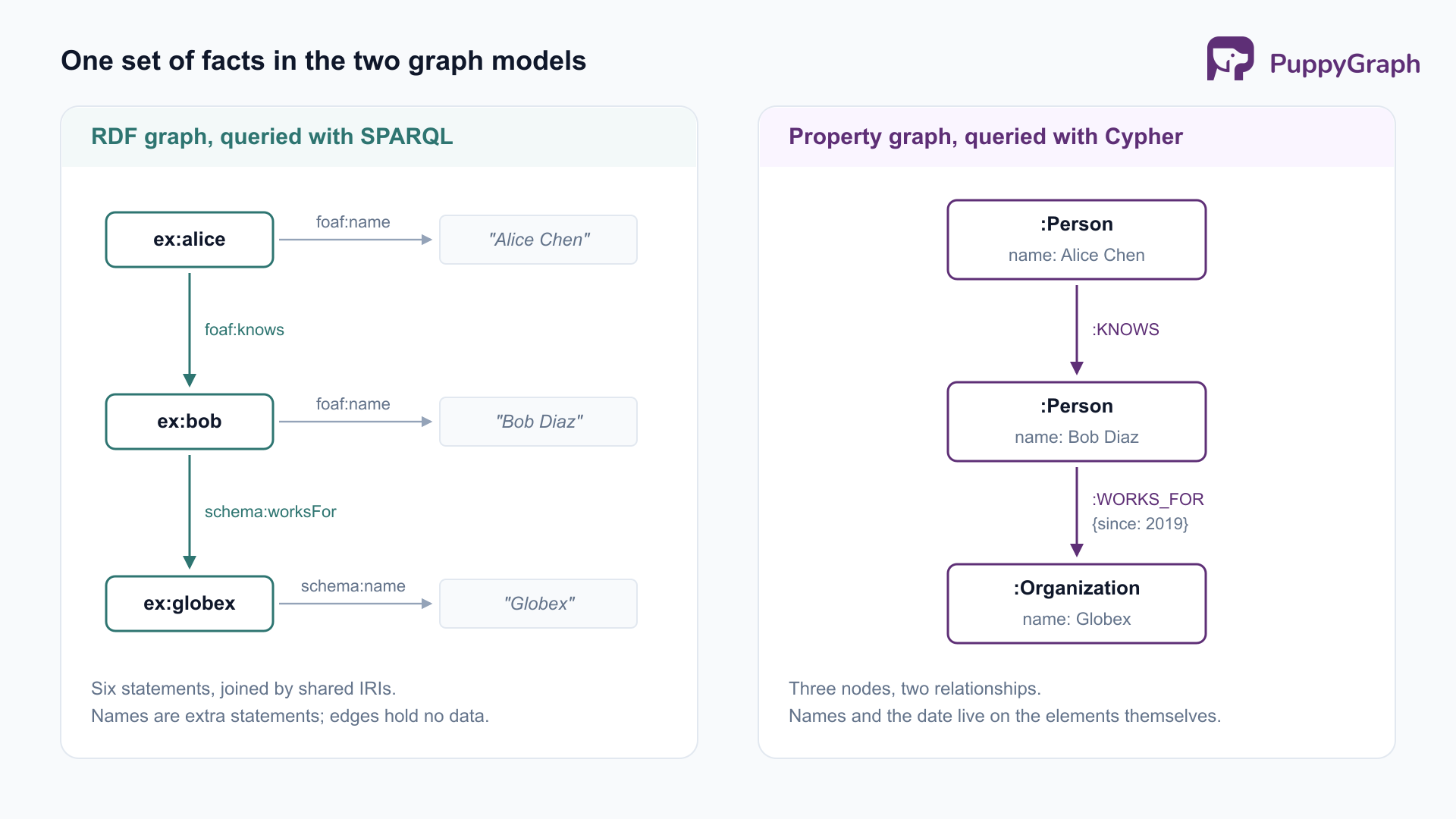
Properties on relationships. In a property graph, a relationship holds key-value pairs natively, so qualifying an edge with a date, weight, or source is one assignment. Classic RDF has no place to hang data on a statement; qualifying an edge historically meant reification (extra triples describing the original triple), and RDF 1.2’s triple terms are the standard’s answer. For data where edges carry substance (transactions, sessions, versioned relationships), this single difference often decides the model.
Identity and merging. RDF names resources with IRIs, so two datasets that reference ex:alice can be poured into one graph and join themselves. Property graphs use store-local identifiers, so merging independent graphs is an entity-resolution project. SPARQL inherits the first property, Cypher the second; teams integrating data across organizational boundaries feel this difference early.
Inference. SPARQL sits in a stack that includes RDFS and OWL, so an engine with reasoning enabled can answer with facts the data implies but never states (every Employee is a Person, so a query for Persons returns Employees). Cypher has no standardized inference layer; what the graph does not contain, application logic must derive. Teams that need formal semantics get them in the RDF stack as a built-in; teams that do not need them often experience the same machinery as overhead.
Standardization and federation. SPARQL was born standard: a W3C Recommendation from the start, stable at 1.1 since 2013, with the 1.2 revision moving through the W3C process. The standard covers the wire as well as the language, so any endpoint speaks the same HTTP protocol and SERVICE joins across remote endpoints inside one query. Cypher took the opposite route, vendor language first, open specification second, ISO standard (as GQL) third, and it has no standardized cross-server federation; connectivity in that world is driver-level (Neo4j’s Bolt protocol being the de facto interface), and cross-source queries are an engine capability rather than a language feature. Both histories are respectable, and they still show in the ecosystems, where SPARQL tooling clusters around standards bodies and Cypher tooling around vendors.
The table reads as a trade rather than a ranking. Every row where SPARQL is stronger traces to RDF’s decision to make meaning global (identity, vocabularies, inference, federation), and every row where Cypher is stronger traces to the property graph’s decision to make modeling local and direct (edge properties, syntax, developer experience). That is why the choice rarely hinges on query syntax, which most engineers pick up in an afternoon for either language. It hinges on which set of model-level guarantees the problem actually needs.
SPARQL vs Cypher architecture comparison
Neither language runs in the abstract; each grew up coupled to a storage architecture, and the coupling shapes performance more than the syntax does.
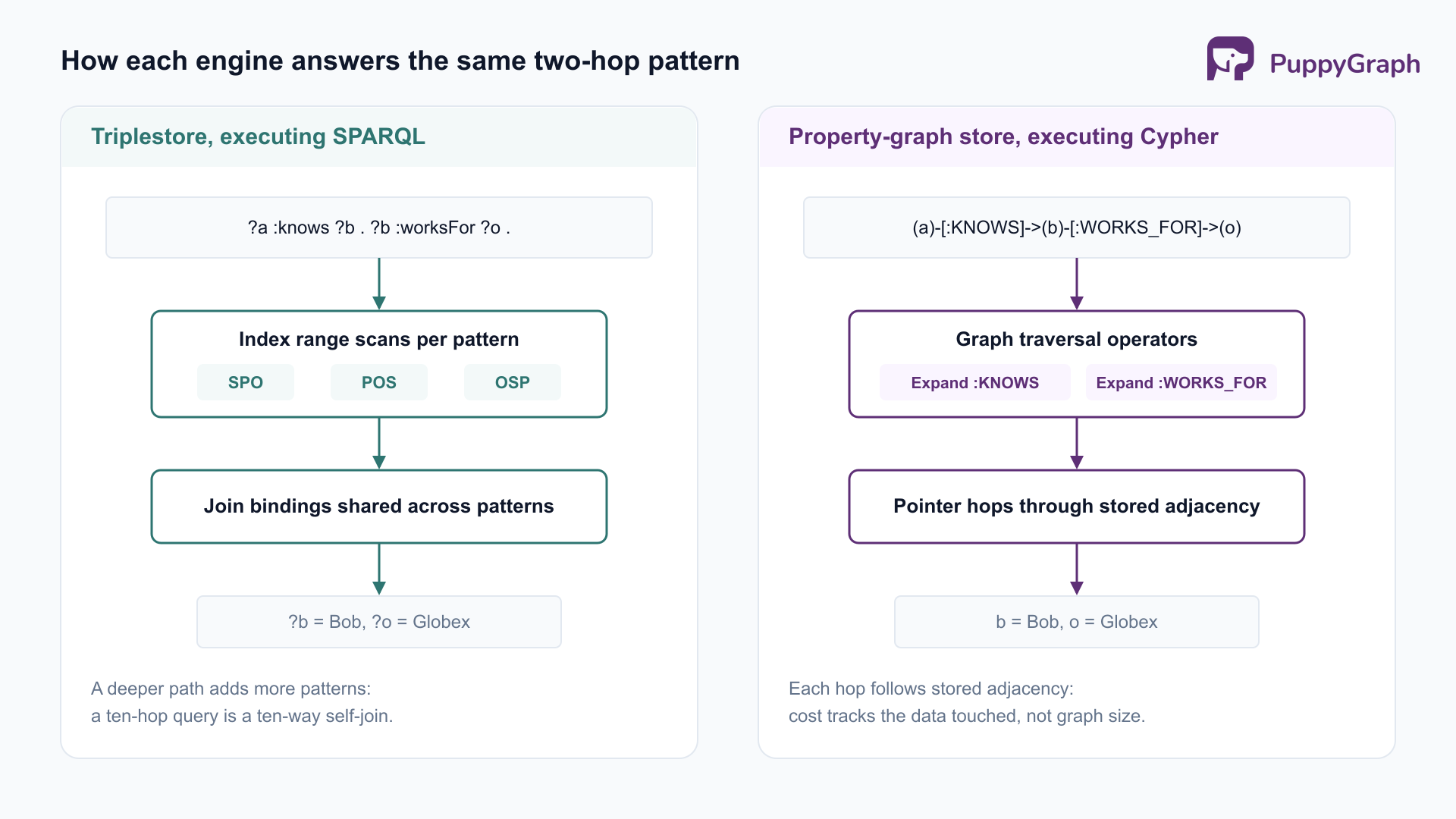
SPARQL engines are triplestores. They store statements, typically as quads (triple plus named graph), and index them in several orderings (subject-predicate-object, predicate-object-subject, and so on) so that any triple pattern can be answered by a range scan on some index. Query execution is join processing: each pattern in the WHERE clause produces bindings, and the optimizer’s job is ordering the joins between them. The architecture generalizes beautifully, any pattern over any data, and it is where reasoning layers attach. Its cost surfaces on deep traversals: a ten-hop path is a ten-way self-join over the statement table, and performance depends on how well the optimizer tames that.
Cypher’s native habitat is the property-graph store, engineered in the opposite direction. Systems like Neo4j store adjacency directly (the design usually called index-free adjacency), so following a relationship is a pointer hop rather than an index lookup, and the cost of a traversal tracks the data it touches rather than the total graph size. Cypher compiles to traversal operators over that layout. The strength is deep, selective path queries; the trade-off is that the graph must live in the store’s own format, which is why property-graph deployments traditionally begin with an import step.
The clean pairing of language to store is loosening, though, and the architecture question is increasingly separate from the language question. On the RDF side, some platforms map external relational sources into the graph at query time, rewriting SPARQL into SQL and pushing it down to the source. On the property-graph side, openCypher implementations now include engines that execute over data outside any graph store. Amazon Neptune illustrates the same decoupling from another angle by offering both SPARQL and openCypher on one managed service. The practical consequence: architecture now belongs on the evaluation checklist as its own line, because two engines speaking the same language can execute it in structurally different ways, and where the data lives has become a choice rather than a given.
How to choose between SPARQL and Cypher
The decision usually resolves quickly once it is framed as a choice of model and ecosystem rather than syntax.
Choose SPARQL when meaning has to travel. Data integration across organizations, published datasets that others will consume, shared vocabularies and ontologies, and inference over formal semantics are RDF’s home ground, and SPARQL is the standard interface to all of it. Domains with deep linked-data investments (life sciences, cultural heritage, government open data) and projects that interoperate with public knowledge graphs such as Wikidata fall here almost by default. The verbosity and the learning curve are real, and they are the price of data that means the same thing everywhere.
Choose Cypher when the work is modeling and traversing a graph inside one system of record. Fraud rings, dependency chains, network paths, recommendation structures: these are entities and relationships with properties on both, and the property graph represents them without ceremony. Cypher’s pattern syntax keeps queries close to the whiteboard drawing, edge properties carry the facts that live on relationships, and the GQL convergence gives the language a standards future that removes the old single-vendor objection. Most teams without a semantic-web requirement land here, which is consistent with the DB-Engines graph DBMS ranking, where property-graph systems led by Neo4j hold the top positions as of July 2026.
In practice, few teams make this choice with an empty database. The entities and relationships are usually already in relational tables in a warehouse or lake, and both classic routes to a graph begin the same way: stand up a dedicated store, convert the data into it, and keep the two synchronized from then on. That pipeline, not the query language, is often the largest cost in the decision. PuppyGraph removes it on the property-graph side: it runs openCypher and Gremlin queries directly over existing tables in SQL databases, data warehouses, and data lakes / lakehouses, including direct reads of open table formats like Iceberg and Delta Lake, with no ETL into a graph store; a user-defined schema maps tables to nodes and edges, and queries compile into a plan of node and edge operators that runs in its own distributed engine rather than being translated into SQL for the source’s planner. Because it speaks openCypher over the Bolt protocol, existing Neo4j drivers and tools can be repointed without rewriting queries. What it changes is the property-graph side of the ledger, where “adopt Cypher” and “stand up and feed a graph database” used to be the same decision and no longer are.
Conclusion
SPARQL and Cypher are both declarative pattern-matching languages, and nearly everything else about them differs. SPARQL is the W3C-standard interface to RDF: global identity, shared vocabularies, inference, and federation, at the cost of verbosity and a steeper conceptual stack. Cypher is the property graph’s language: direct modeling, properties on relationships, traversal-friendly syntax, and an ISO-standard future through GQL, at the cost of RDF’s cross-boundary guarantees. The comparison has no winner in general, only a winner per problem, and the deciding questions are model-level ones: does meaning need to travel across systems, do edges carry data, is inference required, and where does the data already live. Answer those and the language picks itself.
Try the forever-free PuppyGraph Developer Edition and book a demo with the team to see how openCypher and Gremlin queries run over warehouse and lakehouse tables, with no graph-specific ETL, if the property-graph side of this comparison is where your workload lands.

Sa Wang is a Software Engineer with exceptional mathematical ability and strong coding skills. He holds a Bachelor's degree in Computer Science and a Master's degree in Philosophy from Fudan University, where he specialized in Mathematical Logic.

Get started with PuppyGraph!


Developer Edition
- Forever free
- Single noded
- Designed for proving your ideas
- Available via Docker install
Enterprise Edition
- 30-day free trial with full features
- Everything in developer edition & enterprise features
- Designed for production
- Available via AWS AMI & Docker install