


SurrealDB vs Neo4j: Key Differences
Relationships increasingly define how modern systems behave. The structure of connected data now drives product logic, not just analytics, whether the use case be user interactions, knowledge graphs, AI retrieval pipelines, or operational networks. However, all databases don’t have the same approach to solving such requisites of modern apps and systems.
In this post, we discuss SurrealDB and Neo4j: how each system represents relationships, executes queries, scales under load, and fits into a production stack. By the end, you will have sufficient information to be able to align your database choice with the shape of your workload and the future direction of your system.
What Is SurrealDB?

SurrealDB is an open-source, multi-model database that supports several data systems in a single engine. It supports document, graph, relational, time-series, geospatial, and key–value workloads under one query language, SurrealQL. SurrealDB presents graphs as one of several first-class models that you can query and combine within the same execution layer.
If you require multiple paradigms, you don't have to stitch together a relational database, a graph database, and a vector store; rather, you can model relationships, documents, and embeddings in one system and query across them transactionally.
Key Features
Unified multi-model data engine
SurrealDB natively supports multiple data models in a single database instance. Records behave like documents with nested fields. And you can express relationships explicitly using the RELATE statement to create edges between records. Vectors, geospatial objects, and time-series data coexist in the same namespace and participate in the same queries.
Such a unified model allows mixed queries, for example, filtering documents, traversing relationships, and ranking results by vector similarity; you don’t need to move data between systems or coordinate multiple query engines.
Graph modeling with RELATE edges
Graph relationships in SurrealDB are created using the RELATE statement, which defines directed edges between records. These edges are stored as records themselves and can carry properties such as timestamps or weights.
SurrealDB’s graph model allows you to conveniently traverse within a broader data model, as there’s no deep specialization for large-scale traversal workloads. Graphs integrate tightly with documents and attributes as opposed to residing as an isolated subsystem.
SurrealQL: a single query language
SurrealQL is an SQL-like language extended to support graph traversal, nested documents, subqueries, loops, and embedded computation. It handles CRUD operations, graph navigation, vector similarity, and conditional logic in a single syntax.
Because SurrealQL spans multiple models, you don’t have to switch between query languages for different workloads. As a result, applications with evolving data shapes benefit from developer productivity and fast iteration.
Vector search and hybrid querying
SurrealDB includes native support for vector embeddings and similarity search using operations like cosine distance. Vector indexes integrate with SurrealQL, so semantic search can combine with relational filters and graph traversal in one query.
This enables hybrid access patterns commonplace in AI applications that require both semantic similarity and explicit relationships or constraints.
ACID transactions and consistency
SurrealDB supports ACID transactions across multi-statement operations. Transactions apply consistently across documents, relationships, and other data types. This means complex updates, like modifying records and edges together, commit atomically,
And consistency semantics stay the same irrespective of which data models participate in the transaction.
Real-time queries and event handling
SurrealDB includes Live Queries that allow clients to subscribe to changes and receive incremental updates when matching data changes. Event triggers and subscriptions support reactive application patterns without external messaging systems.
Through these capabilities, SurrealDB can well support real-time dashboards, collaborative applications, and event-driven backends.
Pluggable storage and deployment flexibility
SurrealDB separates compute from storage through pluggable backends. It can run:
- Embedded or in-memory for development and edge use cases
- On RocksDB for single-node persistence
- On TiKV for distributed, replicated deployments
So the same data model and query layer can run across environments, from embedded systems to clustered production setups.
Security and access control
SurrealDB provides role-based access control with permissions that you can scope down to namespaces, databases, tables, records, or even fields. Authentication supports JWT-based workflows, among other mechanisms. SurrealDB has built these controls into the query layer as opposed to through external means.
What Is Neo4j?
Neo4j is a native property graph database targeting graph-first workloads. It stores data as nodes and relationships with properties on both, and it treats relationships as first-class citizens in storage and execution. It optimizes for deep traversals, transactional consistency, and graph analytics at enterprise scale.
In Neo4j, the graph is the system of record. Its architecture, query language, and tooling are all tuned for scenarios where relationship structure is the primary concern.
Key Features
Native property graph engine
Neo4j implements a native property graph model with index-free adjacency. Each relationship stores direct references to its start and end nodes, thereby making hops constant-time during traversal. It keeps traversal cost proportional to the subgraph you explore, critical for deep and selective path queries.
Cypher query language
Neo4j exposes graph access through Cypher, a declarative pattern-matching language designed for property graphs. Cypher expresses nodes, relationships, variable-length paths, predicates, and updates in a compact, readable syntax. It avoids JOINs entirely and makes traversal logic explicit and predictable.
Cypher supports both read and write queries, subqueries, projections, and composable graph patterns within a single language surface.
ACID transactions
Neo4j provides fully ACID-compliant transactions. Writes execute atomically and become visible only after commit. These guarantees apply across single-node and clustered deployments, giving concurrent reads and writes without sacrificing correctness.
This transactional model makes Neo4j suitable for application-facing systems where graph mutations occur frequently and must remain consistent.
Graph analytics and data science tooling
Neo4j offers a dedicated Graph Data Science (GDS) library with a large catalog of prebuilt algorithms that cover centrality, community detection, similarity, and pathfinding among others. These algorithms run directly against graph projections and support analytical workflows such as recommendations, fraud detection, and network analysis.
Clustering and replication (Enterprise Edition)
Neo4j Enterprise Edition supports clustered deployments using Raft-based causal clustering. Each database forms an independent Raft group with a single leader for writes. Writes replicate synchronously to other primaries, while secondaries replicate asynchronously and serve read workloads.
Causal consistency
Neo4j supports causal consistency, allowing applications to guarantee read-after-write semantics. Clients use bookmarks to ensure subsequent reads observe their own writes, even when reads route to replicas. Driver-level routing handles this transparently.
Security and governance
Neo4j Enterprise includes role-based access control with permissions scoped to databases, labels, relationship types, and procedures. Authentication integrates with external identity providers, and encrypted communication is supported through TLS.
SurrealDB vs Neo4j: Core Architecture Comparison
When to Use SurrealDB
Building a single backend for mixed workloads
If you prefer one database to handle multiple data models, choose SurrealDB, as it gives you documents, graphs, time-series, and geospatial data through one query language. You have therefore less polyglot persistence and don’t need to stitch together disparate systems for associated workloads.
Neo4j is graph-only by design. It is a solid choice when graphs dominate, but non-graph data typically lives elsewhere and integrates through pipelines or services.
AI and hybrid query workflows
Consider if your use case combines semantic search, graph traversal, and attribute filtering in the same query; if yes, then select SurrealDB. The native vector search integrates with graph edges and document fields through SurrealQL, which supports hybrid access patterns common in AI agents and RAG systems.
Neo4j supports AI workflows natively with vector indexes integrated into Cypher for hybrid vector-and-graph queries, while Graph Data Science library provides advanced capabilities. In this regard, it’s a competitive option to SurrealDB. While you may need additional setup for complex ML, basic hybrid querying operates without external components.
Real-time, reactive applications
Select SurrealDB if applications need push-based updates. With Live Queries, clients subscribe to query results and receive incremental changes as data updates. You can do real-time dashboards, collaboration tools, and event-driven backends without extrinsic messaging layers.
Neo4j does not offer native query subscriptions. To achieve similar behavior, you will typically need to rely on polling or change-data-capture pipelines.
Rapid schema evolution and developer velocity
SurrealDB supports schema-optional modeling with the ability to add constraints as systems mature. SurrealQL blends SQL familiarity with graph traversal and embedded logic to speed iteration in fast-moving teams.
Neo4j’s schema constraints are explicit and stable; it suits long-lived graph models but can slow experimentation if your data shapes change frequently.
Edge, embedded, and distributed deployments
SurrealDB is designed to run across environments, from embedded and browser-based deployments to distributed clusters backed by TiKV. As a result, it is a perfect choice for edge computing, offline-first apps, and globally distributed systems.
Neo4j supports embedded use in Java and robust server deployments, but it is typically positioned as a centralized graph service as opposed to an edge-native database.
When graphs are part of a broader data model
Opt for SurrealDB when graphs don’t define the system but complement other data models. Relationships enhance documents, vectors, and events, but the graph itself is not the sole source of truth. On the contrary, in Neo4j, the graph owns the data model and drives application behavior.
When to Use Neo4j
Graph-first systems with deep traversals
Choose Neo4j if workload’s primary concern is traversing intricate relationships. Neo4j’s native property graph and index-free adjacency optimize deep, selective path exploration with predictable per-hop cost, making it a robust fit for use cases like identity resolution, fraud rings, recommendations, and network analysis.
SurrealDB supports traversal, but graphs are one model among many. Traversal depth is not the primary optimization target as by design the implementation leans toward hybrid access.
Transactional graphs on the request path
Select Neo4j in your applications if the graph owns state and updates occur continuously. ACID transactions, write coordination, and causal consistency support concurrent reads and writes without ambiguity.
SurrealDB provides ACID transactions across models, however, it targets broader backend use. When the graph is the system of record and mutation frequency is high, Neo4j’s graph-centric transaction model makes more sense.
Algorithmic graph analytics
Use Neo4j when you need built-in graph algorithms. The Graph Data Science library provides a large catalog of production-ready algorithms for centrality, similarity, community detection, and pathfinding that run close to the data.
SurrealDB emphasizes hybrid queries and in-database computation. It does not aim to match Neo4j’s depth in graph-specific analytics.
Stable schemas and long-lived models
Neo4j works best when graph schemas are intentional and stable. Labels, relationship types, constraints, and indexes act as durable contracts across teams and services.
SurrealDB supports rapid schema evolution to allow for fast iteration. If your domain values long-term consistency over flexibility, Neo4j is the better answer to your requirements.
Enterprise governance and operations
Neo4j Enterprise provides mature clustering, backups, monitoring, and role-based access control befitting large organizations and regulated environments. Operational behavior under load and failure is well understood.
SurrealDB offers fine-grained permissions and flexible deployment, but the ecosystem and operational tooling are still evolving relative to Neo4j’s enterprise footprint.
Which Is the Better Fit: SurrealDB or Neo4j?
The right choice depends on what part the graph plays in your system and how much of the stack you want one database to own.
Choose SurrealDB When the Backend Is the Product
Select SurrealDB if you want a single backend that handles documents, relationships, vectors, and real-time updates together. It can help you reduce system sprawl as well if you have concerts there. Graphs coexist with other models and participate in hybrid queries, which is a huge advantage if you are dealing with AI-driven apps, real-time products, and fast-moving teams. The same applies when relationships enhance broader application data and not when the graph itself defines the entire domain.
Choose Neo4j When the Graph Is the System
Go with Neo4j when the graph is the core data model. Neo4j possesses native storage, traversal-optimized execution, and graph analytics ecosystem that can support your deep relationship reasoning, frequent mutations, and long-lived graph schemas.
In Neo4j’s case, the graph owns state and drives application behavior. That focus reflects in traversal performance, analytics depth, and enterprise operations.
So in a nutshell, choose SurrealDB if most of these apply:
- You want one database for mixed workloads.
- You want to query graphs, vectors, and documents together.
- Real-time subscriptions and rapid schema changes have high priority.
And choose Neo4j if most of these apply:
- Traversal depth and graph algorithms dominate.
- The graph is a primary system of record.
- You require strong operational maturity and governance.
Why Consider PuppyGraph as an Alternative
Both SurrealDB and Neo4j can be great, but they usually come with the same hidden cost: you’re introducing a new data stack that wants to own your graph view of the world. That means moving data, reworking how it’s modeled, and keeping multiple systems aligned over time.
PuppyGraph targets the teams that want the graph query experience without the migration.

PuppyGraph is the first and only real time, zero-ETL graph query engine in the market, empowering data teams to query existing relational data stores as a unified graph model that can be deployed in under 10 minutes, bypassing traditional graph databases' cost, latency, and maintenance hurdles.
It seamlessly integrates with data lakes like Apache Iceberg, Apache Hudi, and Delta Lake, as well as databases including MySQL, PostgreSQL, and DuckDB, so you can query across multiple sources simultaneously.

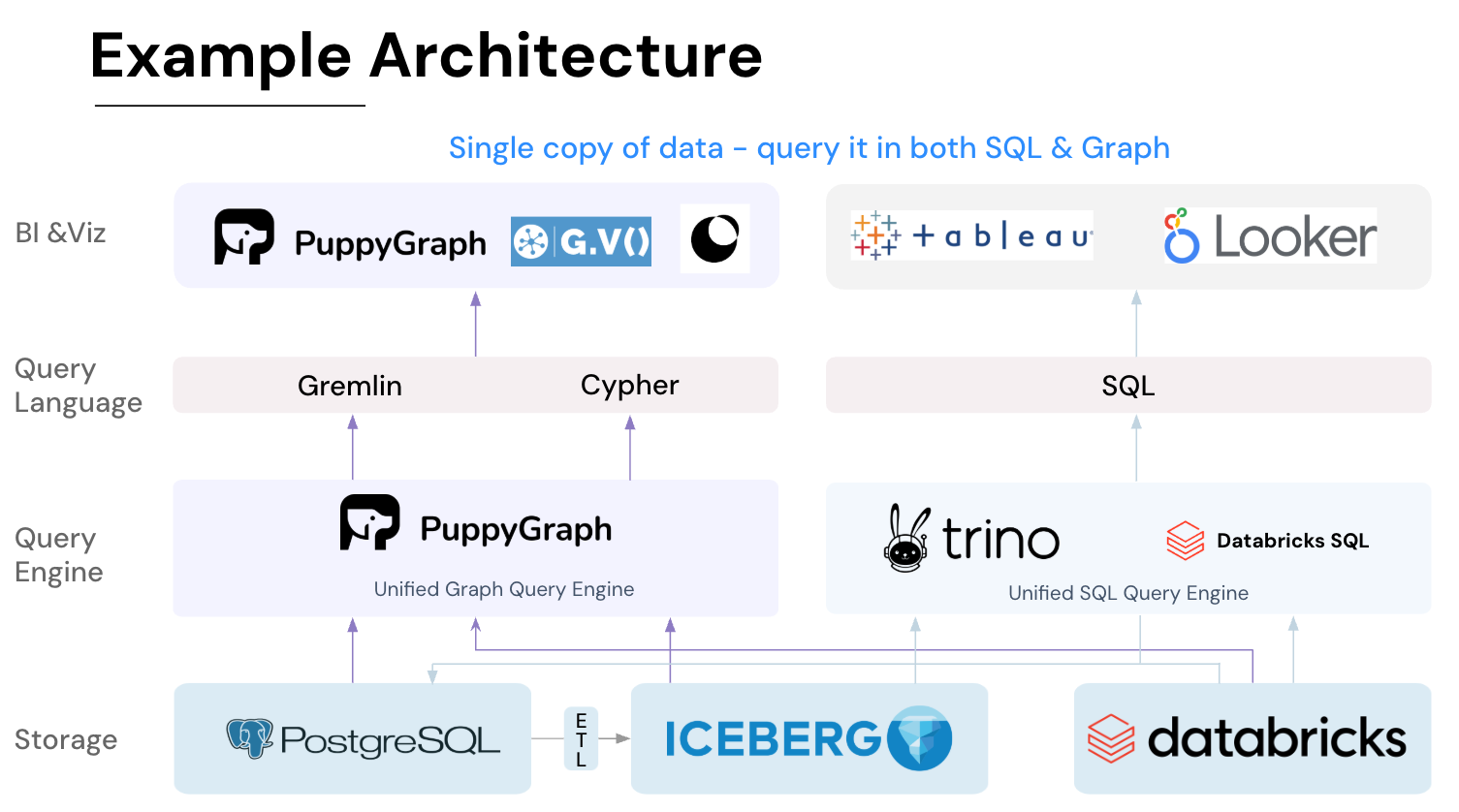
Key PuppyGraph capabilities include:
- Zero ETL: PuppyGraph runs as a query engine on your existing relational databases and lakes. Skip pipeline builds, reduce fragility, and start querying as a graph in minutes.
- No Data Duplication: Query your data in place, eliminating the need to copy large datasets into a separate graph database. This ensures data consistency and leverages existing data access controls.
- Real Time Analysis: By querying live source data, analyses reflect the current state of the environment, mitigating the problem of relying on static, potentially outdated graph snapshots. PuppyGraph users report 6-hop queries across billions of edges in less than 3 seconds.
- Scalable Performance: PuppyGraph’s distributed compute engine scales with your cluster size. Run petabyte-scale workloads and deep traversals like 10-hop neighbors, and get answers back in seconds. This exceptional query performance is achieved through the use of parallel processing and vectorized evaluation technology.
- Best of SQL and Graph: Because PuppyGraph queries your data in place, teams can use their existing SQL engines for tabular workloads and PuppyGraph for relationship-heavy analysis, all on the same source tables. No need to force every use case through a graph database or retrain teams on a new query language.
- Lower Total Cost of Ownership: Graph databases make you pay twice — once for pipelines, duplicated storage, and parallel governance, and again for the high-memory hardware needed to make them fast. PuppyGraph removes both costs by querying your lake directly with zero ETL and no second system to maintain. No massive RAM bills, no duplicated ACLs, and no extra infrastructure to secure.
- Flexible and Iterative Modeling: Using metadata driven schemas allows creating multiple graph views from the same underlying data. Models can be iterated upon quickly without rebuilding data pipelines, supporting agile analysis workflows.
- Standard Querying and Visualization: Support for standard graph query languages (openCypher, Gremlin) and integrated visualization tools helps analysts explore relationships intuitively and effectively.
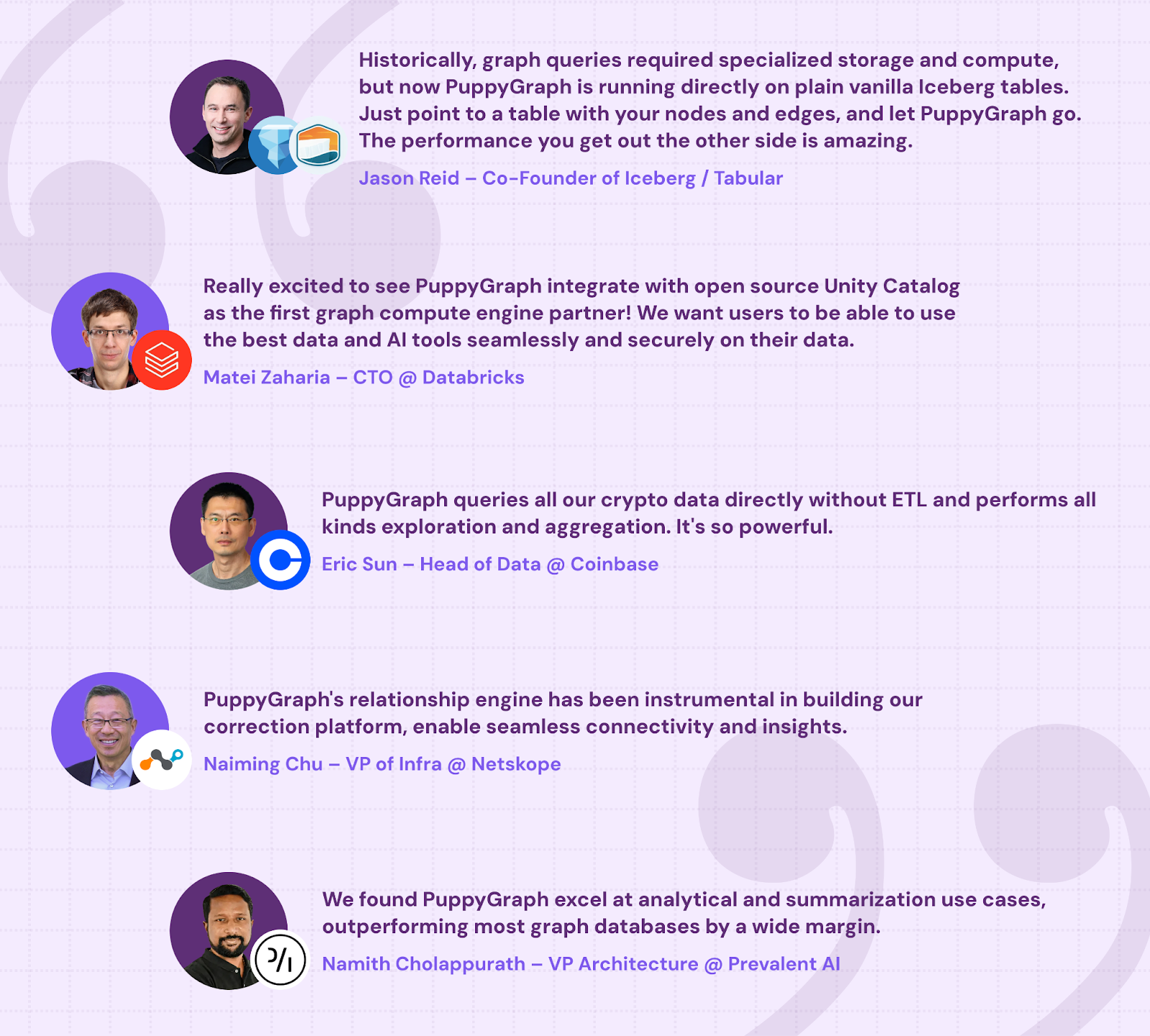
- Proven at Enterprise Scale: PuppyGraph is already used by half of the top 20 cybersecurity companies, as well as engineering-driven enterprises like AMD and Coinbase. Whether it’s multi-hop security reasoning, asset intelligence, or deep relationship queries across massive datasets, these teams trust PuppyGraph to replace slow ETL pipelines and complex graph stacks with a simpler, faster architecture.
As data grows more complex, the most valuable insights often lie in how entities relate. PuppyGraph brings those insights to the surface, whether you’re modeling organizational networks, social introductions, fraud and cybersecurity graphs, or GraphRAG pipelines that trace knowledge provenance.
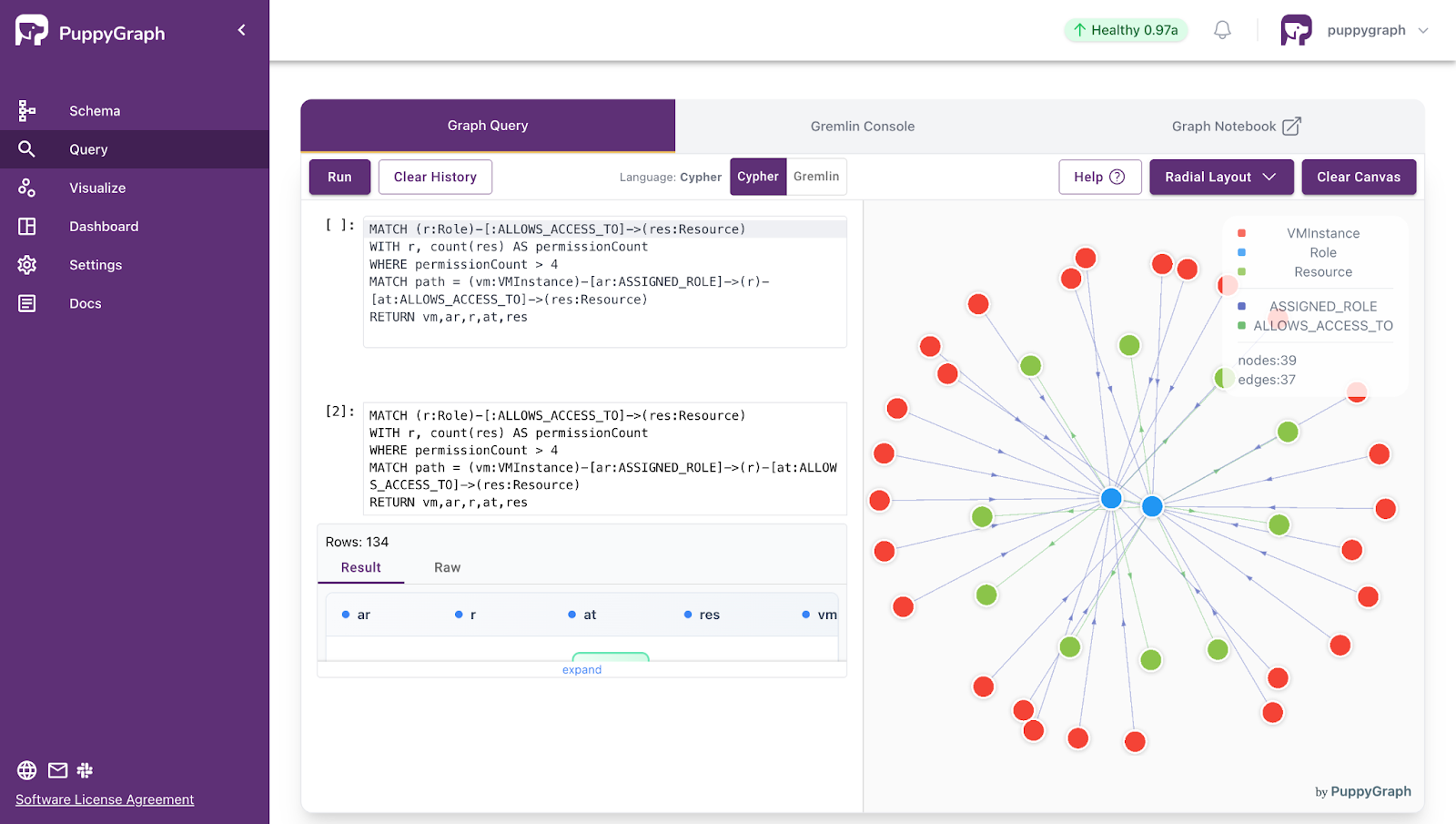
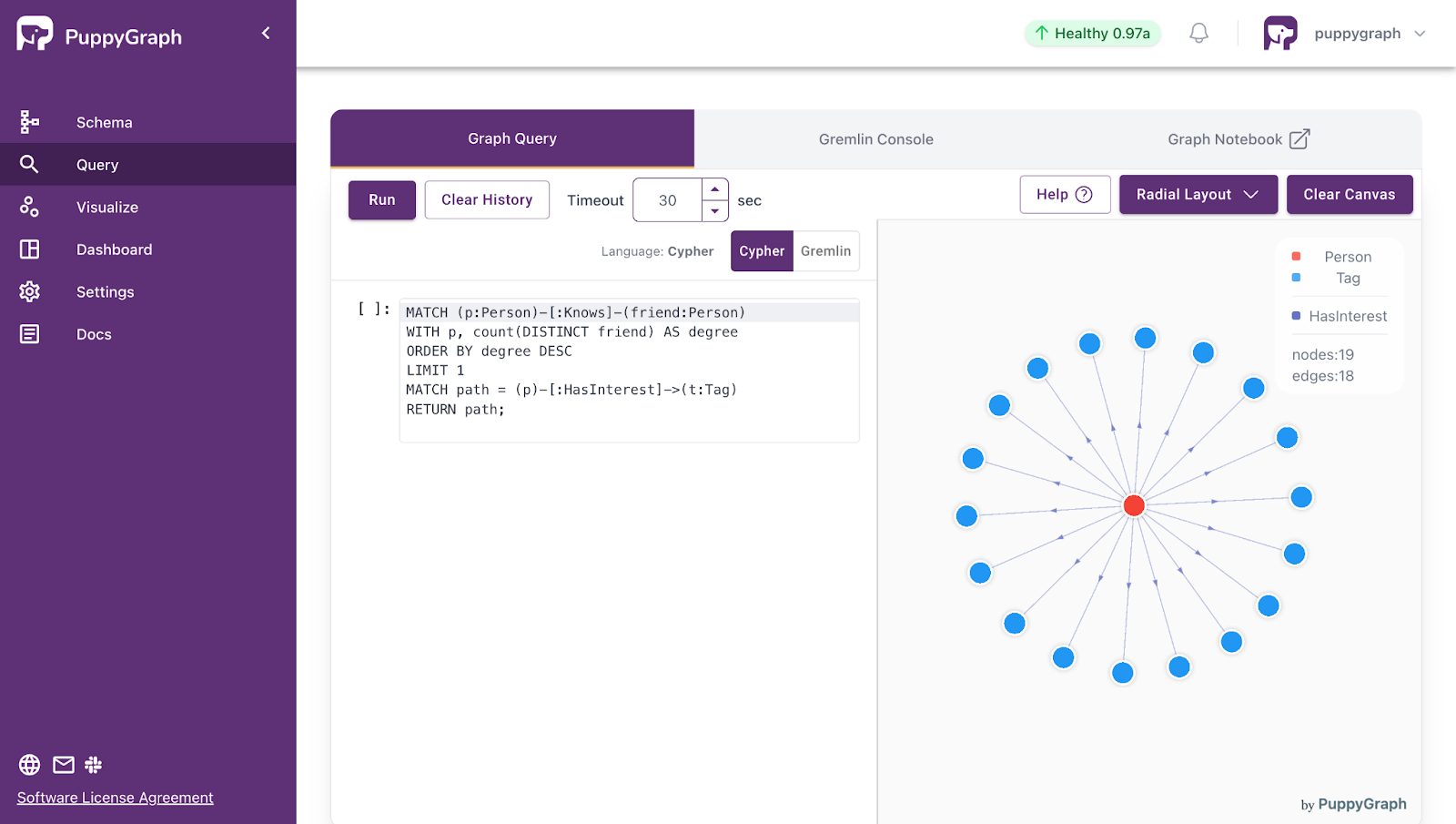
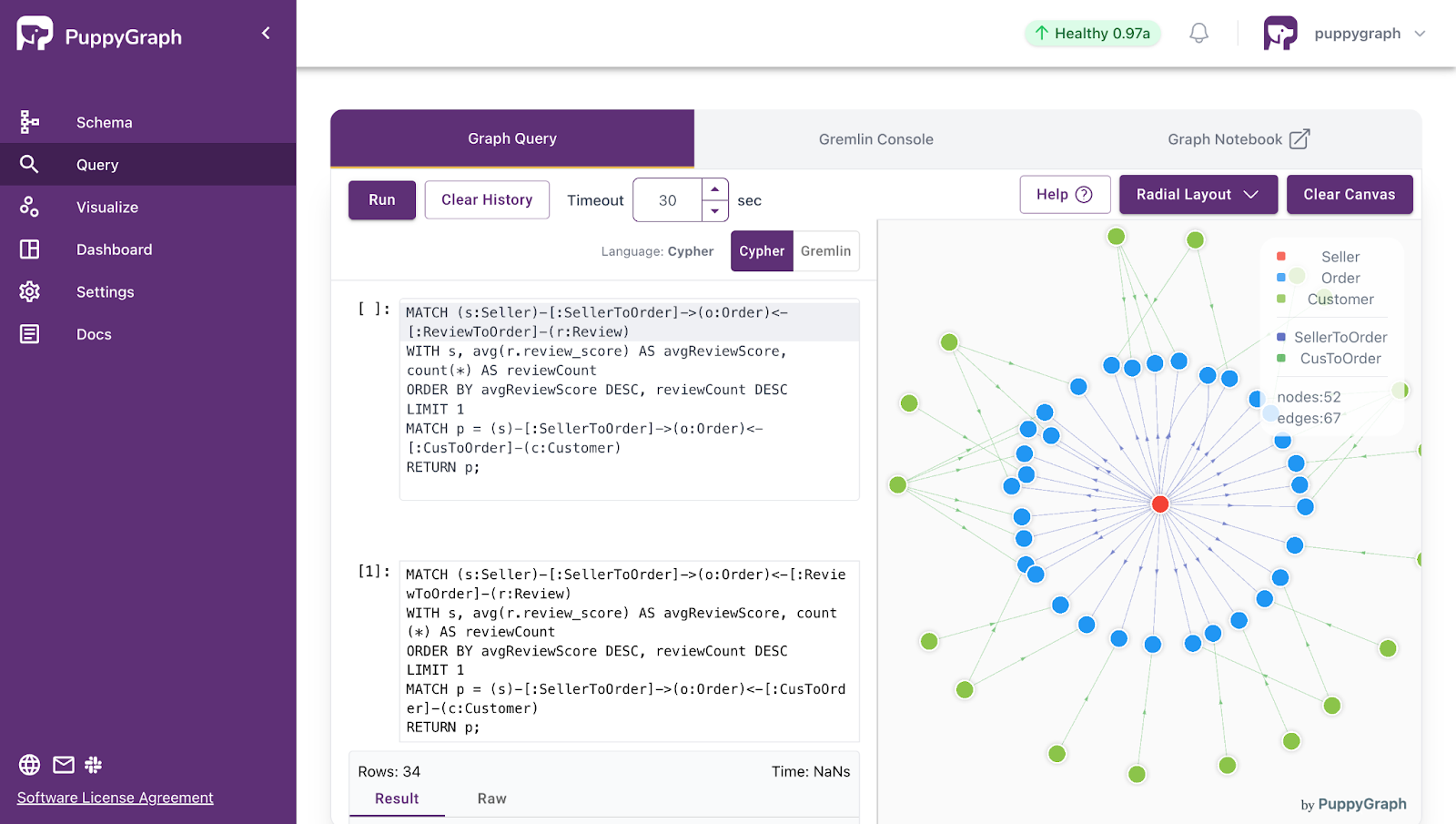
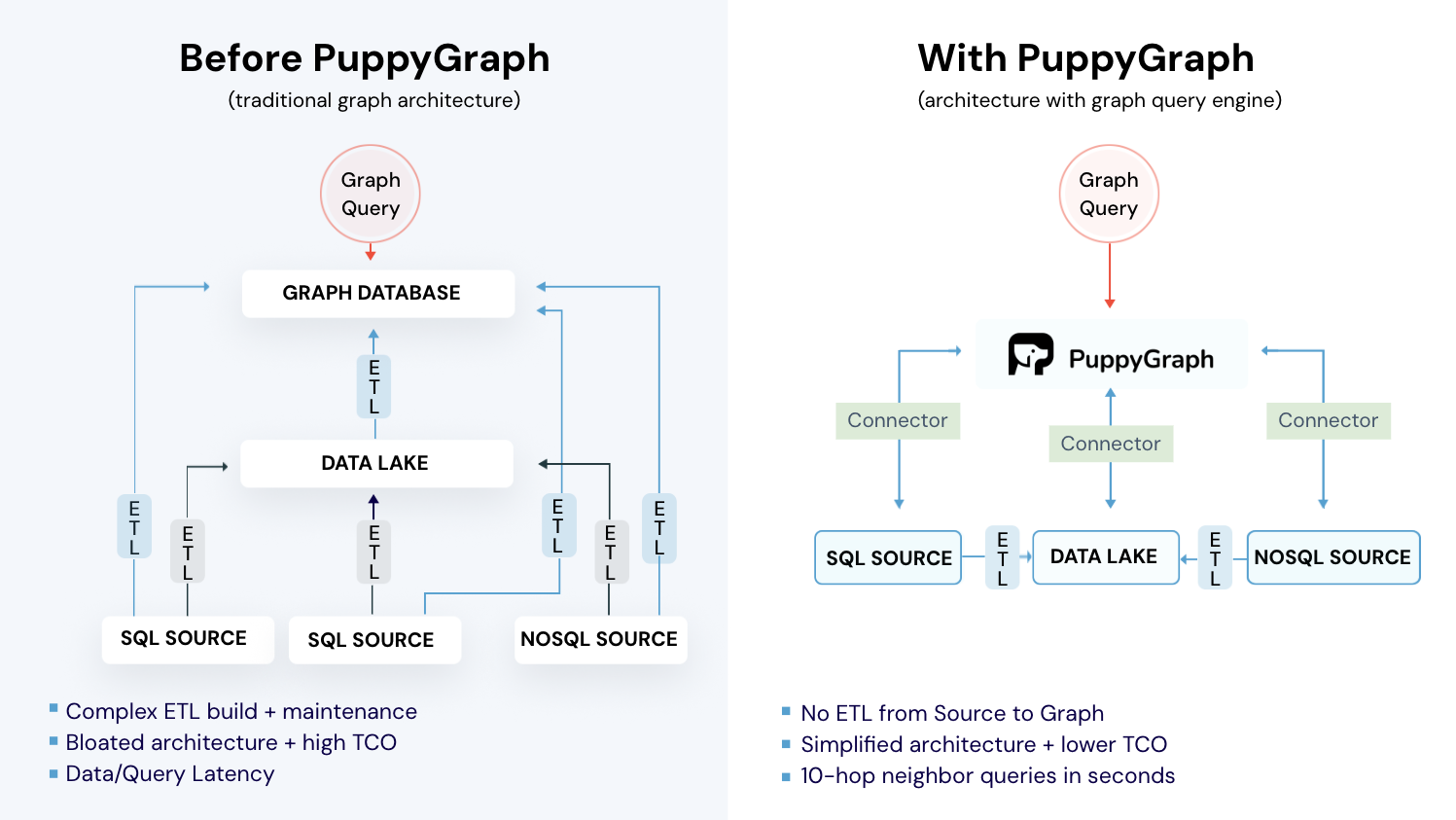
Deployment is simple: download the free Docker image, connect PuppyGraph to your existing data stores, define graph schemas, and start querying. PuppyGraph can be deployed via Docker, AWS AMI, GCP Marketplace, or within a VPC or data center for full data control.
Conclusion
Databases are long-term commitments. Choosing a graph database often comes with brittle ETL pipelines, duplicated storage, and graphs that drift from the source of truth. Over time, that complexity compounds and slows iteration. You are trying to build graphs that answer real questions, not a parallel infrastructure stack to keep them alive.
PuppyGraph avoids locking your data into a separate graph store. It keeps your source systems intact and exposes a property graph layer directly over the data you already run. That means you can quickly map vertices and edges from existing tables, run deep relationship queries when you need them, and keep using SQL for everything else.
Want graph intelligence without the traditional overhead? Download PuppyGraph's forever-free Developer edition or book a demo with the team.

Matt is a developer at heart with a passion for data, software architecture, and writing technical content. In the past, Matt worked at some of the largest finance and insurance companies in Canada before pivoting to working for fast-growing startups.

Get started with PuppyGraph!


Developer Edition
- Forever free
- Single noded
- Designed for proving your ideas
- Available via Docker install
Enterprise Edition
- 30-day free trial with full features
- Everything in developer edition & enterprise features
- Designed for production
- Available via AWS AMI & Docker install