


Trino vs Presto: Key Differences, & Use Cases
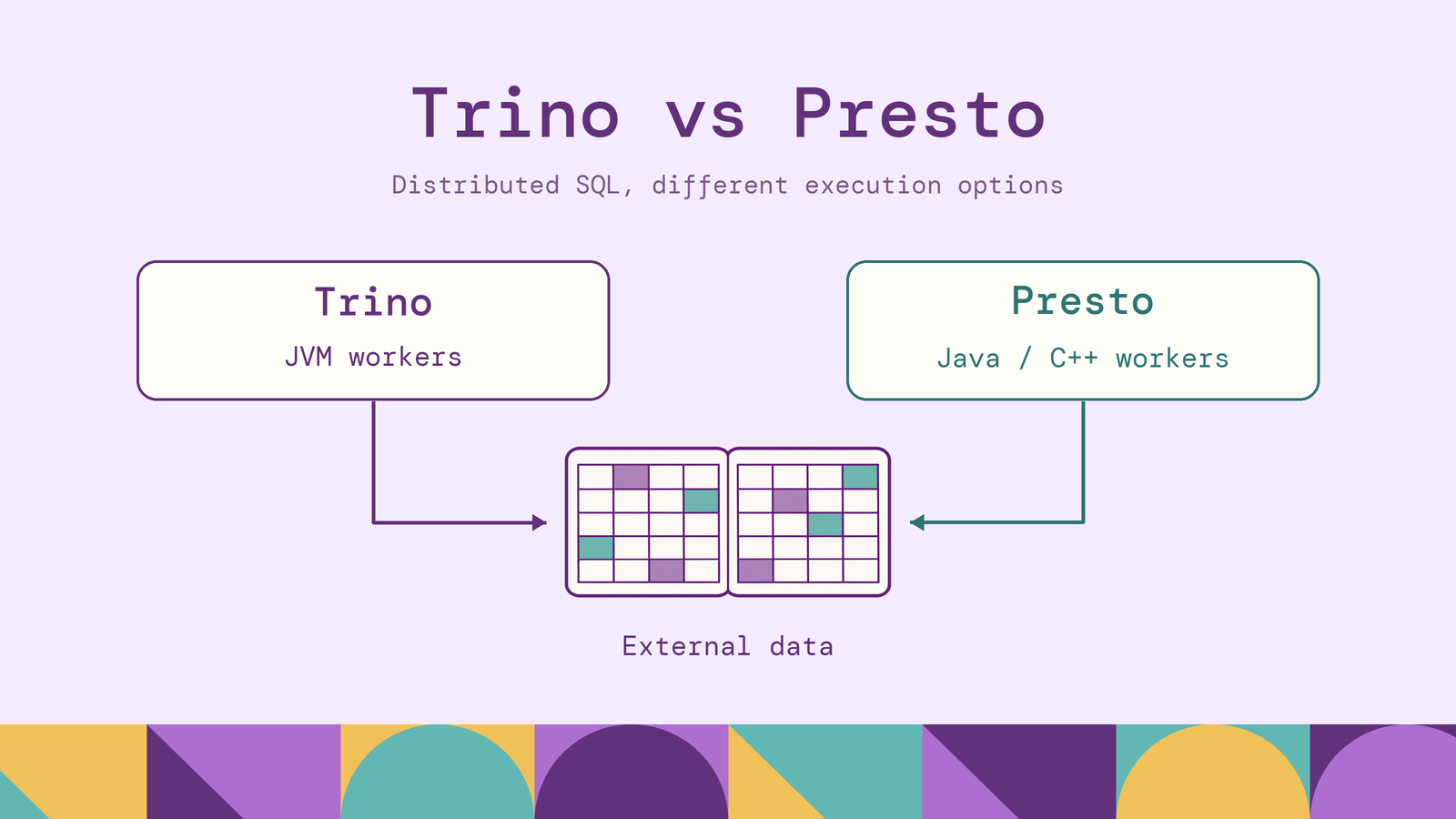
Choosing between Trino and Presto means choosing between two independently developed distributed SQL engines with a shared origin. Both can query data across external systems. The practical differences emerge in their execution options, connector behavior, SQL features, and the work required to operate or migrate a deployment.
This comparison uses Presto to mean PrestoDB. PrestoSQL became Trino, while PrestoDB continued as a separate project. We will compare their architecture and capabilities, identify where each deserves consideration, and explain how to evaluate them against your actual workloads.
What is Trino?
Trino is an open-source distributed SQL query engine for large datasets across heterogeneous sources. It separates query processing from the systems that store the data. A team can use it to analyze lakehouse tables, query a relational database, or combine sources in one SQL statement.
Its connector library includes Hive, Apache Iceberg, Delta Lake, PostgreSQL, and other systems. Each configured catalog exposes a source through a common SQL interface. For example, an analyst could join an Iceberg orders table with a PostgreSQL customer table without first loading both into a new warehouse.
That flexibility makes Trino useful as a shared SQL access layer. It also makes source behavior part of query performance: the engine still needs to retrieve data, and the connector determines which operations the source can perform. Trino's pushdown documentation describes that boundary.
What is Presto?
Presto is the independently maintained PrestoDB distributed SQL engine. Like Trino, it queries external data through connectors and distributes execution across workers. Its applications include interactive analytics, reporting, and querying lake data alongside other enterprise sources.
Presto has its own connector library, including Hive, Iceberg, Delta Lake, and relational databases. Shared connector names do not establish identical functionality across the two engines, or across Presto's execution options.
One significant option is Presto C++, also called Prestissimo. It uses the Velox execution library for native workers while retaining a Java coordinator. This gives teams a distinct execution path to evaluate. Connector and function coverage require separate attention when adopting it.
Presto therefore deserves evaluation on its current capabilities and operational fit. Treating it as a frozen predecessor to Trino would miss a separate development path.
Trino vs Presto: key differences
The most useful comparison connects a capability to an operational decision. Both projects distribute SQL work, but they offer different ways to extend that foundation.
Performance. Both Trino and Presto use connector-provided statistics for cost-based join planning. Neither project name establishes a universal speed advantage. A selective query, a large join, and a concurrent dashboard workload can expose different bottlenecks. Compare equivalent hardware, source layouts, statistics, and execution modes before attributing a result to the engine.
SQL and connectors. Basic joins and aggregations are only the starting point. Compare the functions, type mappings, and table operations your applications need. For example, both the Trino Iceberg connector and Presto Iceberg connector document writes and table maintenance, but their supported operations and requirements differ. A successful read does not validate an entire ingestion or update workflow.
Scalability. Worker capacity and query coordination are separate concerns. Test a larger scan and a larger population of simultaneous users independently. More workers can increase available compute without resolving slow metadata access, coordinator pressure, or a source database's throughput limit.
The decision should follow the capability that constrains your workload. A connector requirement may settle the choice before execution speed matters; an established deployment may make migration cost decisive.
Trino vs Presto: history and evolution
Presto began at Facebook in 2012 to support interactive analytics over its Hadoop data warehouse. The original developers later established the Presto Software Foundation in January 2019 to oversee the project that became known as PrestoSQL. Their rebranding announcement records this history.
In September 2019, the Linux Foundation announced the Presto Foundation for the PrestoDB project. In December 2020, PrestoSQL was renamed Trino. The two names now identify separate projects with separate releases and development decisions.
This history matters when reading older tutorials or planning an upgrade. An article that says Presto may describe either lineage. Check its repository, documentation domain, and release context before copying configuration. Moving between current PrestoDB and Trino requires compatibility testing, even when familiar SQL makes the systems look interchangeable.
Trino vs Presto: architecture comparison
Both engines use a coordinator-and-worker design. The coordinator accepts SQL, plans execution, and schedules work. Workers read source data, perform operations such as joins and aggregations, and exchange intermediate results. The Trino architecture and Presto concepts describe this shared foundation.
For a lakehouse query, workers read the relevant files through the configured connector and storage access. For a relational source, connector capabilities determine how much processing can be delegated. Trino's pushdown mechanisms, for example, can move supported filters, aggregations, or joins into the source. The remaining work executes in the query engine.
Consider an orders-to-customers join. Filtering orders by date before transferring them can reduce subsequent work. If the join runs in the distributed engine, its inputs still need to reach the workers. Source latency, transferred bytes, and intermediate result size all belong in the performance investigation.
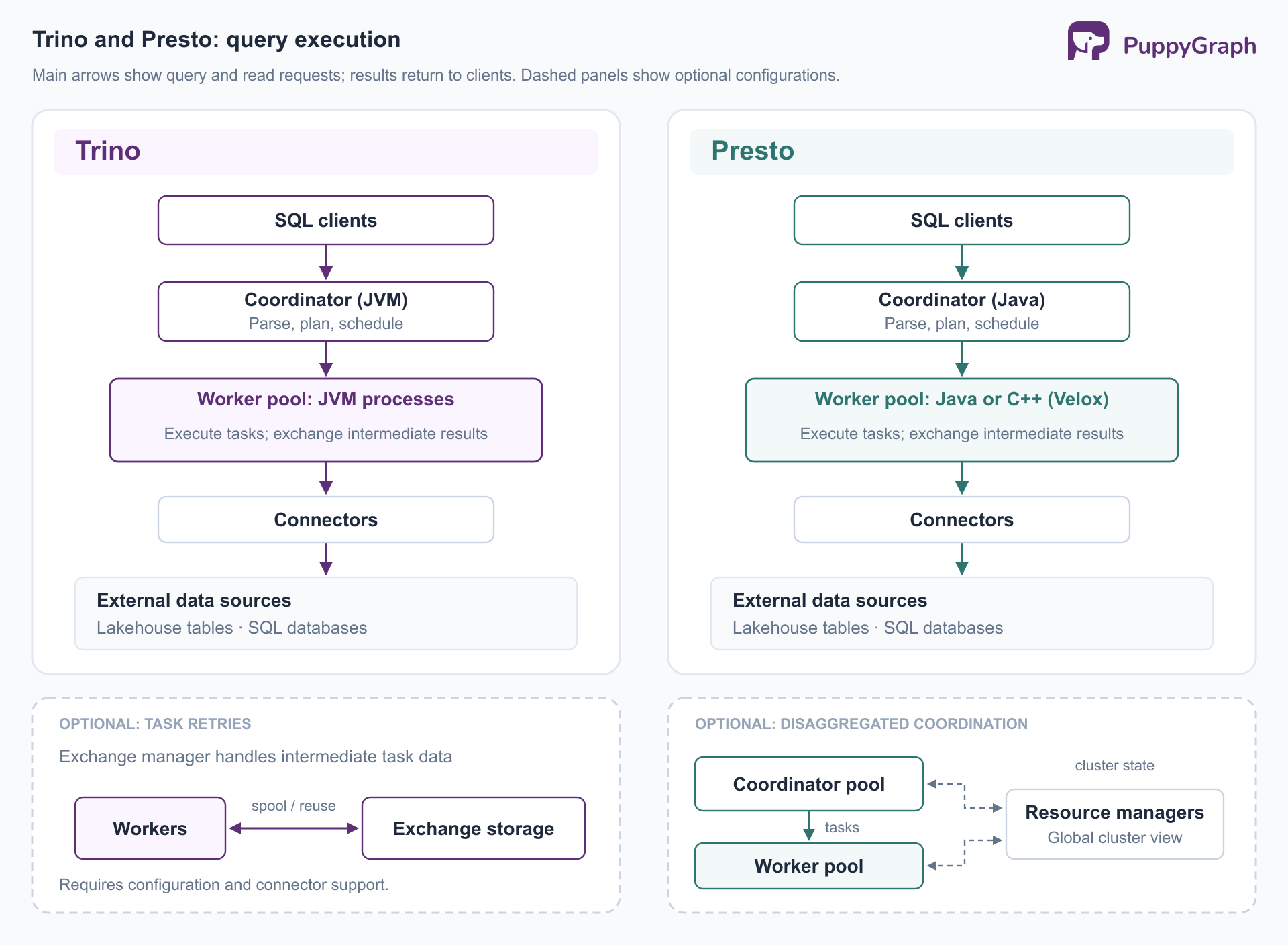
Execution and memory. Trino nodes run in JVM processes. Presto's native path moves worker execution into C++, with Velox providing the execution library. Native execution changes the implementation being measured; it does not remove network, storage, or memory constraints. Presto documents C++ limitations separately, so validate your queries and connectors against that path.
Failure recovery. Trino's fault-tolerant execution can retry whole queries or individual tasks. Task retries require an exchange manager, allowing intermediate data to be reused after worker failure. This mode adds storage work and can increase latency for short queries. Recovery support also depends on the connector and statement. Evaluate the mode appropriate to the workload rather than assuming every Trino deployment uses it.
Presto's Spark integration executes Presto queries through Spark and uses its resource management and materialized exchange facilities. This is a separate deployment choice with additional operational dependencies. It should be evaluated explicitly when large batch processing is part of the requirement.
These differences make the deployment configuration part of the comparison. Record the worker implementation, retry behavior, and topology alongside every performance result.
When to use Trino?
Trino deserves a place on the shortlist when you need a shared SQL layer across a lakehouse and other data systems, especially when its connector capabilities match the operations you plan to run.
Federated analysis. A team might join historical orders on object storage with customer attributes in a relational database. Trino's catalog model makes this a natural workload to evaluate. Test source-side load alongside response time, particularly if analysts share the database with transactional applications.
Lakehouse SQL and transformation. The Iceberg connector supports analytical reads, data modification, and table maintenance. That makes Trino worth testing when the same SQL environment must support exploration and table-oriented data pipelines. Validate the required catalog, table operations, and concurrent access pattern together.
Workloads that benefit from task retries. A long transformation can justify the extra work of persisting intermediate results if recovering smaller tasks avoids restarting expensive queries. Compare this execution mode with your interactive requirements; one cluster configuration may not serve both equally well.
Trino is a stronger choice when these capabilities meet concrete requirements and the team can operate them reliably. An engine change should produce a measurable improvement in the workload or its maintenance burden.
When to use Presto?
Presto merits consideration for existing PrestoDB environments, native execution evaluations, and teams whose infrastructure fits its deployment options.
Established reporting platforms. Keeping Presto can be the sensible choice when dashboards, access controls, custom connectors, and operational procedures already work. A migration needs a specific benefit large enough to justify testing those dependencies. Familiarity with failure modes and recovery procedures has practical value.
Native lake analytics. Evaluate Presto C++ when supported queries over lake data account for substantial compute use. Run the actual workload and measure CPU, memory, latency, and completed queries under concurrency. The native execution documentation identifies supported use cases; Java connector availability alone does not establish native compatibility.
Specialized deployment requirements. Presto's disaggregated coordinator architecture may be relevant when query coordination needs separate attention. Presto on Spark may fit teams that already operate Spark and want that execution path for large queries. Each option brings its own configuration and validation work.
Choosing Presto is strongest when an existing investment or a demonstrated capability matches the requirement. Its suitability for a new deployment should be established by the same workload tests used for Trino.
How to choose between Trino and Presto
Start with a representative query set and a written definition of success. Include dashboard queries, large joins, source-sensitive federated queries, and any writes or maintenance operations. Measure correctness before speed: compare result values, data types, null handling, and timestamp behavior across the candidate deployments.
Then evaluate four practical constraints:
- Connector completeness. Verify authentication, catalog access, required operations, type mappings, and source load. Exercise the operations applications perform after their first successful read.
- Workload behavior. Measure queue time, tail latency, throughput, memory, and failures at realistic concurrency. Keep datasets and hardware comparable, and record cache state and configuration.
- Operating cost. Include compute, temporary storage, network transfer, source-system charges, and engineering effort. Test a worker interruption and observe what must be repeated.
- Migration and ownership. Inventory drivers, views, custom functions, plugins, security rules, and monitoring. Assign an owner for upgrades and rollback before replacing a working deployment.
For a new federated lakehouse platform, begin by testing Trino's required connectors and execution modes. For an established PrestoDB platform or a workload suited to native execution, include Presto early. Let a missing capability eliminate a candidate; use measured behavior to resolve the remaining trade-offs.
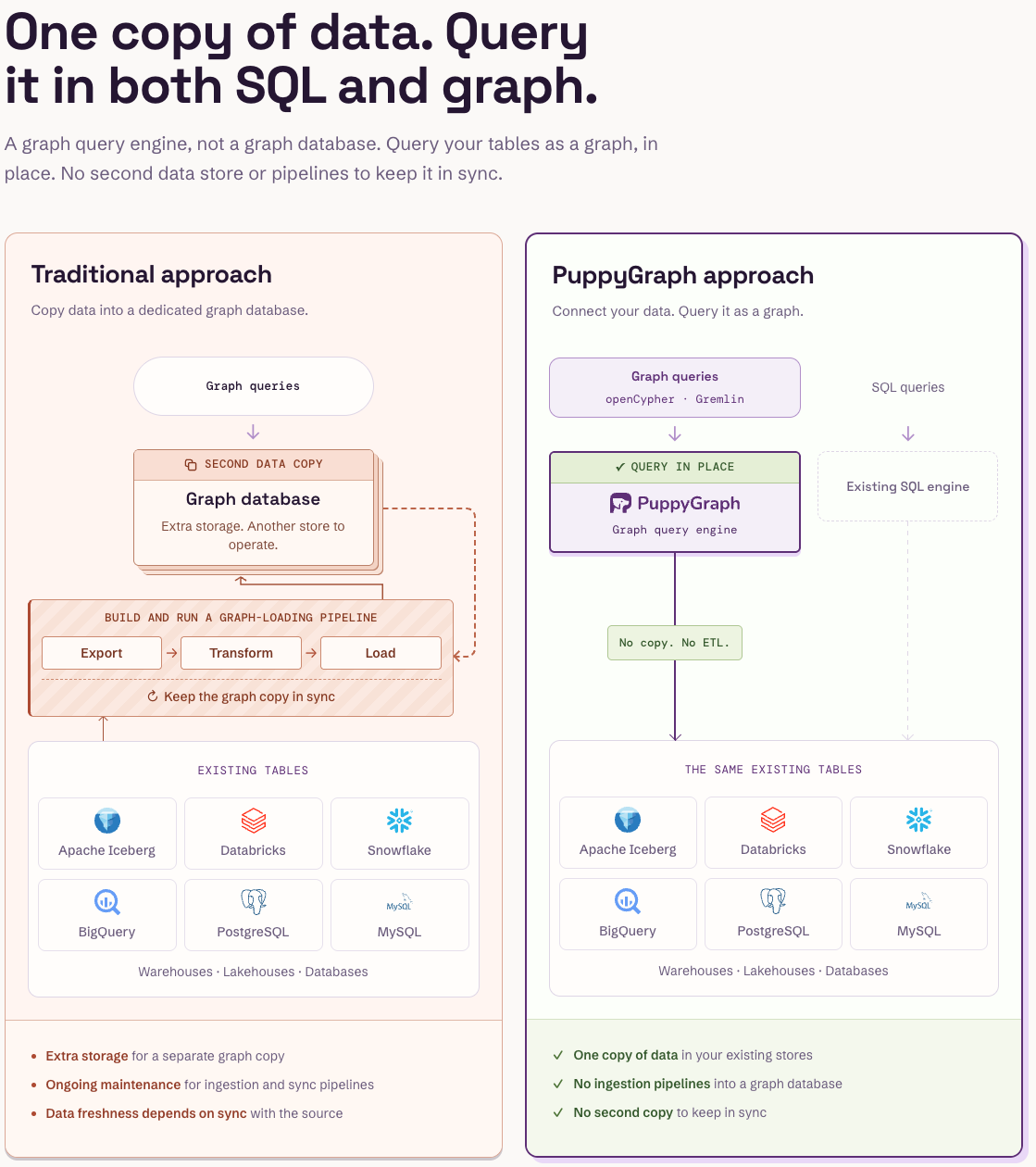
Some requirements also involve relationships that extend across many records: accounts connected through shared devices, or services affected through chains of dependencies. SQL joins can express these relationships, but a reusable graph model gives analysts entity and relationship names to query directly. Include this query shape when deciding which capabilities the data platform needs.
PuppyGraph is the first and only zero-ETL graph query engine that lets teams query existing relational data as a graph without building a separate graph ingestion pipeline. For a Trino deployment, its documented Trino connection provides access through JDBC. Teams define a graph schema over the exposed tables and query entities and relationships with openCypher and Gremlin. This adds a graph query interface alongside the SQL workflows already using Trino.
PuppyGraph compiles a graph query into a plan of node and edge operators that runs in its own distributed engine. When reading SQL sources, it issues simple projection and filter SQL; the graph execution architecture handles multi-hop traversals and pattern matching inside PuppyGraph. Because the execution plan represents graph operations, the engine can optimize specifically for traversals. A fraud analyst can follow account, device, and transfer relationships through the model while the source tables remain available for SQL reporting.
PuppyGraph also supports direct reads of Iceberg tables, providing another integration path when Trino or Presto queries the same lakehouse. Its default direct-query path requires no persistent duplicate graph dataset. The reason to add it is a recurring need for relationship analysis over existing data. Select Trino or Presto for the SQL workload, then evaluate graph querying against the same data platform where that additional capability is useful.

Conclusion
Trino and Presto share a distributed SQL foundation, while their execution options and surrounding capabilities have developed independently. Trino warrants evaluation for federated lakehouse SQL and configurable task recovery. Presto warrants evaluation where existing integrations, native workers, or its deployment options fit the workload. Connector completeness, query correctness, and operational behavior should decide between them.
Try the forever-free PuppyGraph Developer Edition and book a demo with the team to see how openCypher and Gremlin queries run over warehouse and lakehouse tables, with no graph-specific ETL, adding relationship analysis alongside your distributed SQL workloads.

Hao Wu is a Software Engineer with a strong foundation in computer science and algorithms. He earned his Bachelor’s degree in Computer Science from Fudan University and a Master’s degree from George Washington University, where he focused on graph databases.

Get started with PuppyGraph!


Developer Edition
- Forever free
- Single noded
- Designed for proving your ideas
- Available via Docker install
Enterprise Edition
- 30-day free trial with full features
- Everything in developer edition & enterprise features
- Designed for production
- Available via AWS AMI & Docker install