

12 Best ETL Tools in 2026
Choosing an ETL tool in 2026 means choosing in the middle of a consolidation wave. Salesforce completed its acquisition of Informatica in November 2025, Fivetran and dbt Labs closed their merger in June 2026, and IBM completed its acquisition of Confluent in March 2026. The market being consolidated is large and still growing: MarketsandMarkets’ June 2025 data integration report sizes the segment at $17.59 billion in 2025, projected to reach $33.24 billion by 2030 at a 13.6% annual rate. The tools themselves have kept moving too: licenses have shifted from open source to source-available, transformation has migrated into the warehouse, and every vendor now sells some form of managed replication alongside classic batch ETL.
This guide covers what ETL is, what ETL tools actually do, the types of tools on the market, the criteria that separate them in practice, a side-by-side comparison, and twelve tools worth considering in 2026, with an honest read on where each one fits.
What is ETL?
ETL stands for extract, transform, load: the process of pulling data out of source systems, reshaping it into a form suitable for analysis, and writing it into a destination such as a data warehouse. Extract reads from operational databases, SaaS applications, files, and event streams. Transform cleans, deduplicates, joins, and conforms that data so records from different systems agree on keys, types, and business definitions. Load writes the result into the analytical store where queries, dashboards, and models consume it.
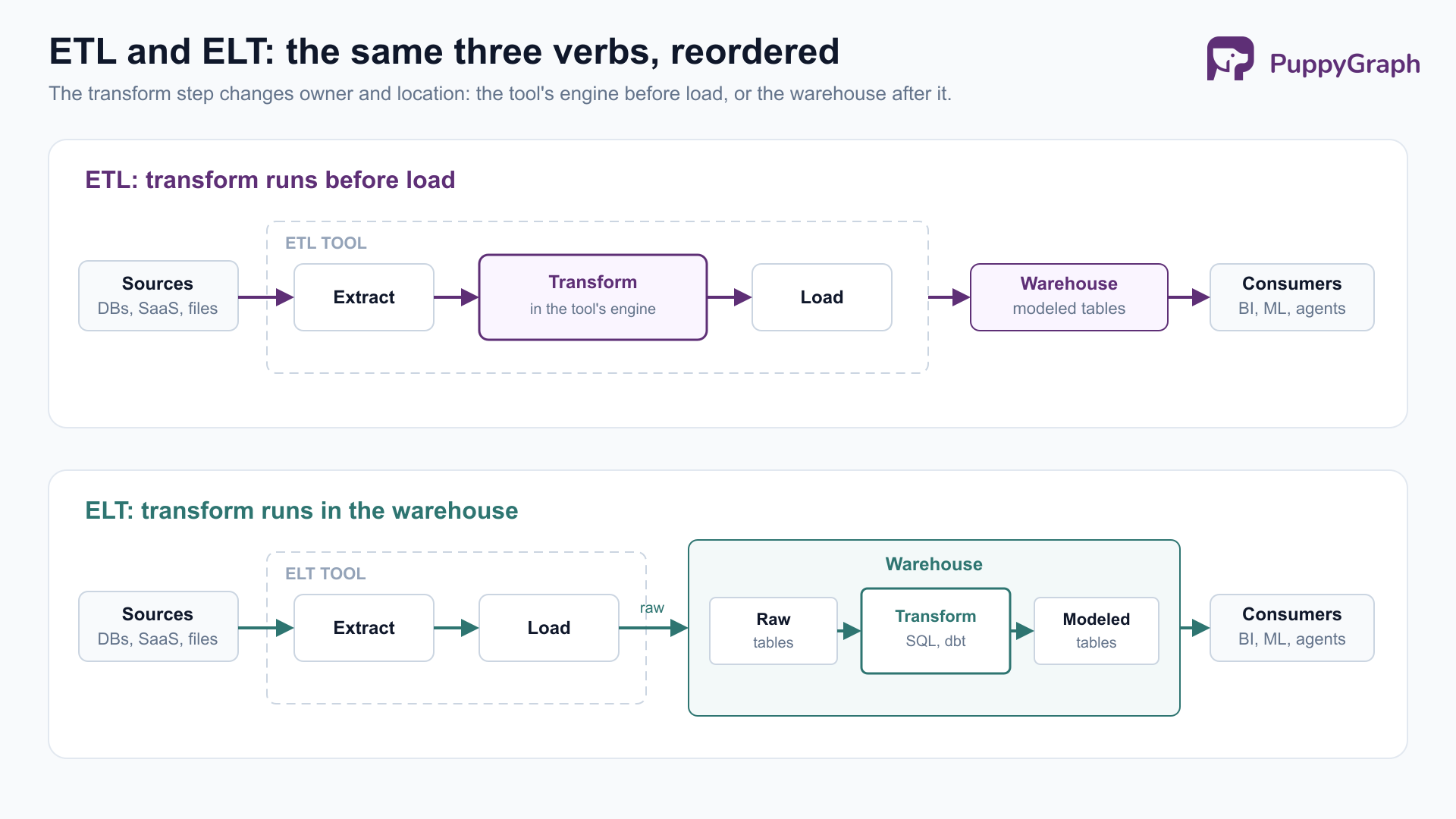
The ordering of those three verbs is where most of the last decade’s change happened. Classic ETL transforms data in a dedicated engine before loading it, a design from the era when warehouse compute was scarce and expensive. The cloud warehouse inverted that economics, and ELT became the default for analytics: extract and load raw data first, then transform it inside the warehouse using its own SQL engine, typically with a modeling layer such as dbt. Most modern tools are ELT under the hood, and the industry keeps using “ETL” as the umbrella term for both. A third pattern, zero-ETL, removes the user-built pipeline entirely for supported source-target pairs, either through vendor-managed replication or by querying data where it already lives; it covers common ingestion paths, not the conformance-heavy transformation work that remains the durable core of the discipline.
However the verbs are ordered, the job is the same: getting data from the systems that produce it to the systems that analyze it, reliably and repeatably. The tools in this guide exist because that job is deceptively expensive to do by hand.
What are ETL tools?
An ETL tool is the software that owns that job as a product rather than a pile of scripts. Teams routinely start with hand-written extraction code, and it works until it becomes the team’s largest maintenance line: every source API change breaks an extractor, every upstream schema change breaks a load, and every failure at 3 a.m. pages an engineer to re-run a backfill by hand. ETL tools industrialize exactly those failure points.
Concretely, the tools in this guide bundle some combination of five capabilities. Connectors: pre-built, vendor-maintained integrations for databases, SaaS applications, files, and streams, so that reading a new source is configuration rather than code. Incremental movement: change data capture (CDC) from database transaction logs, or API-cursor tracking for SaaS sources, so pipelines move only what changed instead of re-extracting entire tables. Transformation authoring: a way to express the reshaping logic, whether visual mapping canvases, generated code, SQL models, or notebooks. Orchestration: scheduling, dependency management, retries, and backfills, so pipelines run in the right order and recover from failure. Observability and governance: run history, alerting, data lineage, and access controls, so someone can tell what ran, what broke, and where a number came from.
No tool weights those five equally, and the weighting is the product. A managed ELT service invests almost everything in connectors and incremental movement and leaves transformation to the warehouse; an enterprise suite invests in transformation depth and governance; a streaming platform invests in latency and delivery guarantees. Reading a tool through this lens, which capabilities it treats as the product and which it delegates, predicts its fit better than any feature checklist.
Types of ETL tools
The market sorts into a small number of camps, and the camp matters more than the feature list, because it determines who operates the pipeline and where transformation runs. The first split is between the platforms enterprises standardize on and the services cloud providers ship natively.
Enterprise data integration suites. Informatica, Qlik Talend, and IBM DataStage treat data movement as one pillar of a governed platform that also spans data quality, cataloging, and master data management. These are the tools of large, regulated estates with complex transformation logic and long-lived batch workloads. The classic on-premises engines they descend from (PowerCenter, Talend Studio, SQL Server Integration Services) still run in production widely, but the vendors’ investment has moved to their cloud platforms, and support windows for the legacy lines are progressively closing.
Cloud-provider services. AWS Glue, Azure Data Factory, and Google Cloud Dataflow are the hyperscalers’ native answers: serverless, deeply integrated with each provider’s catalog, storage, and warehouse, and priced on consumption. They are the path of least resistance inside their own clouds and progressively more awkward the further the estate strays from one provider.
Managed ELT platforms. Fivetran, Matillion, Hevo Data, and (since its December 2024 acquisition of Rivery) Boomi sell pipeline maintenance as the product: the vendor maintains the connectors, absorbs source API and schema changes, and loads into the customer’s warehouse, where transformation runs post-load. Within the camp the center of gravity differs, from movement-first (Fivetran, Hevo) to transformation-first pushdown design (Matillion).
Open-source platforms. Airbyte and Apache NiFi offer self-hosted control over the same job, trading managed convenience for ownership. The label needs reading carefully in 2026: NiFi remains Apache-licensed open source, while Airbyte’s core and connectors are now source-available under the Elastic License rather than open source in the OSI sense.
Streaming and CDC platforms. Kafka Connect (the integration framework of Apache Kafka, with CDC typically supplied by Debezium), Confluent’s managed connector ecosystem around it, and Estuary Flow move data continuously rather than on a schedule, for the workloads where minutes of latency are the requirement rather than a nice-to-have. Confluent has been an IBM subsidiary since March 2026; Kafka itself remains an Apache Software Foundation project.
One more layer sits alongside every camp rather than inside one: the transformation framework. dbt became the de facto standard for the T in ELT, pairing with whichever tool handles extract and load; its merger into Fivetran makes movement and transformation one vendor for the first time, though dbt Core remains Apache-licensed. Across all five camps plus that layer, the practical shortlisting question is operational: who do you want maintaining connectors, where do you want transformation to run, and how fresh does the data need to be. Those three answers eliminate most of the market before any demo starts.
How to evaluate ETL tools
ETL tools look interchangeable on a checklist and diverge sharply in production. These are the dimensions that separate them; the tool entries below apply the same lens throughout. Start with the shape of the workload itself.
Latency model. Scheduled batch, log-based CDC, or continuous streaming. This is the deepest architectural commitment a tool makes and the hardest to retrofit; a batch-first platform bolts on CDC less convincingly than a streaming-first platform bolts on batch.
Where transformation runs. In the tool’s own engine before load (classic ETL), in the warehouse after load (ELT and pushdown designs), or in flight (streaming transforms). This decides whose compute you pay for, where the logic lives, and which team can maintain it.
Transformation depth. Visual mapping canvases, generated code, SQL models, or full programmatic control. A tool whose authoring model does not fit the team’s skills becomes shelfware regardless of its engine.
Then look at whether the tool covers the estate and survives its evolution.
Connector coverage and maintenance. Not just whether a source is listed, but who fixes the connector when the source’s API changes, and how fast. This is the actual product of the managed ELT camp, and the actual burden of self-hosting.
Schema evolution handling. Upstream columns appear, change type, and disappear constantly. Whether the pipeline propagates those changes automatically, quarantines them, or breaks is one of the largest hidden costs of ownership.
Orchestration and observability. Dependencies, retries, backfills, alerting, and lineage, either built in or through clean integration with an external orchestrator. A pipeline nobody can debug at 3 a.m. is a liability whatever its throughput.
Finally, weigh the commercial and structural commitments.
Deployment and data residency. SaaS-only, hybrid agents that keep data processing inside your network, or fully self-hosted. For regulated estates this is a pass/fail gate, not a preference.
Licensing and openness. Open source, source-available, or proprietary, and whether pipeline definitions are portable. The 2025 license shifts in this market are a reminder that today’s terms are not permanent.
Cost shape. Consumption-based on rows moved, capacity-based, seat-based, or paid indirectly through warehouse compute in pushdown designs. Each shape punishes a different usage pattern, and volume-based pricing surprises are this market’s most common complaint.
Vendor trajectory. After the acquisitions of 2024 through 2026, several tools on this list answer to new owners. Roadmaps, pricing, and integration priorities follow ownership, which makes the acquirer’s strategy part of the evaluation.
The strongest evaluation starts from the pipeline your team would otherwise have to build by hand this quarter, and works backward to the tool shape that removes the most of that work. A team drowning in SaaS connector maintenance needs the managed ELT camp; a team with heavy conformance logic and auditors needs a suite; a team feeding fraud models needs the streaming camp. The hardest pipeline decides the shortlist better than the average one does.
Comparing top ETL tools
The table summarizes how the twelve tools line up on the dimensions that most affect a buying decision. Treat it as a starting filter, not a verdict; the right choice depends on your estate.
Read down the table and the market sorts into camps rather than a single ranking. The suites put movement inside a governed platform; the cloud services make it a native primitive of one provider; the managed ELT camp sells maintenance-free connectors with transformation delegated to the warehouse; the open-source options trade convenience for control; and the streaming entries treat latency as the product. The useful decision is which camp fits your estate, latency needs, and operating model; only then does tool-versus-tool comparison inside the camp become meaningful.
Top 12 ETL tools to consider
The twelve tools below are ordered to span the camps above rather than as a strict ranking. Each earns its place for a different estate; the right pick depends on your sources, your latency requirements, and who you want operating the pipeline.
1. Informatica
Informatica is the archetypal enterprise suite, now operating as part of Salesforce after the acquisition closed in November 2025. Its Intelligent Data Management Cloud (IDMC) delivers data integration alongside quality, governance, catalog, and master data management, with the CLAIRE engine automating mapping and classification work across the platform. Cloud Data Integration supports classic ETL, warehouse-pushdown ELT, and serverless execution, and the platform carries one of the broadest connector sets in the market. The trade-offs are the familiar enterprise ones: scope, cost, and implementation weight that smaller teams will find heavy for data movement alone, plus a legacy dimension, since PowerCenter estates face a vendor-driven migration to IDMC as on-premises support windows close. Informatica fits large, governance-driven enterprises, and its Salesforce ownership makes it the default candidate for estates deep in that ecosystem.
2. Qlik Talend
Qlik Talend combines two lineages under one roof: Talend’s code-generating batch ETL and data quality tooling, and Qlik’s log-based CDC replication descended from Attunity. Qlik Talend Cloud packages both as a SaaS platform spanning movement, transformation, quality, and governance, while Talend Studio jobs continue to run on self-managed engines for hybrid estates. The pairing is the pitch: batch pipelines and continuous replication with shared quality and governance, which suits organizations that would otherwise buy those separately. The things to weigh: the open-source Talend Open Studio line was retired in 2024, so the free on-ramp that built Talend’s community no longer exists, and Stitch, the lightweight managed ELT service Talend acquired, is maintained for existing customers while new investment flows to Qlik Talend Cloud. Qlik Talend fits teams that want integration and data quality as one governed platform, particularly alongside Qlik’s analytics stack.
3. IBM DataStage
IBM DataStage is the parallel-processing workhorse of the enterprise camp. Jobs are flows of stages executed by its PX engine, a distributed architecture in which a conductor coordinates horizontally scalable compute nodes, built for the heavy, complex batch transformations of classic enterprise warehousing. It runs as SaaS on IBM Cloud or self-managed on Red Hat OpenShift via Cloud Pak for Data, which keeps it deployable on-premises for the regulated estates where much of its install base lives. Since 2025 IBM has folded DataStage into watsonx.data integration, a unified control plane that consolidates it with StreamSets for streaming, IBM Data Replication for CDC, and Databand for observability; the move consolidates rather than replaces the engine. DataStage fits enterprises with demanding batch transformation workloads and strict deployment constraints, and existing InfoSphere shops modernizing in place; teams without those constraints will find lighter tools faster to adopt.
4. AWS Glue
AWS Glue is AWS’s serverless data integration service, built around Apache Spark jobs that run on managed, auto-provisioned workers with no clusters to operate. The Glue Data Catalog doubles as the metadata backbone for the wider AWS analytics stack (Athena, Redshift Spectrum, Lake Formation), and authoring is genuinely dual-mode: Glue Studio’s visual designer generates Spark code that code-first teams can equally write directly. The current Glue 5.x runtime reads and writes open table formats (Iceberg, Delta Lake, Hudi) natively, which positions it well for lakehouse builds. AWS also runs a set of its zero-ETL integrations through the Glue console, treating managed replication as a complement for common ingestion paths while Spark jobs carry the transformation logic. The trade-off is gravity: Glue is AWS infrastructure, not a neutral cross-cloud tool, and visual jobs still compile to Spark, so debugging ultimately means reading Spark. Glue fits AWS-centric estates with Spark-scale transformation needs.
5. Azure Data Factory
Azure Data Factory is Microsoft’s managed pipeline service: a Copy activity for data movement, Mapping Data Flows for visual transformations executed on Microsoft-managed Spark, and orchestration of external compute such as Databricks and Synapse. Its self-hosted integration runtime reaches on-premises and private-network sources, and the Azure-SSIS runtime runs existing SQL Server Integration Services packages as a lift-and-shift path, which matters to the large install base still running SSIS (still shipped with SQL Server 2025). The 2026 nuance is directional: Microsoft calls Data Factory in Microsoft Fabric “the next generation of Azure Data Factory”, and new capabilities land in Fabric while ADF remains fully supported with no announced deprecation. ADF fits hybrid Microsoft estates and SSIS migrations today; teams starting fresh in the Microsoft ecosystem should evaluate Fabric Data Factory first, because that is where the vendor’s investment is going.
6. Google Cloud Dataflow
Google Cloud Dataflow is a managed runner for Apache Beam pipelines, and its defining trait is one programming model for both batch and streaming: the same pipeline logic processes a bounded historical dataset or an unbounded event stream. The service is serverless, autoscaling workers and dynamically rebalancing work mid-job, and Beam pipelines are portable to other runners such as Flink and Spark, which is the anti-lock-in argument in an otherwise provider-native camp. The canonical pattern is Pub/Sub into Dataflow into BigQuery, and Google positions it for ETL, streaming analytics, and ML feature processing. The trade-offs: Dataflow is a processing engine rather than a connector catalog or orchestrator, so it pairs with other services for scheduling and source coverage, and Beam’s model has a real learning curve. Teams wanting a visual, connector-driven tool on Google Cloud have Cloud Data Fusion instead; Dataflow fits engineering teams building unified batch and streaming pipelines on Google Cloud.
7. Fivetran
Fivetran built the managed ELT category around a simple contract: the vendor maintains the connectors, absorbs source API changes and schema drift, and lands data in the customer’s warehouse on an automated cadence, with log-based CDC (from its HVR lineage) covering databases. The contract now spans the whole pipeline: the merger with dbt Labs closed in June 2026, putting the de facto standard transformation framework and the movement layer under one company, with dbt Core remaining Apache-licensed, and a 2025 agreement to acquire Census, the reverse ETL vendor, extends the same contract back into SaaS applications. Deployment spans SaaS and a hybrid model that keeps data processing inside the customer’s network. The trade-offs: consumption pricing tied to data volume needs active management, and movement plus transformation from one vendor reads as consolidation or concentration depending on the buyer. Fivetran fits teams whose goal is outsourcing pipeline maintenance entirely.
8. Matillion
Matillion takes the pushdown position in the managed camp: its Data Productivity Cloud is a SaaS control plane, but transformations execute inside the customer’s own cloud data platform (Snowflake, Databricks, Redshift, BigQuery), so data is not shipped out to a vendor engine and compute scales with the warehouse the team already sizes. Authoring is a visual, low-code canvas with SQL, Python, and dbt support layered in, and Maia, its agentic AI layer, generates and maintains pipelines from natural-language intent. The design suits warehouse-centric teams that want transformation depth with a visual surface: analysts can read the pipeline, engineers can drop to code. The trade-offs follow from the same design: pushdown means transformation cost lands on the warehouse bill, capability is bounded by the target platform, and connector breadth is secondary to transformation depth compared with movement-first vendors. Matillion fits Snowflake and Databricks shops that want visual ELT design without surrendering where compute runs.
9. Hevo Data
Hevo Data is the mid-market entry in the managed ELT camp: no-code pipelines, vendor-maintained connectors, log-based CDC for databases, automatic schema-drift handling, and loading into the major cloud warehouses, with transformations available through dbt integration and its own SQL and Python transform layer. The appeal is Fivetran-shaped automation with less operational and commercial complexity, which is precisely the trade a smaller data team wants; DoorDash and Postman are among the customers it cites. The constraints define the fit as much as the features: Hevo is SaaS-only, with no hybrid agent or self-hosted option, so estates with strict data-residency requirements are ruled out at the gate, and it is a smaller vendor than the category leader, which conservative buyers will weigh. Hevo fits mid-market teams that want managed pipelines running quickly without an enterprise procurement cycle or an infrastructure project.
10. Airbyte
Airbyte approaches the connector problem from the open side: a platform and protocol in which sources and destinations are containerized connectors exchanging a standard message stream, plus a connector development kit and no-code builder that make the long tail of niche sources buildable rather than waitable. It self-hosts on Kubernetes or runs as a managed cloud, and the 2.x platform generation added a faster sync engine and reverse-ETL delivery; vector-database destinations with built-in chunking and embedding also make it a common ingestion layer for RAG pipelines. The license needs stating precisely: the connectors moved from MIT to the Elastic License in 2025, joining the platform core (ELv2 since 2021), which makes Airbyte source-available rather than OSI open source, though still free to self-host. It moves data on sync schedules rather than streaming, and transformation is delegated downstream. Airbyte fits engineering-led teams that want self-hosted control and coverage of sources no managed vendor prioritizes.
11. Apache NiFi
Apache NiFi is the one entry on this list that is unambiguously open source, an Apache Software Foundation project under the Apache License. Its model is flow-based programming: data moves as FlowFiles through a graph of processors with back-pressure queues between them, designed in a browser canvas, with fine-grained provenance recording where every record came from and what touched it. The NiFi 2.x generation modernized the platform with a native Python processor API alongside Java, JSON flow definitions, and a required Java 21 runtime, and MiNiFi agents extend flows to edge devices; Cloudera offers it as a managed service. NiFi’s fit is continuous dataflow (routing, enrichment, and guaranteed delivery between many systems, including telemetry and security event streams) rather than warehouse ELT; it has no SQL modeling layer, and governing a sprawling flow canvas takes discipline. NiFi fits teams moving and routing data continuously between heterogeneous systems, especially where provenance is a requirement.
12. Estuary Flow
Estuary Flow is the streaming-native entry: pipelines are built from captures (log-based CDC and batch sources), collections (the captured data, stored as append-only journals in the customer’s own object storage), derivations (continuous transformations in SQL, TypeScript, or Python), and materializations that keep destinations current within milliseconds to minutes. The architecture’s distinctive property is that the same collection serves real-time materializations and full-history backfills, so streaming and batch consumers share one pipeline, with exactly-once delivery where the destination supports transactions. It is the managed alternative to operating Kafka, Connect, and Debezium yourself, and private-deployment and BYOC options run the data plane in the customer’s own cloud environment. The qualifiers: the core is source-available under the Business Source License (connectors are open source), there is no supported fully self-hosted path, and Estuary is a younger vendor than anything else on this list. Estuary fits teams that need CDC-grade freshness without streaming infrastructure of their own.
Across all twelve, one destination keeps recurring at the edge of the roadmap: the specialized store that exists to answer questions the warehouse’s vocabulary does not speak. Relationship questions (which accounts share devices with a flagged one, what breaks downstream of this column, how an attacker could chain access) are asked in the data’s semantic vocabulary of entities and relationships, not in tables and joins. The standard way to implement that vocabulary has been a knowledge-graph project: design the semantic model, stand up a graph database as its store, and build one more ETL pipeline to feed it, exporting tables, transforming rows into nodes and edges, and keeping the copy in sync forever. That pipeline is routinely the most fragile one in the stack, because the model churns with every new question and the sync is always behind.
That is one pipeline the tools above never have to build. PuppyGraph treats the semantic model as a layer over the data rather than a destination for it: a schema declared over the tables already in SQL databases, warehouses, and lakehouses (including direct reads of open table formats like Iceberg and Delta Lake) names which tables are entities and which foreign keys are relationships, and that declaration works as an ontology over live data, not a store materialized through its own pipeline. The graph is the implementation: queries run in openCypher and Gremlin, with no data movement and no separate graph store. PuppyGraph compiles a graph query into a plan of node and edge operators that executes in its own distributed engine, issuing only simple projection and filter SQL to the source. Because the query is represented as graph operators end to end, the engine optimizes specifically for multi-hop traversals, which is where its traversal performance comes from. And because the ontology is a mapping over live tables, it cannot drift from the data it describes; the pipelines in this guide land data once, and the semantic layer becomes one more consumer of that copy, following the same zero-ETL logic that is already absorbing the simpler ingestion paths.
Conclusion
The ETL market of 2026 is consolidating fast, but its structure is stable: enterprise suites for governed complexity, cloud-native services for provider-centric estates, managed ELT for teams buying their way out of maintenance, open-source platforms for teams that want control, and streaming platforms for workloads where latency is the point. There is no single best tool, only the best fit for your sources, your latency requirements, your deployment constraints, and who you want holding the pager. Start from the pipeline that hurts most today, decide which camp removes it, and the shortlist narrows to two or three candidates quickly. And before adding a new pipeline to feed yet another specialized store, it is worth asking whether an engine can serve that workload from the copy of the data you already maintain.
Try the forever-free PuppyGraph Developer Edition and book a demo with the team to see how openCypher and Gremlin queries run over warehouse and lakehouse tables, with no graph-specific ETL, answering the relationship questions that would otherwise mean one more pipeline.

Hao Wu is a Software Engineer with a strong foundation in computer science and algorithms. He earned his Bachelor’s degree in Computer Science from Fudan University and a Master’s degree from George Washington University, where he focused on graph databases.


