

External Data Integration: Methods and Architecture
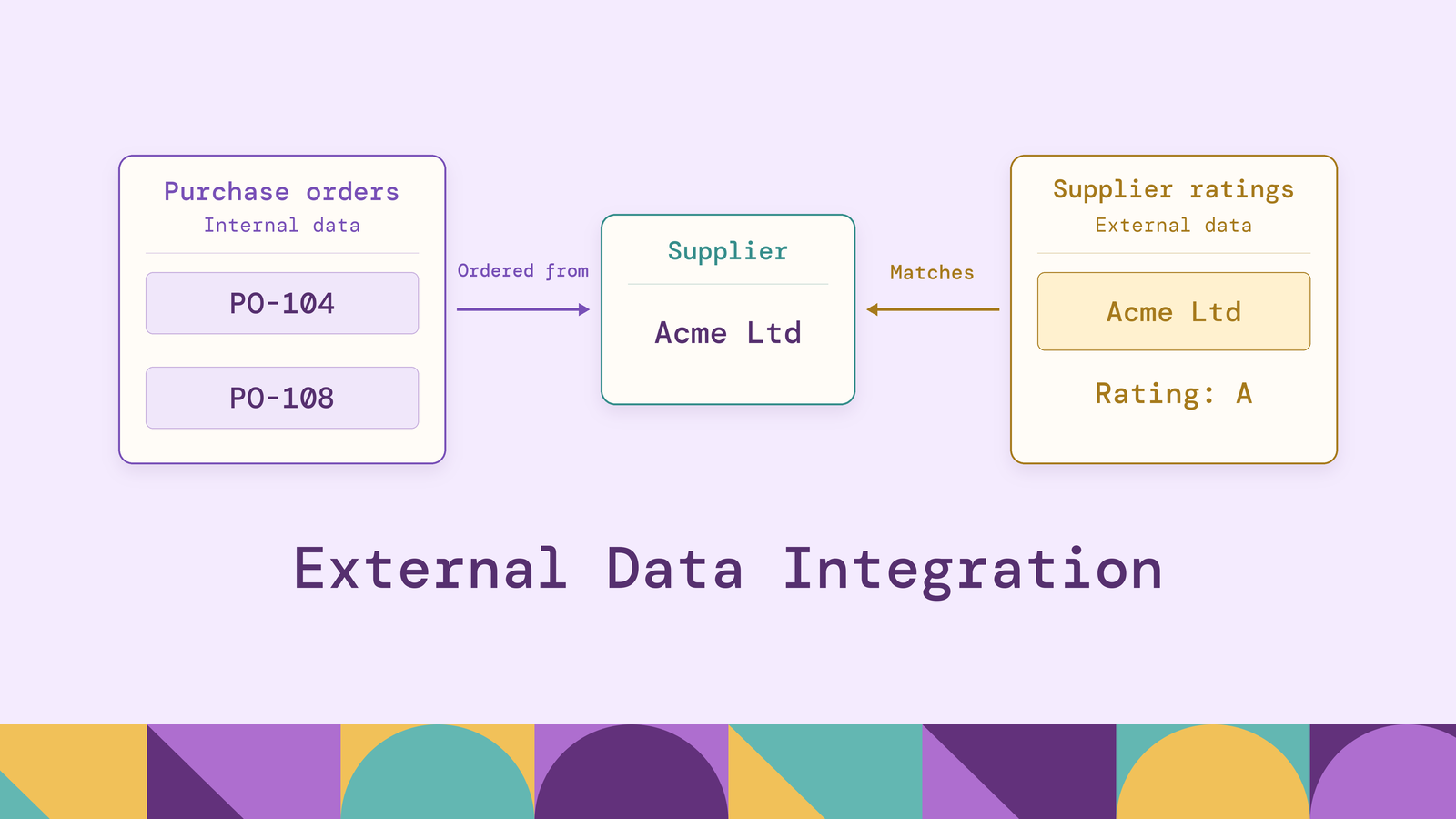
Many of the questions a business most needs answered depend on context it does not produce itself: who ultimately owns a supplier, whether a counterparty appears on a sanctions list, how local demographics track a regional price change, what the weather was at a warehouse on the day deliveries slipped. Getting that context in is usually the easy part. Making it reliable enough to decide on is harder, because the provider sets the schema, the update schedule, the quality, and the terms of use, and your records rarely share a key with theirs.
This guide covers what external data integration is, how it works end to end, the main types of external sources, a reference architecture, the delivery methods from file drops to zero-copy sharing, an implementation plan, and the challenges that decide whether an external dataset pays for itself.
What is external data integration?
External data integration is the process of acquiring data from sources outside an organization, such as public agencies, commercial data providers, partners, and the open web, and combining it with internal data so that both can be queried together. It includes the delivery itself, the validation and standardization that make the data usable, and the matching that links external records to the organization's own customers, suppliers, products, and locations.
The defining property is control. With internal data, the organization owns the source system and can fix a defect where it starts. With external data, someone else decides when the schema changes, when a file arrives, how a field is defined, and what the data may be used for. Every design choice in an external integration either absorbs that loss of control or makes it visible.
That property also settles a common ambiguity. Data from an organization's own SaaS applications, such as a CRM or a billing platform, runs on someone else's infrastructure but describes the organization's own operations, so it is commonly treated as internal data behind an external connector. The tooling overlaps, but third-party data adds licensing, provenance, and matching questions that SaaS data does not. Each external source arrives with terms that limit how long it may be kept, who may see it, and whether derived results can be shared, and those terms have to travel with the data.
How does external data integration work?
Regardless of source or delivery method, an external dataset passes through the same stages on its way to being useful.
Evaluate and acquire. A team identifies the question the data should answer, assesses candidate sources for coverage, history, and update frequency, tests a sample against internal records, and agrees terms. For a public dataset, acquisition may mean accepting a license; for a commercial one, it is a procurement process with a contract that defines permitted use.
Deliver. The provider makes the data available through a file drop, an API, a data share, or a stream. The method sets the freshness ceiling and determines whether the organization holds a copy or queries the provider's copy in place.
Land and record provenance. Each delivery lands as received in a raw zone, tagged with its source, delivery identifier, arrival time, and license. An unchanged raw delivery can be reprocessed when a transformation turns out to be wrong, and shown to an auditor as exactly what the provider sent.
Validate and standardize. Checks confirm that the delivery matches the expected schema, row counts, value ranges, and freshness. Passing data is converted to internal conventions for units, currencies, time zones, codes, and naming.
Match to internal entities. External records are linked to internal ones, through a shared identifier when one exists and through record matching on names and addresses when one does not. The output is a crosswalk table that maps each provider identifier to an internal key.
Serve and monitor. The curated, matched data is published to the warehouse or lakehouse where analysts, applications, and models use it. Monitoring tracks delivery timeliness, quality results, match rates, and usage.
A provider that delivers daily runs this whole chain daily, which is why each stage needs to be automated before a source moves from a pilot to a dependency.
Types of external data sources
External sources differ less in format than in who produces them and on what terms. Five groups cover most of what organizations integrate.
Public and open government data. Statistical agencies, regulators, and international bodies publish economic statistics, company registries, and sanctions lists such as the U.S. Treasury's OFAC Specially Designated Nationals list. The Global Legal Entity Identifier Foundation (GLEIF) publishes Level 2 "who owns whom" data, in which legal entities report their direct and ultimate accounting consolidating parents, and provides its LEI data under the CC0 license. Open data is cheap to acquire but often comes with irregular schedules, revisions to past values, and documentation written for policy readers rather than engineers.
Commercial data providers. Firmographic, credit, market, geospatial, and consumer data is sold under license. This group includes alternative data, such as job postings and satellite imagery. Commercial data is usually better documented than open data, and the contract defines both what the buyer may do with it and what the provider commits to deliver.
Partner and supply-chain data. Suppliers, distributors, and carriers exchange inventory positions, shipment events, and invoices as part of the business relationship. The schema is often negotiated pairwise, so the same kind of data may arrive in a different shape from each partner.
Data marketplaces and exchanges. Marketplaces are a distribution channel rather than a separate type of data, but they change how integration works. Snowflake listings are built on Secure Data Sharing, Databricks Marketplace uses OpenSharing, the protocol Delta Sharing is giving way to, and AWS Data Exchange delivers data sets as files, APIs, or read access to data held in the provider's AWS account.
Web and social data. Prices, reviews, news, and social posts are collected through official APIs, licensed feeds, or scraping. This is the least stable group: page structures change without notice, platform terms restrict collection and reuse, and the data often contains personal information.
The group a source belongs to predicts most of its integration cost. Open data needs the most standardization, commercial data the most contract management, partner data the most per-partner mapping, and web data the most monitoring.
External data integration architecture
A durable architecture separates what the provider sent from what the organization uses, and records the link between the two at every step.
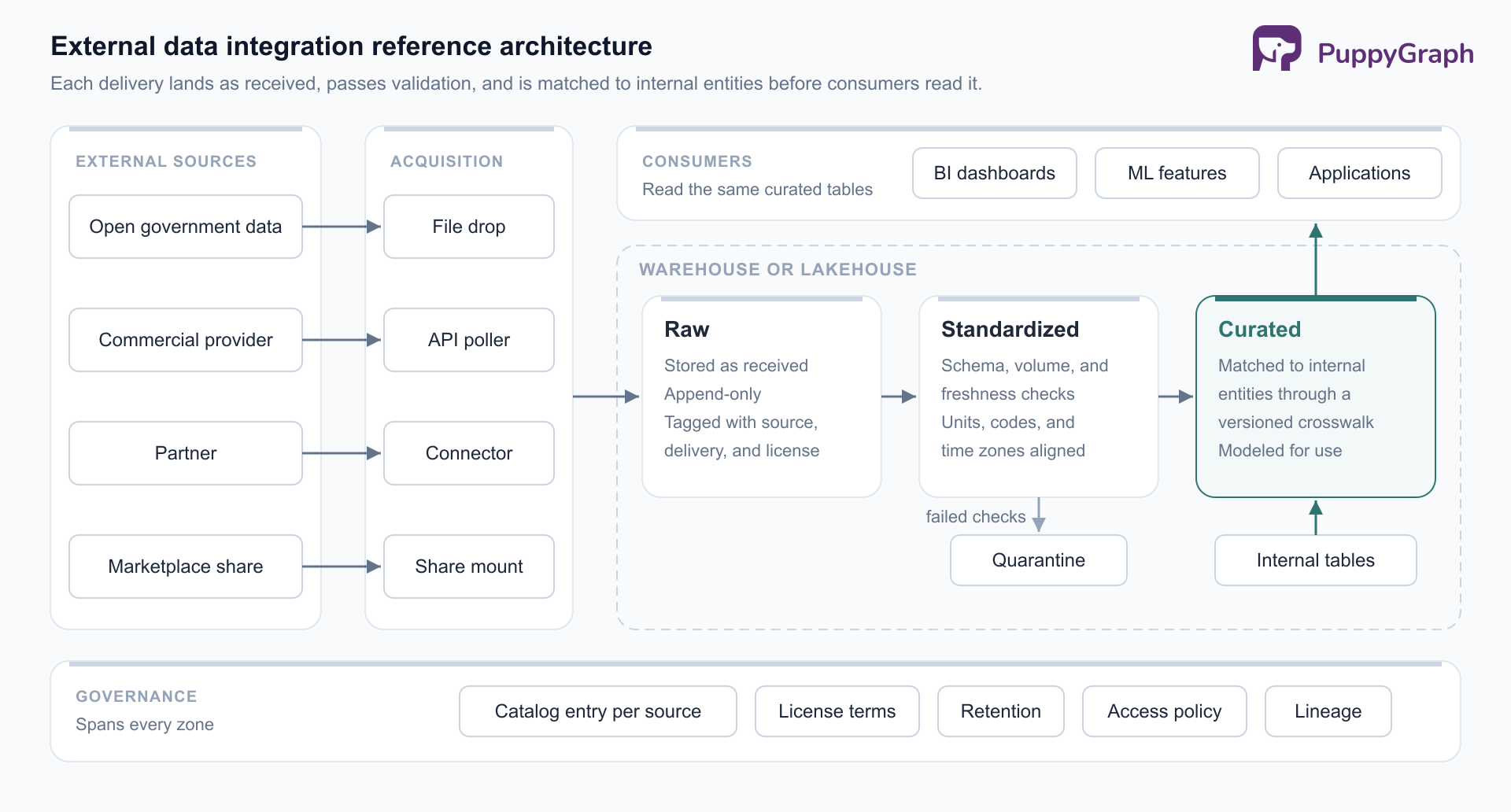
Acquisition layer. Connectors, API pollers, file listeners, and share mounts bring each source in. One job per source keeps failures isolated, so a late file from one provider does not block another.
Raw zone. Deliveries are stored as received, append-only, with provenance metadata attached. When a provider restates historical values, the raw zone preserves both versions, which matters for reproducing a past report or model run.
Standardized zone. Validated data in internal conventions: typed columns, normalized units and codes, consistent time zones, deduplicated records. Deliveries that fail validation go to quarantine, so bad data stops here instead of flowing downstream.
Curated zone. External data joined to internal entities through crosswalk tables and modeled for consumption. Here a provider's company record becomes attributes on the supplier dimension, and a weather observation becomes a feature attached to a store and a date. Crosswalks are versioned tables in their own right, because a matching rule that changes silently can change every downstream number.
Governance band. Each source has a catalog entry recording its owner, license terms, permitted uses, retention period, renewal date, and sensitivity classification. Access policies follow from those terms; a dataset licensed only to the risk team should not be readable by every analyst on the warehouse. Lineage links curated tables back to the deliveries they came from.
The zones are usually separate schemas, catalogs, or table prefixes in one warehouse or lakehouse, and the separation between them is logical: what was delivered, what passed validation, and what has been matched are distinct, queryable states. A source delivered as a share can sit outside that layout: its tables stay in the provider's catalog, validation runs against them where they are, and the crosswalk that matches them to internal keys lives on the internal side.
The curated zone also changes the shape of the data. Once supplier records are matched to LEIs, GLEIF's relationship records link legal entities to their reported direct and ultimate parents, and a sanctions list matched to the same identifiers attaches to the same corporate families. A question such as which active suppliers belong to a corporate family that includes a sanctioned entity walks those links, and in SQL it becomes either a chain of self-joins with the depth fixed in advance or a recursive query.
PuppyGraph answers it as a graph traversal over the tables where they already sit, with suppliers, legal entities, and sanctioned parties as nodes and the crosswalk and parent records as edges. Those tables do not have to share a catalog: one graph schema can draw on several, so a source read from a provider's share stays there while the supplier and crosswalk tables stay in the internal warehouse, and a single query traverses both.
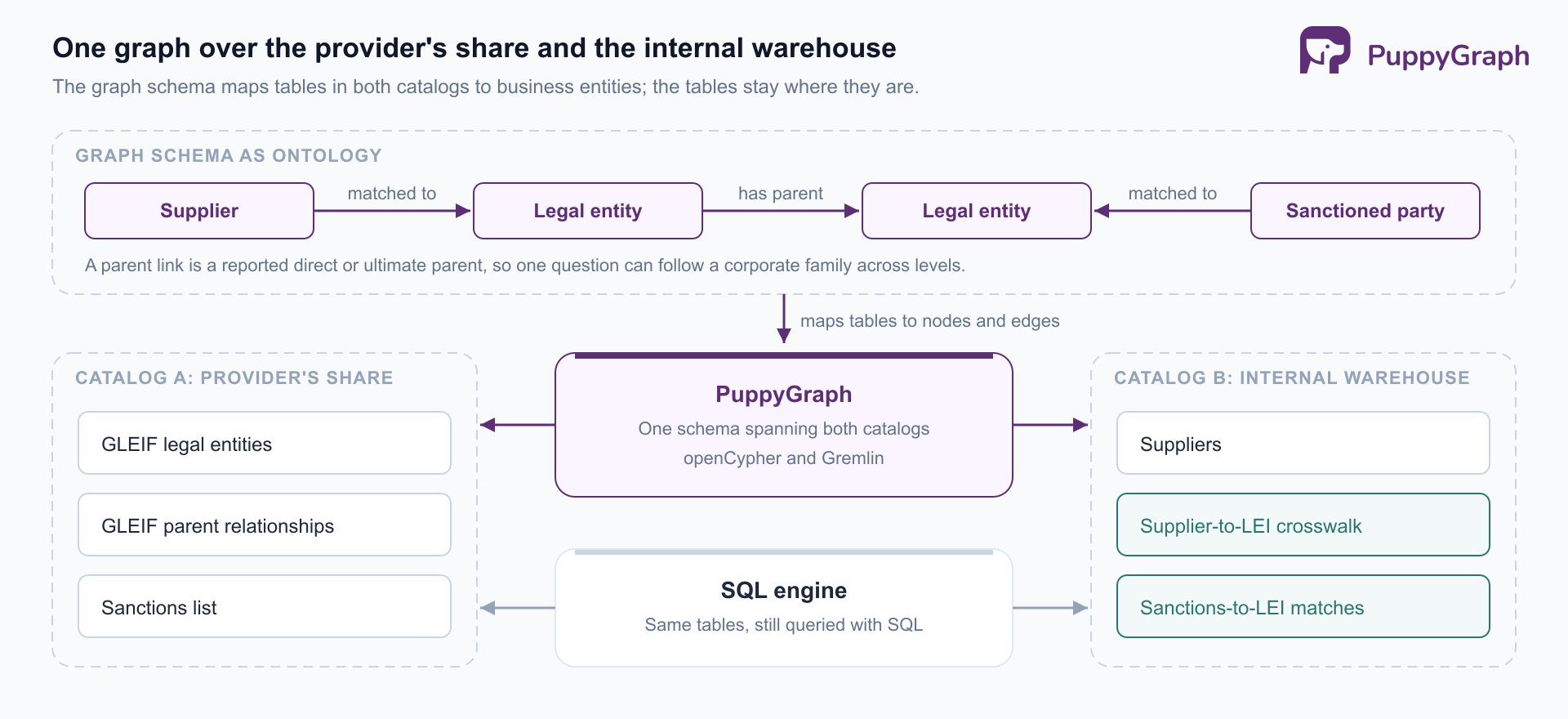
PuppyGraph is a distributed graph query engine that queries tables in place in SQL databases, data warehouses, and data lakes / lakehouses, including direct reads of open table formats like Iceberg and Delta Lake. Users define a graph schema that maps existing tables to nodes and edges, then query with openCypher and Gremlin. There is no ETL into a separate graph database, and the same tables stay queryable with SQL.
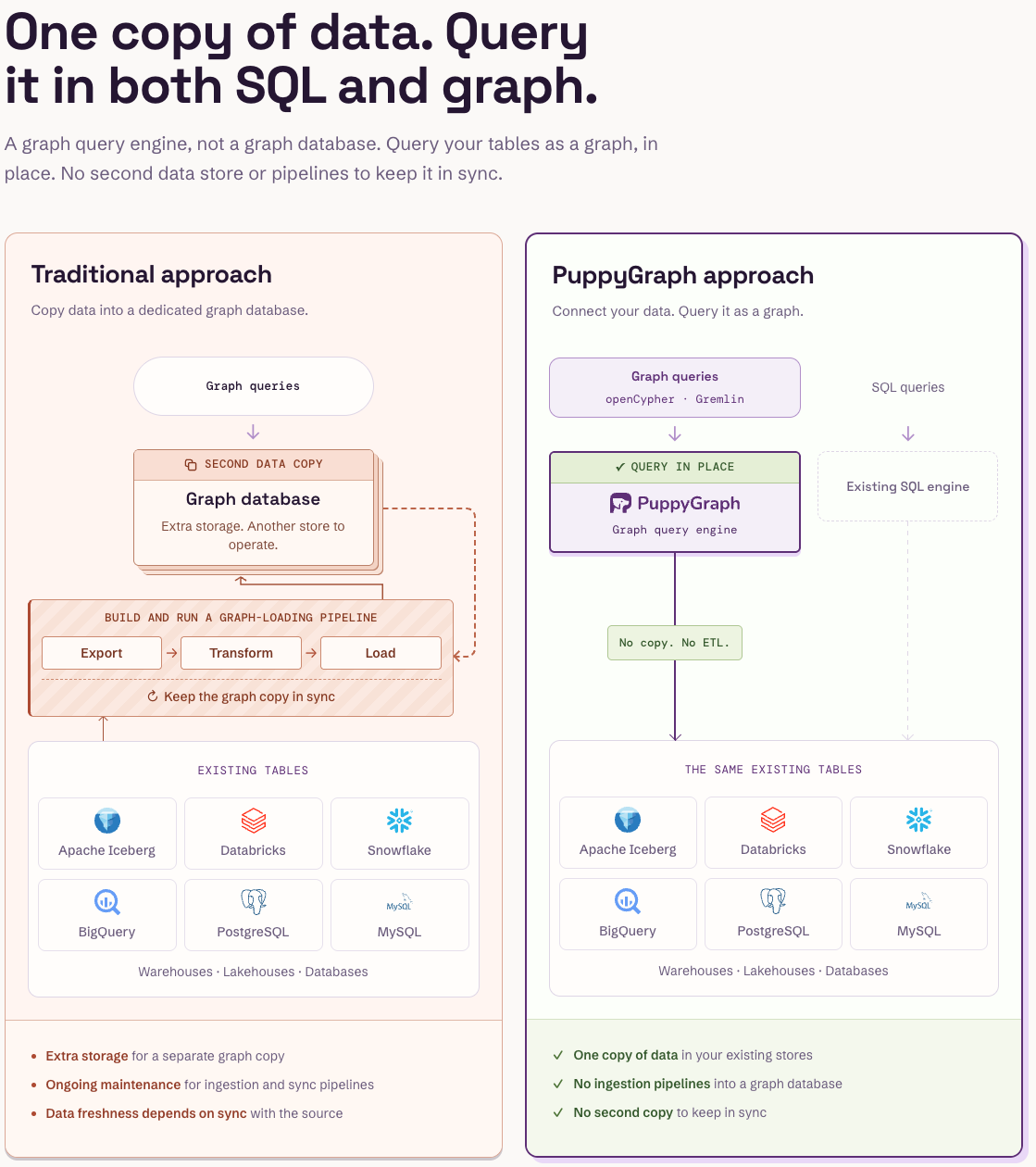
The graph schema also works as an ontology for the integrated data: it names the entities and relationships the business reasons about, such as suppliers, legal entities, parent companies, and sanctioned parties, and maps each one to whichever provider table or crosswalk holds it. The crosswalk reconciles identifiers across sources; the ontology gives the matched result one vocabulary, so a question about corporate families is asked in those terms, and the schema resolves each term to the table that holds it. The built-in AI assistant proposes that model from the connected tables for approval and answers natural-language questions by generating graph queries against it, checking each query against the schema before it runs.

External data integration methods
The delivery method decides whether the organization holds its own copy, how fresh that copy can be, and how much pipeline code someone maintains. Four methods copy data into the organization's environment.
Bulk file delivery. The provider drops files on a schedule into an SFTP server or cloud storage bucket, typically CSV, JSON, XML, or Parquet, often as a full snapshot followed by change files. Files are the most widely supported method and the easiest to reason about, since each one is a discrete, reprocessable unit. The costs are latency, bounded by the schedule, and fragility, since a renamed column or changed delimiter breaks the load. A manifest listing expected files and row counts lets the consumer detect partial deliveries before loading them.
API integration. The consumer calls the provider's API on a schedule to pull changes, or on demand to enrich a single record, such as looking up a company when a new supplier is onboarded. Production integrations handle pagination, incremental cursors, retries with backoff, and rate limits; the HTTP 429 status defined in RFC 6585 signals too many requests and may carry a Retry-After header. APIs give fresher data than files, but per-call pricing and rate limits make them a poor fit for bulk history.
Managed connectors. Managed ELT services and open-source integration platforms ship prebuilt connectors that handle authentication, pagination, and incremental state, and detect schema changes in the source. They remove most pipeline code for well-known APIs and leave the long tail of niche providers to custom work.
Streams and webhooks. Some providers push events as they occur, as carriers often do with shipment updates. Push delivery gives the lowest latency but moves ordering, deduplication, and replay onto the consumer, so it pays off only when the decision it feeds needs that latency.
Two methods leave the data with the provider.
Zero-copy data sharing. The provider grants read access to tables in its own account or storage, and the consumer queries them without an export. Snowflake's Secure Data Sharing documentation states that "no actual data is copied or transferred between accounts" and that shared objects are read-only. Delta Sharing is an open REST protocol that serves shared tables from cloud object storage, so the recipient does not need to run the provider's platform. Sharing removes the delivery pipeline and, within a region, stays as current as the provider's tables; Snowflake's cross-region sharing runs on replication, so a consumer in another region can lag. The costs are dependence on the provider's availability and on both sides supporting the mechanism.
Federation and external tables. A query engine reads the data where it is stored, at query time: a federated SQL engine connected to a partner's database, or a warehouse external table over files in a provider's bucket. Federation suits occasional access and lets a team test a source before copying it; sustained query load usually justifies a local or shared copy, because every federated query depends on the remote system. The trade-off between replicated and in-place access is covered in more depth in what zero-ETL means.
Most programs mix methods: a commercial dataset as a share, a regulator's list as a daily file, a partner's events as webhooks. The architecture above keeps that mix manageable, because every method ends in the same zones with the same provenance tags.
How to implement external data integration
Start with one decision and one source, then generalize once the first source runs reliably.
1. Start from a decision, not a dataset. Name the decision the external data will change, such as supplier risk tiering, credit limits, site selection, or a demand forecast, and the internal records it attaches to. A source that cannot be tied to a decision is hard to justify at renewal.
2. Evaluate sources against your own data. Ask each candidate for a sample covering your entities, then measure the match rate against internal records, field completeness, and agreement with values you know to be true. A provider's headline coverage figure describes its universe; your match rate describes its value to you.
3. Read the license as a technical requirement. Record permitted uses and user groups, redistribution of raw and derived data, retention after the contract ends, and attribution. These terms become access policies, retention jobs, and catalog metadata, so capture them before the first delivery lands.
4. Choose the delivery method per source. Match the method to the freshness the decision needs and what the provider supports. Prefer a share when the platforms line up, files when history and reprocessing matter most, and APIs for record-level enrichment.
5. Build the zones and checks. Land deliveries raw with provenance, validate against an agreed schema and expected volumes, quarantine failures, and standardize what passes. Where the provider agrees, write the schema and schedule into a data contract so that changes are announced rather than discovered.
6. Build and measure the crosswalk. Link external identifiers to internal keys, starting with exact matches on shared identifiers and adding record matching for the rest. Track match rate as a metric, review low-confidence matches by hand, and version the crosswalk. Matching overlaps heavily with master data management, and an existing MDM hub is often the right anchor for it.
7. Assign ownership and monitor. Give each source a named owner for the provider relationship, quality issues, and renewal. Monitor timeliness, validation results, match rate, and query usage, and review unused sources before their contracts renew.
The second source goes faster than the first, because the zones, checks, catalog conventions, and monitoring already exist; what remains per source is evaluation, mapping, and matching.
External data integration challenges
The challenges split into technical problems caused by losing control of the source, and commercial and legal problems caused by the contract boundary. Four are technical.
Schema and format drift. Providers add columns, rename fields, and change enumerations, often without notice. Schema validation at the raw-to-standardized boundary turns drift from a silent data issue into a visible failure.
Quality you cannot fix at the source. When an external record is wrong, the organization can report it and wait. Providers also restate history as better information arrives. Each integration needs a policy on local overrides that survive the next delivery, and on whether reports use values as first delivered or as restated.
Entity matching. Shared identifiers such as the LEI help, but coverage is incomplete, so name-and-address matching fills the gap with a confidence on every match. Match errors are quiet: a false match attaches the wrong company's risk score to a supplier, and a missed match leaves it unscored.
Freshness and availability. A late or missing delivery leaves downstream tables stale without raising an error. Freshness checks with expected arrival windows catch it. Shared and federated tables also depend on the provider's uptime.
Three are commercial and legal.
Licensing and usage rights. License terms on use, redistribution, and deletion apply to every copy and derived table, so they belong in the catalog and access policies, not only in a contract repository.
Privacy obligations. Under the EU's GDPR, Article 14 sets out the information a controller must provide when personal data was not obtained from the data subject, in most cases within a reasonable period and at the latest within one month. Classifying incoming fields, minimizing what is kept, and recording each source's legal basis need to be part of the design.
Cost and value. External data is often bought by one team, used by another, and renewed by default. Usage tracking tied to the decision each source serves turns renewal into a measured choice.
Most of these share a remedy: treat each external source as a managed product, with an owner, a contract, explicit expectations, and monitoring that compares every delivery against them.
Conclusion
External data integration extends what an organization knows about the entities it deals with, but only to the extent that external records are validated, matched to internal ones, and governed by the terms they arrived under. The delivery method matters less over time than the structure around it: a raw zone that preserves what was delivered, checks that catch drift and gaps, a crosswalk that links external identifiers to internal keys, and a catalog that carries license terms into access policy. With that structure in place, each new source adds only its own evaluation, mapping, and matching, and matched external data such as ownership hierarchies and partner networks becomes a connected model of the business's wider environment.
Try the forever-free PuppyGraph Developer Edition and book a demo with the team to see how openCypher and Gremlin queries traverse warehouse and lakehouse tables, with no graph-specific ETL, so relationships in matched external data can be followed across the same tables every other workload reads.

Sa Wang is a Software Engineer with exceptional mathematical ability and strong coding skills. He holds a Bachelor's degree in Computer Science and a Master's degree in Philosophy from Fudan University, where he specialized in Mathematical Logic.


