

What Is Master Data Management (MDM)?
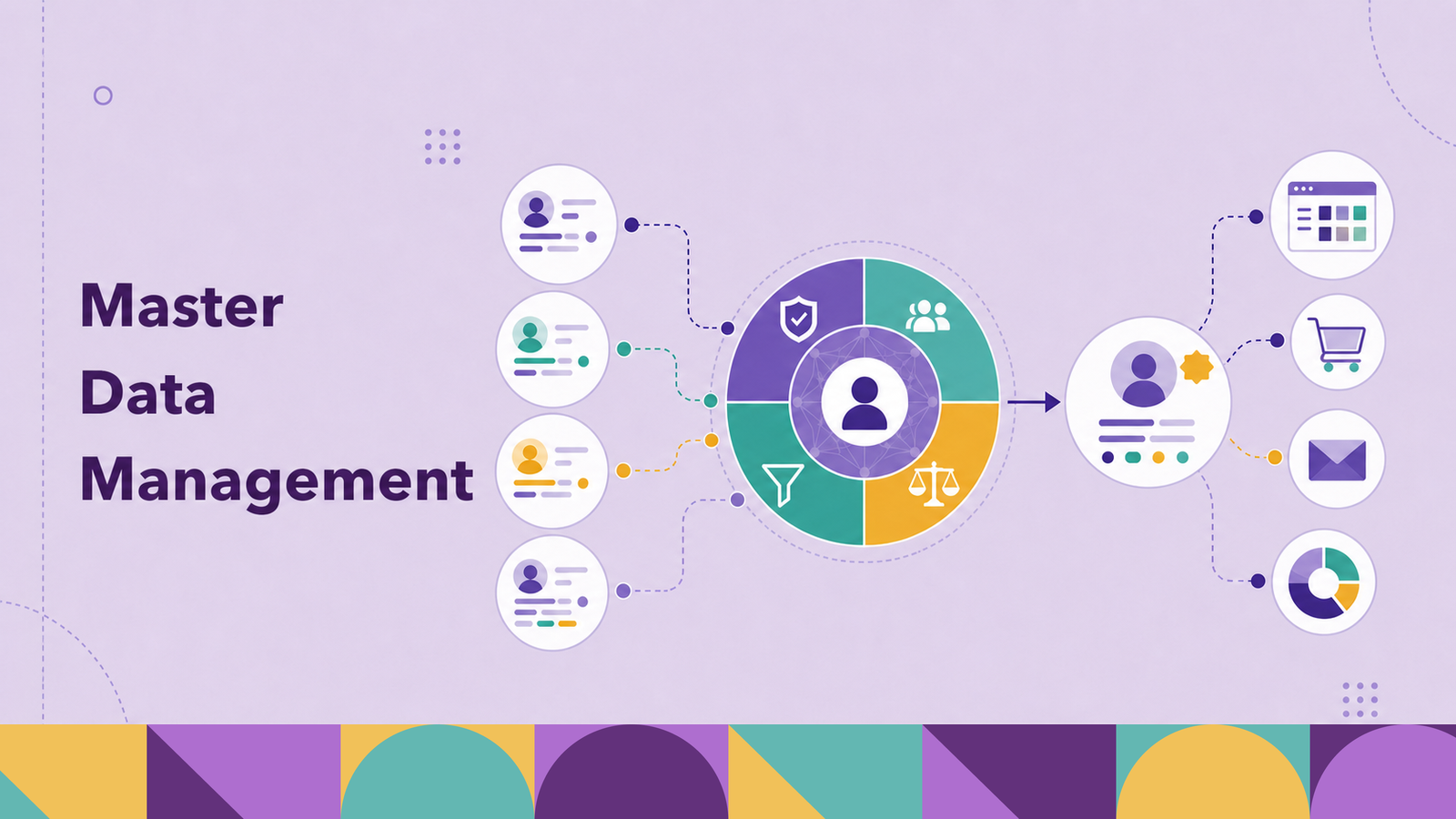
Master data management has been on enterprise data agendas for two decades, but its role in the stack is shifting. Every operational system in a large business quietly maintains its own version of the same core entities: the CRM has one record for a customer, billing has another, support has a third, and a spreadsheet in a regional office has a fourth. Reconciling those records has always mattered for BI, compliance, and operational integration; AI systems reasoning about enterprise entities now need the same authoritative view, and that pulls MDM from a background layer into the load-bearing one for any enterprise AI initiative.
This post defines master data and MDM, walks through how a golden record is produced, and covers architecture, features, implementation, benefits, AI, examples, and the leading tools.
What is master data management (MDM)?
Enterprise data usually falls into three categories.
Master data is the set of business entities that multiple processes and systems refer to over and over: customers, products, employees, suppliers, locations, accounts, assets. These are the nouns of the business, changing slowly, shared widely, and their identity matters across every system that touches them.
Transaction data captures the verbs: orders placed, invoices issued, tickets logged, shipments dispatched. Each transaction points at master data but is meaningful only in the context of the master records it refers to.
Reference data is the small, controlled vocabularies used to categorize the above: country codes, currency codes, status enumerations, industry classifications. Often managed alongside master data because the same governance discipline applies.
Master data management is the combination of processes, governance, and technology that produces authoritative records for master data entities and keeps them consistent everywhere they are used. Its central artifact is the golden record: a single, best-available representation of an entity, assembled from the most reliable fields across every source. The goal is not to force every system onto one database, but to guarantee that when any system asks “who is customer 123?” or “which SKU is this?”, the answer is the same and it is right.
MDM programs are as much organizational as technical. Data stewards own each domain, arbitrate conflicts, and tune matching and survivorship rules over time. Tooling without stewardship rarely survives the first ambiguous match; governance without tooling drowns in reconciliation work.
How master data management works
An MDM system is a pipeline that takes overlapping records from many source systems, produces one clean record per real-world entity, and makes that record available to every consumer that needs it.
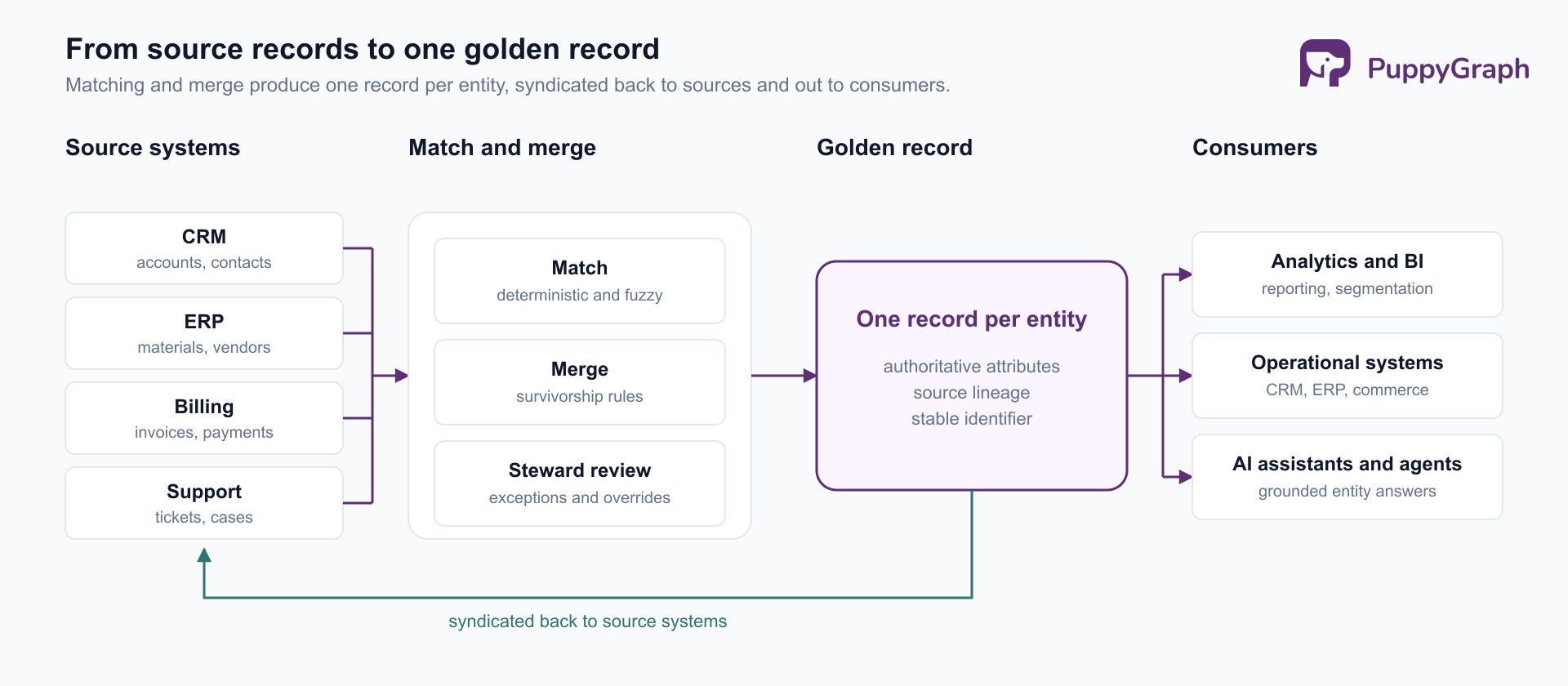
Ingest and standardize. Records arrive through batch loads, change data capture streams, or direct API calls. An early job maps incoming fields onto the canonical model and normalizes addresses, phone numbers, names, and reference values so later matching sees comparable strings.
Match and resolve entities. The system decides which incoming records refer to the same real-world entity. Deterministic rules handle the obvious cases (identical tax IDs, exact email matches); probabilistic or machine-learned matching handles the rest, scoring pairs on many attributes at once. Borderline cases go to a steward rather than being auto-merged.
Merge with survivorship rules. For each cluster of matched records, survivorship rules decide which field value wins: trust-based (a source is authoritative for a specific field), recency-based, or completeness-based. The output is the golden record: one row per entity, sourced from wherever each field is most reliable, with links back to every contributing source.
Publish and syndicate. The golden record is stored in the hub and pushed back out: source systems receive updates so local copies converge; analytics platforms consume it as the reference dataset joined against transaction data; AI consumers query it through an API or semantic layer.
Steward and tune. Stewards review low-confidence matches, resolve conflicts the rules could not, and tune the rules based on what the review queue surfaces. Matching and survivorship are living configuration.
The hub itself takes one of four shapes, and the choice sets how invasive the rollout is on source systems. Registry stores only cross-references and computes the golden record on demand: least invasive, every query pays a federation cost. Consolidation materializes golden records for analytics but does not push updates back, leaving operational inconsistency in place. Coexistence materializes golden records and syndicates them back so source copies converge; typically the style organizations grow into as a multi-domain program matures. Centralized (transaction hub) makes the hub the system of record and has source systems write to it directly: highest consistency, largest integration effort.
The pipeline is largely industry-standard across products; the hub shape is the choice that locks in how much operational change source systems have to absorb and, with it, how far the program can expand from its first domain.
Types of master data
Not every organization manages every domain, but the ones below recur across MDM programs.
Customer or party data. People and organizations the business sells to, partners with, or supports, along with the hierarchies they belong to (a subsidiary rolls up to a parent). Usually the first domain a program tackles, because customer 360 is a common driver and reconciliation pain shows up earliest here.
Product data. Items the business makes, sells, or resources: SKUs, materials, service offerings, and their category hierarchies. Closely related to product information management (PIM), which extends it with commerce content like descriptions, images, and marketing attributes.
Location and address data. Physical places the business operates in or ships to: sites, stores, warehouses, service territories. Overlaps heavily with address cleansing, since usefulness depends on being reconcilable with real-world postal data.
Employee and supplier data. Employees are typically mastered against HR as the system of record, reconciled with the identity, access, and finance systems that also carry employee references. Suppliers cover external parties the business buys from; supplier MDM often carries risk and compliance responsibilities (sanctions screening, third-party risk) that customer MDM does not.
Most programs start with the domain that produces the most business pain, usually customer or product, and add others as the platform proves itself. Asset-heavy industries add asset and financial reference data (equipment, network elements, chart of accounts, legal-entity hierarchies) when reporting and close pressure justify it.
Essential features to look for in an MDM platform
A platform can meet the definition of MDM and still be a poor fit if it lacks the features the program depends on. The capabilities below are the ones evaluations should insist on.
Flexible multi-domain modeling. The ability to model any master data domain, along with the hierarchies (org rollups, product categories, geography) and cross-entity relationships (household to member, account to contact, product to supplier) the domain needs. Prebuilt customer or product templates accelerate the first rollout but constrain the second and third.
Matching, survivorship, and data quality. Both deterministic and probabilistic or machine-learned matching, tunable thresholds, review queues, configurable survivorship rules, and an unmerge path. Native or tightly integrated cleansing, address validation, and reference enforcement applied to every record entering the hub. Match quality sets the ceiling on golden-record quality.
Stewardship workflows and lineage. Interfaces for stewards to review matches, resolve conflicts, and edit records with an audit trail, plus field-level lineage from every golden-record value back to its source records. Lineage is prerequisite for compliance investigations and rule tuning.
Integration, deployment, and query surface. Connectors for source systems, message queues, change data capture, and outbound APIs; cloud, on-premises, or hybrid deployment; and a query surface (REST, GraphQL, streaming, or a semantic layer) rich enough for downstream analytics and increasingly for AI consumers. Thin integration surfaces force custom glue that later has to be maintained, and a thin CRUD API becomes a bottleneck once agents are among the callers.
Security and privacy. Field-level access controls, masking for sensitive attributes, and support for the regulatory regimes that apply to master data (GDPR, HIPAA, sector-specific rules).
A platform’s real ceiling for downstream consumers, operational, analytical, and AI, is set less by any single feature and more by how the stewardship experience, integration surface, and query API compose. A datasheet with strong per-feature bullets can still hide a platform that will bottleneck once the golden record has more than one class of consumer.
Master data management implementation process
MDM rollouts fail more often from scope and sequencing mistakes than from technology choice. The stages below reflect the ordering successful programs converge on.
1. Scope and business case. Identify the domain (usually one, occasionally two) where inconsistent master data hurts the most, and quantify the pain: revenue leakage, compliance risk, analytics rework, integration cost.
2. Architecture selection. Choose the hub style (registry, consolidation, coexistence, or centralized) that fits the pain and the source-system reality. A registry goes live quickly but caps downstream consistency; a centralized hub demands operational change source systems may not be ready for.
3. Model, profile, and design rules. Define the canonical entity, its attributes, identifiers, and relationships. Load source data, measure completeness and duplication per attribute, and use the results as the evidence base for matching thresholds and field-level survivorship rules. The rules themselves are configuration that keeps being tuned as the review queue reveals patterns.
4. Stewardship setup. Assign stewards, define the workflows they use (queue triage, merge and unmerge, exception review), and integrate their tooling into the platform. A steward-facing experience the team actually likes correlates strongly with data quality over time.
5. Load, reconcile, publish. Bring source data in, run matching and survivorship, produce initial golden records, resolve exceptions, and start publishing to the agreed consumers. Treat the first cycle as a staged rollout, not a big-bang cutover.
6. Iterate and expand. Measure match quality, steward workload, and downstream consumer satisfaction. Tune rules, add sources, and only then add the next domain. A second domain before the first is stable multiplies operational surface faster than value.
The pattern across successful programs is narrow start, honest measurement, gradual expansion.
Benefits of implementing master data management
The benefits of MDM are cumulative, compounding as more consumers depend on the golden record.
Consistent analytics and reporting. Dashboards, KPIs, and executive reports stop diverging between systems, because they share the same master reference. Reconciliation meetings that consumed analyst hours become unnecessary once the underlying identity questions are resolved.
Operational efficiency. Teams stop maintaining shadow spreadsheets to reconcile what the systems tell them. Processes that depended on manual matching (invoice reconciliation, credit checks, account merges, M&A integration) run cleanly against the golden record.
Regulatory compliance. Know-your-customer, anti-money-laundering, GDPR, and sector-specific regimes require an authoritative view of the entities the business handles. MDM produces the evidence and lineage those regimes ask for without a compliance-only side database that would itself be a liability.
Better customer and partner experience. Customers stop being asked the same questions across channels. Partners and suppliers deal with a consistent counterparty, not a fragmented one.
AI and agent readiness. Language models, retrieval pipelines, and autonomous agents need entity identity to produce grounded answers. A customer 360 assembled by MDM is the same customer 360 an agent needs to answer “what did this customer buy last quarter?” without hallucinating a plausible-sounding wrong record. New enough to deserve its own section below.
None of these is a headline on its own. Together they explain why MDM keeps returning to the top of enterprise data agendas.
Role of AI in master data management
The AI conversation runs both ways: AI is changing how MDM systems do their internal work, and MDM is becoming a prerequisite for AI systems reasoning about enterprise entities.
AI inside MDM. Probabilistic matching has been part of MDM for decades, and machine-learned matching has extended it over the past several years, with the recent AI wave now expanding the surface further. Language models extract structured entity attributes from unstructured sources (contracts, emails, notes) that used to require manual entry. Anomaly detection flags golden records whose attribute combinations look implausible against historical distribution. Suggestive stewardship interfaces propose merges and survivorship choices for a steward to accept or reject.
MDM as the ground truth AI needs. A model or agent answering questions about enterprise entities has to know which record represents which entity, which fields are authoritative, and how one entity relates to another. Without that structure, “who is our top account in the Northeast?” depends on which system the agent queried. Retrieval pipelines benefit similarly: embeddings anchored to consistent entity identifiers avoid the classic failure where the same customer surfaces as three unrelated hits under three spellings of a name.
Ontology and semantic queries. Both directions point at the same shift. AI consumers of enterprise data need to ask questions in the domain’s vocabulary of entities and relationships, not in the vocabulary of source tables and joins. That is the semantic layer’s job, and MDM is one of the places it naturally lives, since it already models the domain’s entities and relationships. When that model is exposed as an enforced ontology, invalid entity or relationship references are rejected at query time with domain-language feedback, so an agent that made a wrong reference can correct itself instead of hallucinating past the error.
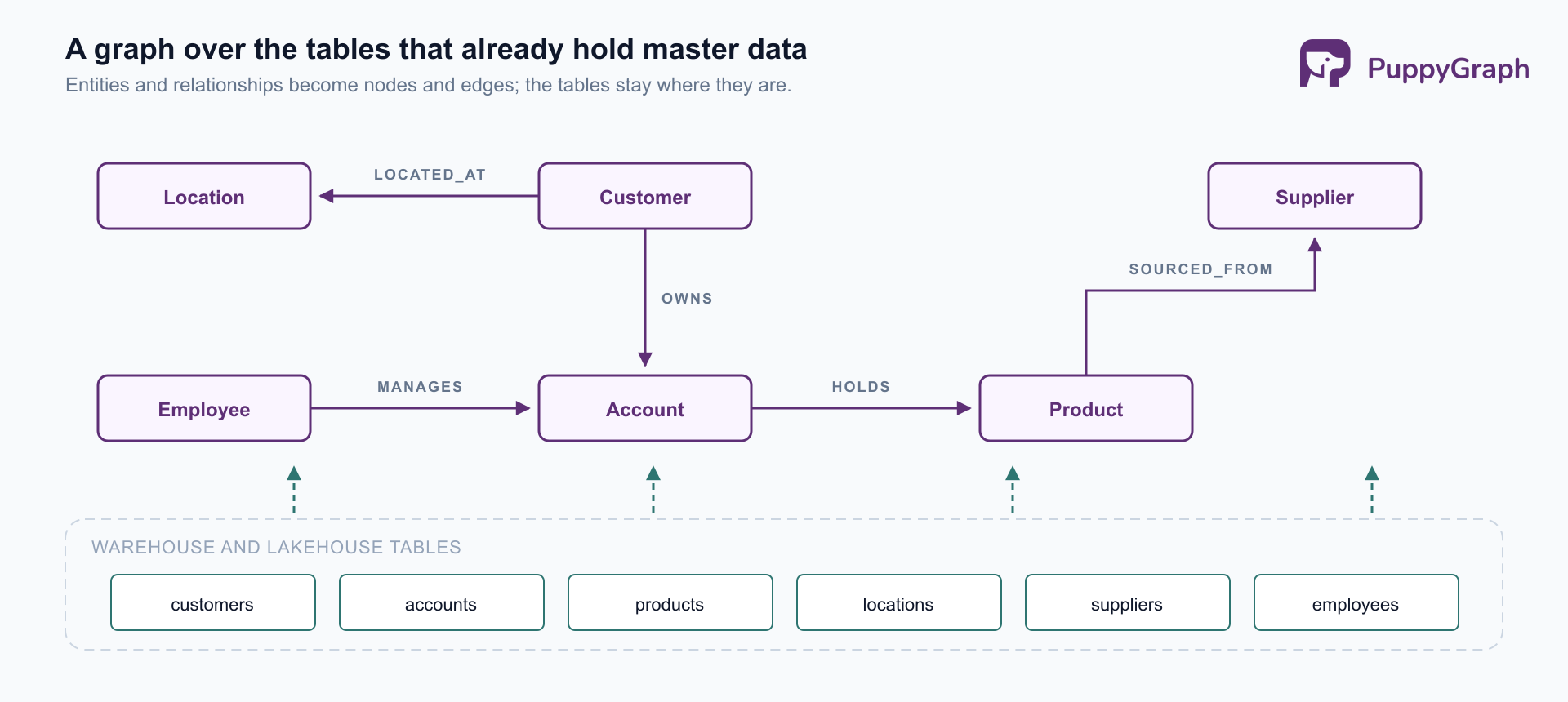
Where the ontology lives. An ontology of entities and relationships is a graph by shape: a customer owns accounts, an account holds products, a product rolls up to a category, a supplier serves a set of locations. The open question is where that graph lives. Defining it over the tables where the master data already sits keeps the model next to the golden record rather than one copy removed from it, and lets queries traverse those relationships in the business’s own vocabulary. PuppyGraph works this way: users define a graph schema over existing warehouse or lakehouse tables, including direct reads of open table formats like Iceberg and Delta Lake, and the engine compiles graph queries into a plan of node and edge operators that runs inside its own distributed engine, with no graph-specific ETL. In an MDM context it is a query and ontology layer, not a replacement for the hub, turning the entities and relationships a golden-record program curates into a graph an AI assistant or agent can query in the domain’s own vocabulary.
The two directions reinforce each other: AI makes the internal work of matching and stewardship faster, and MDM makes AI’s answers about enterprise entities defensible. Either direction on its own is a moderate improvement; together they are the reason MDM is showing up in AI roadmaps that would have skipped it a year ago.
Master data management examples
The domains and features become concrete in an industry context. The examples below are the shapes MDM most often takes.
Retail and consumer goods. Retailers run MDM on customer and product simultaneously. Customer MDM produces a single view of a shopper across store, e-commerce, mobile, and loyalty, enabling personalization and lifetime-value analysis. Product MDM, often paired with PIM, produces one catalog with consistent attributes across every sales channel.
Banking and financial services. Single-customer-view programs are the archetypal MDM use case in banking, driven by regulatory demand (know-your-customer, anti-money-laundering) and the operational need to see a customer’s full relationship across retail, wealth, commercial, and credit products. Legal-entity reference data (LEI) and counterparty hierarchies are additional domains banks manage under the same discipline.
Healthcare. Patient identity resolution, often called enterprise master patient index (EMPI), matches patients across electronic health records, claims, imaging, and lab systems. The consequences of getting it wrong are clinical rather than operational, so matching thresholds, stewardship workflows, and audit trails carry more weight than elsewhere.
Manufacturing. Product and material master data underpin bill-of-materials accuracy, supplier consistency, and defect traceability across plants. Manufacturers often run MDM as part of a broader product lifecycle management strategy across engineering, procurement, and production.
Insurance. Policyholder identity resolution is the equivalent of banking’s single-customer view, extended by the need to link policyholders to claims, beneficiaries, brokers, and reinsured contracts. A long tail of legacy administration systems carrying decades of policy history makes reconciling heterogeneous sources especially valuable.
The pattern is the same across industries: identify the entity whose fragmentation hurts most, produce a golden record for it, and let downstream consumers, operational, analytical, and now agentic, use that record instead of inventing their own.
Top MDM tools
The MDM market is mature, with an established set of vendors and a healthy layer of newer entrants targeting cloud-native and mid-market segments. The platforms below recur most often in enterprise evaluations, described at the architectural and licensing level since feature specs change release by release. They fall into two rough groups: the enterprise incumbents that anchor large multi-domain estates where connector breadth and existing tooling relationships dominate selection, and the cloud-native, mid-market, and converged platforms that optimize for time to value or for managing MDM alongside adjacent disciplines.
The enterprise incumbents are the default shortlist for large multi-domain programs.
Informatica MDM. An established enterprise MDM platform, acquired by Salesforce in 2025 and still shipped under the Informatica brand. Available on-premises and as cloud (Intelligent Data Management Cloud), multi-domain, with a broad connector and data-quality ecosystem.
IBM Master Data Management. IBM’s cloud-native MDM offering, evolved from Match 360 and rooted in the InfoSphere MDM portfolio. It fits best in environments already standardized on IBM’s data and AI stack, especially Cloud Pak for Data and data fabric-oriented architectures.
SAP Master Data Governance. SAP-native MDM, tightly integrated with S/4HANA and the SAP application landscape. Most compelling when operational systems are SAP-heavy.
Stibo Systems (STEP). Multi-domain MDM with strong roots in product and PIM, common in retail, manufacturing, and consumer goods. Suited to programs where product master data is the anchor domain.
The cloud-native, mid-market, and converged platforms compete on time to value, lighter operational footprint, or coverage of adjacent disciplines (data quality, catalog, integration).
Reltio. Cloud-native, SaaS multi-domain MDM that uses a graph model internally to represent entities and relationships. Popular in customer-domain programs that want fast time to value without on-premises infrastructure.
Profisee. Multi-domain MDM with tight integration into the Microsoft data stack, often selected by organizations standardizing on Azure and SQL Server.
Semarchy Data Platform. Unified platform combining MDM (the xDM component), data quality, and data integration. Friendlier to mid-market and mid-scope programs than the top-tier enterprise suites.
Ataccama ONE. Converged data-quality, catalog, and MDM platform, for organizations that want the three disciplines managed together rather than as separate tools.
Selection rarely comes down to one product being globally superior. The dominant factors are the platforms the business already runs, the scope of the domains in play, and whether the program wants a large enterprise implementation or a lighter tool to grow into.
Conclusion
Master data management is the discipline of producing one trusted answer to a small set of questions the whole business keeps asking: who is this customer, which product is this, where is this location, who is this supplier. The stack around it has changed repeatedly, from mainframe reference registries to on-premises hubs to cloud-native platforms, but the underlying job has not. What has changed is the audience: analytics, operational integration, and compliance are now joined by AI systems needing the same authoritative entity view to produce grounded answers. Programs that treat MDM as background plumbing usually find it becomes the difference between an AI initiative that lands and one that hallucinates into a project post-mortem.
Try the forever-free PuppyGraph Developer Edition and book a demo with the team to see how openCypher and Gremlin queries run over warehouse and lakehouse tables, with no graph-specific ETL, so the master data those tables already hold becomes an ontology-enforced graph an AI agent can query in the domain’s own vocabulary.

Hao Wu is a Software Engineer with a strong foundation in computer science and algorithms. He earned his Bachelor’s degree in Computer Science from Fudan University and a Master’s degree from George Washington University, where he focused on graph databases.


