

Enterprise Data Governance: Framework, Best Practices & AI
Data governance used to be the program a company started after an audit and quietly defunded two budget cycles later. AI ended that arrangement. Gartner predicts that by 2027, 60% of organizations will fail to realize the anticipated value of their AI use cases because their governance frameworks are incohesive. When the consumers of data were human analysts, gaps in ownership, quality, and access control surfaced slowly, as arguments over dashboards. When the consumers are models and agents acting at machine speed, the same gaps surface as wrong answers delivered confidently, at scale, to people who have no way to check them.
This guide covers what enterprise data governance is, why it has become a production dependency rather than a compliance exercise, the principles and framework components that make a program work, who does what, how governance underwrites AI and generative AI initiatives, and the challenges, scaling practices, and metrics that determine whether the program survives contact with the organization.
Understanding enterprise data governance
Enterprise data governance is the system of decision rights, policies, standards, and controls that determines how an organization’s data is defined, produced, secured, used, and retired. The word enterprise is doing real work in that definition: the scope is the whole data estate, spanning business domains, warehouses, lakes, operational systems, and the SaaS tools that quietly accumulate customer records. A governance program that covers one platform while the rest of the estate stays ungoverned is a local policy, not enterprise governance.
Governance is distinct from data management, and the distinction matters in practice. Governance decides: who owns the customer table, what quality bar it must meet, who may join it against payroll data, how long it is retained. Data management executes those decisions in pipelines, catalogs, and access systems. The DAMA-DMBOK, the discipline’s standard reference, frames governance as the authority and control function that sits at the center of the other data management functions and coordinates them. When organizations conflate the two, they typically buy a catalog, call it governance, and discover a year later that tooling without decision rights changes nothing.
The working scope of a governance program covers five recurring concerns: data quality (is it accurate, complete, and current), metadata (what does it mean and where is it), access and security (who can see and change it), lineage (where did it come from and what downstream depends on it), and lifecycle (when is it archived or deleted). Everything else in this article, from roles to metrics, is machinery for making decisions about those five concerns and making the decisions stick.
Why enterprise data governance matters
The case for governance has always rested on risk, but the risks have compounded and priced themselves.
Regulatory exposure is broad and still expanding. GDPR set the template, with fines reaching 4% of worldwide annual turnover for the most serious violations, and CCPA and its successors extended the pattern across jurisdictions. The EU AI Act pushes scrutiny one layer down: it regulates not just personal data handling but the data feeding AI systems, with obligations phasing in through 2028. An organization that cannot say where its training data came from will struggle to demonstrate compliance no matter how good its intentions are.
Breaches price the absence of control. IBM’s Cost of a Data Breach Report 2025 puts the global average breach cost at $4.44 million. Access governance is a direct input to that number: knowing what sensitive data exists, where it lives, and who can reach it is the difference between a contained incident and a disclosure that spans systems nobody had mapped.
Ungoverned data taxes every decision. The quieter cost is internal. When two dashboards disagree, someone reconciles them by hand; when a definition of active customer varies by team, every cross-team analysis begins with a negotiation; when nobody owns a dataset, everyone re-verifies it before trusting it. These costs never appear on an invoice, which is why they persist.
AI converts data debt into visible failure. A human analyst who receives a suspicious number pauses and asks around. A model does not. Whatever ambiguity, staleness, or bias exists in the data estate flows into training runs, retrieval pipelines, and agent behavior, and surfaces as output that is wrong in ways that are expensive to even detect. This is the mechanism behind the Gartner prediction cited above: the failing ingredient is data governed to a human standard being consumed at a machine standard.
The common thread is that governance has become the precondition for the offensive uses of data, analytics and AI, that the organization is actually funding.
Core principles of enterprise data governance
Programs differ in structure but converge on a small set of principles. A framework document that contradicts any of these tends to fail predictably.
Accountability is assigned, not assumed. Every governed dataset has a named owner with authority over its definition, quality bar, and access policy. Ownership by committee, or by a team that dissolved two reorgs ago, is the most common form of governance failure and the easiest to detect: ask who can approve a schema change and count how many people answer.
Transparency over tribal knowledge. Definitions, policies, and data locations are documented and discoverable, not carried in the heads of senior engineers. The test is whether a new hire, or an AI agent, can find out what a table means and whether they may use it without asking a person.
Quality is enforced at the source. Governance pushes validation, deduplication, and standardization to the point of production, where a fix propagates to every consumer at once rather than being repeated downstream, one consuming pipeline or dashboard at a time.
Access follows least privilege. People and systems get the narrowest access that lets them do their jobs, granted by role or attribute rather than by individual exception, and reviewed on a schedule. Standing broad access is how a minor compromise becomes a major one.
Everything auditable, across the lifecycle. From creation to deletion, changes to data, definitions, and permissions leave a trail. Auditability is what turns the other principles from aspirations into verifiable claims; retention and deletion schedules are what keep the estate from becoming a liability archive.
None of these principles is novel, and that is the point. Governance programs rarely fail for lack of good principles; they fail because the principles were never wired to enforcement. The framework’s job is exactly that wiring.
Building an effective enterprise data governance framework
A governance framework is the durable structure that turns principles into operating reality. In practice it has five components.
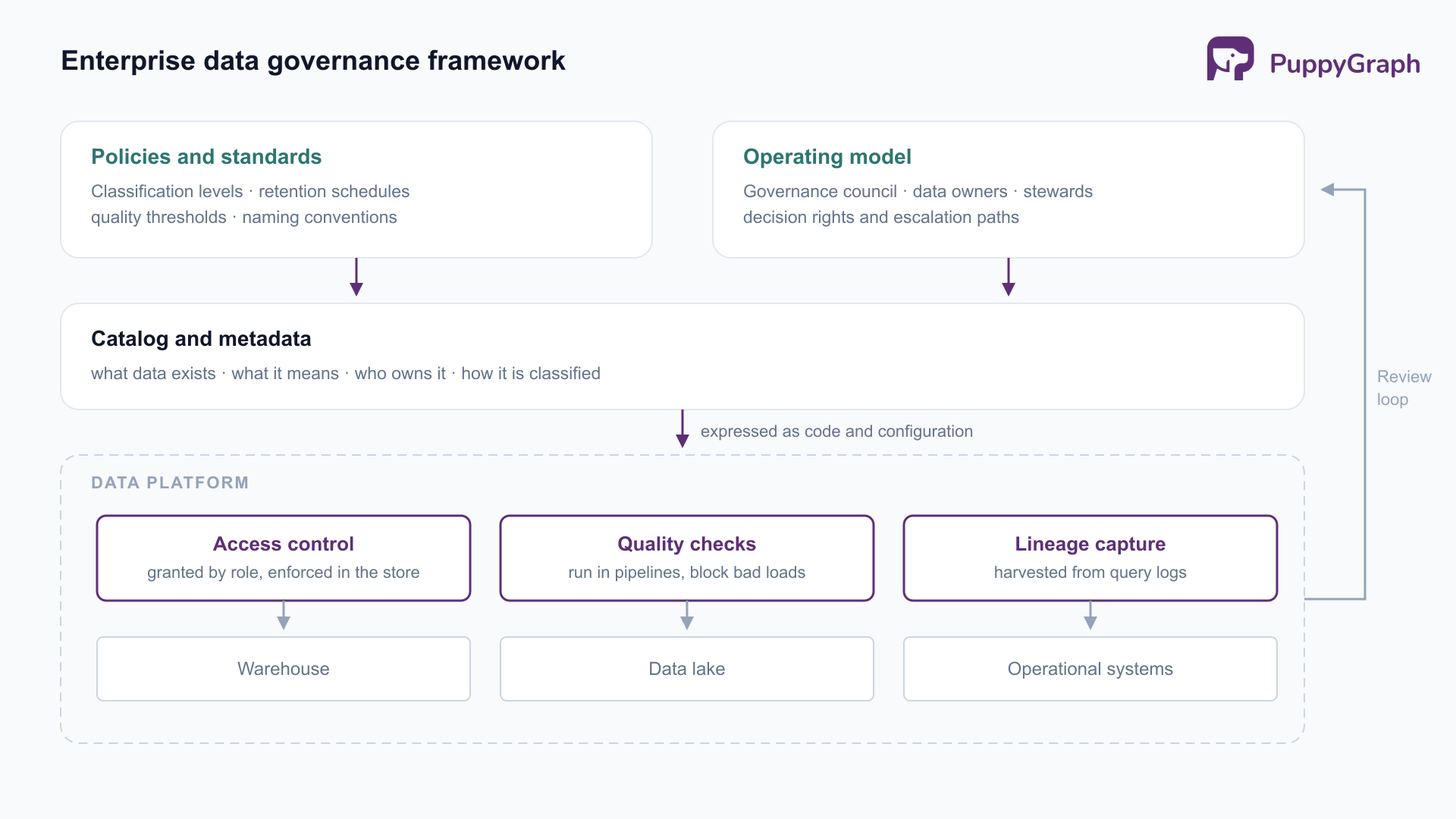
Policies and standards state the rules: classification levels, retention schedules, quality thresholds, naming and modeling conventions. They are necessary but not sufficient on their own; a policy PDF changes nothing by itself.
An operating model assigns the decision rights: a governance council for cross-domain standards, owners and stewards inside domains (the next section details the roles), and an escalation path for conflicts. This is the component organizations most often skip, and its absence is why catalogs go stale.
A catalog and metadata layer makes the estate discoverable: what datasets exist, what they mean, who owns them, how they are classified. Metadata is the substrate governance runs on; ungoverned metadata means every other control operates blind.
Enforcement mechanisms embedded in the platform are where the framework earns its keep: access control enforced in the warehouse rather than requested by ticket, quality checks that run in pipelines and block bad loads, lineage captured automatically from query logs rather than drawn in slides. The reliable test of a framework is how much of it executes without a human in the loop.
A review loop keeps the framework current: periodic access recertification, policy review against new regulation, and retirement of rules that no longer serve a purpose.
The framework also has to pick an operating model shape, and the choice is consequential enough to compare directly.
Most large organizations land on the federated model, not because it is elegant but because the alternatives fail faster: a central team cannot review every schema change in a thousand-person data organization, and full domain autonomy quietly recreates the silo problem governance exists to solve. The practical question is not which model avoids failure, it is which failure mode the organization can detect and correct soonest; federated drift is visible in a catalog report, while centralized bottlenecks surface only as shadow systems built to route around the queue.
Key stakeholders and responsibilities in data governance
Governance is a distribution of labor, and programs fail when the labor is assigned to titles instead of people with time and authority. The roles cluster into three layers.
Sponsorship and arbitration. An executive sponsor, in larger organizations a chief data officer, owns the program’s mandate: funding, priority against competing initiatives, and backing when a domain resists a standard. Below the sponsor, a governance council of domain and function representatives sets cross-cutting standards (classification, retention, shared definitions) and arbitrates conflicts no single domain can settle. Without this layer, governance decisions lose every negotiation against delivery deadlines.
Domain accountability. Data owners are the accountable decision-makers for specific datasets or domains: they approve access policy, set the quality bar, and accept the risk when exceptions are granted. Data stewards do the continuous work the owners are accountable for: maintaining definitions and metadata, monitoring quality, triaging issues, and shepherding changes through review. Stewardship is the most under-resourced role in most programs; a steward with four hours a week and no authority is a symptom that the program is decorative.
Execution and consumption. Data custodians, in practice platform and data engineering teams, implement controls in the infrastructure: provisioning access, wiring quality checks into pipelines, capturing lineage and audit logs. Data consumers, from analysts to ML engineers to AI agents, carry the duty to use data within its stated policy and the reciprocal right to find governed, documented, trustworthy data without archaeology.
The layering matters more than the titles. Any functioning program has someone who can pay for it, someone who can decide, someone who does the daily work, and someone who builds the enforcement; organizations vary the names, but a missing layer is a structural gap that reliably becomes the program’s failure point.
The role of data governance in AI and generative AI
AI raises the required standard of the governance program an organization already has, and adds new objects for it to cover.
AI inherits the estate, unaudited. Training datasets, fine-tuning sets, and retrieval corpora are assembled from the data estate as it actually is, not as the architecture diagram claims. Provenance becomes a hard requirement: to answer what a model was trained on, or what a retrieval-augmented system could have leaked, the program needs lineage from source through transformation to the artifact. Access control has to hold through the AI path too; a model that was fine-tuned on restricted data, or an assistant that retrieves from it, is an access-control bypass wearing a chat interface.
Generative AI adds new governed objects. Prompts, system instructions, vector stores, model versions, and generated outputs all carry data and all need classification, retention, and access policy. The gap between adoption and governance here is measured: IBM’s Cost of a Data Breach Report 2025 found that 63% of breached organizations either had no AI governance policy or were still developing one, and that organizations with high levels of shadow AI, unsanctioned tools operating outside any policy, carried an average of $670,000 in additional breach cost.
Agents need governance made machine-readable. The newest requirement is semantic. A human analyst absorbs tribal knowledge about what tables mean; an AI agent has only what the estate makes explicit, and an agent guessing at semantics produces queries that are syntactically valid but semantically wrong, joining the wrong tables or referencing entities that do not exist. The emerging answer is a semantic layer in the form of an ontology: a defined model of the business’s entities, relationships, and properties that sits between the data and its automated consumers, with each query validated against that model before it executes. This is the layer PuppyGraph occupies. The graph schema it defines over existing warehouse and lakehouse tables functions as an enforced ontology: every query is validated against the model before execution, a reference to an entity or relationship the model does not define is rejected before it touches any data, and the rejection comes back as structured feedback that explains the violation in domain terms rather than as a stack trace. An agent grounded on that feedback can correct itself and retry rather than returning a confidently wrong answer.
What this changes for governance is the enforcement point. A data dictionary can state that customers link to accounts through ownership, but nothing stops a consumer, human or machine, from joining tables in a way that contradicts it; a definition on a page constrains only those who choose to read it. Validated at the query gate, the same definition binds both sides: the agent can only ask questions the model defines, and a query that passes validation means what the governed definitions say it means. The entity and relationship definitions a governance program maintains stop being documentation an agent might consult and become a contract enforced on every query it runs. It is the pattern this article keeps returning to, governance moved from documents into the platform, applied at the semantic layer. And because PuppyGraph queries the source tables in place, with no ingestion and no duplicate copy, adopting the layer adds no new store of the data to govern: the data keeps living in the governed warehouse or lake, under the retention and lineage controls already attached to it.
For AI initiatives, then, governance is not a brake applied to a promising technology. It is the difference between an agent that can be trusted with enterprise data and one that has to be checked answer by answer; an agent whose every answer needs checking saves no one any time.
Common challenges in enterprise data governance
Most governance programs do not fail loudly; they fade. Gartner’s February 2024 prediction that 80% of data and analytics governance initiatives will fail by 2027 attributes the failures to a missing crisis: programs that are not anchored to a business problem people already feel cannot compete for attention against work that is. The recurring failure patterns are worth naming.
Governance as documentation. The program produces policies, standards, and a council charter, and stops. Nothing enforces the documents, so behavior does not change, and the program’s only visible output is meetings. This is the shelfware pattern the Gartner prediction describes.
Copy sprawl outruns the program. Every export, staging copy, and per-team extract is a second place the same data must be governed, and copies multiply faster than controls. Programs that ignore this fight an unbounded surface; architectures that minimize copies, one governed store queried by many engines rather than one copy per engine, shrink the problem to a defensible size.
Ownership without authority or time. Owners and stewards are named in a spreadsheet but given no decision rights and no capacity, so the roles decay into a notification list. The org chart says governed; the behavior says otherwise.
Tool-first thinking. A catalog or quality platform is procured before decision rights exist, on the theory that the tool implies the process. It does not; an unowned catalog goes stale within quarters and takes the program’s credibility with it.
Culture treats governance as friction. If the governed path to data is slower than the ungoverned one, users take the ungoverned one, and they are not wrong to; the program made compliance and productivity opponents. Lasting programs invert this by making the governed path the fast path: discoverable data, self-service access with guardrails, quality that is checked before consumers hit it.
Each of these challenges is organizational before it is technical, which is why the scaling practices that follow are mostly about where governance lives and who feels its value, not about tooling.
Best practices for scaling data governance
The practices that separate durable programs from faded ones share a theme: move governance from documents and committees into platforms and defaults.
Start where the value is concentrated. Govern the handful of domains that feed the most consequential decisions, revenue, regulatory reporting, the flagship AI initiative, and expand from demonstrated wins. A program that starts by trying to catalog everything delivers value to no one long enough to lose its mandate.
Embed policy in the platform. Express classification, access, retention, and quality rules as code and configuration that the platform enforces: policies attached to tables, checks that block bad loads, access granted by role automatically. Every rule that executes without a human is a rule that scales without headcount.
Federate the work, centralize the standards. Stewardship scales only inside domains, where the context lives; standards survive only when set centrally, where consistency lives. The federated model’s council-plus-domain-stewards structure is the practical implementation.
Automate the evidence. Lineage harvested from query logs, quality metrics computed continuously, access reviews generated from actual grants. Hand-maintained evidence is stale by the time it is read, and auditors and agents both consume the automated kind.
Treat metadata as a product. The catalog has an owner, a roadmap, and users whose adoption is measured, or it decays. Metadata is the interface through which humans and AI systems alike discover what data means; its freshness is a leading indicator for the whole program.
Scaling, on this view, means moving the same governance closer to the platform, so that coverage grows without the council growing.
Measuring the success of your data governance program
A governance program that cannot demonstrate progress gets defunded, so measurement is a survival function. The useful metrics cluster into four groups.
Coverage. Share of datasets with a named owner, share cataloged with definitions, share classified. These are the program’s leading indicators; they move first and enable everything else.
Quality and trust. Error and completeness rates on governed datasets, freshness against SLA, volume and age of open data-quality issues, and the blunt but honest signal of how often consumers reconcile numbers by hand.
Speed. Time for a new consumer to find, understand, and get approved access to data. This is the metric skeptics watch: if the governed path is getting faster, the friction argument dies; if it is getting slower, the program is manufacturing its own opposition.
Risk and readiness. Findings per audit and time to close them, access recertifications completed on schedule, incidents traceable to governance gaps, and, increasingly, AI readiness: the share of AI systems whose training and retrieval data comes from governed, provenance-tracked sources.
Two disciplines make the numbers meaningful. Baseline before the program starts, or improvement is unprovable. And pair every metric with the business outcome it serves, fewer reconciliations, faster model launches, cleaner audits, because coverage percentages persuade practitioners while outcomes persuade the people who fund programs.
Conclusion
Enterprise data governance has moved from a compliance obligation to the operating system for how an organization creates value from data. The mechanics have not changed, ownership, quality, access, lineage, lifecycle, but the standard has: AI systems consume data without judgment, at scale, and either inherit a governed estate or amplify an ungoverned one. The programs that work share a shape. Principles wired to enforcement in the platform rather than to documents; a federated operating model with real decision rights; metadata treated as a product; measurement tied to outcomes the business already wants. Built that way, governance becomes the reason the organization can say yes, to the next analytics use case, the next regulator, and the next agent, with evidence instead of hope.
Try the forever-free PuppyGraph Developer Edition and book a demo with the team to see how openCypher and Gremlin queries run over warehouse and lakehouse tables, with no graph-specific ETL, adding relationship analytics without adding a second copy of the data to govern.

Hao Wu is a Software Engineer with a strong foundation in computer science and algorithms. He earned his Bachelor’s degree in Computer Science from Fudan University and a Master’s degree from George Washington University, where he focused on graph databases.


