

What Is Metadata? Types, Examples, Benefits
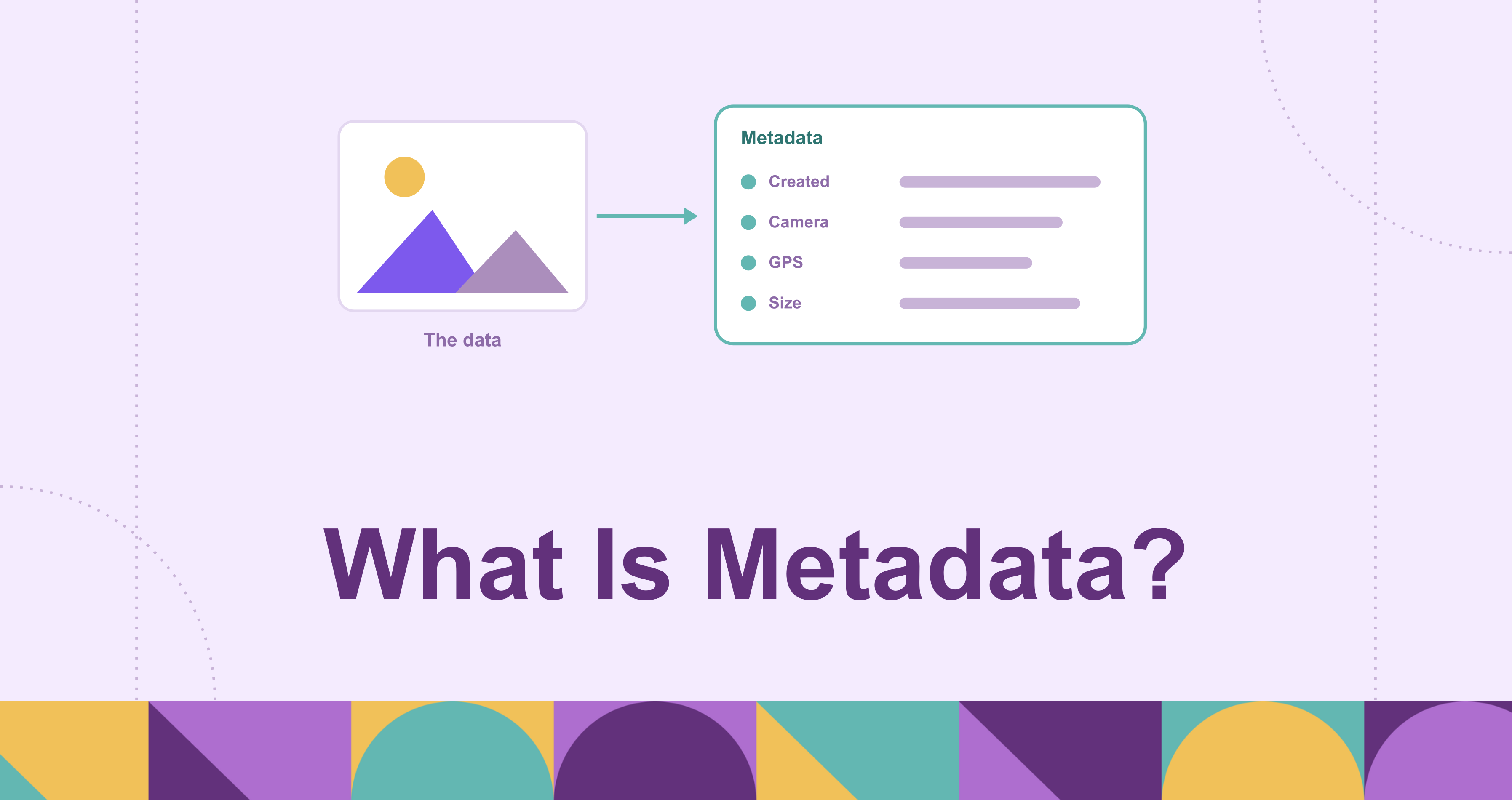
Every file, table, and record an organization holds carries a second layer of information describing it: when it was created, who owns it, what it contains, how it relates to everything else. That second layer is metadata, and it separates a usable data asset from an opaque pile of bytes. A photograph is just pixels until something records the date, camera, and location alongside it; a warehouse table is just rows until a schema names its columns. As data volume climbs, this descriptive layer increasingly decides whether a data estate stays findable, trustworthy, and governable at all.
This article defines metadata, walks through how it works, its types, examples, and role in databases, then covers the benefits, challenges, and standards that keep it consistent.
What is metadata?
Metadata is data that describes other data, capturing the content, structure, context, and provenance of a piece of information without being that information itself. The familiar shorthand is data about data, and while accurate, it undersells the role: metadata is the part that makes a piece of data possible to find, interpret, trust, and connect to everything around it.
A photo on your phone makes the distinction clear. The data is the image, the grid of pixels; the metadata is everything recorded alongside it: the timestamp, camera model, exposure settings, GPS coordinates, and resolution. None of that is part of the visible image, yet it is what lets your photo app sort by date, group by location, and search by lens. Strip it away and you keep the picture but lose almost every way of organizing or retrieving it at scale.
The pattern holds across every kind of data: a document has an author and a creation date; a database table has column names, types, and constraints; a pipeline has a source, a transformation history, and an owner. In each case the metadata is a smaller, structured description beside a larger payload: the payload is what the data is, and the metadata is what it is about, where it came from, and how it can be used.
Why metadata is important
The case for metadata grows out of the case for data itself: organizations accumulate data faster than they can describe it. IDC's Data Age 2025 report (2018) projected the global datasphere would reach 175 zettabytes by 2025, a figure that conveys the scale of the problem. At that scale, data without a description layer is not an asset but a cost center no one can search. Metadata is what makes large data estates usable.
Discovery and self-service. Described data lets people and systems find the right dataset without asking whoever built it, answering "where is the authoritative customer table" in seconds rather than a week of internal email.
Governance and compliance. Knowing what data you hold, where it lives, who can access it, and which records contain regulated information is impossible without metadata; access policies, retention rules, and audit trails are all enforced through it.
Quality and trust. Metadata about freshness, source, and transformation history tells a consumer whether a number can be relied on. A figure last refreshed an hour ago from a verified source means something different from one exported three weeks ago from an unknown place.
Interoperability and analytics readiness. Shared standards let systems exchange data without bespoke translation and let analytics and AI tools interpret a dataset correctly, and a model is only as good as its understanding of the data it reads.
The market reflects this: Grand View Research (2022) projects the metadata management tools market to reach roughly 36.4 billion dollars by 2030. At scale, metadata is the difference between data that compounds in value and data that compounds in liability.
How metadata works
Metadata follows a lifecycle of being created, stored, and used.
Creation. Much metadata is produced automatically: a camera writes capture settings into an image, a database records a table's schema, a pipeline logs each run. The rest is authored by people: a steward tags a table as sensitive, an analyst writes a metric's definition. Automatic metadata is cheap and abundant but shallow; human-authored metadata is expensive but carries the business context automation cannot infer.
Storage. Metadata lives in one of three places: embedded in the file it describes (EXIF in a JPEG, ID3 in an MP3), inside the system that manages the data (a database's system catalog), or in a separate data catalog that aggregates descriptions from many sources into one searchable place.
Use. Metadata earns its keep at the point of use. A search engine ranks pages with it; a query optimizer picks a plan from table statistics; an access-control system decides who can read a record from ownership tags; a lineage tool traces a report to its sources by following recorded transformations. In every case the underlying data is untouched: the metadata is what the system reads to make a decision.
Because metadata is created continuously, in many formats, it goes stale the moment the thing it describes changes without it. Keeping the description in sync with reality is the central problem of metadata management.
Types of metadata
Metadata is conventionally grouped into three categories, which answer what most people mean by the types of metadata.
Descriptive metadata identifies a resource so it can be discovered: titles, authors, abstracts, keywords, and subject tags. Its job is findability.
Structural metadata describes how a resource is organized and how its parts fit together: the page order in a digitized book, the relationship between a table and its columns, the chapters that make up an audiobook.
Administrative metadata describes the management of a resource: how it was created, who owns it, what rights apply, how long it should be kept, and how it should be preserved.
In practice, data teams subdivide these and add categories the classic triad does not name. Technical metadata captures the physical facts a system needs: data types, schemas, formats, and indexes. Business metadata captures human meaning: definitions, glossary terms, ownership, and quality expectations. Operational metadata captures runtime behavior: when a pipeline ran, how many rows it processed, and whether it failed. Others add reference metadata for the classification schemes that give values meaning, and rights and preservation metadata for licensing, retention, and long-term usability.
The table below summarizes the most common types and what each one describes.
These categories overlap, and an attribute can sit in more than one depending on who is asking. The point is coverage: a well-described resource has metadata in each dimension, since each answers a different question a future consumer will have.
Common metadata examples
Metadata is easiest to grasp through the everyday artifacts that carry it.
Photo EXIF data. Digital images carry EXIF (Exchangeable Image File Format) metadata: date and time, camera make and model, exposure, ISO, and often GPS coordinates, letting photo apps build a timeline and a map from a folder.
Document properties. Word processors and PDFs store the author, the creation and last-modified dates, the title, the word count, and the producing application.
Music ID3 tags. Audio files use ID3 tags for the track title, artist, album, genre, and cover art. Every music player reads these tags, not the audio itself, to build its library.
Web page meta tags. An HTML page carries metadata that never appears in the visible content: the <title>, the description and keyword meta tags, and Open Graph tags that control how a shared link looks. Search engines and link previews read this, not the body text.
Email headers. Every email carries headers recording the sender, recipients, subject, timestamp, routing path, and authentication results, used to route, filter, and verify the message.
File-system attributes. Every file on disk has OS-maintained metadata: name, size, type, permissions, and the created, modified, and accessed timestamps.
Database and warehouse schemas. A table's column names, data types, keys, and constraints are metadata describing the rows it holds, the example that matters most in a data-management context.
Metadata in databases
Databases are disciplined producers and consumers of metadata: a relational system cannot function without a precise description of what it stores.
Every database maintains a system catalog (or data dictionary), internal tables that describe the database itself, commonly exposed through the standardized information_schema views. Querying it returns the metadata of every table, column, type, key, constraint, view, and index. The catalog is metadata stored as data: tables that describe tables, queryable with the same SQL used for ordinary records.
This catalog does concrete work. Schema definitions (names, types, nullability, constraints) tell the engine how to interpret each row and which writes to reject; keys and constraints record the relationships that hold data together, primary keys identifying rows and foreign keys linking tables; and indexes record where values live so the engine can avoid scanning a whole table.
The most performance-critical metadata is the set of statistics a query optimizer relies on: running estimates of table sizes, value distributions, and the minimum and maximum values in a column. The optimizer reads these statistics, not the data, to decide which index to use and how to order joins; accurate ones produce a fast plan and stale ones a slow one.
Above the individual database, data catalogs aggregate metadata from many systems into a single searchable inventory so an organization can see what data it has and how it connects. That last word, connects, is where metadata management gets genuinely hard.
Benefits of metadata
The practical payoff of good metadata management shows up across the data lifecycle.
Discoverability and self-service. Cataloged data is data people can find on their own, which shortens projects and curbs the duplicate, slightly-wrong copies that spread when no one can find the original.
Governance and compliance. Classifying regulated data, recording ownership, and enforcing retention and access policies all depend on metadata; it is what answers an auditor asking what you hold and how it is protected.
Data quality and trust. Metadata about source, freshness, and transformation history turns an anonymous table into one a decision can rest on.
Lineage and impact analysis. Metadata recording how data flows from source to report lets teams trace a figure back to its origin and see what downstream assets a change would affect, making a schema change a planned operation rather than a gamble.
Interoperability. Shared standards let systems and organizations exchange data without rebuilding a translation layer each time.
Analytics and AI readiness. Analytics and AI systems interpret data through its metadata: a model over enterprise data needs to know what each field means, how entities relate, and which sources are authoritative.
Taken together, metadata moves a data estate from something only its builders can navigate to something the whole organization can use safely. The recurring theme, shared by the hardest of these benefits, is that much of metadata's value lives in the relationships it records, between datasets, transformations, owners, and policies.
Common metadata management challenges
Metadata is easy to generate and hard to keep useful, which is why managing it is a discipline rather than a one-time setup.
Silos and fragmentation. Metadata is produced independently by every system: the warehouse, each pipeline tool, the BI layer, and a dozen SaaS applications, each holding its own slice in its own format. No tool sees the whole picture without deliberate integration.
Scale and volume. The count of tables, columns, files, and pipelines in a modern estate runs to the millions; describing all of it, and keeping those descriptions complete, outpaces any manual approach.
Staleness and drift. Metadata describes a moving target. A column is renamed, a pipeline rerouted, an owner reassigned, and unless the description updates in step it quietly becomes wrong. Stale metadata is worse than missing metadata because people trust it.
Inconsistent standards and ownership. Different teams describe the same concept differently, and without agreed standards and clear ownership a catalog fills with conflicting definitions and unowned assets. Governance is as much organizational as technical.
Manual effort. The richest metadata, business definitions and quality expectations, is the part automation cannot produce, so it depends on people with many competing priorities.
A further challenge the others build toward concerns the shape of metadata, not its volume. Much of metadata's value lives in the connections between things, and connections are what flat catalogs and row-by-row queries handle worst. Lineage links a report to the transformations and tables behind it; dependencies link a table to every downstream asset that would break if it changed; ownership and policy metadata link datasets to the rules that govern them. The questions that matter most are traversal questions: tracing a figure back through every hop to its origin, or finding everything that depends, directly or indirectly, on a column scheduled for deletion. Answering those by joining catalog tables one level at a time is brittle and slow, because the relationships, not the rows, are the hard part.
This is where treating metadata as the graph it already is becomes useful. PuppyGraph is a graph query engine that builds a graph model over existing relational and lakehouse tables and queries it in place, with no separate graph database and no ETL. Lineage, dependency, and ownership relationships already present across catalog tables, pipeline logs, and warehouse schemas become nodes and edges traversable with openCypher and Gremlin, so multi-hop questions like upstream data lineage and downstream impact analysis become graph traversals rather than chains of joins. Because the engine reads the underlying tables directly, the graph stays in sync with the source metadata instead of becoming another copy to maintain, and the same graph schema doubles as a semantic layer, a data ontology over the estate that both analysts and AI systems can query against. Teams at Coinbase, Dawn Capital, and Prevalent AI use this approach to query connected data where it lives. The point is narrow but practical: when the metadata you care about is a web of relationships, query it as a graph rather than flattening it into rows.
Metadata standards and frameworks
Metadata is only interoperable when the parties describing data agree on how to describe it. A set of standards has grown up for this, most of them domain-specific.
General and library standards. Dublin Core is a small set of fifteen descriptive elements (title, creator, subject, date, and so on) for almost any resource. In libraries and archives, METS (Metadata Encoding and Transmission Standard) packages a digital object's structural and administrative metadata, MODS (Metadata Object Description Schema) carries richer bibliographic description, and PREMIS covers the preservation metadata that keeps digital objects usable over time.
Media-specific standards. EXIF standardizes the metadata embedded in digital images, and ID3 does the same for audio files. Their ubiquity is why any device can read another's files.
Web and open-data standards. Schema.org provides a shared vocabulary for marking up web content so search engines can interpret it. For datasets, DCAT (the W3C Data Catalog Vocabulary) standardizes how data catalogs describe and exchange their holdings, which lets open-data portals interoperate.
Enterprise and registry standards. ISO/IEC 11179 specifies how to build and run a metadata registry, defining how data elements themselves are described so that meaning stays consistent across an organization.
No single standard covers every case, and most organizations use several at once: a media standard at the file level, a catalog vocabulary at the dataset level, a registry standard for definitions. What they share is metadata's own goal, consistency of meaning, applied so description survives crossing system and organizational boundaries.
Conclusion
Metadata is the descriptive layer that turns raw data into something a person or system can find, interpret, trust, and connect. It spans recognizable types, rides alongside everything from photos to database tables, and underpins discovery, governance, quality, and analytics. As data volume grows, managing it well stops being optional, and the hardest part is not the volume but the connections: lineage, dependencies, and policy relationships that span systems and decide what a change will break or what a number really means. Describing data is the first step; keeping those descriptions accurate and traversing the relationships between them is where metadata management earns its value.
Try the forever-free PuppyGraph Developer Edition and book a demo with the team to see how openCypher and Gremlin queries run over warehouse and lakehouse tables, with no graph-specific ETL, turning the lineage and dependency metadata already in your data into a graph you can traverse.

Hao Wu is a Software Engineer with a strong foundation in computer science and algorithms. He earned his Bachelor’s degree in Computer Science from Fudan University and a Master’s degree from George Washington University, where he focused on graph databases.


