


Agentic AI vs Generative AI: Key Differences
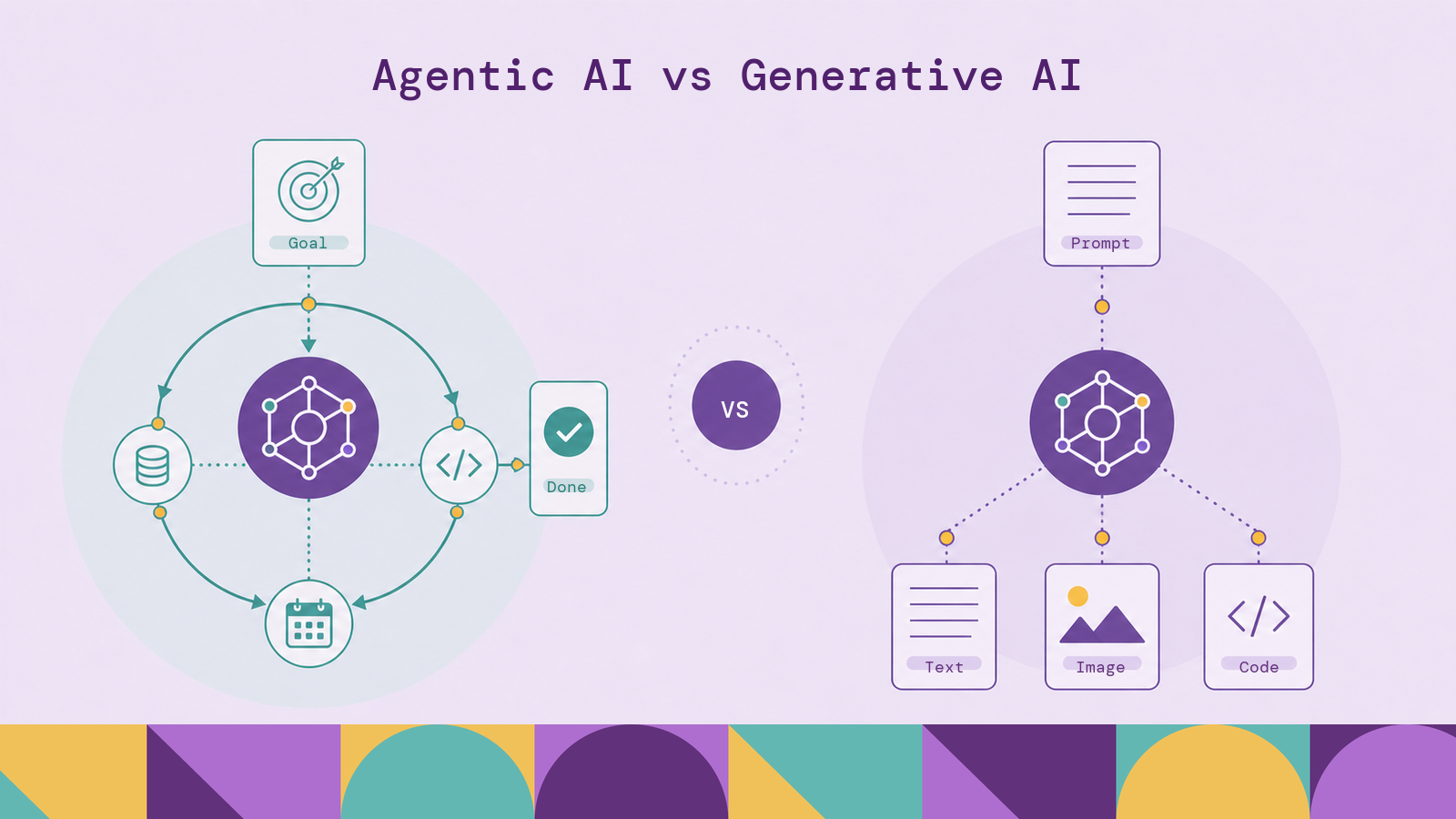
Generative AI and agentic AI describe two different jobs, not two competing products. Generative AI produces content in response to a prompt: a paragraph, an image, a function, an answer. Agentic AI pursues a goal across multiple steps, deciding what to do next and acting on that decision until the goal is met or it gives up. The confusion comes from how close the two sit, because most agentic systems are built on a generative model, using it as the reasoning core and adding the planning, memory, and tool access that turn a single response into a sequence of actions. The honest framing is less a rivalry than a layering, and the interesting question is what the extra layer buys and what it costs.
The distinction matters now because the investment is moving from one to the other. Gartner predicts (June 2025) that 33% of enterprise software applications will include agentic AI by 2028, up from less than 1% in 2024, while generative AI is already in daily use across most organizations. This post defines each approach, sets their differences side by side, compares how they are built, gives concrete guidance on when to reach for each, and closes on how they combine, because in practice the two ship together and the value depends on getting the combination right.
What is generative AI?
Generative AI is a class of models that produce new content by learning the statistical structure of a large training corpus and sampling from it. Give the model a prompt and it returns text, an image, audio, video, or code that resembles what it was trained on without copying any single example. Large language models such as the GPT, Claude, and Gemini families generate text and code; diffusion models such as Stable Diffusion generate images. What they share is the mechanism: predict the next token, pixel, or sample, conditioned on the prompt and everything generated so far.
The defining property is that a generative model is reactive and bounded to the prompt. It has no goal of its own, takes no action in the world, and does nothing between requests. A conversation can carry context forward inside the model’s context window, but each turn is still prompt in, content out. The model does not decide to send an email, query a database, or call an API unless a surrounding system explicitly wires it to do so. Its unit of work is a single response.
That constraint is also why generative AI spread so quickly. A tool that drafts, summarizes, translates, or answers, and then hands the result to a person to judge, is easy to deploy and easy to supervise, because a human stays in the loop on every output. McKinsey (2024) found that 65% of organizations were already regularly using generative AI, roughly double the share of ten months earlier. The capability is real and mainstream. What it does not do on its own is act.
What is agentic AI?
Agentic AI is a system that pursues a goal autonomously: it plans, takes actions, observes the results, and adjusts, repeating the loop until the objective is met. Where a generative model answers a prompt, an agent is handed an objective (“resolve this ticket,” “reconcile these invoices,” “research this question and write a briefing”) and works out the steps itself. The generative model is usually still present, but as one component: the part that reasons and decides, wrapped in machinery that turns those decisions into actions.
Four capabilities separate an agent from the model at its core.
Planning and decomposition. An agent breaks a goal into an ordered set of sub-tasks and revises that plan as it learns, rather than producing one response and stopping.
Tool use. An agent calls external tools: functions, APIs, databases, code execution. This is what lets it gather information and change the world instead of only describing it.
Memory. An agent maintains state across steps: what it has tried, what it observed, what remains. Short-term memory holds the working context of the current task; longer-term memory persists facts and outcomes across runs.
Autonomy with a feedback loop. An agent evaluates the result of each action and chooses the next one, running with limited human intervention. A person typically sets the goal and reviews the outcome rather than approving every step.
Together these change the unit of work from a response to a completed task, which is both the point of the approach and the source of its difficulty. A wrong sentence from a generative model is a wrong sentence; a wrong action from an agent commits a downstream effect, and a wrong early step can compound across every step that follows. Autonomy raises the ceiling on what the system can accomplish and, at the same time, raises the stakes of getting it wrong.
Agentic AI vs generative AI: key differences
The two differ on more than autonomy, and the differences an engineer cares about are the ones that surface in operation and in failure, not just in the definition.
The last row is the one to read first. Agentic AI is not an alternative to generative AI; it is a system that contains one. Everything above that row is what the surrounding machinery adds: memory where the model was stateless, action where the model only spoke, autonomy where the model waited. The failure-mode row is the warning that comes with those additions. A generative model’s mistakes are contained in its output, so a human reviewer catches them; an agent’s mistakes become actions, and the same autonomy that removes the reviewer from each step also removes the checkpoint that would have caught the error. That trade, more capability for less per-step oversight, is the real subject of the comparison, and it is what the rest of this post examines.
Architecture comparison: agentic AI vs generative AI
Both architectures start from the same component and diverge in what surrounds it.
A generative AI architecture is, at its core, a single inference pass. A request carries a prompt and context into the model; the model, a transformer for text or a diffusion network for images, computes a response; the response comes back. Retrieval-augmented generation adds a step in front, fetching relevant documents to include in the context so the output is grounded in specific data rather than the model’s parametric memory alone, but the shape stays linear: assemble context, run the model, return the result. There is one pass through the model per response, and nothing persists afterward.
An agentic architecture wraps that same model in a loop and gives it hands. An orchestrator drives the cycle: it sends the current goal and context to the model, receives a decision about what to do next, executes that decision by calling a tool, feeds the result back in, and repeats. Around this sit the pieces the loop needs: a tool or function-calling interface connecting the model to databases, APIs, code execution, and sometimes other agents; a memory store that carries state across iterations; and the connections to whatever systems and data the agent reads and acts on. The generative model is one box in this diagram, not the whole of it.

The difference that matters here is where correctness has to be enforced. In the generative pipeline, the model’s output is the product, and grounding it through retrieval or a well-built context directly improves that product. In the agentic loop, the model’s output is a decision that triggers an action, so grounding is not a finishing touch on the final answer; it is what keeps each intermediate step from steering the whole run wrong. An agent that misreads the schema of the data it queries, or invents a relationship that does not exist, does not merely return a bad sentence. It takes a bad action and then plans its next step on the result. The hard problem in an agentic architecture is giving the loop a reliable, machine-checkable view of the systems and data it acts on; generating text is the part that already works. That thread runs through the rest of this post.
When to use generative AI
Reach for generative AI when the job is to produce content and a person will judge the result.
Content creation and drafting. Marketing copy, first-draft documents, email replies, code scaffolding, design variations. The model gives a starting point a human refines, which is faster than a blank page and safe because the human owns the final version.
Summarization and extraction. Condensing a report, pulling action items from a meeting transcript, extracting fields from a document. The input is known, the output is bounded, and the person reading it can spot an error.
Transformation. Translation between languages, reformatting, converting code from one language to another, adjusting tone. The task is a mapping from one form to another, not a decision about what to do next.
Question answering and assistance. Answering questions over a known corpus, usually with retrieval to ground the response in specific documents. The assistant surfaces an answer; the user decides what to do with it.
Classification and labeling. Sorting tickets, tagging content, scoring sentiment. A single input produces a single label a downstream system or person consumes.
The common thread is that generative AI fits when the output is the deliverable and a human is the check. Each task above has the same shape: one input, one output, a person who reviews before anything happens as a result. If the work does not require deciding among actions or touching other systems, adding an agent’s autonomy buys complexity and risk without buying capability. Start here whenever a good draft, answer, or transformation is what the job actually needs.
When to use agentic AI
Reach for agentic AI when the job is to complete a multi-step process that spans systems and requires decisions along the way, not just a single output.
Multi-step workflows across systems. Processing an invoice through validation, matching, and posting; onboarding an employee across HR, identity, and provisioning systems; resolving a support ticket end to end. These involve several systems and several decisions, and the value is in finishing the process, not drafting one step of it.
Research and synthesis. Gathering information from many sources, following leads, and iterating toward a briefing or a recommendation. The agent decides what to look at next based on what it has found so far, which a single prompt cannot do.
Monitoring and response. Watching a system, deciding whether a condition warrants action, and either acting or escalating. The work is continuous and conditional rather than a one-shot request.
Orchestration. Coordinating tools, services, or other agents toward a goal, where the sequence depends on intermediate results.
The signal is that the task has sub-steps, requires calling tools and making decisions between them, and that completing it, rather than drafting it, is the deliverable. That autonomy is also what makes agents hard to deploy well, and the current failure rate reflects it. Gartner (June 2025) predicts that over 40% of agentic AI projects will be canceled by the end of 2027, citing escalating costs, unclear business value, and inadequate risk controls. The takeaway is what separates the projects that survive: an agent needs three things a generative feature does not, namely a task whose value justifies the overhead, guardrails scoped to what it is allowed to do, and reliable, grounded access to the data and systems it acts on. Where those are missing, the project tends to become one of the 40%.
Use an agent when the deliverable is a completed task rather than a produced artifact, and when the value of finishing that task end to end justifies the cost of building and governing the autonomy to do it. When the honest answer is that a person will review the output anyway, a generative tool is cheaper and safer. The choice is set by the job, not by which technology is newer.
Can agentic AI and generative AI work together?
They already do, and that is the point the “versus” framing obscures. Nearly every agentic system in production runs on a generative model: the agent’s planning and decisions are the model reasoning, and the tools, memory, and loop are what convert that reasoning into completed work. McKinsey (November 2025) reports that 23% of organizations are already scaling an agentic AI system somewhere in the enterprise and another 39% are experimenting with agents, almost always on top of the generative models they had already deployed. The useful question is how to make that combination reliable.
The weak point of the combination is grounding. A generative model asked about data it was not trained on will produce fluent, confident, and sometimes wrong output. In a chat tool a person catches that; in an agent the wrong output becomes the next action. An agent generating a query against enterprise data can reference a table that does not exist, join two entities that were never related, or misread the schema, and unless something rejects that query, the agent acts on the result and plans forward from it. Fixing this depends less on a better model than on giving the agent an explicit, machine-readable map of the domain it operates on, plus a gate that checks the model’s output against that map before it becomes an action.
This is where a knowledge graph and its underlying ontology come in. An ontology is an explicit model of a domain’s entities, relationships, properties, and rules. Used to ground an agent, it does two jobs at once: it is the vocabulary the agent’s queries are generated against, and it is the schema those queries are validated against before they run. A query that references something the ontology does not contain is rejected with feedback the model can read, which turns a silent wrong action into a correction signal the agent can act on. Our post on ontology-driven agents covers this pattern in depth.
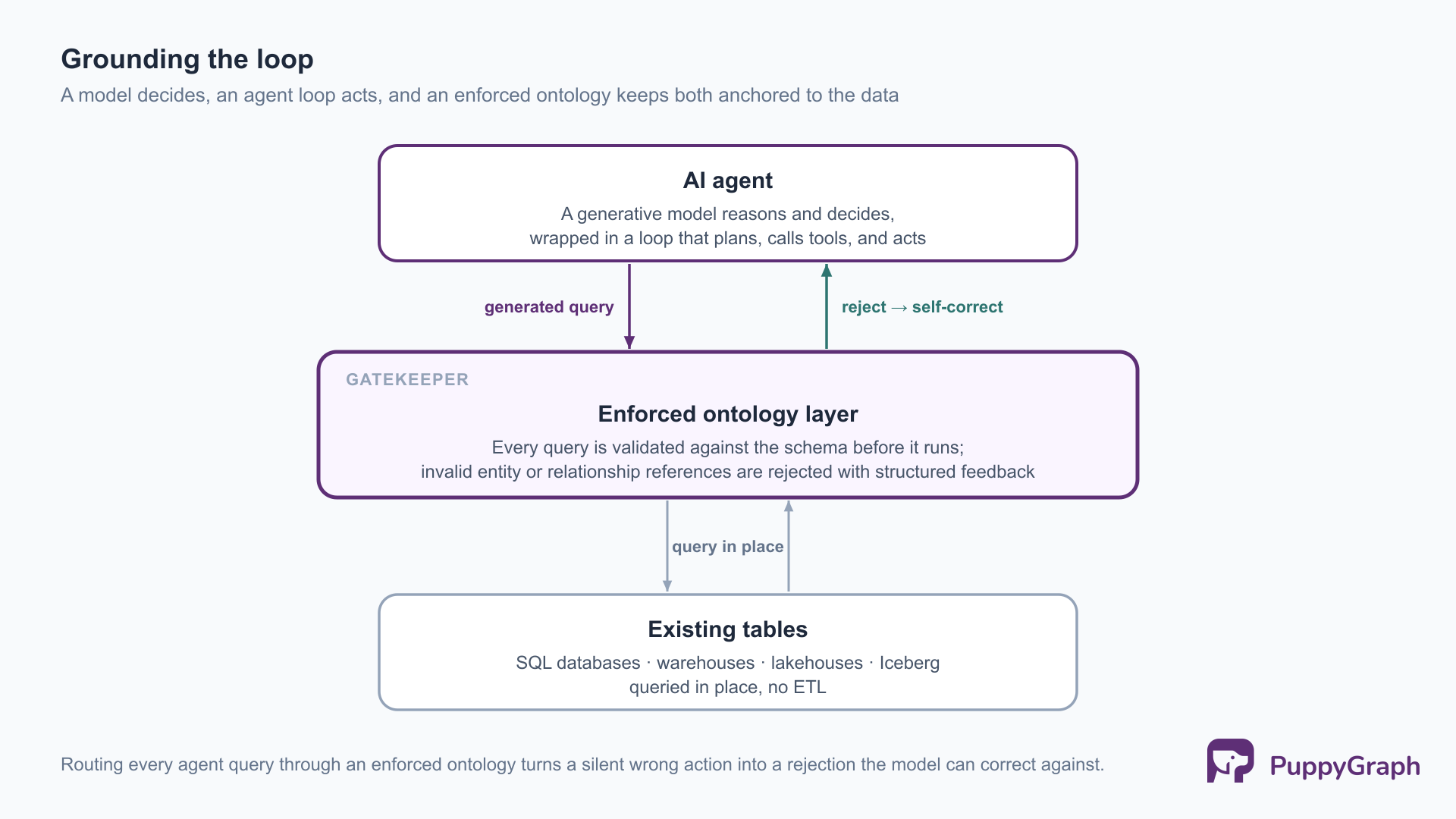
What makes this practical is how the ontology is deployed against live data. PuppyGraph is a graph query engine that defines a graph schema, in effect an ontology of a business’s entities and relationships, directly over existing SQL databases, warehouses, lakehouses, and open table formats such as Iceberg, with no ETL: the data stays where it lives and the engine queries it in place through its own distributed engine. Queries arrive in openCypher, with Gremlin also supported, and every query is validated against the schema before it executes, so one that references an entity or relationship the schema does not contain is rejected with structured, machine-readable feedback that names the violation in domain terms rather than returning a wrong answer. That rejection is exactly the correction signal an agent needs to fix its own semantically invalid queries instead of acting on them, and PuppyGraph’s built-in AI assistant uses the same loop to answer natural-language questions with graph queries. Companies including Coinbase, eBay, and AMD use this approach for graph workloads over data they already store.
The composite is the shape most production systems are converging on: a generative model to reason and decide, an agent loop to plan and act, and a grounded, enforced ontology layer in between that keeps the model’s decisions anchored to what the data actually contains. Generative AI supplies the intelligence, the agent supplies the autonomy, and grounding is what makes the autonomy safe to grant.
Conclusion
Agentic AI and generative AI sit at different layers, not at opposite ends of one axis. Generative AI produces content in response to a prompt and hands it to a person to judge; agentic AI pursues a goal across multiple steps, deciding and acting with limited supervision, and it is typically built on a generative model rather than opposed to one. The practical choice follows from the job. When the deliverable is a draft, an answer, or a transformation a human will review, generative AI is the cheaper and safer tool. When the deliverable is a completed multi-step task whose value justifies the cost of building and governing autonomy, an agent earns its complexity. And because an agent acts on what its generative core produces, the combination is only as reliable as its grounding: an agent without a machine-checkable model of the data it touches inherits every one of the model’s confident mistakes as an action.
Try the forever-free PuppyGraph Developer Edition and book a demo with the team to see how openCypher and Gremlin queries run over warehouse and lakehouse tables, with no graph-specific ETL, giving the agents built on top a grounded, self-correcting view of the data you already have.

Sa Wang is a Software Engineer with exceptional mathematical ability and strong coding skills. He holds a Bachelor's degree in Computer Science and a Master's degree in Philosophy from Fudan University, where he specialized in Mathematical Logic.

Get started with PuppyGraph!


Developer Edition
- Forever free
- Single noded
- Designed for proving your ideas
- Available via Docker install
Enterprise Edition
- 30-day free trial with full features
- Everything in developer edition & enterprise features
- Designed for production
- Available via AWS AMI & Docker install