


AI Agents: What They Are, How They Work ?
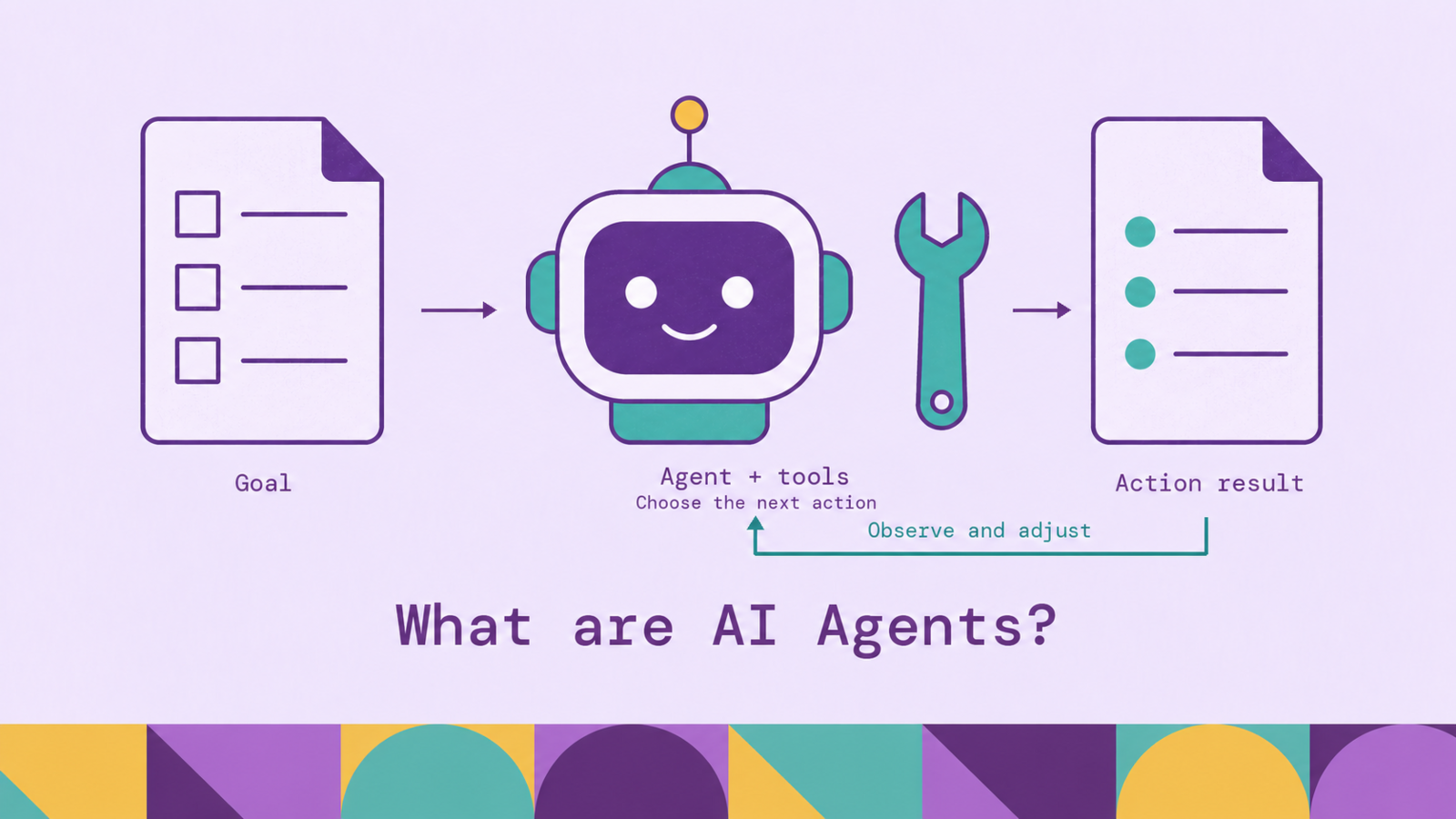
AI agents extend AI applications from generating responses to carrying out tasks. Their usefulness depends on whether they can choose an appropriate next action, obtain evidence about its result, and stay within the authority delegated to them. For enterprise teams, that makes tool design, data access, and verification central parts of the system.
This article explains how AI agents work, how they differ from assistants and chatbots, and which components support reliable execution. It also covers agent types, practical use cases, architecture choices, and the controls needed to build and operate them.
What are AI agents?
An AI agent is a system that observes its environment and selects actions in pursuit of a goal. The broader concept includes rule-based and learning systems. In enterprise generative AI, the term usually refers to an application in which a large language model (LLM) helps decide what to do next and uses tools to perform work.
An agent might investigate a failed deployment by reading logs, checking recent changes, and testing a hypothesis. Its environment includes the information and operations exposed through those tools. Its autonomy is bounded by the application's permissions and execution rules.
Terminology varies. Anthropic's architectural distinction separates workflows that follow predefined code paths from agents whose models dynamically direct tool use. This article uses that distinction for LLM applications. A fixed sequence of model calls can be useful automation without delegating control of the sequence to a model.
How do AI agents work?
An LLM agent typically operates through a repeated action-and-feedback loop. The model receives the task and available context, proposes a next step, and receives the result of any permitted tool execution. The application continues until it reaches a completion condition, needs human input, or exhausts its budget.
Consider an illustrative support investigation:
- A customer reports a missing shipment. The agent identifies the order and retrieves its status.
- The carrier response shows a delivery exception. The agent requests the exception details instead of assuming the parcel is lost.
- It checks the relevant support policy and prepares a proposed resolution.
- The application requests approval if the resolution requires an action outside the agent's delegated authority.
- The agent reports the verified status and any completed action.
The ReAct research paper explores interleaving reasoning and actions so observations can inform subsequent steps. In an application, this feedback must come from actual tool results. A model's statement that it issued a refund is insufficient evidence that the payment system accepted one.
Key components of AI agents
An LLM agent combines several responsibilities, even when one library packages them together.
Model and instructions. The model interprets the task and proposes actions. Instructions define the objective, relevant constraints, available tools, and circumstances that require clarification or escalation.
Tools and execution runtime. Tools expose operations such as searching documentation, querying records, or creating a ticket. The runtime validates requests, executes permitted calls, and returns results. The model proposes a tool call; application code performs it.
Context and state. Context holds information available to the current model call. Task state records progress, identifiers, observations, and pending decisions. Persistent storage can retain selected information across sessions, with explicit retention and access rules.
Knowledge access. Retrieval connects the agent to information beyond model training. Depending on the question, this can involve document search, SQL queries, graph traversals, or application APIs.
Verification and control. Validators, permission checks, approval gates, execution budgets, and logs govern the run. They also provide evidence for determining whether the task succeeded.
These responsibilities deserve separate interfaces. Changing the model should not silently change which actions a user has authorized.
AI agents vs AI assistants
An AI assistant describes a product's role in helping a user. An agent describes how work is controlled. An assistant can therefore contain an agent, and the same product can support both interactive suggestions and delegated execution.
The useful comparison is between interaction modes:
A coding assistant might explain a failing test. In an agent mode, it could inspect files, edit code, and rerun the test. The evaluation question changes with that delegation: both answer quality and the consequences of executed actions matter.
AI agents vs chatbots
A chatbot provides a conversational interface. It may use scripted responses, retrieval, an LLM, or an agent behind that interface. Conversely, an agent can start from a scheduled job or a system event without any chat window.
For example, a chatbot that retrieves a return policy answers a question. A system that identifies an order, checks eligibility, prepares a return, and verifies the result performs a task. Both could appear in the same conversation.
This distinction prevents misleading comparisons based on interface labels. Inspect the underlying behavior: whether the system can select tools, retain task progress, change external state, and confirm completion. A conversational interface alone establishes none of those properties.
Types of AI agents
The classical architectures described in the University of Pittsburgh's AIMA lecture slides, based on Russell and Norvig's Artificial Intelligence: A Modern Approach, distinguish how agents select actions. Learning can be applied across these architectures:
Simple reflex agents apply condition-action rules to current observations. They work best when the relevant situation can be recognized directly and the appropriate response is predefined.
Model-based reflex agents maintain an internal representation of the environment. That state helps them act when the current observation leaves out information seen earlier.
Goal-based agents consider actions in relation to a desired outcome. Planning can help identify a sequence that reaches it.
Utility-based agents compare outcomes using a preference or utility measure. This supports trade-offs among acceptable outcomes, such as delivery speed and transportation cost.
Learning agents improve aspects of their behavior using experience or feedback. Learning can be combined with the other approaches.
These categories describe decision mechanisms, not product maturity levels. For an LLM application, distinguish learning from retaining context: adding a past result to memory does not itself update the model's weights. Single-agent and multi-agent systems describe another dimension, the number and organization of participating agents.
AI agent architecture
A practical architecture separates the agent's decision loop from the systems that execute actions and store data. A request enters through a user interface or event handler. An orchestrator assembles context, calls the model, routes proposed actions through validation, and records their results.
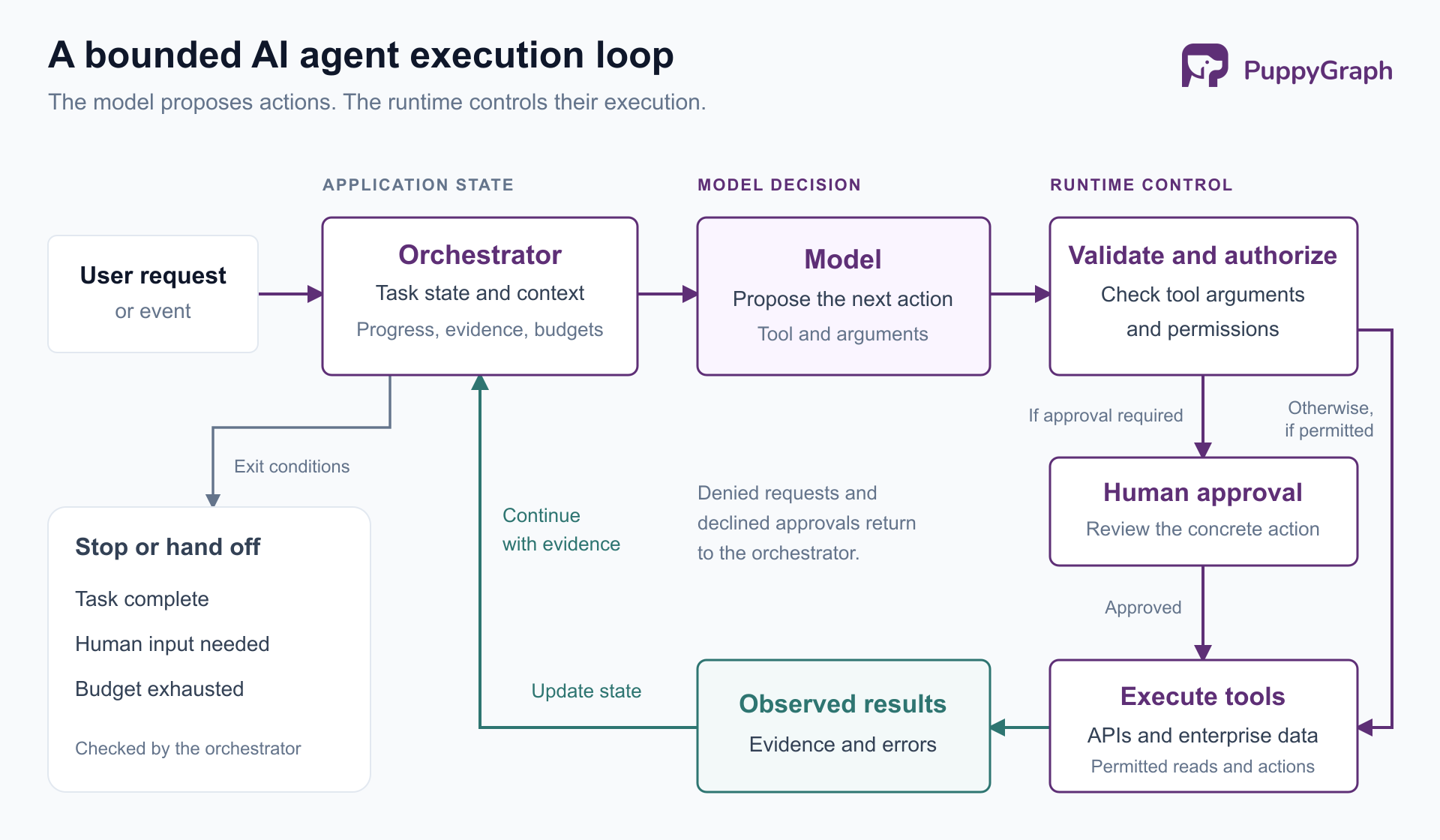
For work that may outlast one process, persist task state and pending approvals. A restarted worker should know which actions completed before the interruption. LangGraph's runtime documentation describes durable execution and human intervention as core capabilities for stateful agents.
A single agent is a reasonable starting point. Separate workers become useful when subtasks need different tools, context, or permissions. That separation also creates coordination work: define what each worker returns, how the coordinator checks it, and who owns shared state. Additional agents need a measurable purpose.
Key capabilities of AI agents
Task decomposition turns an objective into actionable steps. A useful plan identifies dependencies and missing information while remaining open to revision when observations contradict it.
Tool selection connects a question to an appropriate operation. A record lookup, document search, and calculation answer different kinds of questions; choosing among them affects both correctness and cost.
Contextual retrieval gathers evidence relevant to the current step. Document passages can explain a policy, while structured queries can establish which order, account, or service the policy applies to.
Recovery and escalation keep failures from disappearing into a plausible final answer. A timeout may justify a retry; an ambiguous identifier may require clarification; a permission denial should trigger an authorized alternative or a stop.
Capabilities should be evaluated together on complete tasks. Excellent planning offers little value if the agent cannot distinguish a successful operation from an error response.
AI agent use cases
The following are illustrative application designs, each with a concrete output that an organization can inspect.
Customer support. An agent can assemble account history, check troubleshooting guidance, and draft a resolution. Separate permission to investigate from permission to issue credits or change an account.
Software maintenance. An agent can investigate a bug, modify affected files, and run relevant checks. The deliverable is a reviewable change accompanied by test results and remaining limitations.
IT operations. An incident agent can correlate alerts with deployment records and service ownership. Start with an evidence-backed incident summary before delegating remediation.
Procurement operations. An agent can investigate a delayed order, identify dependent purchase requests, and prepare supplier follow-up. Purchase commitments should follow established approval rules.
Internal research. An agent can search several approved sources, reconcile terminology, and produce a cited briefing. Evaluation should check source coverage and whether the conclusions follow from the retrieved evidence.
A strong use case has accessible evidence, bounded actions, and a recognizable completion condition. These properties make errors easier to detect and the benefit easier to measure.
AI agents in enterprise
Enterprise agents need reliable connections between business terms and operational records. A question about delayed shipments can involve customers, orders, suppliers, and inventory stored in different systems. A plausible answer can still be wrong if the agent confuses identifiers or assumes an unsupported relationship.
Start with accountable data ownership, stable entity identifiers, and documented freshness expectations. Expose tools whose inputs and outputs use those definitions. Access should reflect the requesting user and task, with an operational owner responsible for failures and exceptions.
A semantic model makes the data relationships explicit. An ontology defines entities, relationships, and properties, giving the agent a vocabulary for asking connected questions. The model still needs maintained mappings and accurate source data.
PuppyGraph defines a graph schema over existing SQL databases, warehouses, and lakehouses, including direct reads of open table formats such as Iceberg and Delta Lake. That schema functions as an enforced ontology. Ontology enforcement validates queries before execution and rejects invalid entity or relationship references with structured, LLM-readable feedback. An agent can use that feedback to revise its query. Through openCypher and Gremlin, it can query those relationships while source tables remain in their existing storage systems, with no graph-specific ETL required on the default direct-query path. Schema validation grounds query construction; source accuracy and action authorization remain separate responsibilities.
Examples of AI agents
GitHub Copilot cloud agent illustrates delegated software work. It can research a repository, plan changes, edit code, and execute tests in a development environment. The resulting changes can be reviewed through the repository workflow. Here, files and test results provide observable feedback for the next step.
Amazon Bedrock Agents Classic illustrates configurable business-task execution. Developers connect instructions, knowledge sources, and action groups so an agent can gather information and invoke application functionality. The service is in maintenance mode and closed to new customers; existing customers can continue using it. What the agent can accomplish depends on those configured integrations.
These examples expose different environments to a model: a development workspace in one case and configured business operations in the other. Neither product name establishes suitability for a particular task. Evaluate the actual tools, permission scope, completion evidence, and failure handling of the deployment.
Benefits of AI agents
Less manual coordination. Agents can carry intermediate context between searches, records, and tools. This can reduce the effort spent gathering information before a person makes a decision.
More flexible handling of exceptions. When the required steps vary, an agent can inspect the situation and choose the next investigation. A fixed workflow remains appropriate where the path is already well understood.
Reviewable work products. A completed investigation can include cited evidence, proposed changes, and execution results. That package can make review easier than reconstructing the work from a conversational answer.
Treat these as potential benefits to validate locally. Compare an agent with the existing process using completed-task quality, review time, escalation frequency, and cost per accepted outcome. A fast first response matters little if downstream correction takes longer than the original task.
Challenges of AI agents
Errors can accumulate across a run. An incorrect entity match early in an investigation may contaminate later queries and conclusions. Intermediate checks should verify critical identifiers and assumptions before dependent actions proceed.
Tool behavior introduces another source of uncertainty. APIs can time out, return partial results, or accept an operation whose response never reaches the agent. Retrying a write without checking its status can duplicate work. Design write operations with idempotency keys or explicit reconciliation where the underlying system supports them.
Cost and latency also grow with model calls, retrieved context, and external operations. Set budgets for time, tool usage, and retries, and preserve useful partial results when the budget expires.
Finally, evaluation must cover more than the final prose. Include ambiguous requests, unavailable dependencies, stale evidence, and interrupted runs. Record whether the system completed the right task and respected its constraints, including when escalation was the correct outcome.
How to build an AI agent
- Choose a bounded task. Define the input, expected artifact, allowed actions, and success criteria. Investigating a failed job and producing an incident draft is a clearer starting point than managing operations.
- Establish a baseline. Measure the current process or a simpler retrieval workflow. Use it to determine whether dynamic action selection adds value.
- Design the tools. Give each tool a precise purpose, typed inputs, structured results, and explicit error behavior. Separate investigation tools from tools that change records.
- Implement the execution loop. Assemble context, request a model decision, validate the proposed action, execute it, and record the observation. Add stopping conditions and escalation paths before expanding access.
- Build an evaluation set. Include representative successful tasks and realistic failures. Check outputs against source records and executable assertions where possible, with human review for judgments that require context.
- Roll out with limited authority. Begin with drafts or proposed actions, inspect traces, and expand permissions only after reviewing observed performance.
Keep task definitions, tool contracts, and evaluation cases under version control. Reevaluate after changing the model, instructions, or integrations, since any of them can alter the agent's behavior.
AI agent frameworks and platforms
Frameworks provide application building blocks; managed platforms take responsibility for selected deployment and operational services. Compare them according to the parts of the system your team needs to own.
Prototype one representative task before committing to a platform. Check trace visibility, state export, tool testing, and approval recovery. A framework can organize these mechanisms, but the application team still defines correctness and authorized behavior.
AI agent security and governance
An agent's tools determine the consequences of a compromised decision. Retrieved documents, webpages, and tool responses can contain instructions that try to redirect the agent. The OWASP AI Agent Security Cheat Sheet addresses prompt injection, tool misuse, memory risks, and excessive permissions as agent security concerns.
Enforce authorization outside the model. Use narrowly scoped credentials, validate tool arguments, restrict destinations, and isolate code execution. Treat external content as untrusted data. Instructions asking the agent to behave safely supplement those controls.
Bind approvals to concrete actions, including the target and relevant parameters. If those change, reevaluate the approval. Keep audit records of tool requests, authorization decisions, results, and human interventions, with sensitive data redacted and retention defined.
Governance assigns responsibility for those mechanisms. Name an owner, document permitted uses, establish incident handling, and provide a way to suspend execution. A system should be able to demonstrate which authority supported an action and what evidence confirmed its result.
Conclusion
AI agents combine model-driven decisions with tools and feedback to carry out bounded work. Reliable implementations make success observable, keep permissions enforceable, and give agents access to well-defined data. Start with a task whose outcome you can verify, then expand its scope based on measured results.
Try the forever-free PuppyGraph Developer Edition and book a demo with the team to see how openCypher and Gremlin queries connect entities across warehouse and lakehouse tables, with no graph-specific ETL, to ground agent investigations in an enforced ontology.

Hao Wu is a Software Engineer with a strong foundation in computer science and algorithms. He earned his Bachelor’s degree in Computer Science from Fudan University and a Master’s degree from George Washington University, where he focused on graph databases.

Get started with PuppyGraph!


Developer Edition
- Forever free
- Single noded
- Designed for proving your ideas
- Available via Docker install
Enterprise Edition
- 30-day free trial with full features
- Everything in developer edition & enterprise features
- Designed for production
- Available via AWS AMI & Docker install