


Taxonomy vs Ontology: Key Differences
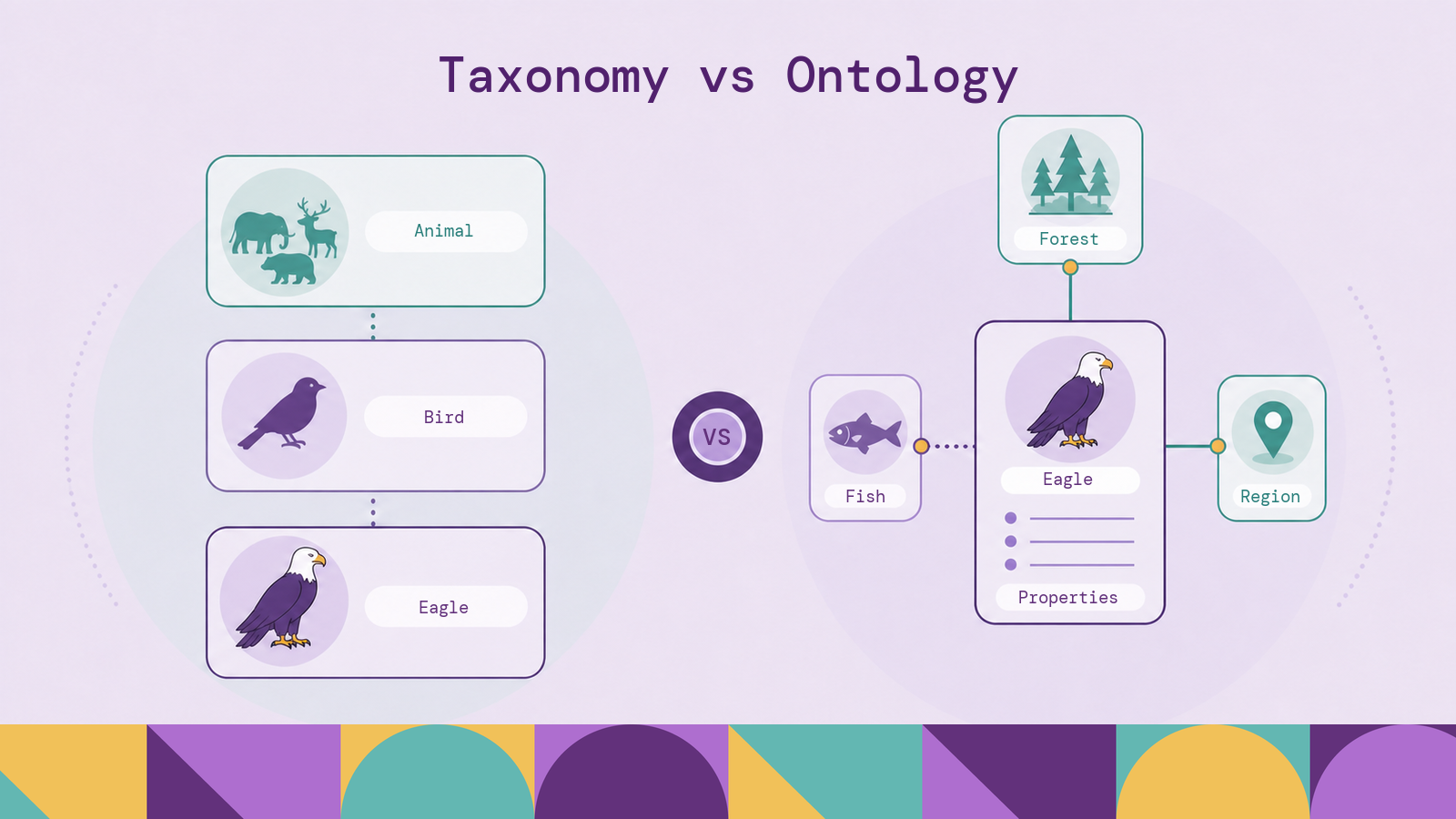
Taxonomy and ontology are the two terms most often reached for when an organization decides to make the meaning of its data explicit, and they get used interchangeably often enough that the distinction has blurred. The distinction is worth keeping sharp, because the two artifacts answer different questions. A taxonomy tells you what kind of thing something is; an ontology tells you how things relate to each other, what properties they carry, and what rules govern them. Choosing between them is less a modeling preference than a decision about which questions your systems will be able to answer later. And the stakes have risen: these models used to be read mostly by humans organizing content, and they are now consumed directly by AI systems that need an explicit map of a domain to reason over.
This post defines each term, puts the key differences side by side, looks at how the two organize information at a structural level, gives concrete guidance on when each is the right tool, and closes with the pattern most mature systems land on, which is the two working together.
What is a taxonomy?
A taxonomy is a hierarchical classification scheme. It arranges concepts into parent-child relationships in which each child is a kind of, or a narrower case of, its parent: laptops are computers, computers are electronics. Moving up the tree generalizes; moving down specializes. The canonical example is Linnaean biological classification, which places every organism in a nested hierarchy running from kingdom down through phylum, class, order, family, and genus to species. The everyday examples are closer to hand: an e-commerce product catalog, a library classification scheme, a support-ticket category tree, the section structure of a document management system.
Three properties define the form. The first is that a taxonomy has essentially one relationship type. Whether a given scheme writes it as “is a,” “broader than,” or “parent of,” every link in the structure carries the same meaning: the child concept is subsumed by the parent. The second follows from the first: a concept’s meaning comes from its position. “Laptop” means what it means in the catalog because it sits under “Computers” and above nothing else; the path from the root is the definition. The third is economy. Because there is one relationship type and a shape everyone already understands, taxonomies are cheap to build, cheap to explain, and maintainable by content and domain teams without an engineering project behind them.
Taxonomies are standardized enough to be portable. SKOS (Simple Knowledge Organization System), a W3C Recommendation since 2009, is the common interchange format: it models concepts with broader, narrower, and related links plus labels and notes, which is exactly the vocabulary a taxonomy needs and nothing more. Most enterprise taxonomy tools can import and export it.
The strength and the limitation are the same fact seen from two sides. One relationship type keeps a taxonomy simple, and one relationship type means a taxonomy can only ever answer one family of questions: what belongs where. Everything a domain knows that is not a classification, such as who supplies a part, which service depends on which, what a drug interacts with, has no place in the tree.
What is an ontology?
An ontology is a formal, machine-readable model of a domain: the types of entities it contains, the relationships that hold between them, the properties both can carry, and the rules that constrain what counts as a valid statement. The most-cited definition comes from Tom Gruber’s 1993 paper, which called an ontology an “explicit specification of a conceptualization.” Less formally: an ontology writes down the working model of a domain that experts otherwise carry in their heads, in a form software can check and query.
Where a taxonomy has one relationship type, an ontology names many. A supply-chain ontology might define that a Product has component a Component, that a Component is supplied by a Supplier, and that a Supplier operates a Facility. Each relationship is typed and directional, and the ontology can state which entity types it may connect (a supplied by link runs from a component to a supplier, never between two products). Entities and relationships carry attributes: a supplier has a region, a dependency has a criticality. And an ontology can include axioms, rules a reasoner can apply to derive facts nobody wrote down: if every Laptop is a Computer and every Computer is a Product, a query for products correctly returns laptops without anyone asserting it directly.
The Semantic Web stack is the classical home of all this. RDF Schema and OWL 2, the latter a W3C Recommendation whose second edition dates to 2012, provide class hierarchies, typed properties with domains and ranges, and formal semantics for inference; SHACL (2017) adds constraint validation. Mature public ontologies show the form at scale: the Gene Ontology models gene function across species and underpins gene-function annotation across computational biology, schema.org defines the entity vocabulary search engines read from web pages, and the Financial Industry Business Ontology models financial instruments and the parties to them.
In practice, many working engineers now meet ontologies in a second form: as the schema of a knowledge graph, where the ontology’s classes become node types, its relationships become edge types, and the model is something analysts and applications query rather than a specification document. The formal stack and the graph-schema form are the same idea at different levels of ceremony; our post on what an ontology is treats that spectrum in more depth.
Structurally, an ontology is a graph, not a tree. A class hierarchy usually exists inside it, but it is one relationship among many rather than the whole structure.
Taxonomy vs ontology: key differences at a glance
Read structurally, the table says an ontology is the superset, and that is true: any taxonomy can be embedded in an ontology as its class hierarchy. But superset does not mean better, and the first and last rows explain why. The core-question row says the two are built for different queries, so a team whose questions are all of the “which bucket” kind gains nothing from typed relationships it will never traverse. The failure-mode row says each form breaks in its own way, and the ontology’s characteristic failure is precisely unused generality: a model rich enough to answer questions nobody asks, at a maintenance cost somebody pays anyway. The honest comparison is not a maturity ladder from taxonomy up to ontology; it is a match between the structure you maintain and the questions you need answered.
How taxonomies and ontologies organize information differently
The difference shows most clearly when the same domain is modeled both ways.
A taxonomy organizes by subsumption: every statement it can make has the shape “X is a narrower case of Y.” In SKOS terms, a product catalog is a chain of broader links:
ex:Laptops    skos:broader  ex:Computers .
ex:Computers  skos:broader  ex:Electronics .
This structure answers classification questions well and immediately: what is this, what does the Electronics section contain, which ancestor categories should this product inherit for filtering and reporting. What it cannot do is hold any fact that is not a classification. That a laptop contains a battery, that the battery comes from a particular supplier, that the supplier operates in a particular region: none of these are “narrower than” statements, so the tree has nowhere to put them. Teams feel this limit as pressure on the hierarchy itself, forcing a concept to live under two parents at once (a polyhierarchy, which SKOS permits but which makes rollups ambiguous) or spawning parallel taxonomies (one by product type, one by supplier, one by region) that nothing connects.
An ontology organizes by explicit assertion. Instead of encoding all meaning in position, it lets the modeler state each kind of fact as its own typed relationship, with rules about what the relationship may connect:
:Laptop   rdfs:subClassOf :Computer .

:hasComponent  a owl:ObjectProperty ;
    rdfs:domain :Product ;
    rdfs:range  :Component .

:suppliedBy    a owl:ObjectProperty ;
    rdfs:domain :Component ;
    rdfs:range  :Supplier .
The subclass hierarchy is still there, in the first line, but it is now one relationship among several. The domain and range declarations are the machine-checkable part: they state that “has component” only runs from a product to a component, so a statement connecting a supplier directly to a laptop by that relationship is invalid by construction, not by convention.
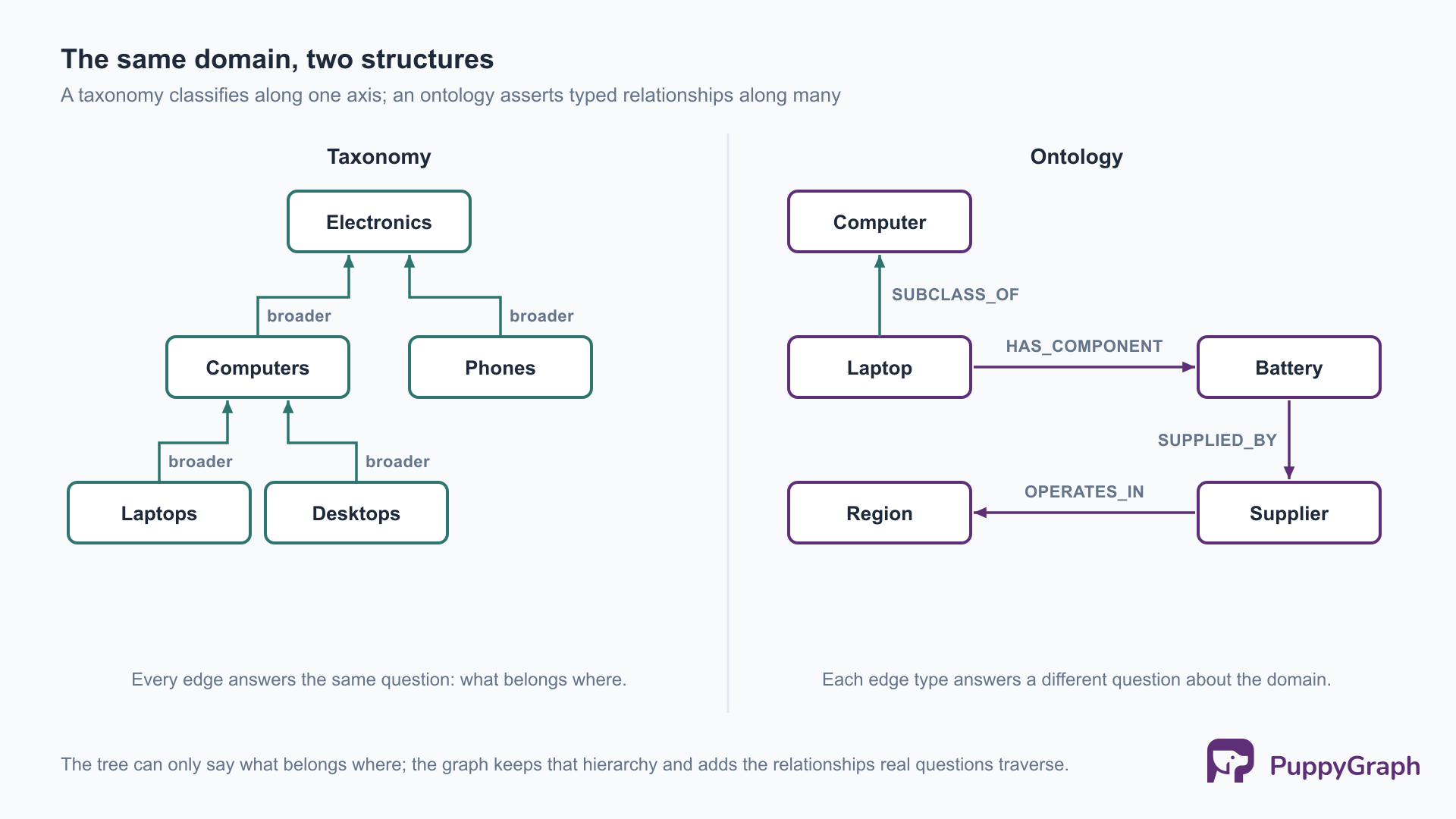
The payoff of the second structure is the questions it opens. Rendered as a property graph, the same ontology becomes directly queryable, and a question that spans three relationship types is one traversal:
MATCH (p:Product)-[:HAS_COMPONENT]->(c:Component)
      -[:SUPPLIED_BY]->(s:Supplier)
WHERE s.region = 'APAC'
RETURN p.name, c.name, s.name
Which products depend on components from suppliers in one region is not an exotic question; it is the shape of most operational questions, and it is unanswerable from a taxonomy because the relationships it walks through simply do not exist there. That is the organizing difference in one sentence: a taxonomy stores meaning along a single axis, position in a hierarchy, while an ontology stores meaning as assertions along as many axes as the domain needs.
When should you use a taxonomy?
A taxonomy is the right tool when the questions are classification questions and the consumers are mostly people.
Navigation and findability. Catalog browsing, faceted search, site sections, knowledge-base structure: these are all “drill down from general to specific” interactions, which is exactly the motion a tree supports. Users already know how to navigate a hierarchy; no one has to be taught what a category is.
Consistent tagging and controlled vocabulary. When many hands label content, tickets, or products, a taxonomy is the agreement that keeps the labels convergent. It fixes the term set, resolves synonyms to a preferred label, and gives every tag a defined place, which is what makes the tagged corpus searchable and reportable later.
Reporting rollups. A hierarchy gives aggregation for free: revenue by category and subcategory, incidents by type, spend by department. Any reporting dimension that rolls smaller buckets into bigger ones is a taxonomy doing quiet work.
Governed simplicity. A taxonomy can be owned by the team closest to the content, evolved by adding and renaming nodes, and reviewed in a spreadsheet. When the maintainers are librarians, content strategists, or support leads rather than engineers, that ownership model is a feature the more expressive alternative does not offer.
The signal that a taxonomy suffices: the questions people ask of the model are “which bucket does this belong to” and “what is in this bucket,” there is one dominant axis of classification, and the model’s consumers are human. When in doubt, start here. A taxonomy built this quarter that gets used beats an ontology scoped this quarter that ships next year, and as the last section shows, the taxonomy is not throwaway work if the needs grow.
When should you use an ontology?
An ontology earns its higher cost when the questions cross entity types, the data crosses systems, or the consumer is software.
Questions that traverse relationships. Which customers are affected if this supplier fails, which services sit downstream of this database, which access paths connect this user to that resource: each of these walks through two or more typed relationships. If the questions your teams actually ask have that multi-hop shape, no amount of taxonomy work will answer them, because the tree does not contain the edges the question needs to walk.
Integration across systems. When the same real-world entities appear in a CRM, an ERP, a data warehouse, and a ticketing system, an ontology serves as the shared semantic model that says what a Customer or an Asset is and how the records in each system map onto it. This is the classical data-integration role, and it is why large reference ontologies exist in medicine and finance, where dozens of systems have to agree on meaning.
Rules, consistency, and inference. An ontology can state constraints the data must satisfy and let a reasoner enforce them or derive their consequences: every component has exactly one primary supplier, a subsidiary’s parent cannot also be its customer of record, everything true of computers is true of laptops. When correctness of this kind matters, encoding the rules once in the model beats re-implementing them in every application.
Grounding AI systems. A language model answering questions over enterprise data needs an explicit, machine-readable map of what exists and how it connects; without one, it guesses at schema and produces answers and queries that are syntactically plausible but semantically wrong, referencing entities and joins that do not exist. An ontology is that map, which is why it has moved from a knowledge-management concern to a piece of AI infrastructure: it is the vocabulary an agent’s queries are generated against and checked against. Our post on ontology-driven agents covers this pattern in depth.
The signal that an ontology is warranted: the valuable questions traverse relationships between different kinds of things, more than one system holds pieces of the answer, or software (an application, a reasoner, an AI agent) will consume the model directly. What all four cases share is that the relationships themselves carry the value, and relationships are precisely what a taxonomy cannot represent.
Can taxonomies and ontologies work together?
They can, and in most mature systems they do, because the relationship between the two forms is containment rather than competition.
The standard pattern is the taxonomy as the backbone of the ontology. The classification hierarchy a team already maintains becomes the ontology’s class tree (in OWL terms, its subclass hierarchy; in property-graph terms, its label structure), and typed relationships are then attached across the branches: the product taxonomy keeps saying that a laptop is a computer, while new edges say what the laptop contains, who supplies it, and where it ships. Nothing about the taxonomy is discarded; it becomes the is-a skeleton of a richer model. The standards were designed for this coexistence, and SKOS vocabularies are routinely used alongside OWL ontologies within one knowledge graph.
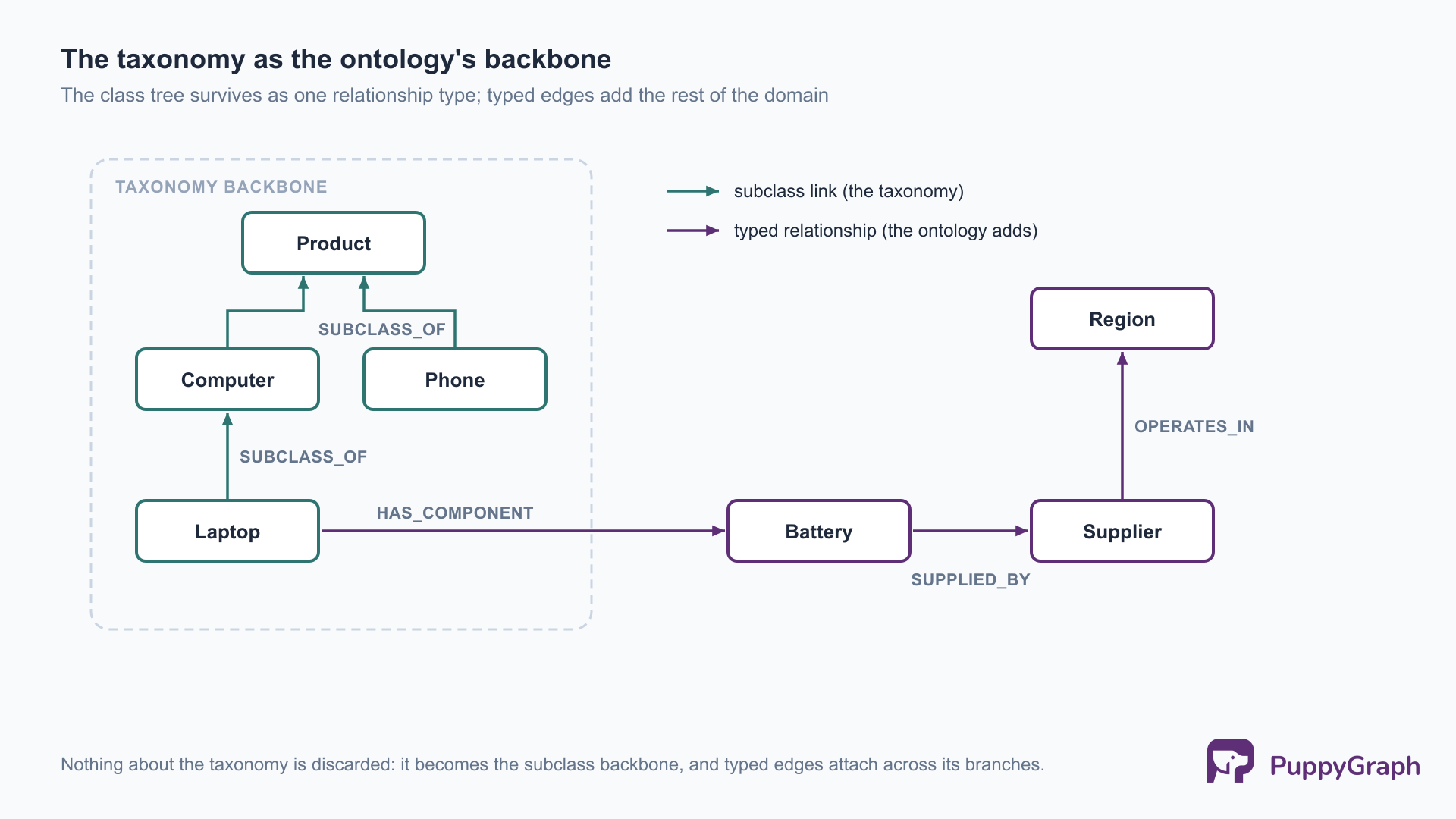
This containment is also what makes the incremental path practical. Start with the taxonomy, because classification needs arrive first and a taxonomy is cheap to stand up. When multi-hop questions start going unanswered, add the specific relationship types those questions need, and only those. An ontology grown this way stays anchored to real queries, which is the discipline that avoids the over-modeling failure mode from the comparison table.
The remaining question is where such a model runs, because an ontology pays for itself only when it is queryable against live data rather than sitting in a design document. One path is to instantiate it in a dedicated store, a triplestore or graph database, and build pipelines that copy data in and keep it synchronized. The other is to define the ontology as a layer over the data where it already lives. PuppyGraph implements the second path: it lets you define a graph schema over existing tables in SQL databases, warehouses, and lakehouses (Postgres, Snowflake, Databricks), including open-format tables like Iceberg read directly on object storage, and that schema functions as an enforced ontology for both analysts and AI agents. Queries arrive in openCypher or Gremlin and are validated against the ontology before execution, so a query referencing an entity or relationship the model does not contain is rejected with structured feedback naming the violation in domain terms, which is what lets an AI agent correct its own semantically wrong queries instead of returning confident nonsense. Because the engine reads the tables in place, there is no ETL pipeline to build and the ontology stays a live model over current data rather than a copy that drifts. Companies including Coinbase, eBay, and AMD use this approach for graph workloads over their existing data.
A mature system ends up with all three: a taxonomy for the classification backbone, an ontology for the relationships and rules around it, and a query engine to run the whole model against the data it describes.
Conclusion
Taxonomy versus ontology is a match between structure and questions. A taxonomy is a hierarchy with one relationship type, and that economy is its value: it is cheap to build, easy to govern, and exactly sufficient for classification, navigation, tagging, and rollups. An ontology is a full domain model, with typed relationships, properties, and rules, and it earns its cost when the questions traverse relationships, when systems must agree on meaning, or when software and AI agents consume the model directly. The two compose rather than compete: the taxonomy becomes the class backbone of the ontology, which makes starting simple the first step of the incremental path. What has changed recently is the consumer. Models that once served human browsing now ground machine reasoning, and that shift moves the ontology from a nice-to-have toward the piece of infrastructure that determines whether an AI system’s answers stay anchored to what the data actually contains.
Try the forever-free PuppyGraph Developer Edition and book a demo with the team to see how openCypher and Gremlin queries run over warehouse and lakehouse tables, with no graph-specific ETL, against an ontology defined on the tables you already have.

Sa Wang is a Software Engineer with exceptional mathematical ability and strong coding skills. He holds a Bachelor's degree in Computer Science and a Master's degree in Philosophy from Fudan University, where he specialized in Mathematical Logic.

Get started with PuppyGraph!


Developer Edition
- Forever free
- Single noded
- Designed for proving your ideas
- Available via Docker install
Enterprise Edition
- 30-day free trial with full features
- Everything in developer edition & enterprise features
- Designed for production
- Available via AWS AMI & Docker install