

AI-Ready Data: Architecture, Preparation & Best Practices
Data that serves a dashboard well can still fail an AI system. A sales report tolerates a day of latency, an undocumented column, and a few duplicate rows, because the person reading it fills the gaps. A model, a retrieval pipeline, or an agent consumes exactly what it is given, at scale and without judgment, so whether data is ready for AI depends on the specific use case it serves rather than on any general measure of how clean it is.
This guide covers what AI-ready data is, how to prepare it and keep it ready, which quality requirements change for AI, and how to build a strategy and measure progress.
What is AI-ready data?
AI-ready data is data that is fit for a specific AI use case: representative of the problem the model or application has to handle, current enough for the way it will be consumed, documented well enough for a machine to interpret, and governed so that its origin and permitted uses are known. Gartner's definition puts the use case first: the data "must be representative of the use case," and AI-ready data is "a process and a practice based on availability of metadata to align, qualify and govern the data."
That breaks with the traditional data-quality mindset. In BI, an outlier is usually a defect to be cleaned away. For a fraud model, the outliers are the signal, and a training set scrubbed of unusual transactions teaches the model that fraud does not happen. The same table can be AI-ready for a demand forecast and unready for an anomaly detector.
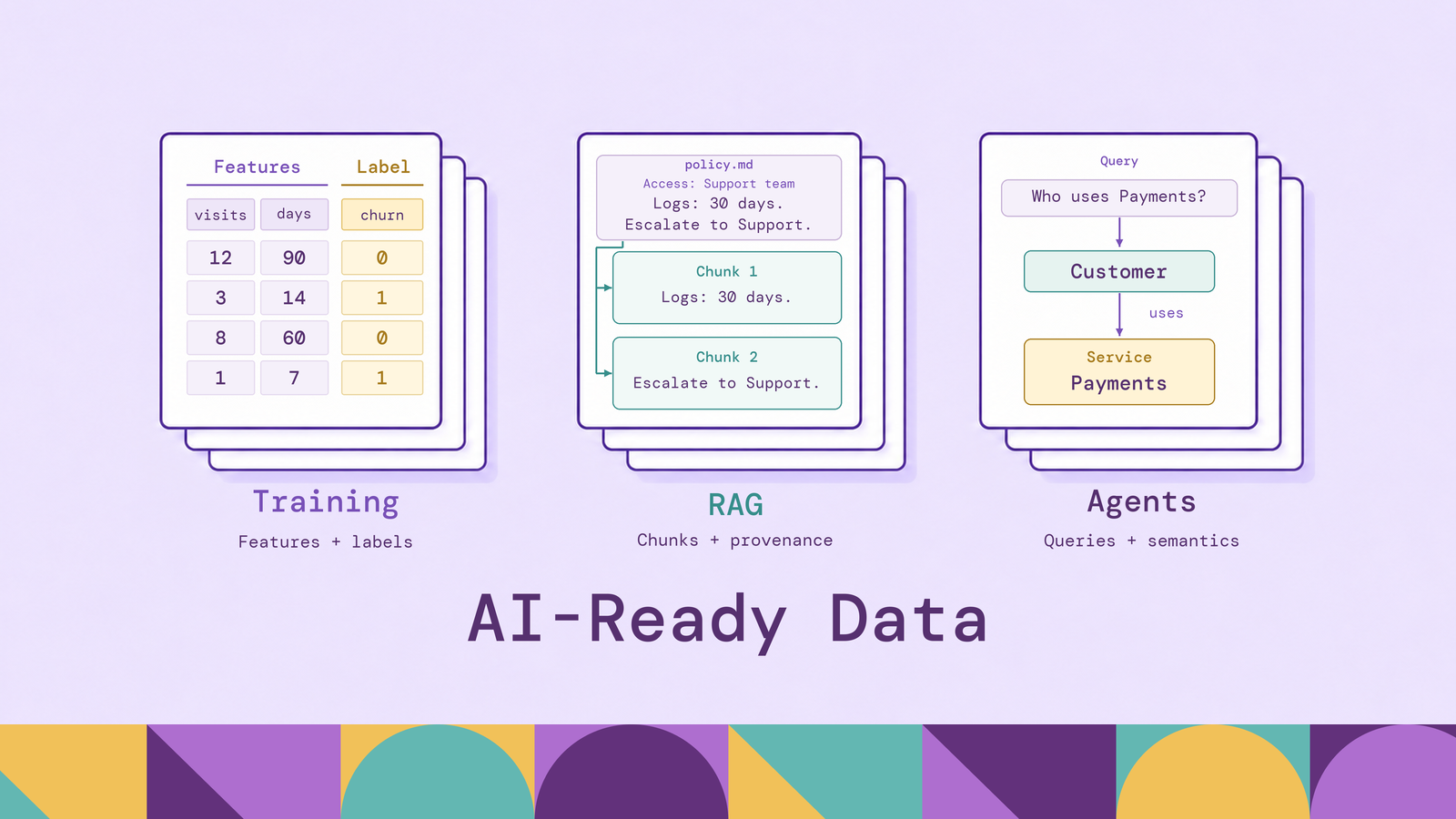
The use case also determines which form of readiness matters most. AI workloads consume data in three broad ways:
Training and fine-tuning need historical data that is labeled where required, representative of the conditions the model will meet in production, and reproducible.
Retrieval for generative AI, as in retrieval-augmented generation (RAG), needs a corpus that is current, deduplicated, split into coherent chunks, and tagged with the metadata and permissions needed to filter what each user may see.
Agents and tool use, where the model itself decides what to query and issues queries or API calls against live systems, need data exposed through interfaces whose meaning is explicit: defined entities, relationships, and metrics an agent can query without guessing what a table or column represents.
Most organizations need all three, which is why AI readiness is best treated as a property of the data platform.
Why is AI-ready data important?
Data readiness often decides whether an AI initiative moves from pilot to production. Gartner predicted (February 2025) that through 2026, organizations would abandon 60% of AI projects unsupported by AI-ready data, and the same release reports that 63% of organizations either do not have or are unsure they have the right data management practices for AI. In the Gartner Hype Cycle for Artificial Intelligence (August 2025), AI-ready data and AI agents were the two fastest-advancing technologies.
AI systems also fail quietly. A model trained on skewed data fails in production on the cases the data under-represented. A RAG application with a stale corpus answers confidently from last quarter's policy. An agent that misreads a column name produces a query that runs, returns rows, and is wrong. In each case the model behaves correctly given its inputs, so better models do not fix the problem; better data does.
Regulation adds a second reason for some systems. For high-risk AI systems, Article 10 of the EU AI Act requires that training, validation, and testing data sets be "relevant, sufficiently representative, and to the best extent possible, free of errors and complete in view of the intended purpose," and subject to data governance practices covering data origin, preparation steps such as labeling and cleaning, and examination for possible biases.
How to prepare data for AI
Preparing data for AI turns raw source data into the form a specific AI workload consumes. The steps below are ordered the way most teams encounter them.
Start from the use case and inventory the data it needs. List what the model or application must do, the sources that cover it, their owners, and what is missing. This is what Gartner means by aligning data to the use case, and it is where most readiness gaps surface.
Profile before you clean. Measure distributions, null rates, and value ranges first. Profiling shows whether the data represents the population the model will see before cleaning removes the rare cases it most needs.
Clean and standardize with the use case in mind. Resolve duplicates, normalize formats, reconcile entity identifiers across sources (the same customer under three keys is a classic training-set defect), and handle missing values deliberately. Record every transformation so the dataset can be regenerated and audited.
Label and annotate where supervision is required. Label quality bounds model quality. Define labeling guidelines, measure agreement between annotators, and version labels like any other data.
Enrich with metadata and semantics. Add descriptions, owners, sensitivity classifications, and business definitions. For generative AI and agents this metadata is part of the input: it is how a retrieval system filters by permission and how an agent learns what cust_stat_cd = 3 means.
Transform into the consumption form. Training needs feature tables split into training, validation, and test sets without leakage. RAG needs documents parsed, chunked, embedded, and indexed in a vector database. Agents need a queryable model of the entities and relationships they will reason about.
Done once, these steps produce a dataset. Automated, they produce a pipeline, which is what keeps the data ready after the first model ships.
AI-ready data pipelines
AI-ready data pipelines encode the preparation steps as software that runs continuously, so readiness holds as sources change. The architecture is the familiar ingest, transform, and serve shape, with requirements that BI pipelines rarely had to meet.
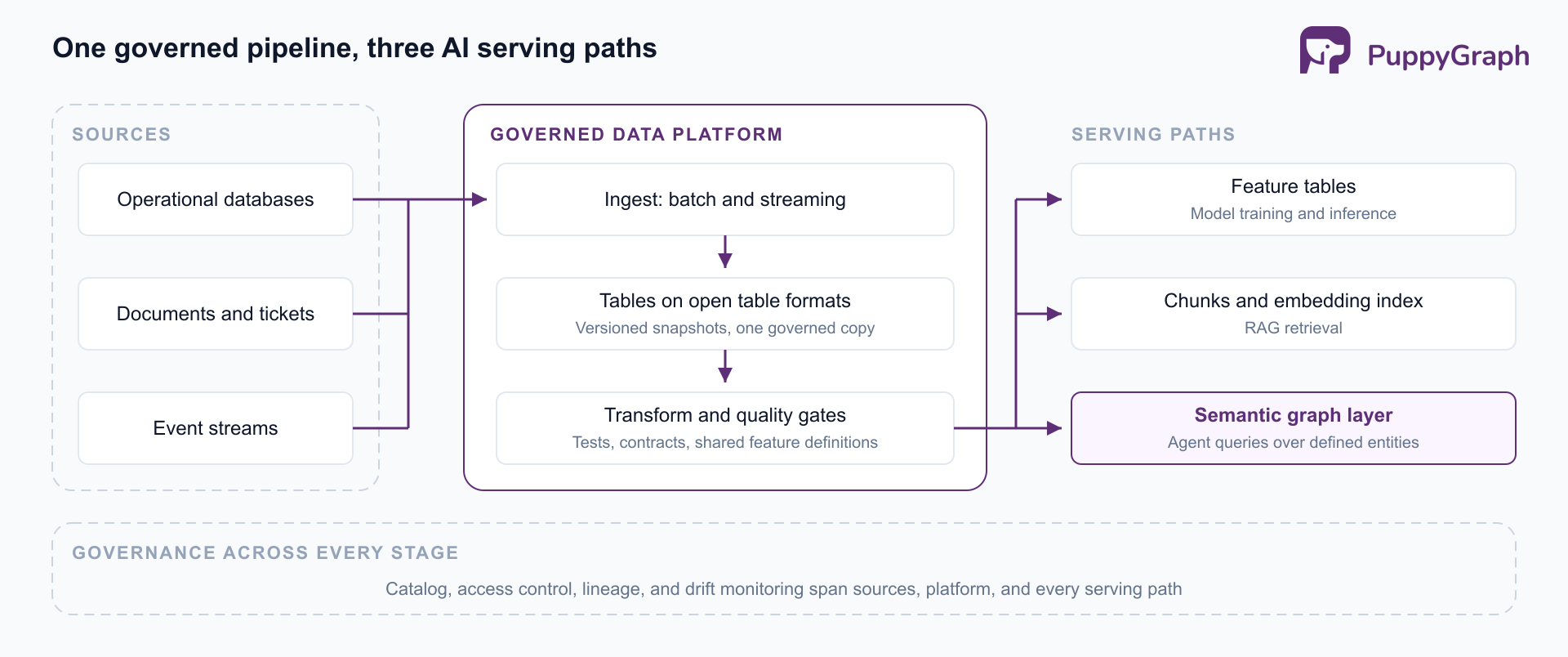
Freshness matched to consumption. A training set can be rebuilt nightly. Inference features and RAG documents often need to be minutes old, which streaming ingestion and incremental processing provide without a separate architecture per tier. For RAG, incremental processing must propagate edits, deletions, and permission changes as well as new documents; otherwise the index keeps serving content that no longer exists or that the user may no longer see.
Consistency between training and serving. Google's Rules of Machine Learning defines training-serving skew as "a difference between performance during training and performance during serving," and names "a discrepancy between how you handle data in the training and serving pipelines" as a cause. The fix is to compute a feature once and serve the same definition to both paths.
Versioning and reproducibility. Open table formats such as Apache Iceberg and Delta Lake keep snapshot history, so a training set can be pinned to a snapshot (kept alive by a tag or retention policy) instead of copied, and a past result can be reproduced against the data as it was.
Quality gates and data contracts. Tests on schema, value ranges, and distributions run inside the pipeline and stop bad data before it reaches a training run or an index. Contracts between producing and consuming teams surface breaking changes before deployment.
Lineage and observability. Data lineage, captured through integrations that emit open standards such as OpenLineage, records which jobs and input datasets produced each table and downstream dataset. Monitoring compares live data against training-time distributions to catch drift.
Data quality requirements for AI readiness
The classic data-quality dimensions still apply to AI, but each one is judged against the use case.
Accuracy and validity. Values must be correct and within expected types and ranges. For training data this extends to labels, since the model learns a mislabeled example faithfully.
Completeness. Beyond null fields, the data must cover the conditions the model will see. A churn model trained only on one region's customers is complete at the row level and incomplete for the use case.
Consistency. The same entity and metric must mean the same thing across sources. If finance and the AI assistant compute "active customer" differently, the assistant's answers will conflict with numbers the business already trusts.
Timeliness and uniqueness. Freshness follows the consumption pattern. Duplicates distort training distributions, and in RAG corpora near-duplicate documents crowd the retrieved context with conflicting versions of the same content.
AI adds requirements of its own:
Representativeness and bias. The data must reflect the population the system will serve, including rare cases, which is the core of Gartner's definition and the EU AI Act's "sufficiently representative" requirement.
No leakage. Training data must not contain information unavailable at prediction time, such as a field populated only after the predicted outcome. Leakage produces models that evaluate well and fail in production.
Provenance and permitted use. Every dataset should carry its origin, its consent or license terms, and its allowed uses, so restricted data does not end up in a training set or retrieval index by accident.
A dataset that met its thresholds at training time can fall below them as sources drift, which is why quality checks belong inside the pipeline.
Structured vs unstructured data for AI
Structured data (tables in databases, warehouses, and lakehouses) and unstructured data (documents, tickets, logs, media) both feed AI, but they become ready through different work.
RAG made documents queryable by meaning, so unstructured data gets most of the attention in generative AI. Structured data holds the facts many questions turn on (balances, orders, assets, configurations), and its weakness is different: the values are exact, but their meaning is spread across column names, undocumented conventions, and join paths analysts learned on the job.
The hardest questions combine the two and depend on relationships. "Which customers affected by this outage have open support tickets mentioning data loss?" needs the service dependency graph, the customer accounts, and the ticket text. Vector search finds similar passages but does not, on its own, follow a chain of connections across records. That gap motivates approaches such as GraphRAG, which add an explicit model of entities and relationships to retrieval so that the connections between records can be followed.
How to build an AI-ready data strategy
An AI-ready data strategy turns preparation from project work into a reusable capability. It sits within the broader data strategy and gives it an AI-specific priority order.
Lead with a portfolio of use cases. Invest first where business value and data readiness are both high, and make each early use case leave reusable assets (a cleaned entity table, a governed corpus, a feature definition) for the next.
Treat datasets as products. A data product with a named owner, a documented interface, and published quality guarantees is something an AI team can depend on.
Consolidate on one governed copy. Keep analytical data in a lakehouse, or in a warehouse that supports open table formats such as Iceberg, so that BI, model training, retrieval, and agents read the same data under the same policies. Every copy made for a specific AI tool is another place where freshness, permissions, and definitions can diverge.
Build governance in from the start. Catalogs, lineage, access control, and classification answer what a model was trained on, what an agent may read, and where a generated answer came from. Governance should extend explicitly to training sets, embedding indexes, and agent access paths.
Make semantics machine-readable. The last layer, and one that is easy to defer, is an explicit model of what the data means: the entities the business cares about, the relationships between them, and the definitions of its metrics. Without it, an agent must infer join paths from column names. An ontology defined over the existing tables gives agents and analysts a shared vocabulary of entities and relationships.
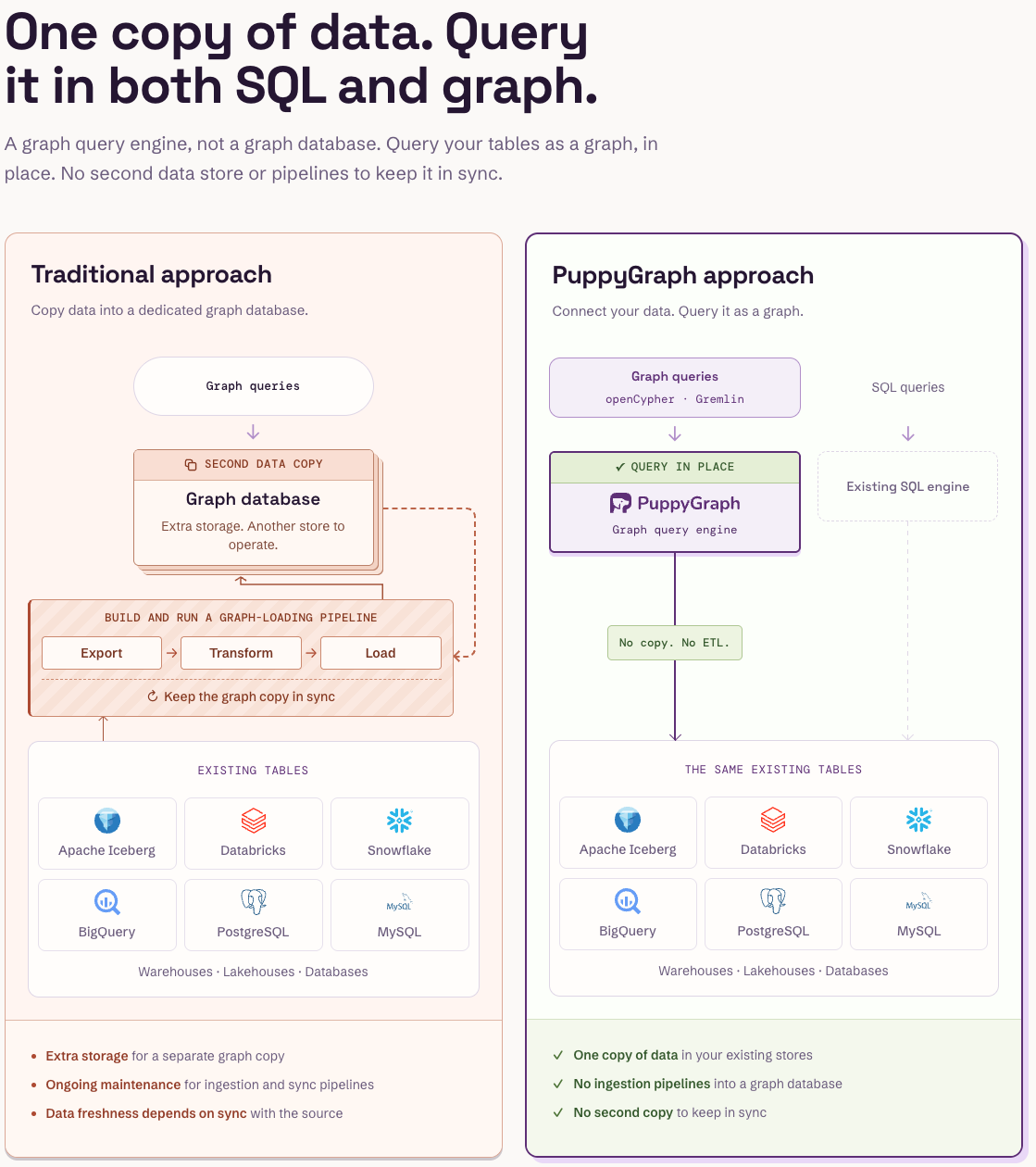
PuppyGraph implements that layer as a graph over the tables a strategy already consolidates. It is a distributed graph query engine that, by default, queries tables in place in SQL databases, data warehouses, and data lakes and lakehouses, including direct reads of open table formats like Iceberg and Delta Lake, so there is no ETL into a separate graph database and the same tables stay queryable with SQL. Teams connect their existing sources and define a graph schema that maps tables to nodes and edges, and analysts and AI agents query it in openCypher or Gremlin.
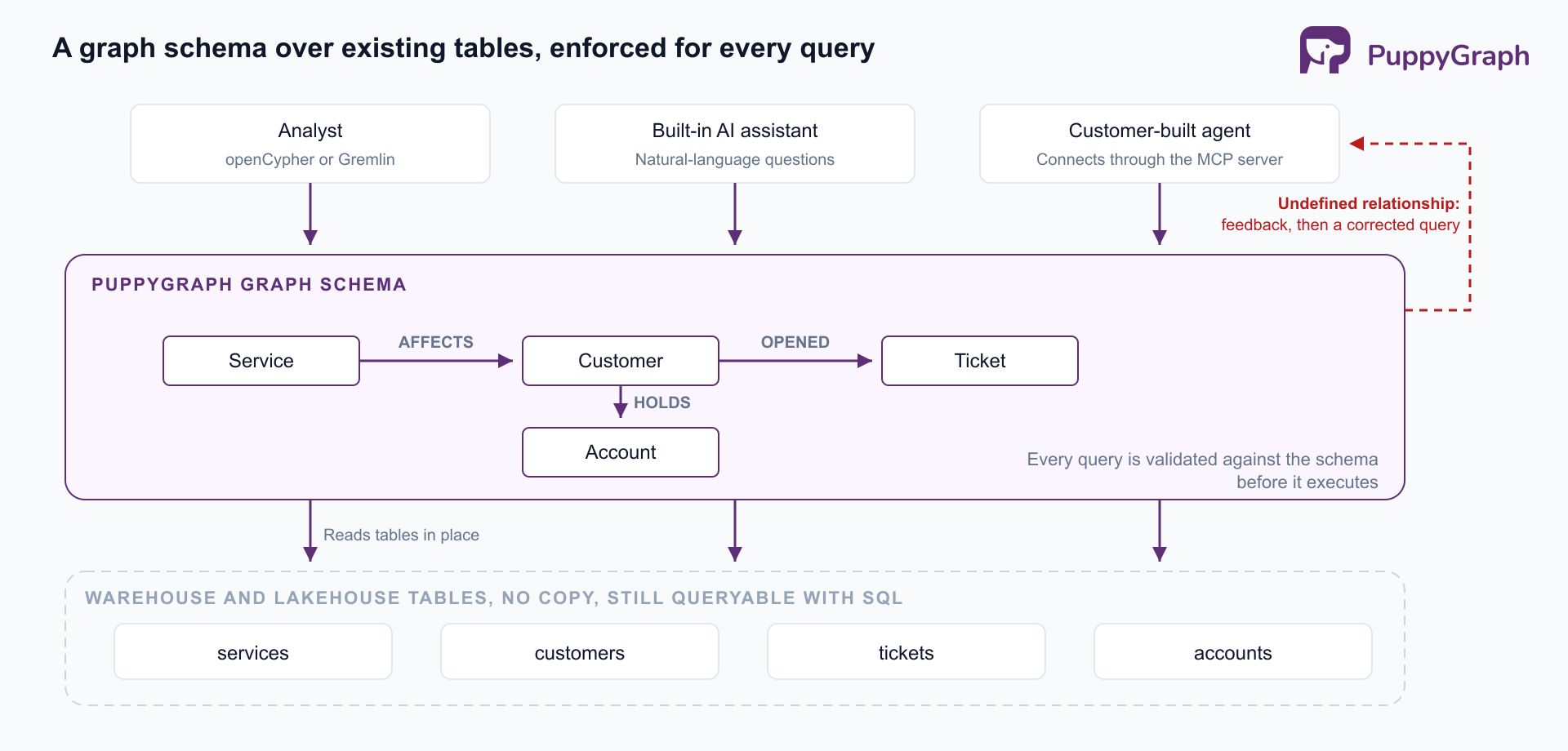
For agents, the schema is enforced: every query is validated against it before execution, and a reference to an entity or relationship the model does not define is rejected with structured, domain-language feedback that the agent can use to correct its query. PuppyGraph's built-in AI assistant runs that self-correction loop end to end: it turns a natural-language question into graph queries against the schema, uses the rejection feedback to correct invalid references, and follows up with related queries to build a complete answer. For agents a team builds itself, PuppyGraph's MCP server gives any MCP-compatible agent tools to read the graph schema and run openCypher or Gremlin queries against it.
How to measure AI data readiness
Readiness is measured per use case, against criteria set before the data work begins.
Coverage. Track the share of required sources connected, required fields populated, and known edge cases represented.
Quality against thresholds. Set a threshold for each dimension that matters and measure continuously: label agreement for training data, duplication and staleness for a RAG corpus, freshness lag against the inference SLA. There is no universal passing grade.
Metadata and governance coverage. Measure the share of in-scope datasets with an owner, a description, a sensitivity classification, lineage, and an access policy. A catalog supplies these cheaply, and they are useful leading indicators.
Downstream evaluation. The final test is the AI system's behavior on held-out evaluation data: accuracy and calibration for models, retrieval recall and answer correctness for RAG, and the share of agent-generated queries that are valid and return correct answers. When results fall, lineage should lead back to the data change behind it.
Coverage and governance metrics explain the gaps before a model is built; downstream evaluation confirms whether closing them worked.
Challenges in creating AI-ready data
The obstacles are mostly organizational and architectural.
Silos and copies. One use case's data usually spans systems owned by different teams. Copying it into an AI-specific store solves access now and creates freshness, security, and consistency problems later.
Missing semantics. Much of what makes data interpretable is undocumented: which of three customer tables is authoritative, what a status code means, which join path is correct. Capturing it in machine-readable form is slow, cross-team work.
Permissions that do not follow the data. Access controls defined in a source system are easily lost when data moves into a training set or vector index, which can then expose restricted content to any user who asks the right question.
Keeping data ready. Schemas change, distributions drift, documents go stale, and regulations change what may be used. Readiness decays without continuous pipelines, monitoring, and owners.
Conclusion
AI-ready data is data fit for a specific AI use case: representative, current, documented, and governed for the way a model, retrieval pipeline, or agent will consume it. The teams that succeed treat readiness as a property of the platform: one governed copy, pipelines that keep data ready as sources change, quality measured continuously, and semantics explicit enough for machines to use without guessing.
Try the forever-free PuppyGraph Developer Edition and book a demo with the team to see how openCypher and Gremlin queries run over warehouse and lakehouse tables, with no graph-specific ETL, giving AI agents an enforced model of the entities and relationships your data already contains.

Sa Wang is a Software Engineer with exceptional mathematical ability and strong coding skills. He holds a Bachelor's degree in Computer Science and a Master's degree in Philosophy from Fudan University, where he specialized in Mathematical Logic.


