

Data Strategy: Framework, Benefits & Best Practices
.png)
Organizations are spending more on data than ever and trusting it about the same as before. In the 2025 AI & Data Leadership Executive Benchmark Survey, 98% of data and AI leaders said their companies are increasing investment in data and AI, yet only around a third described their organizations as data-driven. That gap comes from strategy, not tooling: decisions about what data to collect, how to govern it, where it lives, and which outcomes it serves are being made locally, one team and one project at a time, instead of deliberately.
This guide covers what a data strategy is, why it matters, the components that make one effective, how to align it with business goals, the roles of governance and architecture, how AI raises the stakes, and the challenges, best practices, metrics, and mistakes that decide whether the strategy changes anything.
What is a data strategy?
A data strategy is a long-term plan for how an organization collects, stores, governs, and uses data to serve its business goals. It is a set of decisions, not a set of tools: which data matters and which does not, who owns it, what quality bar it must meet, where it lives, who may use it for what, and which business outcomes it is expected to move. The technology stack is an output of those decisions, not a substitute for them.
A useful way to frame the decisions comes from DalleMule and Davenport’s “What’s Your Data Strategy?” (Harvard Business Review, May-June 2017), which splits data strategy into defense and offense. Defense covers minimizing downside risk: security, privacy, regulatory compliance, data quality, and a governed single source of truth. Offense covers creating upside: analytics, personalization, new data products, and faster decisions. Every organization needs both, but the right balance is industry-specific; a hospital weights defense heavily, a consumer app weights offense, and the strategy’s job is to make that trade-off explicit rather than letting it emerge by accident.
A data strategy is also distinct from the artifacts that implement it. Data governance is the control system the strategy prescribes; data architecture is the technical design it motivates. Both are covered below as components; the strategy is the layer above them that says why they exist and what they must achieve.
Why every organization needs a data strategy
Without a strategy, data decisions still get made; they just get made implicitly, by whoever builds the next pipeline. The case for making them deliberate has sharpened along four lines.
AI has raised the price of unmanaged data. Gartner (February 2025) predicts that through 2026, organizations will abandon 60% of AI projects unsupported by AI-ready data, and reports that 63% of organizations either do not have or are unsure they have the right data management practices for AI. AI projects inherit whatever the data estate already is; a strategy is how the estate gets ready before the projects arrive.
Silos compound quietly. Each team choosing its own store, schema, and definitions is locally rational and globally expensive; the costs appear later, as reconciliation work, contradictory dashboards, and integration projects that exist only to undo earlier fragmentation.
Regulation keeps expanding. GDPR and CCPA made personal-data handling a board-level concern, and the EU AI Act extends that scrutiny to the data feeding AI systems, with obligations phasing in through 2026 and 2027. Compliance retrofitted onto an unmanaged estate costs far more than compliance designed in. Cost now scales with usage. Cloud platforms price storage and compute elastically, so an ungoverned estate does not just confuse analysts; it bills the company monthly for its own sprawl.
All four pressures punish improvisation with a delay. A data strategy is how an organization pays those costs early and once, instead of late and repeatedly.
Core components of an effective data strategy
Effective strategies vary in emphasis but converge on the same six components.
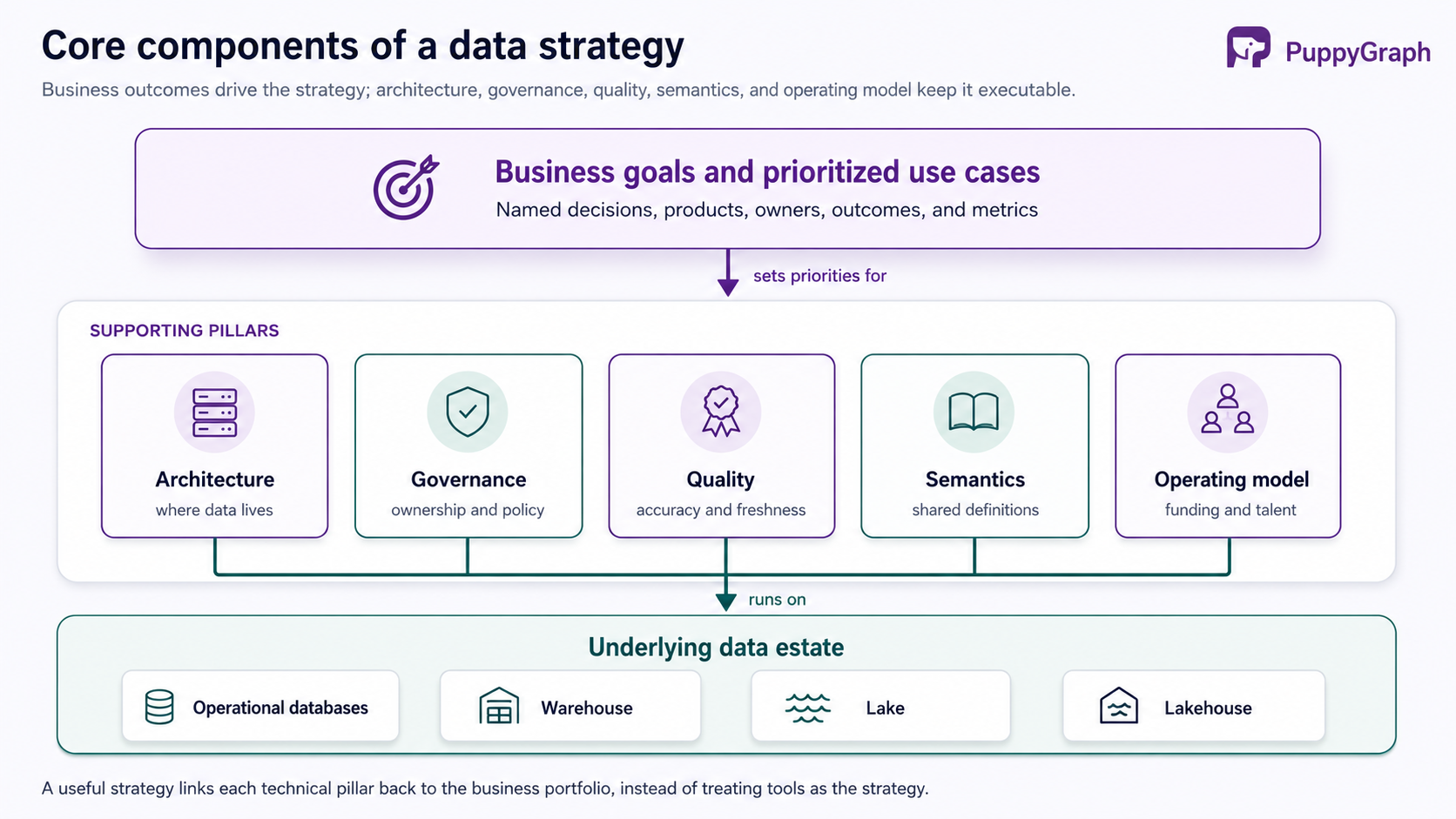
A business-aligned use-case portfolio. The anchor component: a prioritized list of decisions, processes, and products the data should improve, each with an owner and an expected outcome. Everything else in the strategy exists to serve this list.
Data architecture. Where data lives and how it moves: operational stores, the warehouse or lake, pipelines, and the engines that query them. The strategy sets the principles; the architecture section below covers the substance.
Data governance. Ownership, policies, access control, and compliance: who is accountable for each dataset and what rules its use must follow.
Data quality management. Explicit quality expectations (accuracy, completeness, freshness) attached to the datasets that matter, with monitoring to detect drift and owners accountable for fixing it, rather than a general aspiration to clean data.
Semantics and metadata. Shared definitions of the entities the business runs on (customer, account, order) plus the catalog, lineage, and documentation that make data findable and interpretable. Long treated as optional hygiene, this component became load-bearing with AI consumption, a point the AI section returns to.
The last component determines whether the strategy can survive contact with the organization that has to run it.
Operating model and talent. Who does the data work and how it is funded: central platform team vs. embedded analysts, project funding vs. product funding, and the skills the plan assumes.
The components are not a menu. A strategy that specifies architecture but skips governance, or names use cases but ignores the operating model, fails at the seam it skipped.
Aligning data strategy with business goals
The most common failure mode in data strategy is strategic: the plan is written about data instead of about the business. Alignment is a working method, not a slide.
Start from decisions, not datasets. Inventory the highest-value decisions the organization makes (pricing, credit, routing, retention, capacity) and work backwards to the data each one needs, at what freshness and quality. This ordering prevents the classic inversion where a platform gets built first and goes looking for users afterwards.
Prioritize a portfolio, not a wishlist. Score candidate use cases on business value and feasibility given the current estate, then sequence them so early wins fund later infrastructure. A strategy that promises everything in year one is a strategy that has not made choices.
Attach each use case to an accountable owner and a metric. “Improve customer analytics” is not alignable; “reduce churn in the self-serve segment, owned by the growth lead, measured quarterly” is. The metric is what lets the strategy be judged later.
Fund data as a product, not a project. Projects end; the datasets and pipelines they leave behind do not. Treating shared datasets as products with owners, consumers, and roadmaps keeps them maintained after the launch team moves on.
Alignment done this way also settles the offense-defense balance empirically: the use-case portfolio reveals whether near-term value lies in new analytics or in getting compliance and trust right, instead of leaving that balance to taste.
The role of data governance in data strategy
Governance is the component most often misread as bureaucracy, and the misreading is expensive in both directions: too little and the estate degrades into contradictory numbers and compliance exposure; too much, imposed as a police function, and teams route around it.
Ownership and stewardship come first. Every dataset that matters needs a named owner accountable for its quality and meaning, and stewards close to the data who handle definitions and access day to day. Policies without owners are documentation, not governance.
Policies should be executable. Access control, retention, masking, and classification work when they are enforced in the platform (catalog-driven permissions, column-level masking, audit logs) rather than described in a PDF. The test of a governance program is whether its rules fire without a human remembering them.
Governance is what makes self-service safe. The payoff for the discipline is speed: when quality expectations, definitions, and access rules are explicit and enforced, new teams and new tools can be pointed at the data without a gatekeeping committee in the loop.
The governance mandate is also widening. A Gartner survey (May 2025) found that 70% of chief data and analytics officers are now responsible for their organization’s AI strategy and operating model as well. The consolidation reflects a real dependency: AI governance is mostly data governance, because model behavior inherits the lineage, quality, and access properties of the data underneath it.
Building a modern data architecture to support your strategy
Architecture is where the strategy’s principles become concrete, and the principles matter more than the vendor names, because platforms change faster than strategies should.
Consolidate analytical data on a shared foundation. The center of gravity is a cloud data warehouse, a data lake, or their convergence, the lakehouse, which applies warehouse-grade tables and transactions over lake storage. Which one fits depends on the mix of structured and unstructured data the use-case portfolio actually needs.
Prefer open formats at the storage layer. Standardizing on open table formats such as Apache Iceberg or Delta Lake keeps the storage decision reversible: engines can be added or swapped without migrating the data. For a strategy, this is the difference between committing to a vendor and committing to an architecture.
Design pipelines for the freshness the use cases demand. Batch ELT covers most reporting; streaming ingestion earns its complexity only where a use case genuinely turns on minutes-old data. The strategy should name which use cases those are, because real-time everything is a cost decision disguised as an ambition.
Plan for one copy of the data, many engines. The strongest consequence of open formats is that new analytical capabilities become a matter of pointing another engine at the same tables: a SQL engine for BI, Spark for machine learning, and a graph query engine for relationship-shaped questions (fraud rings, dependency chains, customer networks) that SQL handles poorly as self-join chains. PuppyGraph, for example, connects directly to warehouse and lakehouse tables and queries them as a graph with no ETL and no second copy. Each engine added this way extends the estate without adding a silo.
An architecture built on these principles does not predict the future; it stays cheap to change when the future arrives, which is the most a strategy can ask of it.
Leveraging AI and analytics through a data strategy
Analytics ambitions climb a maturity curve: descriptive reporting, then diagnostic and predictive work, then AI systems acting with less human review. A data strategy’s job is to make each rung reachable, because every rung consumes the same estate with stricter requirements.
BI and self-service analytics need conformed, documented, governed tables; this is where the governance and quality components pay off first.
Machine learning adds demands on history and lineage: models train on years of raw events, and reproducibility requires knowing exactly what data a model saw.
AI agents and assistants are the newest consumer, and the most demanding. They query without a human in the loop, at machine volume, and their failure mode is distinctive: a generated query can be syntactically perfect and semantically wrong, joining tables that should not join or referencing entities that do not exist.
That failure mode is why the semantics component of the strategy has moved from hygiene to infrastructure. Human analysts absorb tribal knowledge about what tables mean; an AI agent has only what the estate makes explicit. The emerging pattern is a semantic layer in the form of an ontology: a defined model of the business’s entities, relationships, and properties that sits between the data and its automated consumers, with queries validated against it before execution. This is the layer PuppyGraph occupies: the graph schema it defines over existing warehouse and lakehouse tables functions as an enforced ontology, invalid entity or relationship references are rejected with structured, domain-level feedback, and an agent grounded on it can use that feedback to correct itself rather than returning a confidently wrong answer. Teams at Coinbase, eBay, and AMD use PuppyGraph over their existing data; AMD builds its graph layer over an Apache Iceberg lake spanning tickets, code, logs, and telemetry. The strategic reading: AI raises the required grade on components a good strategy already has, quality, lineage, governance, and above all explicit semantics.
Common challenges in data strategy implementation
Most data strategies fail in the middle, between the approved document and the changed organization. The recurring obstacles are worth naming because they are predictable.
Culture outweighs technology. In the 2025 AI & Data Leadership Executive Benchmark Survey, 92% of data leaders identified people and organizational change, not technology, as the primary barrier to building a data-driven culture. Incentives decide behavior: teams adopt shared data when it is easier and more trusted than their local copy, and no mandate substitutes for that.
Legacy estates resist tidy plans. Decades of operational systems, undocumented pipelines, and load-bearing spreadsheets do not migrate on a slide’s schedule. Strategies that assume a clean slate stall; those that sequence around the messiest systems keep moving.
Quality debt surfaces late. Data problems hide until a use case depends on them, which is typically mid-implementation. Profiling the data behind the first use cases before committing dates converts surprises into line items.
Talent and funding models lag. Skills concentrate in a central team while demand is distributed, and funding runs out when the project ships even though the datasets it created need permanent owners. Both are operating-model problems the strategy must address explicitly.
None of these challenges is avoidable in full; the difference between strategies that survive and strategies that shelf is whether the challenges were budgeted for or discovered.
Best practices for developing a data strategy
The practices that separate working strategies from documents share one property: they keep the strategy falsifiable and iterative rather than aspirational.
Anchor everything to the use-case portfolio. Every architectural choice, governance policy, and hire should trace to a use case someone is accountable for. If a component cannot be traced, it is a preference, not a strategy element.
Ship value in the first two quarters. Sequence the portfolio so an early use case lands visibly while foundations are still being built; a strategy that is all foundation invites cancellation.
Right-size governance to risk. Apply the heaviest controls to the data that carries real regulatory or financial exposure and the lightest that safety allows elsewhere. Uniform maximum governance is how strategies acquire a reputation for slowing everyone down.
Choose reversible architecture. Prefer open formats and interchangeable engines over single-vendor coupling, per the architecture principles above, so the strategy survives platform churn.
Treat AI readiness as data readiness. Resist a parallel AI initiative with its own data plans; route AI ambitions through the same portfolio, governance, and semantics as everything else.
The final practice keeps the strategy from freezing into a plan that no longer matches the estate.
Revisit on a cadence. A strategy is a living decision record: a 3-to-5-year direction reviewed and re-sequenced annually as use cases land, fail, or change shape.
Held together, these practices form a loop (prioritize, ship, measure, re-plan) rather than a waterfall, which is what lets the strategy absorb the surprises the challenges section promised.
How to measure the success of your data strategy
A strategy without metrics cannot be defended at budget time or corrected mid-course. The workable approach mixes lagging value metrics with leading health metrics.
Business outcome metrics are the lagging truth: the per-use-case measures defined during alignment (churn reduced, fraud losses cut, forecast error narrowed), reviewed on the cadence the owning executive already uses. If no use case moved a business number, the strategy did not work, whatever the platform metrics say.
Adoption and trust metrics lead the outcomes: how many teams consume governed datasets, what share of reporting runs on certified sources instead of local extracts, and how often data products are reused. Reuse is the most honest signal, because teams only reuse what they trust.
Operational health metrics track the estate itself: time from question to usable data, quality SLA attainment on critical datasets, incident counts and time to resolution, and unit costs (cost per query, per pipeline, per team) that catch sprawl early.
Risk metrics cover defense: audit findings, access-review completion, and time to fulfill regulatory requests such as data-subject deletions.
Two disciplines keep the scorecard honest. Baseline every metric before the strategy starts, or improvement claims will be unfalsifiable. And resist vanity metrics: dashboards created, rows ingested, and platform uptime measure activity, not value.
Common mistakes to avoid
The recurring mistakes are near-inversions of the practices above, which is exactly why they recur: each one is the locally easier path.
Buying a platform and calling it a strategy. A lakehouse subscription answers none of the questions in the components section: not ownership, not quality, not semantics, not the use-case portfolio. Technology-first strategies produce well-architected estates nobody uses.
Boiling the ocean. Cataloging every dataset and governing every table before delivering any use case exhausts sponsorship before value appears. Scope discipline is a survival trait.
Governance as an afterthought, or as police. Retrofitting governance after an incident is expensive; imposing it as a gatekeeping committee teaches teams to route around it. Executable, risk-sized governance is the narrow path between the two.
Copying another company’s strategy. The offense-defense balance, regulatory exposure, and data maturity that shaped a strategy elsewhere do not transfer. Frameworks transfer; conclusions do not.
Treating the strategy as finished. A document with no review cadence ages into fiction as platforms, regulations, and business priorities move.
One final mistake sits under the rest: treating adoption as a communication problem instead of an operating-model problem.
Ignoring the people who must change behavior. The 2025 AI & Data Leadership Executive Benchmark Survey 92% finding above is the summary: strategies fail on incentives and habits far more often than on architecture diagrams.
Most of these mistakes are visible early if the measurement section’s leading metrics are in place, which is one more argument for standing them up first.
Future trends in enterprise data strategy
The near-term direction of data strategy is set less by new platforms than by a new consumer, AI systems querying data without a human in the loop, and by the estate’s response to that.
Semantic layers become first-class infrastructure. As agents and assistants take a growing share of query traffic, the explicit ontology described in the AI section becomes the contract that keeps automated consumers grounded, budgeted for the way storage and compute already are.
Open table formats become the default substrate. The Iceberg and Delta Lake convergence across warehouses and lakes keeps eroding the storage-level lock-in that strategies used to plan around, and shifts differentiation to engines and governance layers over shared tables.
Data products and federated ownership spread selectively. The data mesh vocabulary of domain-owned data products is being absorbed pragmatically: fewer wholesale reorganizations, more product thinking applied to the datasets many teams depend on.
Regulation shapes design directly. With the EU AI Act’s obligations phasing in through 2026 and 2027, lineage, documentation, and quality evidence for the data behind AI systems stop being internal virtues and become compliance artifacts.
Real-time narrows to where it pays. Streaming matures from an aspiration into a targeted tool, applied to the specific use cases (fraud, operations, personalization) whose economics justify it.
None of these trends replaces the fundamentals; each one raises the return on a strategy that already treats semantics, governance, and open architecture as core components rather than add-ons.
Frequently asked questions about data strategy
What is the difference between a data strategy and data governance? The strategy is the overall plan linking data investments to business goals; governance is one of its components, the control system of ownership, policies, and enforcement that keeps data trustworthy and compliant. A strategy without governance generates insights nobody trusts.
Who should own the data strategy? A single accountable executive, typically a chief data (and analytics) officer where one exists, with visible CEO-level sponsorship and business-unit leaders owning the individual use cases. Ownership spread across a committee is the same as no ownership.
How often should a data strategy be updated? Hold the 3-to-5-year direction steady and re-sequence the roadmap annually, or sooner when something material changes: a regulation, an acquisition, or a capability shift of the kind generative AI caused.
Do small companies need a data strategy? Yes, in proportion: a few pages naming the critical datasets, their owners, the quality bar, and the first use cases. The cost of deferring strategy scales with the data, not with headcount.
How does AI change a data strategy? It raises the required grade on existing components rather than adding a separate track: stricter quality and lineage (model behavior inherits both), governance that extends to training and retrieval data, and explicit semantics, since AI systems consume only what the estate makes machine-readable. Organizations whose data was not managed this way are the ones in Gartner’s 60% abandonment forecast.
Conclusion
A data strategy is the difference between a data estate that accumulates and one that compounds. The components are knowable (a business-anchored use-case portfolio, executable governance, reversible open architecture, explicit quality and semantics, an operating model that funds data as a product), and the discipline is iterative: ship value early, measure honestly, re-plan annually. What has changed is the audience. Data strategies used to serve dashboards and analysts; they now also serve machine consumers that inherit every ambiguity the estate carries and none of the tribal knowledge that papers over it. The organizations that treat that shift as a data-readiness problem, not an AI-tooling problem, are the ones whose AI investments will survive contact with production.
Try the forever-free PuppyGraph Developer Edition and book a demo with the team to see how openCypher and Gremlin queries run over warehouse and lakehouse tables, with no graph-specific ETL, adding the relationship analytics and enforced ontology a modern data strategy plans for.

Hao Wu is a Software Engineer with a strong foundation in computer science and algorithms. He earned his Bachelor’s degree in Computer Science from Fudan University and a Master’s degree from George Washington University, where he focused on graph databases.


