


What Is a Graph Schema?
Ask a graph database MATCH (p:Persno)-[:WORSK_AT]->(c:Company) RETURN p and most engines will not raise an error. They will return zero rows, because the label Persno and the relationship type WORSK_AT simply do not exist, and a graph with no schema has no way to tell a typo from a query that is correctly spelled and legitimately found nothing. A graph schema is what closes that gap: the declared or assumed set of node labels, relationship types, and properties that every query, dashboard, and increasingly AI-generated query is written against. Get the schema right and that vocabulary is shared and checkable across every consumer; skip it, and correctness quietly depends on every query author remembering the same spelling.
This post covers what a graph schema is, why the decision carries more weight in a graph than a table's column list ever did, how a schema functions once queries run against it, the components that make one up, the two representations a graph schema can take, how schema-based and schema-optional databases differ in practice, and a practical process for designing a schema that holds up under real queries.
What is a graph schema?
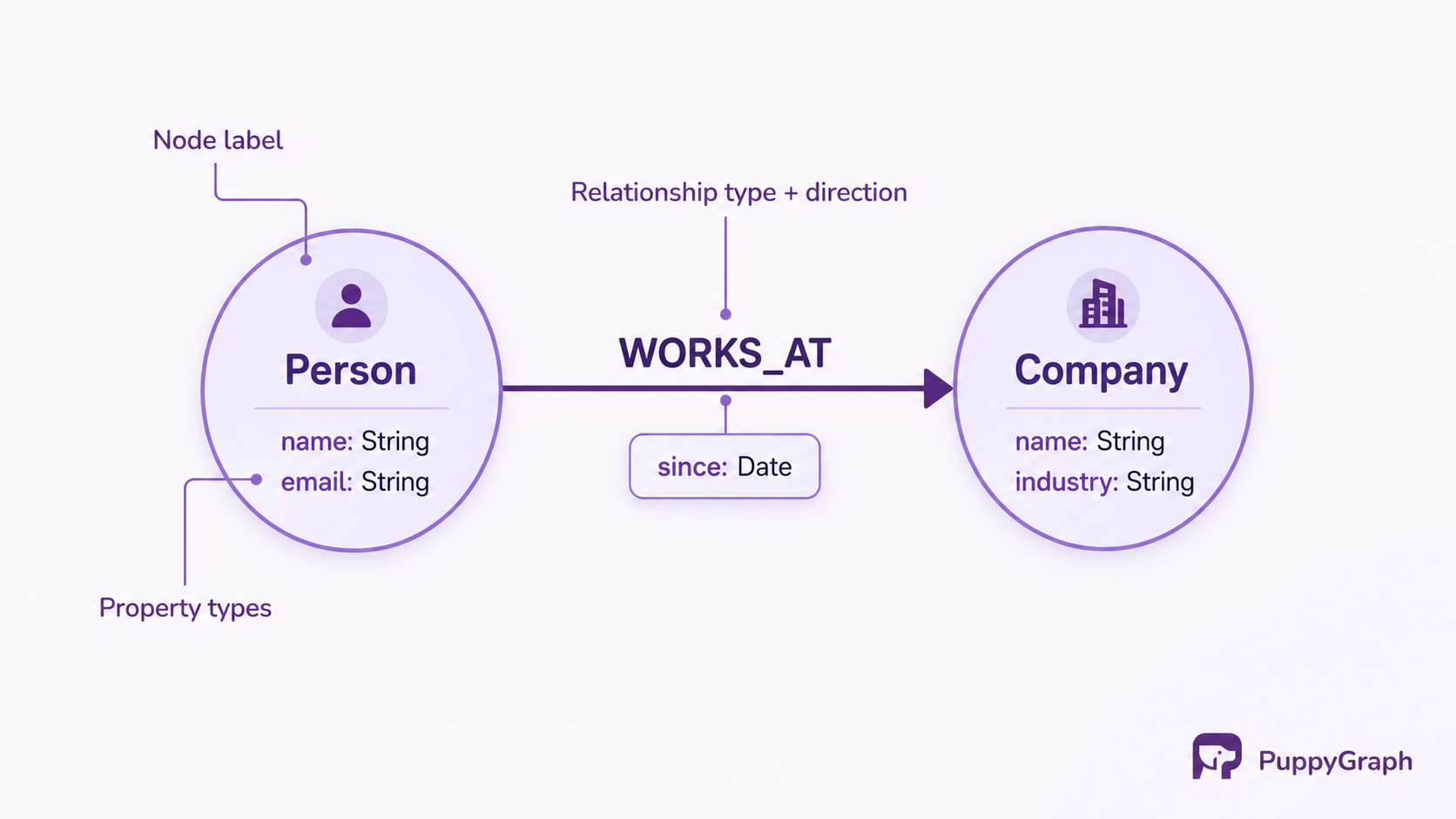
A graph schema is a structural description of what a graph database contains: which node labels exist, which relationship types connect them and in which direction, and which properties each node and relationship carries, along with their data types. It plays a similar role to a table definition in a relational database, naming the fields a row can have, but it additionally has to describe the shape of relationships between records, which is exactly the part a table's column list has no vocabulary for.
Graph schemas take two forms in practice, corresponding to the two graph data models in active use. This post focuses on the labeled property graph, the model behind Neo4j, Amazon Neptune's property-graph mode, and most operational graph databases, where the schema is expressed as node labels and typed relationships. The other form, RDF, describes structure as classes and typed properties instead; the "Types of graph schemas" section below covers the difference directly, and our posts on taxonomy vs ontology and what an ontology is go deeper on the RDF and ontology side of that split.
Why graph schemas matter
A schema matters for three overlapping reasons: what a query can trust, what a query planner can use, and what every later consumer of the graph can rely on.
Silent failure without one. In most schema-optional graph databases, a query against a label or relationship type that doesn't exist doesn't error. It just matches nothing, which looks identical to a query that is spelled correctly and legitimately found no data. A relational database catches a typo'd column name at parse time; a schema-less graph traversal catches it by returning an empty result set that could just as easily mean "no data" as "wrong vocabulary." A schema, even an informally maintained one, is what lets a query author or a validation layer distinguish the two before the query ever runs.
Faster traversals. Labels and relationship types are also how a graph engine narrows its work. A label lets the engine maintain a per-label index, so a pattern like MATCH (p:Person) starts from an index of Person nodes rather than scanning every node in the graph, and a relationship-type filter narrows the set of edges considered at each hop the same way. Without labels and types to filter on, a traversal has no cheap way to skip the parts of the graph it doesn't need.
A shared vocabulary across consumers. Analysts writing ad hoc queries, applications with hard-coded traversals, and text-to-Cypher systems generating queries from natural language all depend on the schema being the one source of truth for what exists. A generated query that references a label or property the schema doesn't have repeats the same failure mode at machine scale: a system that cannot tell "no matches" from "wrong vocabulary" reports a confident answer that is actually a miss.
All three reasons point the same direction. A schema turns assumptions that would otherwise live only in the head of whoever wrote the first query into an explicit structure that the database, the query planner, and every later query author, human or generated, can check against.
How a graph schema works
A graph schema shows up in three places: at write time, at query time, and inside the query planner.
At write time, a node is tagged with one or more labels (:Person, or :Person:Employee for a node that is both an employee and a person more generally), and a relationship is given exactly one type (:WORKS_AT), a direction fixed at creation, and its own set of properties, distinct from the properties on either endpoint. In a schema-optional engine, none of this is validated against a predeclared definition; the labels, types, and properties a write introduces simply become part of what the graph now contains. In a schema-based engine, covered later in this post, the same write is checked against a schema declared in advance and rejected if it doesn't conform.
At query time, a pattern names the exact vocabulary it expects to traverse:
MATCH (p:Person)-[:WORKS_AT]->(c:Company)
WHERE c.industry = 'aerospace'
RETURN p.name, c.name
Person, WORKS_AT, and Company only make this query meaningful because the schema and the query agree on what those names refer to. Change the relationship's direction in the data (say, if the graph actually models Company -[:EMPLOYS]-> Person) and the query above has to change to match, or it silently returns nothing.
Inside the planner, that same label and type information is what lets the engine decide where to start and how far to look. A query that begins from Person nodes and follows WORKS_AT edges only has to consider the subset of the graph tagged with those names, not every node and relationship that exists.
The schema, in other words, is not a document that sits next to the database. It is the vocabulary the write path produces, the query path consumes, and the planner indexes against, which is why a mismatch between what a query assumes and what the graph actually contains shows up as a correctness or performance problem rather than a syntax error.
Core components of a graph schema
Node labels. A label tags a node with its type: Person, Company, Order. Most labeled property graph databases let a node carry more than one label, which is how a schema expresses that an entity is simultaneously a general type and a more specific one, an Employee who is also a Person, without duplicating the node.
Relationship types and direction. A relationship carries exactly one type, and that type is directional: WORKS_AT runs from a Person to a Company, not the reverse, even though a query can traverse it either way. The type is also where cardinality expectations live informally: nothing stops a Person from having many WORKS_AT edges, but the schema is where a team documents whether that's expected or a data quality issue.
Properties and their types. Both nodes and relationships carry properties as typed key-value pairs: a Person.name as a string, a WORKS_AT.since as a date. Deciding whether an attribute belongs on a node or on the relationship between two nodes is itself a schema decision, covered further in the design section below.
Constraints. A constraint states a rule the data has to satisfy: uniqueness (no two Person nodes share an email), existence (every Person must have a name, in databases that support it), or a node key (properties that together must be unique). Constraints turn a schema from documentation into something the database enforces on write.
Indexes. An index is built on a label and property combination to make lookups by that property fast, the same role an index plays in a relational database. A schema that names the properties a graph is actually queried on is also, implicitly, the map of where indexes belong.
Types of graph schemas
Two representations of a graph schema are in active use, corresponding to the two graph data models a graph-curious engineer is likely to run into.
A labeled property graph schema names node labels and relationship types directly, and it is the form the rest of this post has used throughout:
CREATE (p:Person {name: 'Alice'})-[:WORKS_AT {since: date('2023-01-15')}]->(c:Company {name: 'Acme'})Person and Company are labels, WORKS_AT is a relationship type, and since is a property scoped to the relationship rather than to either node.
An RDF schema, expressed in RDFS, OWL, or SHACL, describes the same kind of structure as classes and typed properties with declared domains and ranges, over data modeled as subject-predicate-object triples rather than as nodes and edges with inline properties:
:Person a rdfs:Class .
:Company a rdfs:Class .
:worksAt a owl:ObjectProperty ;
    rdfs:domain :Person ;
    rdfs:range  :Company .
The rdfs:domain and rdfs:range declarations are doing the same job the arrow direction does in the Cypher example above: stating which class a relationship may originate from and which class it may point to. The practical difference is where that structure is checked. A labeled property graph schema is usually enforced (or simply assumed) by the database engine that stores nodes and relationships directly; an RDF schema is checked by a reasoner or a SHACL validator running against triples, and it can additionally support inference, deriving new facts from stated rules rather than only validating existing ones. Our post on taxonomy vs ontology covers that RDF and ontology side of graph modeling, including the inference and constraint-checking layers, in more depth.
Schema-based vs. schema-less graph databases
Graph databases split into two camps on how strictly they hold data to a schema, and the difference shows up the moment data is loaded rather than only when it's queried.
Schema-based engines require the schema declared before any data is written. TigerGraph is a documented example: its GSQL data definition language requires CREATE VERTEX and CREATE EDGE statements, naming a primary key and typed properties, before a single row loads, and a write that doesn't conform is rejected. KuzuDB takes the same approach with CREATE NODE TABLE and CREATE REL TABLE statements declaring typed columns and multiplicity constraints up front. The upfront cost buys validated writes and lets the engine lay out storage more efficiently, since it knows in advance exactly what every row of a given type looks like.
Schema-optional (sometimes called schema-free) engines let data define its own shape as it's written. Neo4j is the documented example: any node can take any label and property at any time, with indexes and constraints available as opt-in additions rather than a precondition for writing. Amazon Neptune leans the same direction: node and relationship properties are non-mandatory attributes, and the same engine serves either a labeled property graph or an RDF model without a schema declared in advance. The trade-off runs the other way from the schema-based case: onboarding messy data is friction-free, but nothing in the engine catches a typo'd label or a property that drifted to a new name elsewhere in the graph; a validation layer, if one exists, sits outside the database.
Neither approach is a strict upgrade over the other. A schema-based engine fits best when the data's shape is already known, often because it arrives from relational sources with their own schema, and validation at write time is worth the modeling cost. A schema-optional engine fits best for exploratory or fast-evolving data, where declaring structure before it's understood would slow the work down more than an occasional typo'd label costs later.
A third path avoids the choice by skipping the copy of the data altogether. PuppyGraph's schema designer lets a user map existing tables in a SQL database, warehouse, or lakehouse to node labels and relationship types through a visual interface, producing a graph schema without ingesting the underlying data; the schema is something the user defines on top of the existing tables, not something PuppyGraph infers from them. Every openCypher and Gremlin query then runs against that declared schema, and a query referencing a label or relationship type the schema doesn't define is rejected with structured feedback rather than silently returning nothing, the same failure mode this post opened with. Companies including Coinbase, eBay, and AMD use this approach to define a graph schema over data that stays in their existing warehouse or lakehouse.
How to design an effective graph schema
Start from the questions, not the source tables. A schema modeled by mechanically copying relational tables into node labels tends to reproduce the relational database's join structure instead of the traversal patterns the graph is meant to answer. Write down the two or three multi-hop questions the graph needs to answer well, and let those decide which entities need separate node labels and which relationships need to exist directly, rather than being reconstructed through a join table at query time.
Name labels as nouns and relationship types as verbs. The conventional style across most property graph tooling is PascalCase for labels (Person, Company) and SCREAMING_SNAKE_CASE for relationship types (WORKS_AT, SUPPLIED_BY). The convention isn't cosmetic: a pattern like (p:Person)-[:WORKS_AT]->(c:Company) should read like a sentence, and a schema that keeps to it is easier for a new team member, or a text-to-Cypher system, to get right on the first try.
Decide where a property lives based on what it describes. A Person.name clearly belongs on the node: it describes the person regardless of any relationship they're part of. A since date describing when a person started working at a company belongs on the WORKS_AT relationship instead, because it describes the relationship, not either endpoint on its own.
Get cardinality and direction right early. Whether a relationship type is one-to-one, one-to-many, or many-to-many, and which direction it should be written in, are both easier to fix before queries and application code start assuming the current shape. Revisiting a relationship's direction later means rewriting every query pattern built against it.
Constrain and index what you'll actually query. Add uniqueness constraints on the properties that identify an entity, and indexes on the properties queries filter on most often, rather than indexing defensively across every property up front. A schema that constrains and indexes everything is no more informative than one that constrains nothing; the useful signal is in choosing the properties that matter to the graph's real query load.
Designing a schema this way keeps it anchored to the questions the graph exists to answer, which is also what keeps it from needing a rewrite the first time real query traffic arrives.
Conclusion
A graph schema is the vocabulary a graph database's write path produces, its query path consumes, and its planner indexes against: node labels, relationship types and direction, properties, and the constraints and indexes layered on top. That vocabulary matters more in a graph than in a relational table list because a graph query fails silently, not loudly, when it assumes structure the data doesn't have. Whether that vocabulary is enforced up front by a schema-based engine, left optional in a schema-free one, or mapped onto tables that already live somewhere else, the underlying job is the same: give every human, application, and AI system that queries the graph one shared, checkable definition of what it actually contains.
Try the forever-free PuppyGraph Developer Edition and book a demo with the team to see how openCypher and Gremlin queries run over warehouse and lakehouse tables, with no graph-specific ETL, against a schema you design once and map directly onto the tables you already have.

Hao Wu is a Software Engineer with a strong foundation in computer science and algorithms. He earned his Bachelor’s degree in Computer Science from Fudan University and a Master’s degree from George Washington University, where he focused on graph databases.

Get started with PuppyGraph!


Developer Edition
- Forever free
- Single noded
- Designed for proving your ideas
- Available via Docker install
Enterprise Edition
- 30-day free trial with full features
- Everything in developer edition & enterprise features
- Designed for production
- Available via AWS AMI & Docker install