


What Is Ontology Engineering ? Process & Examples
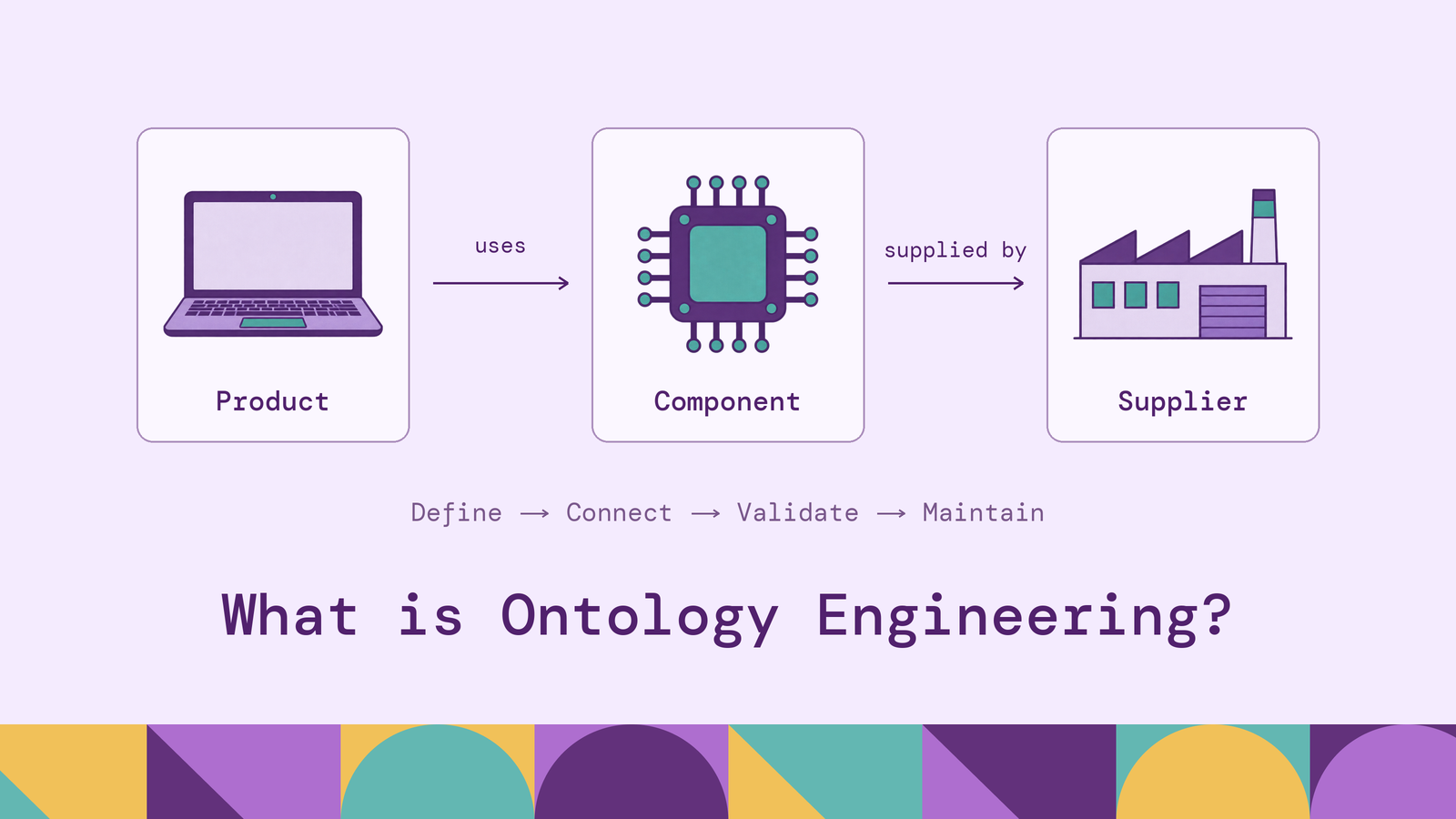
An enterprise ontology becomes useful when people and software can rely on its definitions to answer real questions. That requires agreement about what entities mean, mappings to the records that describe them, and tests that catch changes in meaning. Ontology engineering brings those responsibilities into a repeatable process.
This article explains that process, the challenges it exposes, and the use cases it supports. A supply-chain example connects the modeling decisions to an enterprise implementation, including validation, tool selection, and governance.
What is ontology engineering?
Ontology engineering is the discipline of designing, formalizing, evaluating, and maintaining explicit models of a domain's concepts and relationships. The ontology is the model; the engineering work makes it usable and keeps it aligned with the domain as requirements change.
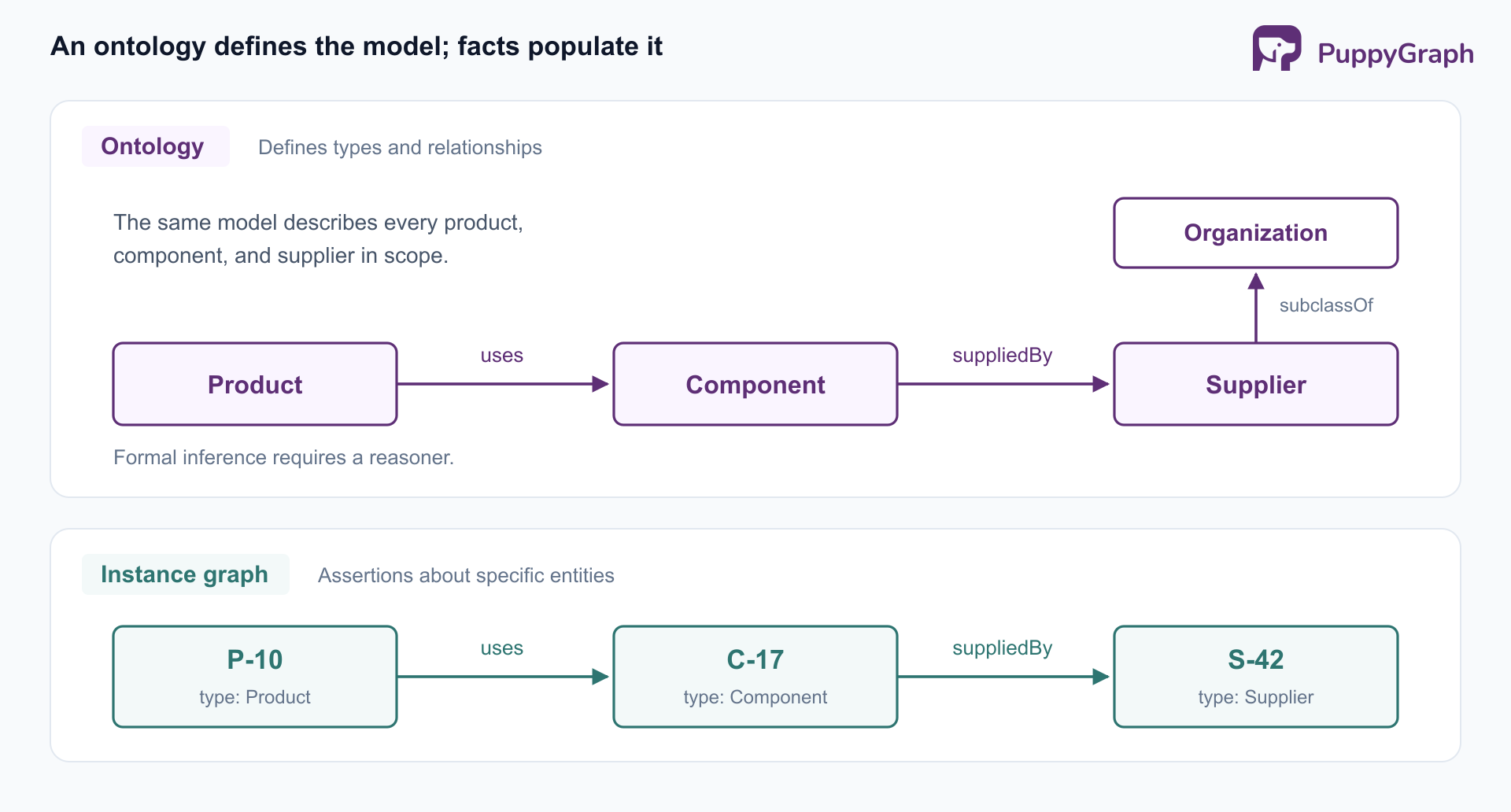
An ontology can describe classes of entities, relationships between them, attributes, and logical axioms. Consider a manufacturer that needs to understand its exposure to supplier disruptions:
The model defines what a supply relationship means. Individual facts, such as component C-17 being supplied by supplier S-42, populate it. In an ontology-backed knowledge graph, the ontology provides the shared vocabulary and semantics, while the graph also contains assertions about particular entities.
The implementation can vary. The Web Ontology Language (OWL 2) supports formal axioms that reasoning software can interpret. A property-graph schema can implement an operational model through node labels, edge labels, and properties. Mapping an ontology into that schema requires deciding how to handle its semantics: class inheritance or logical implications do not follow automatically from assigning graph labels.
Why is ontology engineering important?
Enterprise systems can share field names while describing different things. A procurement system's supplier record might represent a legal entity, while a logistics system's record represents a shipping location. Joining those records requires a decision about identity and meaning before it requires a query.
Shared definitions make integration reviewable. An ontology gives teams a place to distinguish the legal entity from the facility and define the relationship between them. Source mappings can then express those decisions explicitly. Engineers can review whether a mapping preserves the distinction instead of rediscovering it in each report.
Reusable relationships support consistent questions. Once teams agree on what suppliedBy means, a risk application and a procurement analyst can use the same relationship. They still need appropriate access, data coverage, and time filters, but they begin with a common interpretation of the path they are querying.
Machine-readable semantics enable checks. Formal axioms can support inference and consistency analysis; separately defined constraints can validate data against business requirements. These are distinct operations. A model may imply that every supplier is an organization, while a data-quality check requires a supplier identifier to be present.
The value comes from making those decisions reusable across consumers. When a single application already has clear definitions and adequate schema checks, a separate ontology may add little. It earns its maintenance cost when meaning must be shared across systems, teams, or applications.
The ontology engineering process
Established methodologies approach the work at different levels. Noy and McGuinness's Ontology Development 101 offers an iterative modeling approach built around scope, reuse, classes, properties, and instances. METHONTOLOGY treats ontology development as a lifecycle, including specification, conceptualization, implementation, evaluation, documentation, and maintenance. Its evolving-prototype approach allows the model to change as understanding improves.
The following workflow applies those principles to the supply-chain example.
1. Define scope through competency questions. A competency question states something the ontology-backed system should be able to answer. Start with concrete questions: Which products use components supplied by S-42? Which components have only one recorded approved supplier? Which supply relationships were valid when an order was placed?
These questions expose different requirements. The first needs product, component, and supplier relationships. The second also needs approval status and a trustworthy account of source coverage. The third needs historical validity. Agree on the initial scope and record what each answer requires before expanding the vocabulary.
2. Gather domain knowledge and evaluate reuse. Review source schemas, business definitions, representative records, and existing vocabularies with domain experts. Ask procurement staff to explain the difference between an approved supplier, a contracted supplier, and a supplier used on a purchase order. Similar labels are not evidence that the relationships are interchangeable.
Reuse an existing ontology where its definitions fit. Record which terms are adopted, how local terms relate to them, and which upstream release is used. A familiar term with a different meaning is a mapping problem to resolve, not an automatic match.
3. Model the concepts and choose a representation. Define the classes, relationships, identifiers, and attributes needed for the agreed questions. Write a plain-language definition and a concrete example for each important relationship. For suppliedBy, specify whether it describes an approved sourcing option, an active contract, or an observed delivery.
Choose the representation according to the required behavior. The Resource Description Framework (RDF) represents statements as subject-predicate-object triples. OWL adds formal semantics for expressing and reasoning over ontologies. A property graph can represent the entities and relationships needed for operational traversals. Document how any required inference or validation will run alongside the chosen representation.
4. Separate logical axioms from data constraints. OWL uses an open-world assumption: missing information is not automatically false. A restriction saying a component has a supplier does not, by itself, establish that the supplier is explicitly recorded in the dataset. Likewise, property domain and range axioms can infer types; they do not behave like database checks that simply reject an unexpected type. The OWL 2 Primer explains these semantics.
Use an explicit validation mechanism for requirements about recorded data. For an RDF implementation, the following shape, written in the Shapes Constraint Language (SHACL), requires each targeted supplier to have exactly one string-valued supplier identifier:
@prefix ex: <https://example.com/supply/> .
@prefix sh: <http://www.w3.org/ns/shacl#> .
@prefix xsd: <http://www.w3.org/2001/XMLSchema#> .


ex:SupplierShape
    a sh:NodeShape ;
    sh:targetClass ex:Supplier ;
    sh:property [
        sh:path ex:supplierId ;
        sh:minCount 1 ;
        sh:maxCount 1 ;
        sh:datatype xsd:string
    ] .
A supplier with no identifier fails this shape. A supplier with one string identifier passes this particular check. It does not establish that the identifier is unique across suppliers or that the supplier exists in an authoritative registry; those require additional checks. In a property-graph implementation, specify equivalent checks in the supported validation or data-quality layer.
5. Evaluate, release, and revise. Test competency questions against a small dataset with known answers. Include records that should pass, records that should fail, and cases where the evidence is incomplete. If the model uses formal reasoning, also check logical consistency and unexpected inferences. Domain experts should review the answers as well as the definitions.
Keep these examples as regression tests. When a relationship changes meaning, the affected queries should reveal the consequences before consumers adopt the new version. The model, source mappings, and tests together make an ontology release usable.
Ontology engineering challenges
The difficult decisions usually concern boundaries: what a concept includes, when two records identify the same entity, and how much of the world the available data describes.
Conflicting definitions. Procurement may use supplier to mean an approved organization, while accounts payable uses it for any payee. Forcing both into one class can create misleading answers. Preserve the distinction through explicit roles or relationships, and document which interpretation each application uses. A shared ontology needs agreed connections between local meanings, not identical terminology everywhere.
Entity identity and source quality. Defining Supplier does not determine whether two similarly named records refer to the same organization. Establish authoritative identifiers, matching rules, and a review path for uncertain matches. Incorrect merges can connect unrelated components and suppliers; missed matches can hide dependencies. Keep the evidence behind identity decisions available for inspection.
Time and incomplete knowledge. A supplier can lose approval, and a component can acquire a second source. Historical questions need dated relationships or modeled events. Missing relationships also require care: one recorded supplier does not prove that only one supplier exists. OWL's open-world semantics make this distinction explicit, but operational graph queries need the same care when their results are interpreted.
Scope and maintenance cost. A model can become difficult to maintain long before it covers the entire enterprise. Separate domain modules, define their interfaces, and add concepts when an agreed question requires them. Test the chosen reasoner and query engine against representative data as the model grows. Vocabulary size alone says little about either usefulness or execution cost.
These challenges make ownership part of the engineering work. Every consequential definition and mapping needs someone who can resolve ambiguity and approve a change.
Ontology engineering use cases
Ontology engineering is useful where an answer depends on how entities relate and on what those relationships mean. The following examples illustrate different requirements for the model.
Supply-chain dependency analysis. A manufacturer can connect products, components, suppliers, and facilities to investigate disruption exposure. The ontology distinguishes an approved supply option from a shipment that actually occurred. A risk analyst can then ask which products depend on a particular supplier and whether alternative sources are recorded. Historical analysis also requires the dates for which each relationship held.
Financial data integration. The Financial Industry Business Ontology (FIBO) defines concepts and relationships for financial business applications using OWL. An enterprise can evaluate its terms when aligning definitions across financial datasets. Adopting the vocabulary still requires mappings from local records and review of whether local definitions match the reference concepts.
Biological research and annotation. The Gene Ontology describes molecular functions, biological processes, and cellular components. It illustrates the value of a shared domain vocabulary for describing gene-product functions. Its distinction between a molecular activity and the entity performing that activity is also a practical modeling lesson: closely related concepts may need separate representations to preserve meaning.
AI retrieval and question answering. An ontology can give an AI application explicit entity types and relationships to use when retrieving evidence. A supply-chain assistant answering a disruption question can retrieve the product-component-supplier paths that support its response. In an ontology-driven agent, query validation can also identify references outside the model and return feedback for correction. The implementation must still evaluate whether the selected path answers the user's question and whether the retrieved facts support the generated answer.
Across these cases, the acceptance test is a domain question with a defensible answer. A model's usefulness depends on the distinctions it preserves and the evidence its consumers can retrieve.
How to build an enterprise ontology
An enterprise implementation needs a maintained connection between definitions, source data, and consumers. Start with a bounded domain and establish that connection before extending the model across departments.
Assign ownership around the first use case. For the supply-chain example, procurement should approve the meaning of an approved supplier, a data owner should confirm the source of that status, and an engineering owner should maintain the mappings and queries. Choose an initial question such as identifying products exposed to a named supplier. Define the expected answer, the relevant time period, and the required source coverage.
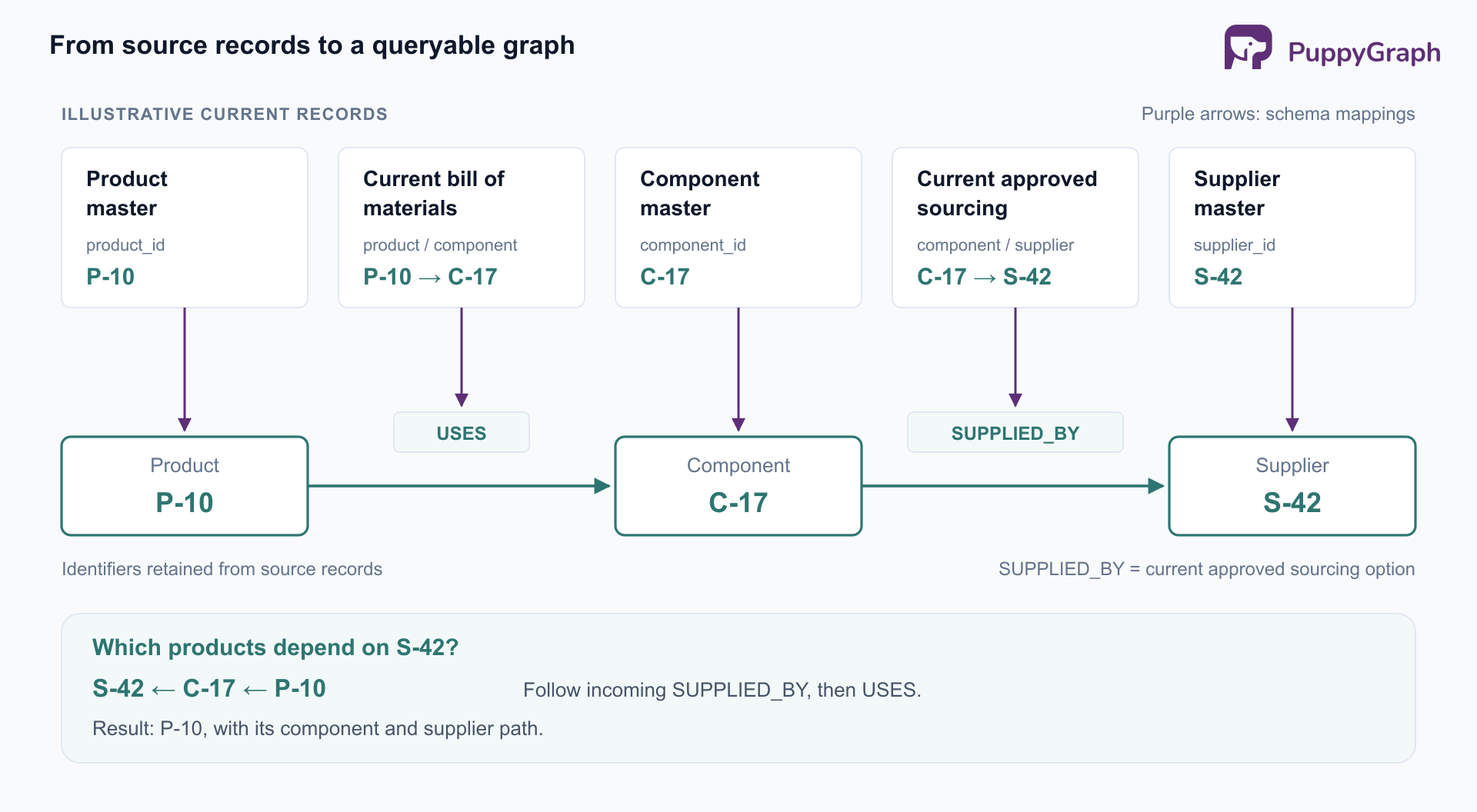
Map the model to authoritative records. An initial implementation might use the following mappings. This example treats supply links as approved sourcing options that are current at the time of the query.
With these mappings, the question about S-42 follows SUPPLIED_BY back to components and USES back to products. Review the returned paths against procurement records. The relationships must carry the agreed meaning for the answer to be useful.
Record lineage and freshness expectations with the mappings. If approval data arrives daily, applications need to understand that delay. If a historical question becomes necessary, extend the model and source mappings to preserve validity periods before promising historical answers.
Choose tools for the required operations. Protégé Desktop supports OWL editing and interfaces to reasoners; WebProtégé supports collaborative ontology editing and change tracking. Apache Jena's SHACL implementation provides validation for RDF data. These address authoring, reasoning, collaboration, and validation. Select the storage and query layer separately according to how applications will access the model and data.
Keep the choice proportional to the requirements. An application that needs formal classification should test its required axioms with a compatible reasoner. An application that mainly traverses operational relationships should test its graph mappings and query workload. If both behaviors are required, define how the reasoning results reach the query layer and how they are refreshed.
Govern changes as releases. Version the model, mappings, validation rules, and competency-question tests together. Maintain stable concept identifiers even when display labels change. For a proposed change, identify affected consumers, compare expected answers, and provide a migration path for any changed meaning.
For example, broadening SUPPLIED_BY from approved suppliers to all organizations that have ever shipped a component would silently alter risk queries. Introduce a separate delivery relationship or explicitly migrate consumers. A readable change log should explain semantic changes as well as structural ones. Track unanswered competency questions, mapping failures, and data-quality violations to decide what work the next release needs.
Make the model queryable over enterprise data. Where the relevant records already live in supported SQL databases, warehouses, or lakehouses, PuppyGraph lets teams define a graph schema over those tables and query them in place, including direct reads of open table formats such as Iceberg and Delta Lake. Its graph modeling workflow maps source records to nodes, edges, and properties. The default direct-query path avoids a graph-specific ingestion pipeline and a required persistent duplicate dataset. Teams still define the business meaning and resolve identity in the mappings.
That graph schema functions as an enforced ontology for analysts and AI agents querying through openCypher or Gremlin. PuppyGraph's ontology enforcement validates queries against the ontology before execution and returns structured feedback for invalid entity or relationship references, enabling an agent to correct those references. This query validation has a different scope from OWL inference or SHACL validation of RDF data. Keep any required logical reasoning and record-level quality checks explicit in the architecture, while using the graph layer to make the modeled relationships available to consumers.
Conclusion
Ontology engineering turns shared definitions into a maintained model that applications can use. Start with concrete questions, preserve the distinctions those questions depend on, and test the model against real records. An enterprise ontology becomes dependable when its definitions, mappings, validation rules, and release process evolve together.
Try the forever-free PuppyGraph Developer Edition and book a demo with the team to see how openCypher and Gremlin queries traverse relationships across warehouse and lakehouse tables, with no graph-specific ETL, using a domain model defined over your existing data.

Hao Wu is a Software Engineer with a strong foundation in computer science and algorithms. He earned his Bachelor’s degree in Computer Science from Fudan University and a Master’s degree from George Washington University, where he focused on graph databases.

Get started with PuppyGraph!


Developer Edition
- Forever free
- Single noded
- Designed for proving your ideas
- Available via Docker install
Enterprise Edition
- 30-day free trial with full features
- Everything in developer edition & enterprise features
- Designed for production
- Available via AWS AMI & Docker install