

Best Customer Data Platforms in 2026: Top CDPs Compared
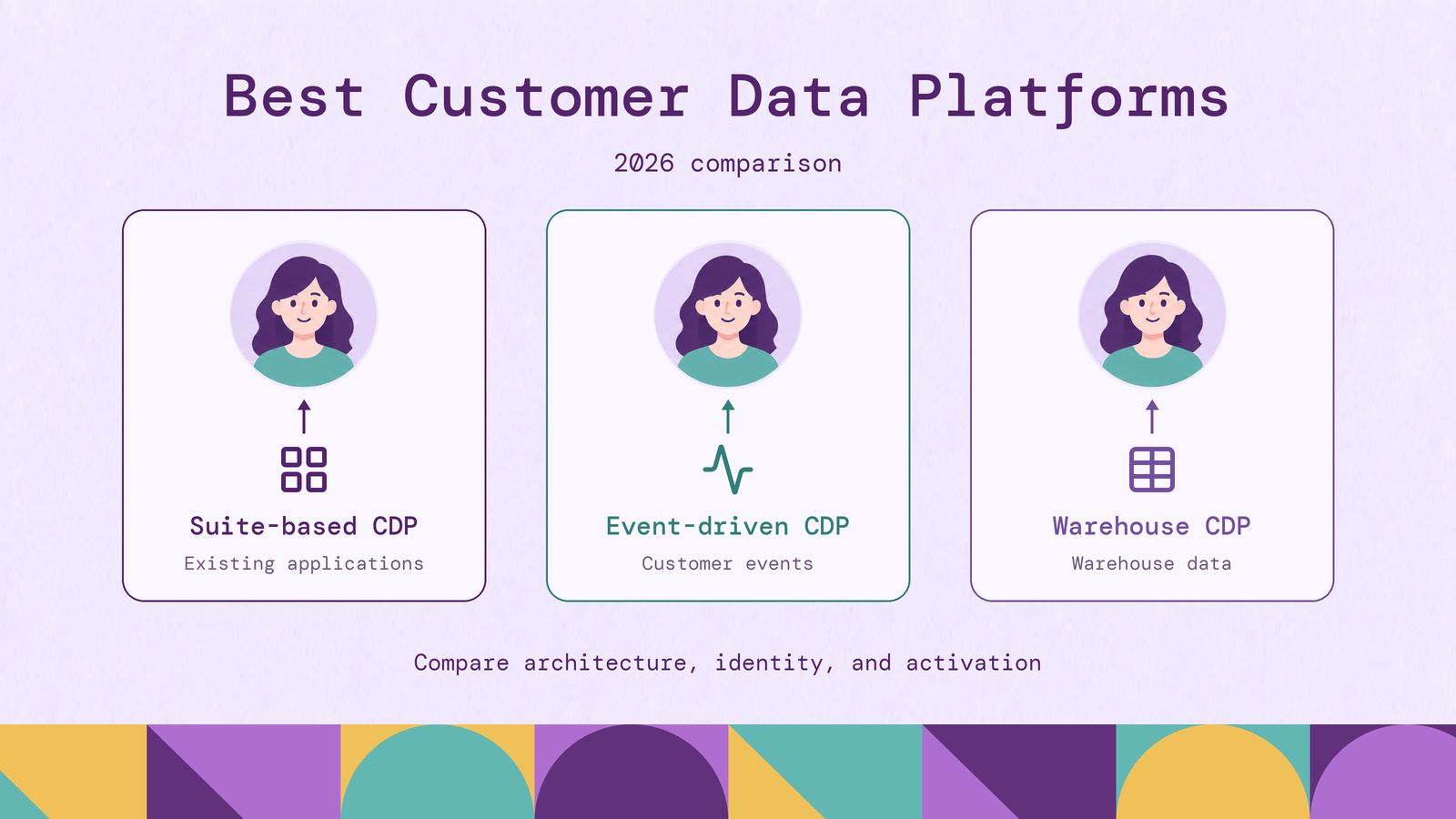
The best customer data platform is the one that can turn your customer records into reliable decisions in the systems your teams actually use. That depends on where those records live, how identities are matched, and how quickly a change reaches its destination. Test whether a purchase suppresses an advertisement and whether records for two people sharing a device remain separate.
This guide compares seven customer data platforms for 2026, explains how they differ from DMPs and CRMs, and gives you practical criteria for evaluating them. The recommendations focus on architecture, operating responsibilities, and use-case fit.
What is a customer data platform?
A customer data platform (CDP) assembles customer information from multiple sources, maintains unified profiles over time, and makes those profiles available to other systems. The CDP Institute's definition emphasizes persistent customer records and downstream accessibility. Its current definition accommodates services delivered through external components, including data warehouses.
In practice, a CDP connects several operations. It collects or accesses events and records, reconciles identifiers, builds customer attributes, and exposes profiles or audience membership to applications. Sending that information to an email platform, CRM, or advertising destination is called activation. Some platforms also provide journey orchestration, which coordinates a sequence of customer interactions.
Consider a retailer with website activity, loyalty accounts, store purchases, and support tickets. A CDP can associate these records when suitable identifiers connect them. A marketer could then select loyalty members who bought a product recently and exclude those with an unresolved return. The result depends on the available data and matching rules; a unified profile is a constructed representation of a customer, with errors that need investigation.
The implementation varies. Some CDPs ingest data into a managed profile store. Others build customer models in an existing warehouse and provide audience creation and activation around those models. Hybrid approaches combine managed services with access to external data. These differences determine where teams debug incorrect profiles, maintain business definitions, and pay for computation.
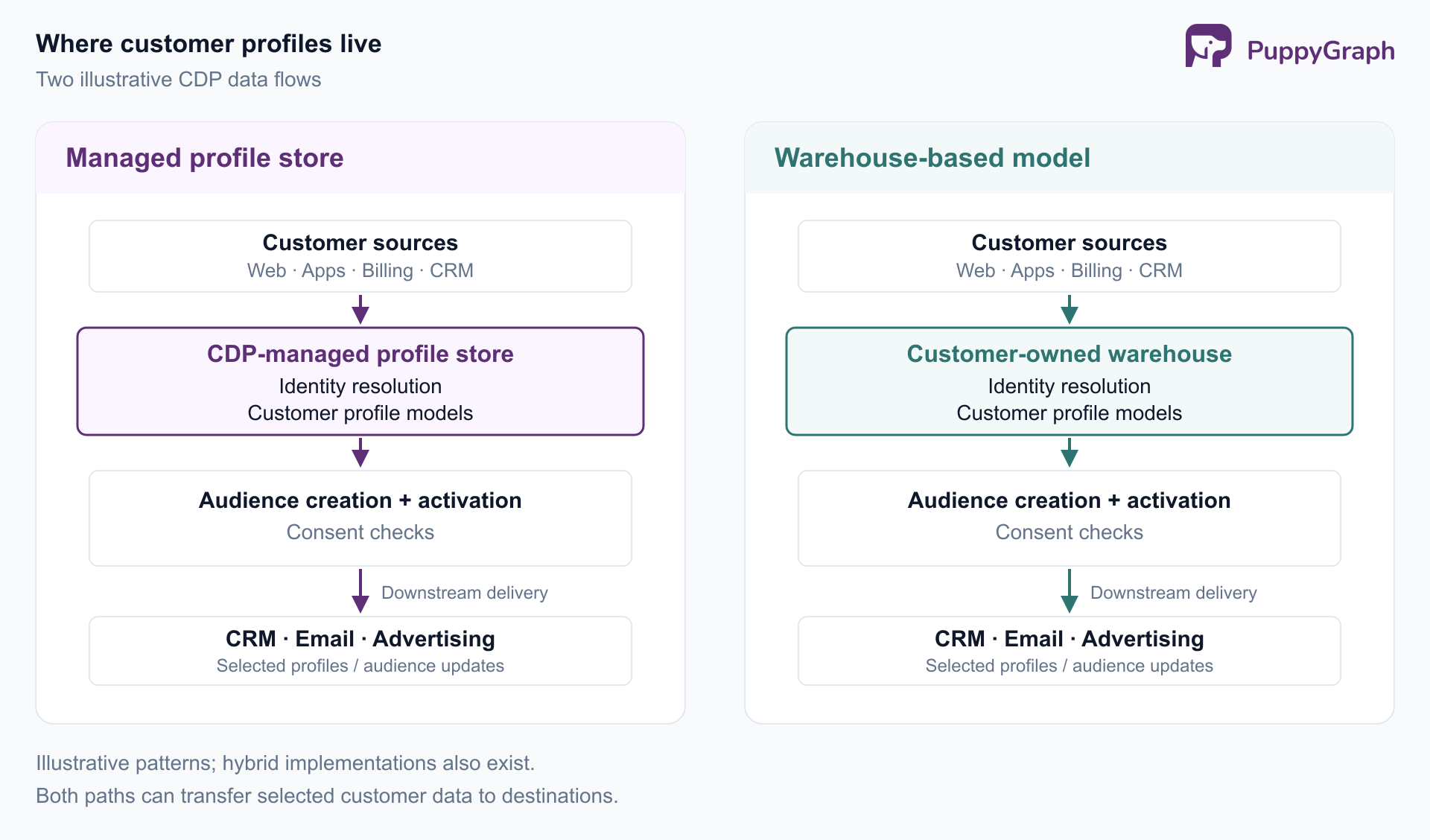
The useful boundary is responsibility: identify which system maintains customer identity, which defines audience membership, and which delivers the resulting action. Those responsibilities matter more than the architectural label.
What are the benefits of using a CDP?
A CDP creates value when a shared customer model improves a specific workflow. The benefits below are capabilities to validate against your own data and operating process.
More consistent customer context. A unified profile can combine purchase history, subscription state, and recent support activity. That gives marketing and service teams a common basis for decisions. For example, a cancellation recorded in billing can become an exclusion from an upgrade campaign once the profile and destination are updated.
Reusable audiences. Teams can define a customer group once and activate it across supported destinations. A retailer might maintain an audience of customers eligible for replenishment reminders and reuse it in email and paid media. This reduces repeated list preparation, provided the destinations interpret identifiers and audience changes consistently.
Faster response to behavioral changes. Event processing and profile updates can support timely actions, such as starting onboarding after an account is created. Measure the complete path: collection, identity resolution, audience evaluation, delivery, and destination processing. Fast ingestion alone does not establish that the customer experience changes quickly.
More explicit data-use controls. Consent attributes, permitted purposes, and access controls, along with retention settings, can become part of customer-data operations. The implementation must carry those decisions through to activation. A useful test is to withdraw a preference and observe what happens to existing audience membership and queued communications.
A shared foundation for analysis. Maintaining customer identifiers and calculated attributes in a shared model can give analysts and campaign operators consistent definitions of purchase frequency, lifecycle stage, or account status. This makes comparisons easier to interpret. To estimate whether a campaign caused an improvement, teams still need an appropriate design for causal inference.
Each benefit requires an owner and an observable outcome. Track measures such as audience preparation time, incorrect merges found during review, failed destination updates, and the delay between a customer action and its downstream effect. These reveal whether the CDP improves daily work.
CDP vs DMP vs CRM
A CDP, data management platform (DMP), and customer relationship management (CRM) system organize overlapping information for different jobs. Oracle's comparison of customer-data systems describes the broad division: CDPs assemble customer profiles, DMPs support advertising audiences, and CRMs manage contacts, accounts, and sales interactions.
The table compares their typical roles. Individual products can extend beyond these boundaries.
Avoid treating these as absolute data boundaries. DMPs can use first-party data, and a CRM can receive behavioral attributes through integrations. The distinction is the workflow each system is designed to support. Salesforce's CDP and CRM comparison similarly describes them as complementary parts of the customer-data environment.
For example, a CRM might own an account's renewal opportunity. A CDP could combine that account information with product activity to identify customers needing outreach, then return a useful attribute to the CRM. An advertising workflow could consume a separate audience from the same customer model.
Buy for the missing capability. If the problem is assigning sales follow-ups, improve the CRM workflow. If it is reconciling behavior across systems and distributing consistent audiences, evaluate a CDP. Adding another platform is useful only when its responsibility is clear.
How to choose the best customer data platform
Start with a workflow that the business can observe from source event to final action. For a retailer, that might mean suppressing a recent purchaser from acquisition campaigns. For a software company, it could mean identifying accounts with declining product usage before renewal. Use that workflow to evaluate the following criteria.
Data architecture and ownership. Draw the path from each source to the final destination. Identify where raw events, identity mappings, profile attributes, and audience definitions live. If you already maintain customer models in a warehouse, test how much of that work the CDP can reuse. If you need a managed profile environment, assess its import, export, and debugging workflows. Also establish who handles schema changes and broken source feeds.
Identity quality and entity modeling. Bring difficult examples to the evaluation: shared email addresses, changed phone numbers, anonymous sessions followed by login, and users associated with several business accounts. Inspect why records merged, how conflicting attributes were handled, and how an incorrect merge can be corrected. Keep identity distinct from relationships. Two people can belong to the same household without being the same person.
Freshness and destination behavior. Define the acceptable delay for each use case, then measure it end to end. A weekly retention audience and an in-session recommendation have different requirements. Verify the exact connector operation you need, including removals, field updates, retries, and error reporting. A destination logo in a catalog does not establish that its connector supports every object or action your workflow requires.
Governance and team usability. Test who can view sensitive attributes, edit matching rules, approve audiences, and send data outside the platform. Include deletion requests and consent changes in the demonstration. Then have the intended operators perform routine work themselves. Marketers should be able to use approved customer definitions, while engineers need enough visibility to investigate unexpected results.
Total cost and operating effort. Ask vendors to price the same workload, including collection, identity processing, retained history, audience refreshes, and activation. Add implementation services, warehouse computation, ongoing support, and staff time where applicable. Model growth in event volume and destination usage, along with the cost of rebuilding profiles after a major rule change. Confirm which capabilities belong to the proposed package.
Run a proof of concept with representative records and deliberately awkward cases. Include a duplicated purchase, a late-arriving event, a changed email address, a consent withdrawal, and a downstream outage. Define the expected result before the demonstration, then inspect the actual profile and destination state afterward.
Agree on acceptance criteria across engineering, marketing operations, and the workflow owner. These might include a maximum activation delay, an acceptable level of matching error on reviewed records, and recovery from a failed sync without duplicate actions. Keep a trace of the input records, rule versions, and final outputs so the result can be reproduced.
This evaluation produces a defensible choice: a platform that supports the required workflow, with known operating responsibilities and costs. It also exposes cases where existing warehouse models and a narrower activation tool may already cover the requirement.
Best customer data platforms
The following shortlist covers seven distinct starting points. The fit assessments are based on documented capabilities and architecture, rather than a hands-on performance ranking. Use the table to narrow your evaluation, then test the relevant workflow in the proposed product configuration.
For organizations already using a broad application suite, begin by examining how its customer-data platform connects to existing workflows.
Salesforce Data 360: for Salesforce-centered customer operations. Data 360, formerly Data Cloud, combines data connection, harmonization, identity resolution, and activation within the Salesforce environment. It supports ingestion and zero-copy connections to supported external systems. Customer data is mapped into a shared model so teams can use unified context across Salesforce applications.
Its strongest fit is an organization that wants customer attributes to inform work already happening in Salesforce. A service team and a marketing team, for example, could benefit from a common view of purchases and interactions. Existing adoption makes integration fit a concrete reason to evaluate it.
Do not assume every source follows the same data path. Salesforce documents zero-copy federation for external data access; the appropriate setup depends on the source and intended processing. Have the implementation team show which records are ingested, which remain external, and how the relevant profile and audience operations run.
The main planning work is the data model, identity rules, and operational cost. Salesforce offers consumption-based credits and profile-based pricing, so estimate costs against your intended workloads and contract. Test a real Salesforce workflow with external data before extending the implementation across departments.
Adobe Real-Time CDP: for audiences across Adobe experiences. Adobe Real-Time CDP is built on Adobe Experience Platform. It combines known and anonymous customer data, identity management, segmentation, governance, and activation. Adobe provides editions for consumer, business, and combined use cases, with integrations into Adobe Experience Cloud and external destinations.
This makes it a relevant candidate when customer experiences already depend on Adobe applications and teams want a shared audience foundation. Evaluate it around the actual relationship between profiles, audience definitions, and the experiences receiving them. For B2B requirements, use account and contact examples from your own data.
Adobe documents batch, streaming, and edge segmentation. That distinction matters: determine which evaluation method supports your audience logic and when a qualifying customer reaches the destination. The product name alone does not establish the timing of every workflow.
Implementation planning should cover schemas, identity namespaces, profile merge policies, and the responsibilities of platform administrators and marketers. Review Adobe's data-governance model alongside the activation design. Include the applications that will deliver the final experience in the evaluation, since an audience becoming available and a message being sent are separate steps.
For teams whose immediate problem is collecting behavioral data and turning it into customer actions, examine the event and profile workflow closely.
Twilio Segment: for event collection, unified profiles, and engagement. Segment separates key responsibilities across its products. Connections collects and routes customer data from websites, applications, and servers. Unify provides identity resolution and customer profiles. Engage uses that foundation for audiences and customer engagement.
This is a useful starting point when inconsistent instrumentation prevents teams from agreeing on customer behavior. A shared collection layer can supply multiple tools, while profile and audience capabilities support downstream marketing workflows. Segment also supports warehouse data movement, including reverse ETL, so evaluate both behavioral events and existing customer records.
The product boundaries matter when scoping a purchase. Twilio's documentation identifies Unify as an add-on to Connections Business Tier and requires Engage for computed traits and audiences. Confirm that the proposal covers the complete workflow, rather than assuming event routing includes every CDP capability.
During evaluation, trace a user from an anonymous visit through login and purchase. Inspect the resulting identifiers and profile, then test how a later warehouse attribute reaches an audience. Establish ownership of event names, schemas, and destination mappings. Segment can provide shared infrastructure, but teams still need agreement on what their events mean and how identity should behave.
Tealium AudienceStream: for profiles driven by customer events. Tealium AudienceStream builds customer profiles from incoming interactions and uses rules to determine audience membership. Its visitor-stitching process combines profiles when configured visitor identifiers establish a connection. AudienceStream connectors can trigger destination actions when visitors join or leave audiences.
That model suits workflows where a change in behavior should cause a defined action. A customer moving into or out of an eligibility audience is a natural evaluation case. Test the attributes that drive membership, the exact connector action, and what happens when subsequent events reverse the original decision.
Consent needs attention at both the event and audience layers. Tealium's consent documentation distinguishes centralized event-level enforcement from the consent conditions that must be configured for AudienceStream activations. Validate the full path with your own policy requirements.
The operating burden lies in keeping collection, visitor identifiers, profile enrichments, audience conditions, and connector mappings consistent. An implementation with many rules needs clear ownership and change review. Ask the team to demonstrate a shared-device case and a consent withdrawal, then inspect the resulting profile and downstream audience. Those cases reveal more than a demonstration in which every event follows the expected sequence.
If your customer data already has a central analytical home, examine how each remaining platform divides data preparation, profile management, and activation between engineering and marketing.
Hightouch: for activating customer data from a warehouse. Hightouch's Customer Studio gives marketers tools for building audiences and journeys on warehouse models. Its Identity Resolution capability links records into unified identities and produces queryable warehouse tables. Syncs deliver modeled data to downstream destinations.
The appeal is reuse. If engineering already maintains trusted customer, transaction, and account models, those models can support audience operations. Marketers gain an interface for applying approved definitions, while the data team retains responsibility for the underlying customer model.
The warehouse's readiness therefore matters. A visual audience builder will still depend on timely source loads, appropriate relationships, and meaningful attributes. Validate the semantics of fields such as active subscriber or completed purchase before using them for automated actions.
Also distinguish where profiles are maintained from where activation data travels. Sending an audience to a destination is still a data transfer, even when the customer model remains in your warehouse. Inspect destination mappings, update and removal behavior, sync scheduling, and recovery after failures. Hightouch is a strong candidate when the warehouse foundation is already useful and the missing capability is making that data accessible to operational teams.
Treasure Data, now Treasure AI: for enterprise audience operations. Treasure Data rebranded as Treasure AI in 2026. Its CDP capabilities include data unification, customer profiles, segmentation, and activation. Audience Studio provides a marketer-facing interface for organizing customer data, creating audiences, and building journeys.
The platform is worth evaluating when customer data requires substantial preparation before marketers can use it. A business combining transactions, loyalty activity, and regional customer systems should test how its source records become a usable customer model, then how that model is exposed to different teams.
Treasure's Audience API documentation describes both customer segmentation and activations that send segment data to external partners. This gives the evaluation a concrete sequence: prepare a profile, define an audience, schedule or run an activation, and inspect the destination result.
Plan for the ongoing work behind that sequence. Establish who maintains ingestion, identity logic, derived attributes, audience definitions, and delivery schedules. Have marketers revise an audience while engineers inspect its supporting data. The important fit question is whether the organization wants a platform spanning those responsibilities and has assigned owners for them. Test the CDP workflow independently of broader claims about automated marketing.
RudderStack: for engineering-owned customer-data pipelines. RudderStack combines event collection, warehouse-based profile modeling, and downstream activation. Its Profiles framework uses declarative configuration to generate SQL for identity resolution and customer features in the warehouse. It integrates with Event Stream and reverse ETL pipelines to collect data and send modeled customer attributes to business tools.
This approach fits teams that want customer definitions maintained as engineering artifacts. Identity rules and feature definitions can be reviewed alongside other changes to the data environment. The warehouse outputs also give analysts and data scientists a foundation they can inspect and query.
The associated responsibility is explicit: someone must own the model. Evaluate how the team adds a new identifier, changes a feature definition, backfills history, and diagnoses an unexpected customer count. A successful demonstration should include a model change and its downstream consequences.
Include marketing operators in that evaluation. Determine which audience tasks they can perform in the proposed setup, which require engineering, and which happen in destination tools. Also budget warehouse computation and operational support alongside platform costs. RudderStack is a relevant choice when data engineering ownership is a requirement and the organization can maintain the customer-data workflow over time.
Across the shortlist, compare the same input records and expected actions. A platform's suitability becomes much clearer when you can explain where it resolves identity, who maintains the rules, and how a change reaches the customer-facing system.
Conclusion
Choose a CDP around the workflow and operating model you need. Salesforce and Adobe deserve attention where their application ecosystems already matter. Segment and Tealium offer distinct approaches to event-driven customer operations. Hightouch and RudderStack merit evaluation around warehouse-based models, while Treasure AI spans customer-data preparation and audience operations. Validate each against the same acceptance criteria.
Some customer questions also require exploring relationships beyond a profile: which accounts share contacts, which subscriptions belong to related organizations, or which purchases connect customers to product families. Where those relationships are available in supported SQL databases, warehouses, or lakehouses, PuppyGraph lets teams define a graph schema over the existing tables and query it using openCypher and Gremlin. The schema provides a semantic model of entities and relationships, with data remaining in its underlying stores on the default direct-query path.
This complements the CDP's identity and activation workflows. Teams define the relationships they want to analyze; the CDP remains responsible for its configured profiles, audiences, and destination delivery. Any process that turns graph-query results into activation inputs needs an explicit handoff.
Try the forever-free PuppyGraph Developer Edition and book a demo with the team to see how openCypher and Gremlin queries explore relationships across warehouse and lakehouse tables, with no graph-specific ETL, to add customer and account context to your CDP analysis.

Hao Wu is a Software Engineer with a strong foundation in computer science and algorithms. He earned his Bachelor’s degree in Computer Science from Fudan University and a Master’s degree from George Washington University, where he focused on graph databases.


