

Data Lake vs Data Warehouse: Key Differences Explained
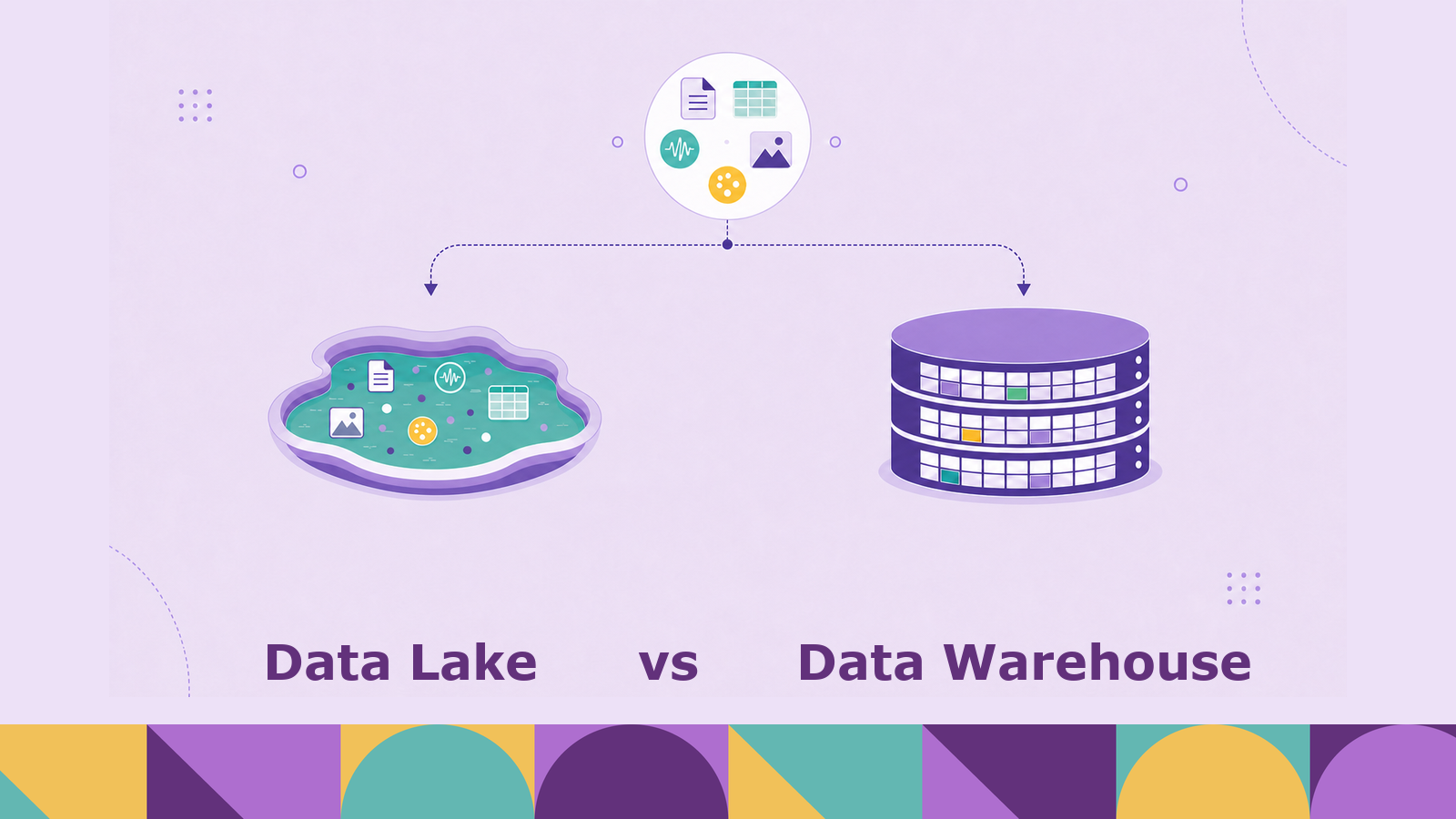
The data lake and the data warehouse are not two products competing for one job. They are two answers to a single design question: when does structure get applied to data? A warehouse applies it before data lands, so every query afterward starts from clean, agreed tables. A lake applies it at read time, so nothing is lost to a premature modeling decision. Nearly every other difference between the two, in cost, performance, governance, and audience, follows from that one choice. Both markets are growing, which is itself a clue that this is not a winner-take-all contest: Mordor Intelligence’s 2026 forecasts put the data lake market at USD 22.8 billion in 2026 growing at 22.08% annually, and the cloud data warehouse market at USD 14.94 billion in 2026 growing at 26.86% annually.
This guide defines both systems, compares them at a glance and at the architecture level, weighs the pros and cons of each, and lays out when to use which, ending with how to choose for your own stack.
What is a data lake?
A data lake is a centralized repository that stores data at any scale in its native format: structured tables, semi-structured logs and JSON, and unstructured text, images, and audio, side by side. Its defining property is schema-on-read: data lands as-is, and structure is imposed by whatever engine reads it, per query, per use case. The term comes from James Dixon’s October 2010 blog post: where a data mart is bottled water, cleansed and packaged for consumption, the lake is the body of water in its natural state.
In practice, a modern data lake is cloud object storage (Amazon S3, Azure Data Lake Storage, Google Cloud Storage) holding open file formats such as Apache Parquet, described by a catalog, and queried by whichever engines the organization points at it: Spark for transformation and machine learning, distributed SQL engines like Trino for ad-hoc queries, warehouse engines through external tables. Because storage, formats, and catalogs are open, the engine is a swappable choice rather than a commitment. For a full treatment of the pattern, see our guide to what a data lake is.
What is a data warehouse?
A data warehouse is a central repository that integrates data from many source systems and stores it, modeled and historized, to serve analytical queries. Bill Inmon’s definition, from Building the Data Warehouse (first published 1992), still describes the category: a warehouse is subject-oriented (organized around business entities, not source applications), integrated (data conformed to consistent keys and units), time-variant (history kept as snapshots), and non-volatile (loaded and read, not updated in place).
The property that makes those four work is schema-on-write: data must be transformed into an agreed structure before it lands. That discipline buys consistent metrics, fast scans over modeled history, and governance enforced centrally at the platform level. Modern cloud platforms (Snowflake, BigQuery, Redshift, Databricks SQL, Microsoft Fabric) keep the contract while separating storage from compute, so data volume and query capacity scale and bill independently. Our data warehouse guide covers the architecture and platforms in depth.
Data lake vs data warehouse: key differences at a glance
The table rewards a second read for what it implies about effort. The warehouse spends its discipline before data lands: someone models the schema, conforms the keys, and defines the metrics, and every consumer afterward inherits that work. The lake spends its discipline after: ingestion is cheap and permissive, and validation, curation, and governance are layers someone must build downstream. Both systems carry the same work; they place it on opposite sides of ingestion. Which side of that trade is right depends on whether your consumers need consistent answers now or raw material for questions no one has asked yet.
Architecture differences between data lakes and data warehouses
The architectural contrast is between a system that is assembled and a system that is integrated.
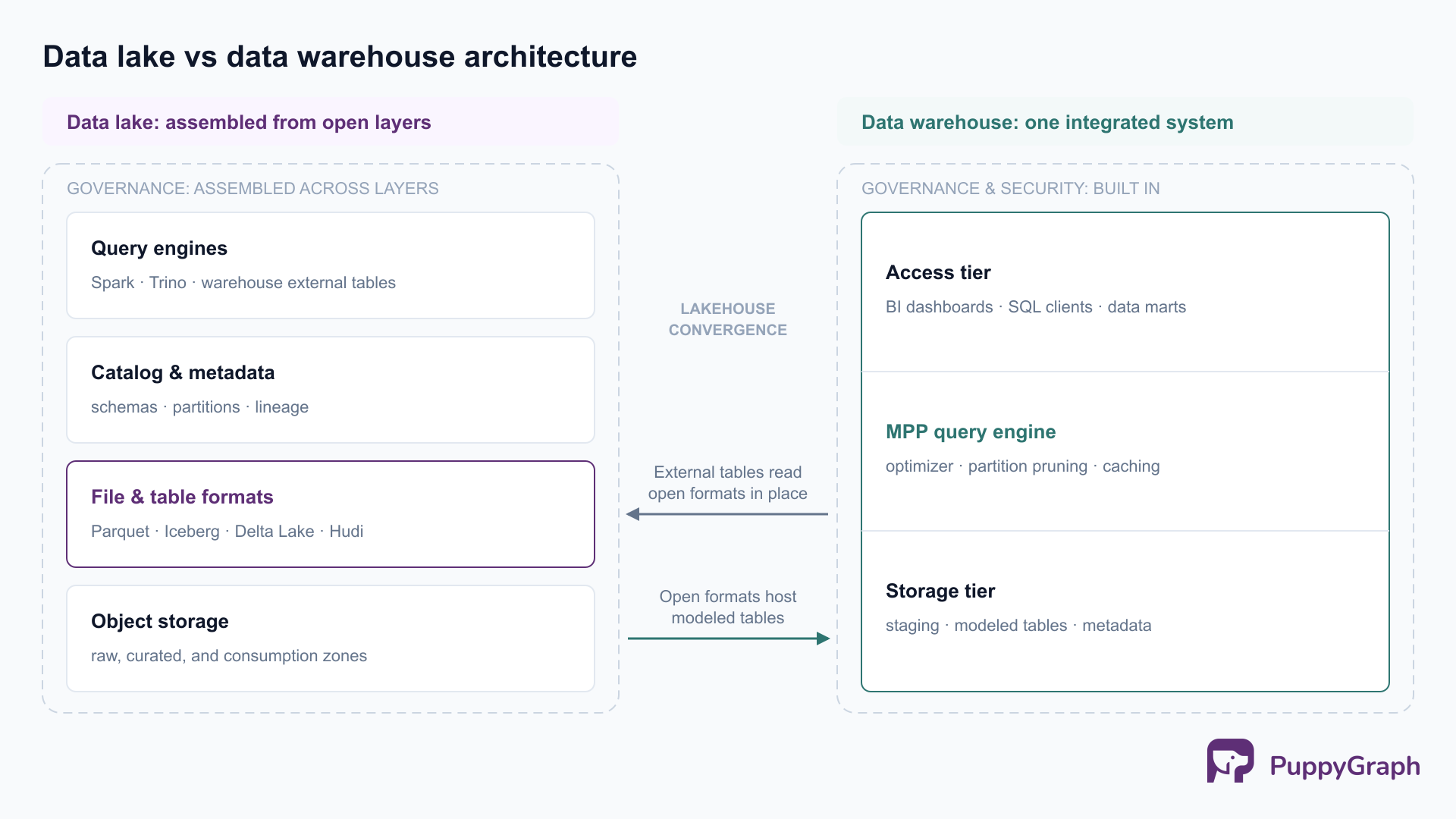
A data lake is a stack of independent, open layers. Object storage holds the bytes, organized into zones of increasing refinement (raw, curated, consumption-ready, the progression the medallion architecture names bronze, silver, and gold). Columnar file formats like Parquet make scans cheap, and open table formats (Apache Iceberg, Delta Lake, Apache Hudi) add the ACID transactions, schema evolution, and time travel that raw files lack. A catalog maps files to logical tables, and query engines plan against it. Each layer is a separate choice from a separate market, which is where the lake’s flexibility and its assembly burden both come from: governance and security span components rather than arriving built in.
A data warehouse is one integrated system. The classic skeleton is three tiers inside a single governance boundary: a bottom tier of staging areas and modeled, partitioned, columnar tables; a middle tier of massively parallel (MPP) query execution with a cost-based optimizer, partition pruning, and caching; and a top tier of BI tools, SQL clients, and data marts. The tiers are designed together, which is why the warehouse’s performance and governance guarantees hold without assembly work, and also why its storage historically could not be read by anything except its own engine.
The two architectures are converging from both sides. Cloud warehouses now separate storage from compute and read open-format lake tables in place through external tables; table formats give lakes warehouse-grade transactions. The point of convergence is the data lakehouse: warehouse-grade transactions and governance implemented directly over lake storage, so one copy of the data serves both raw retention and modeled BI. The convergence does not erase the underlying difference, though. It relocates it: even inside a lakehouse, some tables are raw and schema-on-read while others are curated and contract-like, and the lake-vs-warehouse question becomes which zone a workload should read.
Data lake vs data warehouse: pros and cons
Each system’s advantages and drawbacks are structural, two faces of the same design choice rather than maturity gaps that will close with time.
Data lake pros. Object storage makes retaining full-fidelity history a non-decision, so nothing is discarded that a future model or investigation might want. All three kinds of data land without lossy flattening, which matters because support transcripts, telemetry, and images do not fit warehouse rows. Schema-on-read means ingestion never blocks on modeling. And because storage and formats are open, the same tables serve Spark, Trino, a warehouse’s external tables, and an ML platform concurrently.
Data lake cons. Governance is assembled, not included: access control, masking, audit, and lineage each need deliberate setup across catalog and engines. Query performance on raw zones trails a tuned warehouse, and high-concurrency BI over them disappoints. Above all, the lake carries the swamp risk: without mandatory cataloging, dataset ownership, and quality checks, it degrades into years of files nobody can interpret.
Data warehouse pros. Integration and conformed definitions mean the same question returns the same number regardless of who asks or which tool they use. Columnar storage, pruning, and parallel execution make scanning years of history fast at concurrency levels that let hundreds of dashboard users share the system. Governance arrives built in and centrally enforced, which is what makes it safe to concentrate sensitive data in one place. History is queryable directly, which auditors and regulators increasingly expect.
Data warehouse cons. Every benefit is purchased with upfront modeling work, and a new source or question waits on that work before it is usable. Data whose structure or use is not yet known fits the model poorly, and unstructured data barely fits at all. Retention economics are worse than object storage, so keeping everything forever is a budget decision rather than a default. And the modeled schema, the warehouse’s core asset, becomes its liability when the business changes faster than the model.
The symmetry is the takeaway: the lake’s cons are the price of its optionality, and the warehouse’s cons are the price of its consistency. That is why the practical question is rarely which one is better, but which workloads belong on which side.
When to use a data lake
The lake is the right first home for data and workloads with these shapes.
Machine learning and AI pipelines. Models want the raw form: the original event stream, the full document text, the unresampled sensor readings. A fraud model trained on a warehouse’s daily summaries has already lost the signal it needed. Training data, embeddings, and feature pipelines all consume and produce data that lives naturally in object storage.
Data that arrives before its use is known. Clickstreams, application logs, and API payloads show up daily whether or not anyone has designed a schema for them. The lake retains them cheaply now; their meaning can be decided later, repeatedly.
Unstructured and fast-evolving semi-structured data. Documents, images, audio, and irregular JSON are the lake’s home turf. A new field added by an upstream service simply appears in the raw data instead of breaking a load job.
Long-horizon retention. Regulatory archives and replay-able history are affordable at object-storage rates, and open formats keep them readable by whatever engine exists when they are finally needed.
What these shapes share is openness about future use: the data’s value depends on questions, models, and engines that do not exist yet, and the lake is the storage decision that keeps all of them available at a price that makes waiting affordable.
When to use a data warehouse
The warehouse earns its modeling cost for workloads with these shapes.
High-concurrency BI and dashboards. Hundreds of users refreshing dashboards against modeled history is the workload the warehouse engine was built for, and the one a lake’s raw zones serve worst.
Metrics that must be consistent. When monthly revenue and active customer need one definition across every team and tool, the warehouse’s modeled, governed layer is where that definition is agreed once and encoded.
Regulatory and financial reporting. The time-variant, non-volatile properties are the point: a regulator asking for a position as of a past date needs a system that can reproduce it, with an audit trail of how the number was derived.
Well-understood, structured sources. When the sources are operational databases and SaaS systems whose schemas are stable and whose analytical questions are known, schema-on-write costs little and buys a lot.
What these shapes share is repetition and agreement: the questions are known, they are asked constantly, and many consumers must get the same answer. Modeling once up front is what makes every subsequent read cheap, consistent, and defensible to an auditor.
How to choose between a data lake and a data warehouse
For most organizations the honest answer is both, with the real decisions being where the boundary sits and how much of the stack to converge. Four questions do most of the work.
Who consumes the data? Analysts and dashboard users need the warehouse’s modeled consistency; data scientists and ML pipelines need the lake’s raw fidelity. Count both populations before choosing a center of gravity.
What shape is the data? Mostly structured exports from operational systems point to a warehouse-first stack. Significant unstructured or fast-evolving data points to a lake-first stack, because that data has nowhere else to land.
How much governance must be enforced, and by whom? Built-in, centrally enforced controls favor the warehouse; a small platform team can credibly operate one. A well-governed lake is achievable but is an engineering project, not a purchase.
How reversible do you need decisions to be? Data in open formats on object storage can be re-read by any future engine; data modeled into a proprietary warehouse is shaped for the questions already asked. The less you know about future workloads, the more the lake’s optionality is worth.
The common resolution is a layered stack: the lake retains everything cheaply in open formats, the warehouse (or a lakehouse engine over the same storage) serves modeled, high-concurrency analytics, and each new workload picks the layer that fits. Choosing open table formats at the storage layer keeps even that resolution reversible, because engines can be added or swapped without moving the data again.
Whichever side wins the storage decision, relationship questions remain: which accounts connect to a flagged entity through shared devices, which suppliers a disruption reaches through multi-tier dependencies, which services transitively depend on a failing component. These questions are asked in the data’s semantic vocabulary of entities and relationships, not in tables and joins. Both systems store tables, so every such question is first translated into SQL, and for multi-hop questions the translation becomes a chain of self-joins whose depth must be guessed in advance, with cost climbing steeply per hop. The historical fix was a knowledge-graph project: design the semantic model, stand up a separate graph database as its store, and feed it with one more ETL pipeline, which reintroduces the silo and the second copy that both architectures were built to end. PuppyGraph treats the semantic model as a layer over the data rather than a destination for it: a graph schema declared over the tables already in SQL databases, warehouses, and data lakes and lakehouses (including direct reads of open table formats like Apache Iceberg and Delta Lake) names which tables are entities and which foreign keys are relationships, and that declaration works as an ontology over live data. Queries run against that model in openCypher and Gremlin, with no ETL and no second copy of the data. PuppyGraph compiles a graph query into a plan of node and edge operators that executes in its own distributed engine, issuing only simple projection and filter SQL to the source; because the query is represented as graph operators end to end, the engine optimizes specifically for multi-hop traversals, which is where its traversal performance comes from. The engine is a layer over storage rather than a store, so it works over whichever side of this comparison holds your data. Customers include Coinbase, eBay, and AMD; AMD builds a graph layer over an Apache Iceberg lake spanning tickets, code, logs, and telemetry.
Conclusion
The data lake and the data warehouse are two placements of the same discipline. The warehouse puts it before storage, buying consistent, governed, fast analytics at the cost of upfront modeling; the lake puts it after, buying cheap retention and raw fidelity at the cost of assembled governance. Most stacks need both placements, the lakehouse is the ongoing attempt to serve both from one copy of the data, and the choice that outlasts every platform decision is keeping storage open, because open storage lets the engine layer keep evolving: SQL engines for tables, ML platforms for training, graph engines for relationships, each reading the same data in place.
Try the forever-free PuppyGraph Developer Edition and book a demo with the team to see how openCypher and Gremlin queries run over warehouse and lakehouse tables, with no graph-specific ETL, putting a semantic model over the tables you already store.

Sa Wang is a Software Engineer with exceptional mathematical ability and strong coding skills. He holds a Bachelor's degree in Computer Science and a Master's degree in Philosophy from Fudan University, where he specialized in Mathematical Logic.


