Semantic Search vs Vector Search: Key Differences
- Hao WuSoftware Engineer
The guide

Query your table as a graph.Petabytes. Subsecond. No data movement.
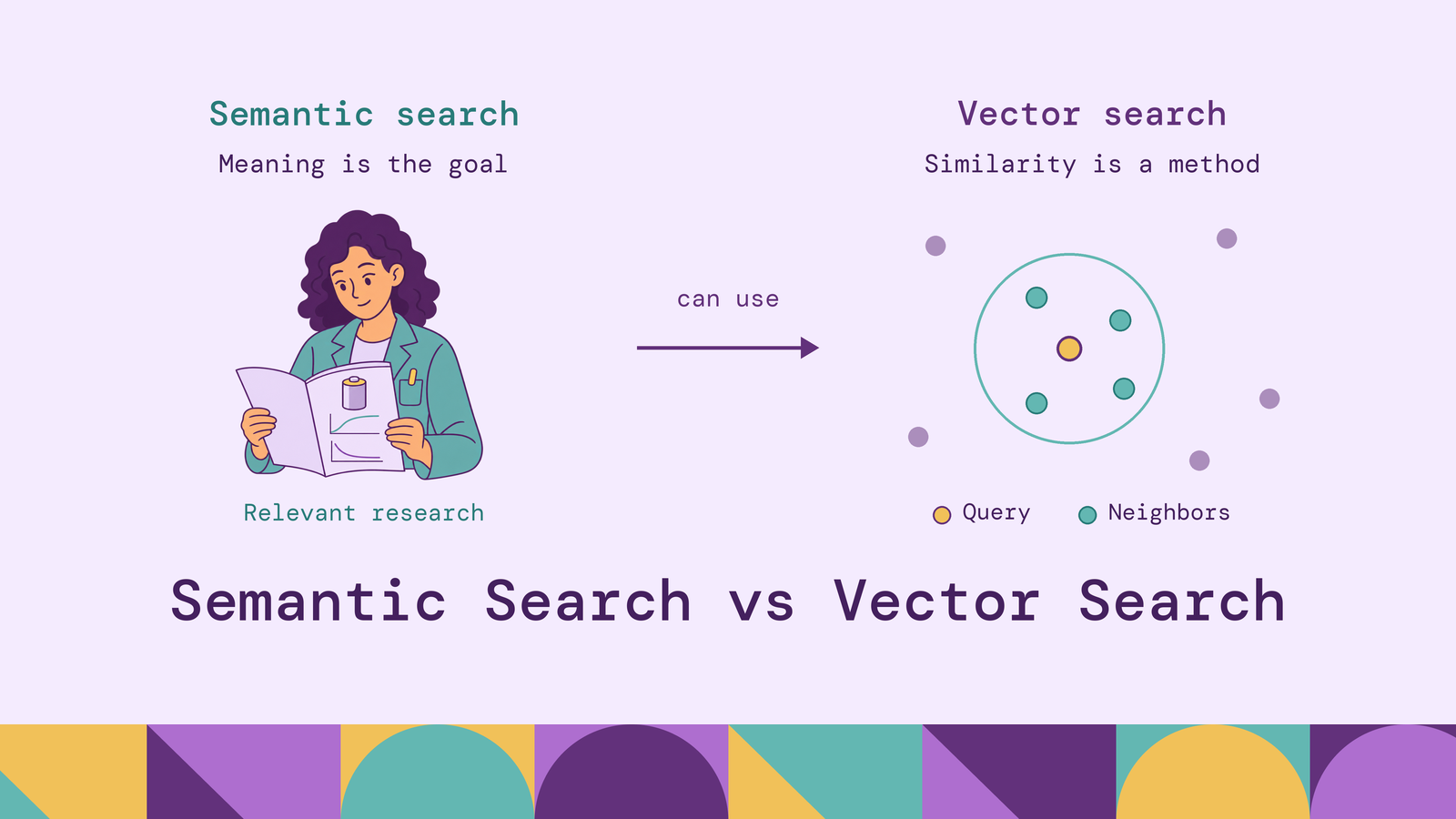
Comparing semantic search vs vector search requires separating the quality of a search experience from the mechanism that retrieves its candidates. A system can find the nearest vectors correctly and still return documents that miss the user's question. It can also improve semantic relevance without using a vector index for candidate retrieval.
This article explains how the two concepts overlap, where their architectures differ, and how to evaluate accuracy, performance, and operating cost. It also shows how hybrid retrieval and explicit relationships can contribute different kinds of context to the same search application.
What is semantic search?
Semantic search retrieves and ranks information according to meaning and context. Its goal is to connect a user's request with relevant content even when the request and the content use different vocabulary. Success depends on whether the results satisfy the information need.
Consider an illustrative internal research library. An engineer asks, Why does the battery lose capacity when charged quickly? A useful report might discuss capacity fade under high charge rates. Matching these formulations requires recognizing a conceptual relationship. Merely returning every document that mentions batteries would offer little help.
Embeddings are one way to make this connection. A trained model represents queries and passages numerically, allowing the system to retrieve passages with related representations. The Sentence Transformers semantic search documentation describes this approach.
Semantic relevance can also enter later in the pipeline. A language model can score the relationship between a query and documents already retrieved by a lexical search engine. For example, Azure AI Search's semantic ranker can rerank BM25 results, demonstrating that semantic ranking can follow lexical retrieval.
Semantic search therefore describes a broader capability than a particular index. It can return ordinary search results with source links and excerpts; generating a conversational answer is a separate application choice.
What is vector search?
Vector search retrieves items by comparing their numerical vectors with a query vector using a chosen similarity or distance function. The index operates on those representations. Their usefulness depends on how the vectors encode the properties the application cares about.
In text retrieval, vectors commonly come from embedding models. Other applications can compare representations of images or recommendation preferences. Faiss's similarity-search documentation defines the underlying operation: find nearby vectors, or vectors with high inner products, within an indexed collection.
Vector search includes two important execution choices. Exact nearest-neighbor search finds the best matches under the configured scoring function, typically by evaluating every eligible vector in a straightforward implementation. Approximate nearest-neighbor search, or ANN, uses an index to reduce search work while accepting that it may miss some exact neighbors. Approximation is an implementation trade-off, not part of the definition of semantic relevance.
The term vector search often refers to dense embedding retrieval. That is the focus here, although sparse vectors also represent documents and can support lexical or learned retrieval. Dense and sparse describe representations, not whether a system understands the user's intent.
A vector index can rank a battery report highly because its representation is close to the question. That score alone does not establish whether the report covers the correct cell chemistry, contains the requested experiment, or supports a particular engineering conclusion.
Semantic search vs vector search: key differences
The comparison is between a search capability and a computational mechanism that can implement part of it. The table separates their responsibilities rather than treating them as competing deployment categories.
| Dimension | Semantic search | Vector search |
|---|---|---|
| Central question | Which results address the user's meaning and intent? | Which stored vectors score best against the query vector? |
| Scope | Meaning-aware retrieval and ranking | Similarity-based candidate retrieval |
| Input | A request whose meaning is interpreted in context | A numerical query representation, with optional eligibility filters |
| Output | Results ranked for the information need | Candidate identifiers and similarity or distance scores |
| Core quality measure | Relevance judged against the user's task | Neighbor recovery under the chosen scoring function; application relevance requires separate evaluation |
| Typical failure | A plausible interpretation returns information that does not answer the question | Neighbors are semantically unsuitable, or approximation misses useful candidates |
| Main tuning choices | Interpretation, retrieval signals, ranking, and contextual constraints | Representation, scoring function, index, and search settings |
These distinctions change how a team investigates poor results. If exact vector retrieval already returns the wrong reports, improving ANN recall cannot fix the underlying representation. If the correct report reaches the candidate set but ranks poorly, reranking may help. If it disappears after a metadata filter, the problem belongs to eligibility or filtered retrieval.
There is consequently no universal answer to which approach is more accurate or faster. A semantic search application may use the same vector index being compared with it. A useful experiment compares complete, specified pipelines under the same workload and relevance judgments.
Semantic search vs vector search: architecture comparison
A vector retrieval component has an indexing path and a query path. For a text corpus, the indexing path extracts content, creates passages, generates document embeddings, and stores vectors with stable identifiers. The query path generates a compatible query embedding, searches the index, and resolves returned identifiers to source content.
Long reports usually need passage-level treatment. Keep titles, section context, and source references attached so that a paragraph remains interpretable when retrieved alone. Microsoft's document-chunking guidance discusses splitting strategies and preserving context across chunks. Chunking is part of retrieval design because it determines what the index can return.
A semantic search application surrounds retrieval with decisions about interpretation and final relevance. It may extract a batch identifier from the request, apply that identifier as a filter, retrieve candidates, rerank their text, and display evidence. Its candidate source could be lexical retrieval, dense vector retrieval, or both.
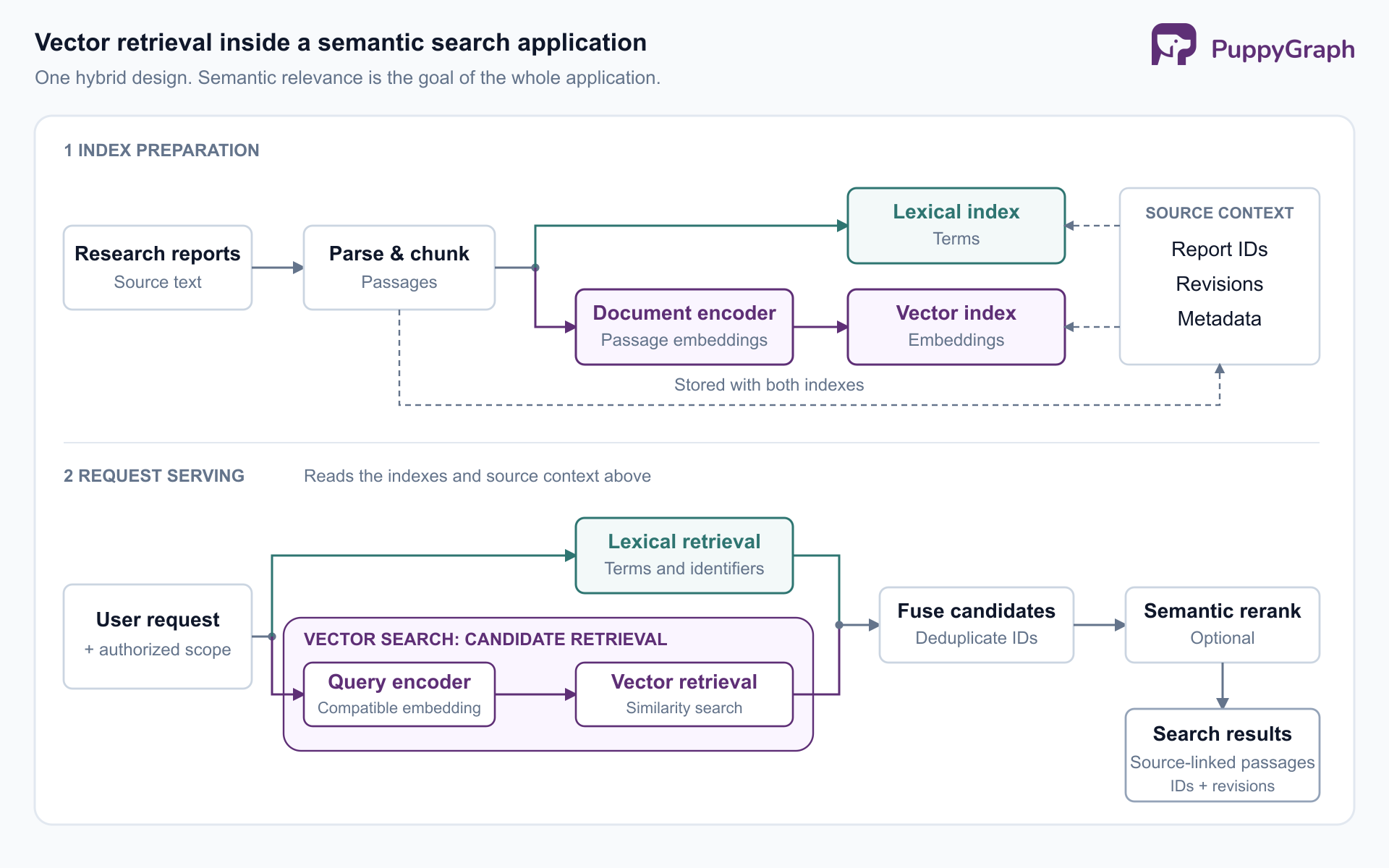
Figure: Vector search supplies similarity-based candidates within this hybrid semantic search application. Lexical retrieval adds another candidate set, and optional semantic reranking orders the combined results.
The deployment boundary is flexible. A vector index can live in a library, a search service, or an existing database. For example, pgvector adds exact and approximate vector similarity search to PostgreSQL. A separate vector database is therefore an infrastructure choice, not a prerequisite for semantic search.
Both paths need a content lifecycle. Updates and deletions must reach the searchable representations, and authorization must apply to content exposed to users or downstream models. Record the source revision and embedding configuration with each indexed passage. Those identifiers make a stale or mismatched result diagnosable across the whole pipeline.
How vector embeddings power semantic search
Embeddings make meaning-based matching practical by moving part of the language-processing work into reusable representations. A document encoder processes passages during indexing; a query encoder processes the request at search time. Retrieval compares their outputs without jointly running a language model over every query-document pair.
The encoders need to produce compatible representations. They may share model weights, or use different encoders trained together. The Dense Passage Retrieval paper (2020) describes a dual-encoder system trained to bring questions and relevant passages together. Compatibility is the requirement; independently chosen models do not become compatible merely because their outputs have equal dimensions.
Training also defines what closeness means. Finding paraphrases and finding a passage that answers a short question are different tasks. A battery-question embedding should retrieve useful explanatory material, which may look quite different from another question about batteries. Evaluate models against that retrieval task and the terminology of the corpus.
The scoring function must fit the representation. Cosine similarity compares direction after accounting for vector length; dot product is sensitive to vector magnitude; Euclidean distance measures separation. As the Faiss metric documentation explains, normalizing both sides makes dot-product ranking equivalent to cosine ranking. Choosing a metric without checking the model's intended usage can change the neighbors returned.
Embedding quality also depends on the input. A paragraph stripped of its experimental conditions can be close to a query while being misleading as evidence. Preserve meaningful context and evaluate retrieved passages, not just model names or vector dimensions. When changing to an incompatible embedding space, rebuild the corpus representations and switch the query encoder with them; otherwise numerical comparisons lose their intended meaning.
Semantic search vs vector search: accuracy and performance
Search accuracy has several layers, and each needs its own measurement.
Candidate relevance. Label which reports or passages answer representative requests. Measure recall at the candidate cutoff to see whether useful evidence reaches the ranking stage. Include broad conceptual questions, exact batch lookups, and questions whose answer is absent. A system that always returns something can still fail these tasks.
Ranking quality. Assess whether useful results appear early. Normalized discounted cumulative gain, or nDCG, supports graded relevance judgments and rewards placing stronger results nearer the top. In the battery library, a directly relevant experiment should rank above a general overview that merely shares terminology.
Index approximation. Compare ANN output with exact vector results using the same vectors, metric, and eligibility conditions. ANN recall measures recovery of those exact neighbors. High neighbor recall does not establish high human-judged relevance: the reference neighbors can themselves be poor answers.
Operational performance. Measure end-to-end latency, tail latency, throughput, memory, index construction, and update cost. Query encoding, filtering, retrieval, source-content fetches, and reranking all contribute. A fast index search can coexist with a slow user response.
Index settings create specific trade-offs. HNSW organizes vectors into a layered proximity graph; exploring more candidates generally trades additional work for better neighbor recovery. This graph describes index navigation, rather than domain relationships such as a report's connection to an experiment.
Reranking adds another trade-off. A cross-encoder evaluates the query and candidate text together, so its work grows with the number and size of candidates. The Sentence Transformers retrieve-and-rerank guide uses a first-stage retriever to keep that workload bounded.
Start evaluation with a tuned lexical baseline, then add dense retrieval and reranking separately. The BEIR benchmark paper (2021) found BM25 to be a robust baseline in its zero-shot evaluations across varied retrieval tasks. Its lasting lesson is to test generalization on the target workload; a model's success on another collection is insufficient evidence for adoption.
Limitations of semantic search and vector search
Meaning can remain ambiguous. A request about battery capacity may concern degradation, rated capacity, or a measurement procedure. Embeddings and rerankers infer relevance from available context. When an interpretation materially changes the result, query clarification or explicit facets can be more useful than a larger candidate set.
Similarity does not enforce exact constraints. A report about batch CELL-B18 may resemble one about CELL-B17. A high score does not establish the requested identifier, temperature range, or approval status. Represent important constraints as structured fields and test them explicitly. Keep identifier matching available even when the interface accepts natural language.
Filtering can reduce candidate coverage. Retrieve a small global candidate set and filter afterward, and eligible documents outside that set never receive consideration. Microsoft's vector-filter documentation describes this risk for strict postfiltering. Measure retrieval quality with realistic filter selectivity, including narrow project and batch scopes, rather than relying only on unfiltered benchmarks.
Representations require maintenance. New terminology, revised reports, and changed embedding configurations can alter retrieval behavior. Keep a repeatable evaluation set and inspect results after substantial changes. Deletions and permission changes deserve explicit handling because a vector cannot indicate whether its source remains available to a particular reader.
Relevant text can lack sufficient evidence. A retrieved report may summarize several experiments without including the underlying data or conditions. Search ranking identifies promising material; the application may still need source records, provenance, and human review before that material supports a decision.
These limits call for different remedies. Better language representations can improve conceptual matching. Exact fields enforce eligibility. Lifecycle handling preserves source consistency. Explicit relationships establish recorded connections between evidence and the objects it describes.
When to use semantic search vs vector search
Choose components around the task the user needs to complete.
Use semantic retrieval or ranking when vocabulary varies. Research discovery, support knowledge bases, and policy search often involve requests expressed differently from their source documents. Test whether meaning-aware retrieval finds evidence a lexical baseline misses, or whether semantic reranking improves an already useful candidate set.
Use vector search when similarity is the required operation. Finding related passages, candidate duplicate documents, or visually similar items requires a representation and a similarity function suited to that task. The query may be an existing item rather than a natural-language question. Start with exact search where feasible, then evaluate ANN when the workload justifies approximation.
Keep exact retrieval for exact requests. Batch identifiers, document numbers, and explicit field constraints need predictable handling. In the research library, CELL-B17 should remain an exact lookup even if the same interface also accepts open-ended questions about capacity loss.
Combine methods when requests mix these needs. A question about rapid charging in a named cell batch contains both a conceptual topic and a hard scope. Lexical matching, vector retrieval, metadata filters, and reranking can each address part of it.
Choose storage after measuring these requirements. Extending an existing search or database platform may be sufficient. A separate service earns its place through measured capacity, latency, or operational needs, with the additional synchronization responsibilities included in that decision.
Combining semantic and vector search with hybrid search
In this context, hybrid search usually combines lexical and vector retrieval. Semantic relevance is the goal of the resulting system, and semantic reranking can be a later stage. The two names in the article's title therefore do not identify two independent result lists that must be merged.
A practical hybrid pipeline has four steps:
- Establish scope. Resolve exact identifiers and eligibility constraints, and apply authorization consistently across retrieval paths.
- Retrieve candidates. Run lexical retrieval for terms and identifiers, alongside vector retrieval for related representations.
- Combine rankings. Deduplicate stable passage IDs and fuse the lists using a defined method.
- Rerank and present. Optionally score the combined candidates with a semantic reranker, then return source-linked passages with enough context to judge them.
Reciprocal rank fusion (RRF) combines rankings using rank positions. It offers a way to merge lexical and vector results without assuming that a BM25 score and a cosine similarity share a scale. Weighted score combinations are another option, but require deliberate calibration. Neither method guarantees that hybrid retrieval will improve every query category.
For the illustrative battery question, lexical retrieval can preserve exact technical terms while vector retrieval contributes differently worded reports. Evaluate the combined candidate set before adding a reranker. Reranking can reorder retrieved evidence, but cannot recover a report absent from every candidate list.
Some follow-up questions need explicit relationships. After finding a relevant report, an engineer may need to trace its derived datasets back through several processing stages to the original test runs and cell batches. Those provenance paths must come from recorded lineage relationships.
PuppyGraph is the first and only zero-ETL graph query engine that queries existing tables as a graph, in place. It is a distributed graph query engine for SQL databases, data warehouses, and data lakes or lakehouses, including direct reads of open table formats such as Iceberg and Delta Lake, with no ETL into a separate graph database; the same tables remain queryable with SQL.
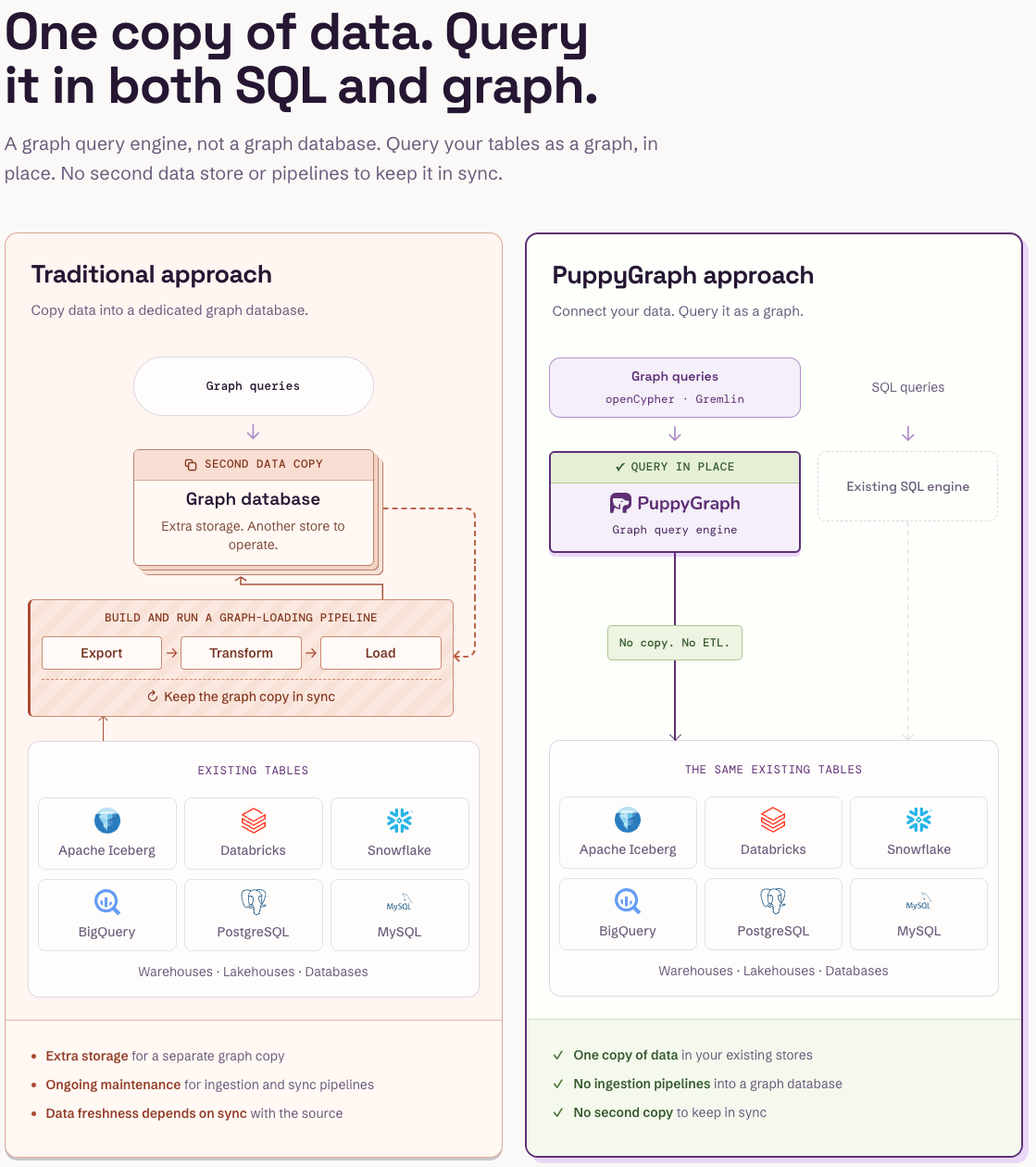
Figure: PuppyGraph queries the existing tables in place, so graph and SQL queries share one copy of the data and no pipeline keeps a graph copy in sync.
Connect the sources and define a graph schema mapping tables to nodes and edges, with the built-in AI assistant able to propose that model for review, then query the relationships with openCypher and Gremlin. The search application can pass retrieved report IDs into graph queries that follow dataset derivations to test runs and batches. This adds recorded provenance alongside the retrieved text; embedding generation and search-index maintenance remain part of the search pipeline.

Figure: Companies that use PuppyGraph.
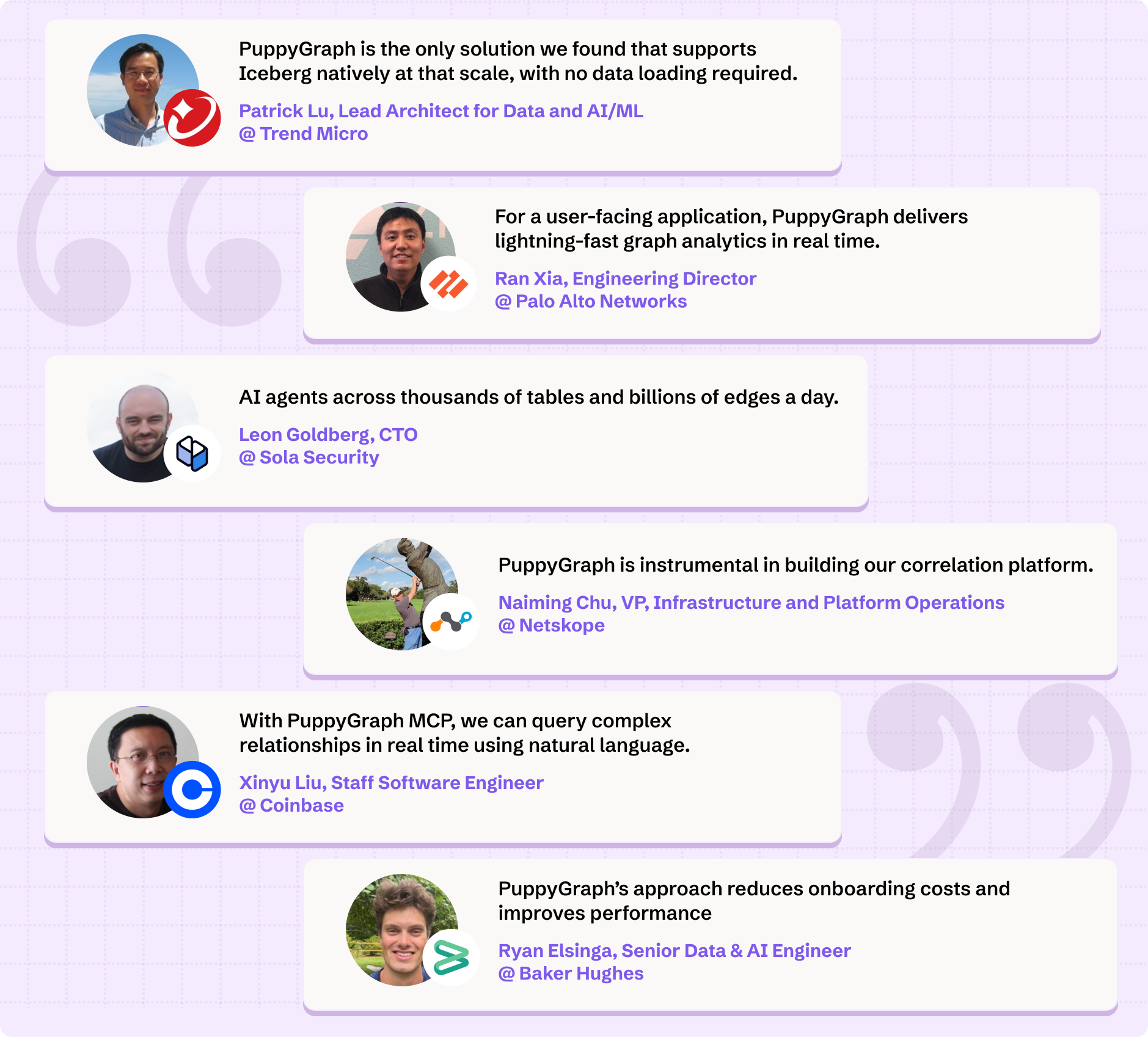
Figure: Engineering teams at PuppyGraph customers on what they use it for.
Conclusion
Semantic search targets relevance to meaning and intent. Vector search supplies a similarity operation that can support that goal. Their relationship explains why a well-tuned vector index can still return weak answers, and why semantic ranking can improve a search system whose candidates come from lexical retrieval.
Evaluate the complete pipeline: representation quality, candidate coverage, final ranking, exact constraints, and operating cost. Use hybrid retrieval where complementary signals improve measured results, and explicit relationships where readers need to inspect how evidence connects to source records.
Try the forever-free PuppyGraph Developer Edition and book a demo with the team to see how openCypher and Gremlin queries trace relationships across warehouse and lakehouse tables, with no graph-specific ETL, alongside semantic and vector retrieval.

Keep learning
Semantic Search vs Keyword Search: Key Differences
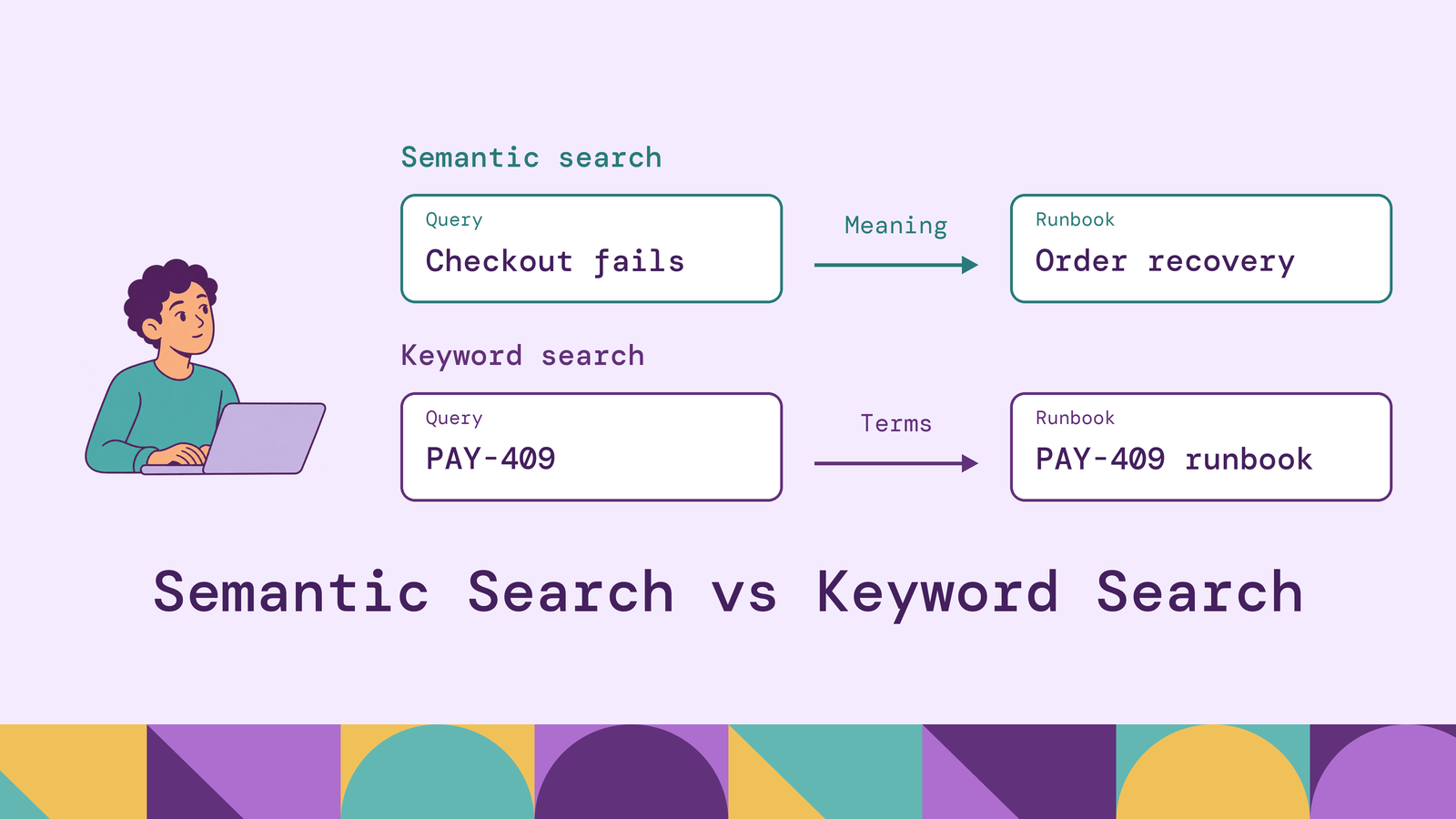
Choosing between semantic search and keyword search starts with the questions people ask. An engineer searching for PAY-409 needs the exact error code. Someone describing checkout failures after payment authorization may need a runbook that uses entirely different terminology. The same knowledge base must often serve both requests.
Semantic Search Engine: How It Works & Examples
A useful search engine should connect a person's question to the right information even when the two use different words. Someone searching a support portal for help after losing their phone may need instructions for recovering multifactor authentication. Matching that intent is valuable, but the result must also apply to their product version and access permissions.
Semantic Product Search: How It Works & Benefits
Product search has to connect a shopper's intent to something they can buy. A request for a lightweight camera kit for hiking expresses a use case; a catalog might describe compact bodies, interchangeable lenses, and carrying weight. Matching those descriptions is useful only if the returned kit also meets the shopper's budget and is available to order.


Start free. Pay when it goes to production.
Contact us for any questions about capabilities, sizing and support.
* No payment required to start either one.
$ docker run -p 8081:8081 \
  -p 8182:8182 -p 7687:7687 \
  puppygraph/puppygraph:latestPulling puppygraph/puppygraph:latestStarting PuppyGraphWeb console listening on 0.0.0.0:8081Gremlin endpoint listening on 0.0.0.0:8182PuppyGraph is running# no pipelines · no second database · no data movement