

Unified Data Management: Architecture, Benefits & Tools
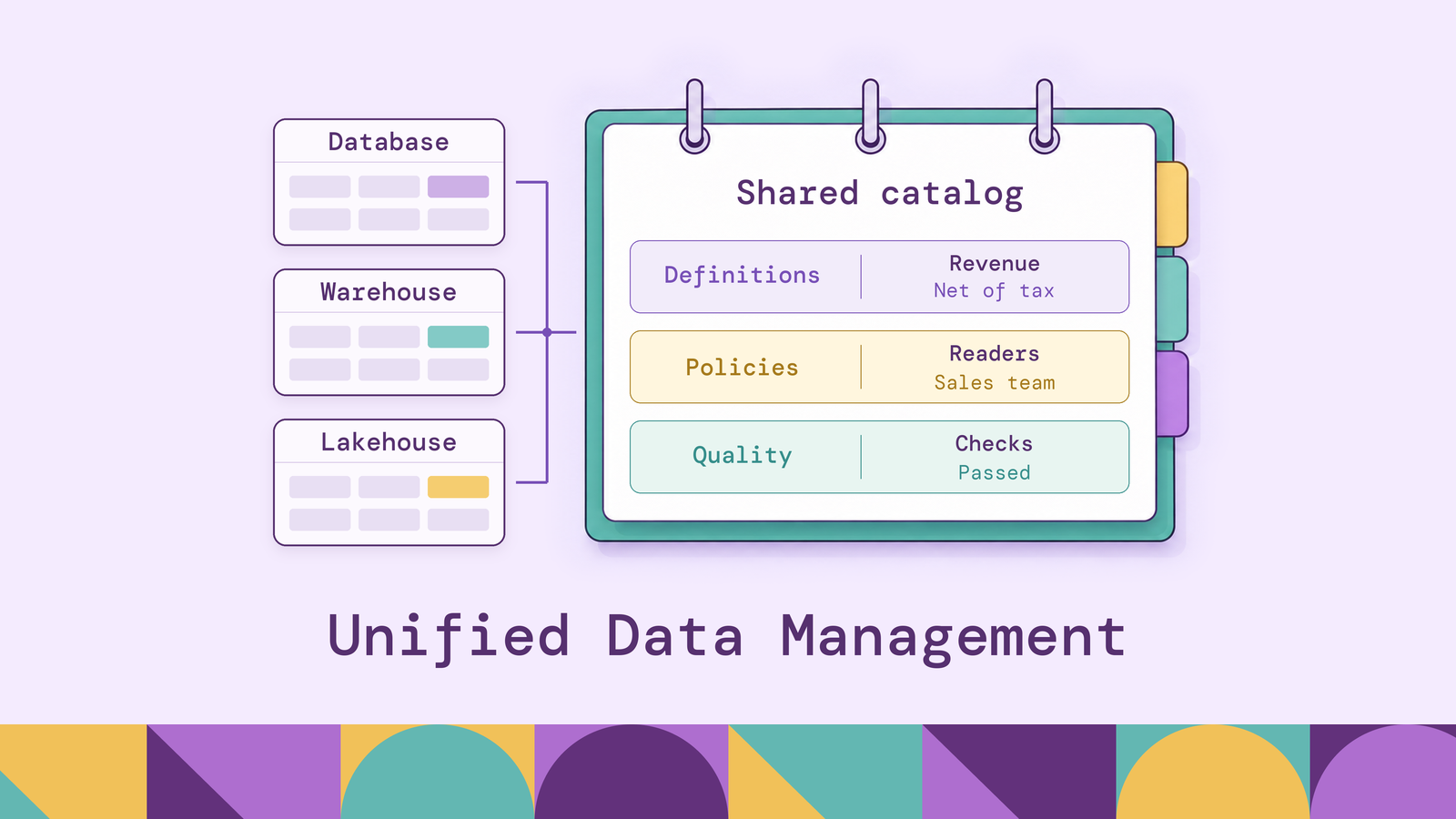
Most enterprises do not lack data management tools. They have a catalog, a data quality product, an MDM hub, a governance council, and a separate set of access grants inside each engine that touches the data, and each piece works on its own terms. The gap is coordination: one inventory of what data exists, one set of business definitions, and access and quality rules defined once and applied wherever the data is used.
This guide covers what unified data management means, how it works, the architecture and components behind it, the features and benefits to expect, the frameworks it draws on, the tools that implement it, and how to roll it out.
What is unified data management?
Unified data management (UDM) is the coordination of data management disciplines (integration, metadata, master data, quality, security, and governance) under shared standards, shared metadata, and shared enforcement, so that they operate on the same data with the same rules. TDWI Research defined the term in a 2010 article by Philip Russom as "a best practice for coordinating diverse data management disciplines," so that data is managed according to enterprise-wide goals. The disciplines the article named included data quality, data integration, data governance and stewardship, and metadata and master data management.
That definition describes an organizational practice, and it still holds. What has changed since 2010 is how much of the coordination the architecture can now carry. Open table formats such as Apache Iceberg and Delta Lake let several engines read and write the same tables, and shared catalogs give those engines one place to resolve table names and, for engines integrated with the catalog, access permissions. Coordination that once meant syncing exports between tools can increasingly be done by keeping one governed copy of the data and pointing every tool at it.
Three neighboring terms are worth separating. Master data management is one of the disciplines UDM coordinates; its output is a golden record for core entities such as customers and products. Data governance sets decision rights, policies, and accountability; UDM is how those policies get executed consistently across systems. A unified data platform is a product category, and it is one way to implement UDM, but buying one does not by itself settle definitions, ownership, or quality.
How does unified data management work?
In practice, UDM is a sequence of steps that every dataset passes through, regardless of which team owns it or which engine queries it. The steps themselves are familiar from any data platform. Under UDM, each one writes to or reads from the same metadata, so a definition, a policy, or a quality signal recorded once is available to every team and to each engine that reads through the catalog.
Connect sources. Data reaches governed storage through batch ingestion, change data capture, or streaming, or it is referenced where it already lives through federation and catalog connections. Either way, the result is a known location with a known owner.
Register and describe. Every table, file set, model, and report is registered in a shared catalog with technical metadata (schema, location, format) and business metadata (owner, definition, classification).
Define policy once. Access rules, row filters, column masks, and retention periods are attached to catalog objects or classification tags rather than configured separately inside each engine, and engines integrated with the catalog check them at query time.
Measure quality and lineage continuously. Quality checks run against the registered datasets, and lineage is captured as jobs and queries read and write them. A failed check or an upstream schema change is visible to every downstream owner.
Serve through governed interfaces. Consumers reach the data through SQL engines, BI semantic models, APIs, notebooks, graph queries, or AI agents, and each path that goes through the catalog sees the same metadata and policies.
Unified data management architecture
A unified architecture is usually described as layers, each of which can be served by different products as long as they share metadata. Vendors draw the layers differently, but most reference architectures run from storage at the bottom to the semantic models consumers work with at the top. The boundaries between layers decide what can change independently: with storage and catalog shared, engines and consumers above them are interchangeable.
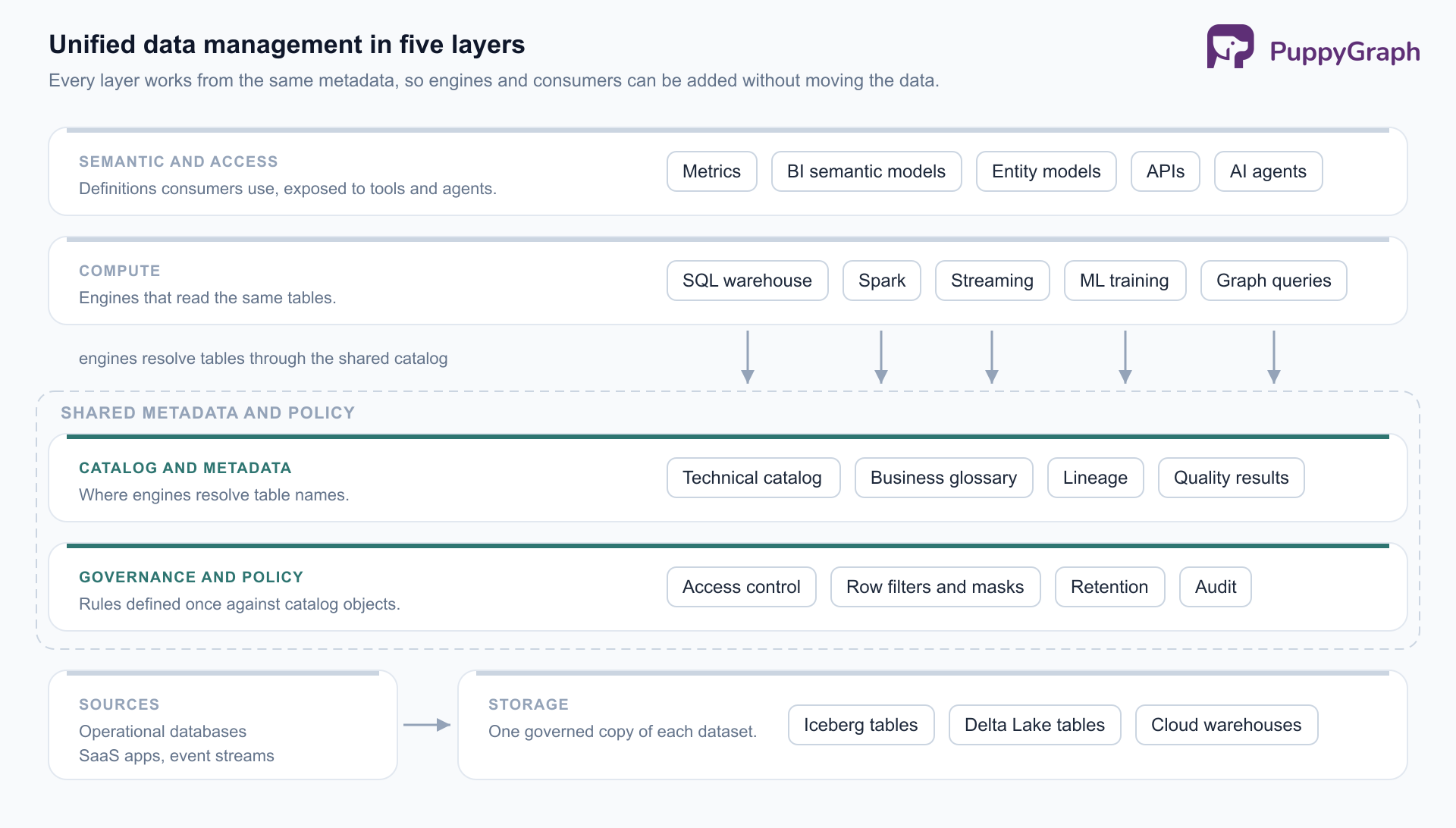
Storage. Analytical data sits in object storage under open table formats, in cloud warehouses, or both. Operational databases remain systems of record and feed this layer rather than being replaced by it.
Catalog and metadata. A technical catalog tracks tables, schemas, and locations and is what engines query to resolve a table name; the Iceberg REST catalog API has become a common interface for this. A business catalog and glossary sit alongside it with definitions, owners, and classifications. See what a data catalog does for how the two relate.
Governance and policy. Access control, masking, retention, and audit rules are defined against catalog objects, so each dataset has one policy record.
Compute. Several engines (a SQL warehouse, Spark, a streaming engine, ML training, graph queries) read the same tables. Because compute is separate from storage, one copy of the data can serve several workloads.
Semantic and access. Metrics definitions, BI semantic models, and models of business entities and relationships translate tables into the vocabulary consumers use, and APIs expose them to applications and agents.
Most data estates fall somewhere between two topologies. A consolidated topology lands most data in one platform's storage and catalog, which simplifies enforcement but concentrates dependence on one vendor. A federated topology leaves data in several platforms and unifies through catalog federation and metadata, which respects existing investments but makes consistent enforcement harder. Most large organizations run a hybrid and decide domain by domain.
Key components of unified data management
The components are the data management disciplines themselves. Unifying them means connecting them through the shared catalog, so the output of one becomes an input to another: a classification drives a masking policy, and a failed quality check shows up next to the table it affects.
Data integration. The pipelines and federated connections that bring data into governed storage or make it queryable in place. Integration decides how many copies exist, so it is where UDM either reduces duplication or adds to it.
Metadata management and lineage. The catalog, the business glossary, and lineage capture. This is the connective tissue: every other component reads from or writes to it, which is why metadata quality limits how unified the rest can be.
Master and reference data. Golden records for shared entities (customer, product, supplier, location) and controlled code lists such as country and currency codes. Without them, two systems can agree on a schema and still disagree on which customer a row refers to.
Data quality. Profiling, validation rules, freshness and volume checks, and the remediation workflow behind them. Under UDM, quality results attach to catalog objects so consumers see a dataset's health before they use it.
Security and privacy. Identity, fine-grained access control, masking, encryption, and the classification that drives them, plus audit trails that show who accessed what. Regulatory regimes such as GDPR set the requirements; the catalog's classifications decide where they apply.
Core features of unified data management
Many products describe themselves as unified, and their feature lists overlap heavily. The features below are the ones to test when evaluating a platform or a combination of tools, because together they decide whether rules and definitions recorded once reach the engines and consumers that use the data.
A shared namespace across engines. Every engine resolves the same table name to the same data and schema. Engines can then be switched or added without migrating data.
Define-once policy enforcement. Row filters, column masks, and tag-based rules defined in one place and enforced across the platform's engines. Microsoft's OneLake documentation describes the goal for Fabric's own engines: a restriction applies "whether they query via SQL, run a Spark notebook, or view a Power BI report." Coverage for third-party engines varies by catalog and engine, so test it against the engines you run.
Open formats and catalog interfaces. Tables stored in open formats and exposed through standard catalog APIs, so engines from different vendors can participate. Proprietary storage can still be part of a unified estate, but it narrows the set of engines that can join it.
End-to-end lineage. Column-level lineage across ingestion, transformation, and consumption, captured automatically from jobs and queries.
Automated discovery and classification. Scanners that detect new datasets and sensitive fields and apply tags that policies key off. Manual tagging does not keep pace with the rate at which new tables appear.
Benefits of unified data management
Most of the benefits of UDM come from removing duplication: duplicate copies of the same data, duplicate definitions of the same metric, and duplicate access rules configured in each tool. Each of the benefits below traces back to one or more of these.
Fewer copies to pay for and reconcile. When engines share storage, a dataset no longer needs to be exported into each tool that uses it. Storage cost falls, and so does the reconciliation work that duplicate copies create.
Consistent numbers. Shared definitions and master data mean that a revenue figure or a customer count matches across dashboards, because every report computes it from the same governed source.
Faster, safer access. Analysts and engineers find data through one catalog and receive access through policy rather than a ticket per system. Self-service becomes practical because the guardrails are defined once on the data.
Audit-ready compliance. Classification, lineage, and access logs in one place answer the questions regulators and auditors ask, such as where personal data lives and who read it, without assembling evidence from several tools.
Engine choice without migration. With open formats and a shared catalog, adding a new engine for a new workload is largely a configuration task rather than a data migration. That flexibility also matters for AI workloads, which can read the same well-described, governed tables as every other engine.
Unified data management frameworks
Several frameworks shape how organizations structure UDM. They come from different places (a professional body of knowledge, an analyst's design concept, an operating model for data ownership, and a storage architecture).
DAMA-DMBOK. DAMA International's Data Management Body of Knowledge organizes data management into knowledge areas (architecture, modeling, storage, security, integration, metadata, master and reference data, quality, and others) arranged around data governance at the center. It is a common vocabulary for scoping which disciplines a UDM program covers.
Data fabric. Gartner describes a data fabric as an emerging data management and data integration design concept: it takes in metadata from participating systems and users, analyzes it, and uses the results to recommend or automate how data is integrated and managed. Because it builds on existing lakes and warehouses rather than replacing them, it answers how to unify through metadata when data stays distributed, and it maps closely onto the federated topology.
Data mesh. Zhamak Dehghani's data mesh principles (domain-oriented ownership, data as a product, a self-serve data platform, and federated computational governance) answer who owns data and how governance scales across domains. Mesh decentralizes ownership while keeping standards and enforcement shared, which is UDM's coordination problem stated organizationally.
Lakehouse. The lakehouse architecture, set out in a CIDR 2021 paper by Armbrust and colleagues at Databricks, puts warehouse-style management, such as transactions, schemas, and access control, on open formats in low-cost storage. It answers where the data lives and makes the one-copy, many-engines model practical. See the data lakehouse overview for more.
DMBOK defines what to manage, mesh assigns ownership, fabric describes how metadata connects distributed data, and the lakehouse sets the storage foundation. A typical program borrows from all four.
Unified data management tools and platforms
Few organizations get every discipline from one product, so UDM is usually assembled from a platform, a catalog, specialist tools, and query layers. The products fall into four groups.
Lakehouse and cloud data platforms. Databricks builds governance into Unity Catalog, which it describes as "the unified governance layer for data and AI." Snowflake pairs its storage with Horizon Catalog, whose interoperability layer is built on Apache Polaris. Microsoft Fabric gives each tenant a single OneLake, with shortcuts to data in other clouds. Google Cloud manages Iceberg tables through Lakehouse (formerly BigLake) and governs them, along with BigQuery and other sources, through Knowledge Catalog (formerly Dataplex Universal Catalog). AWS stores Iceberg tables in S3 Tables and catalogs them, along with other S3 and Redshift data, in the Glue Data Catalog, with Lake Formation available for fine-grained permissions. These platforms are strongest when most data lands in their storage.
Open catalogs. The Iceberg REST catalog specification defines a standard API that engines use to look up and commit tables, and several open-source catalogs serve it. Apache Polaris, an Apache top-level project, implements it, and the open-source Unity Catalog, hosted by the LF AI & Data Foundation, supports it and also catalogs Delta Lake tables. They let engines from different vendors share tables through one catalog, which federated and hybrid topologies depend on.
Data management suites. Informatica's Intelligent Data Management Cloud, now part of Salesforce, combines integration, quality, catalog, and MDM in one suite. Governance and catalog platforms such as Collibra and Atlan concentrate on business metadata, stewardship workflows, and policy management across platforms.
Query and access layers. Federated SQL engines such as Trino query data across sources without moving it, which suits analysis that spans systems a program has not consolidated. Graph query engines extend the same in-place approach to relationship questions.
Questions such as which customers share a payment method with a flagged account, or which dashboards a schema change will break, are about entities and the relationships between them, the vocabulary of the semantic layer. In SQL they become chains of self-joins or recursive queries. With PuppyGraph, that vocabulary is declared once as a graph model over the same tables the catalog governs, and those questions run as graph queries against it.
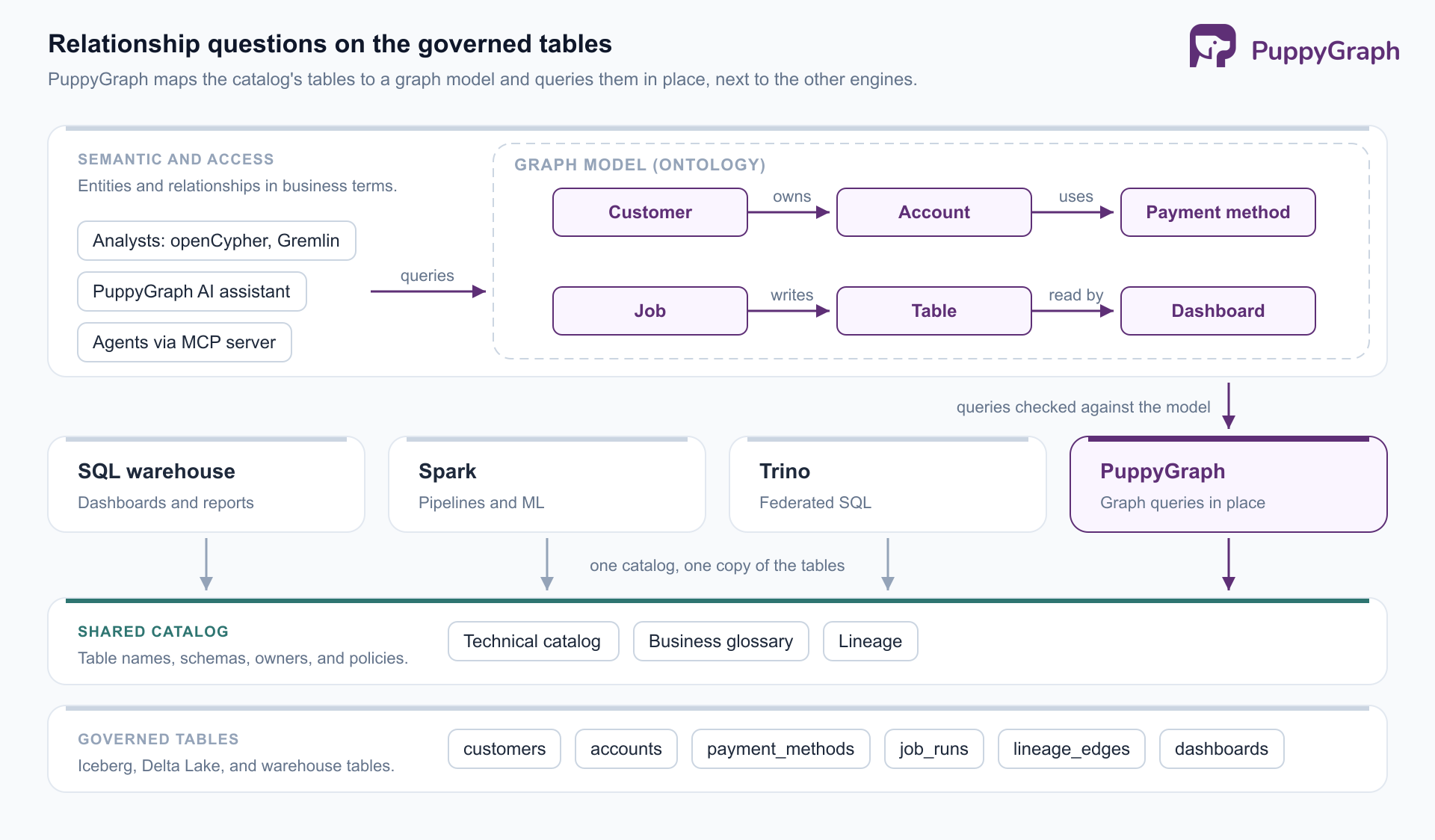
PuppyGraph is a distributed graph query engine that queries SQL databases, data warehouses, and lakehouses in place, including direct reads of open table formats like Iceberg and Delta Lake. Users connect those sources, define a graph schema that maps tables to nodes and edges, and query with openCypher and Gremlin. There is no ETL into a separate graph database, and the same tables stay queryable with SQL.
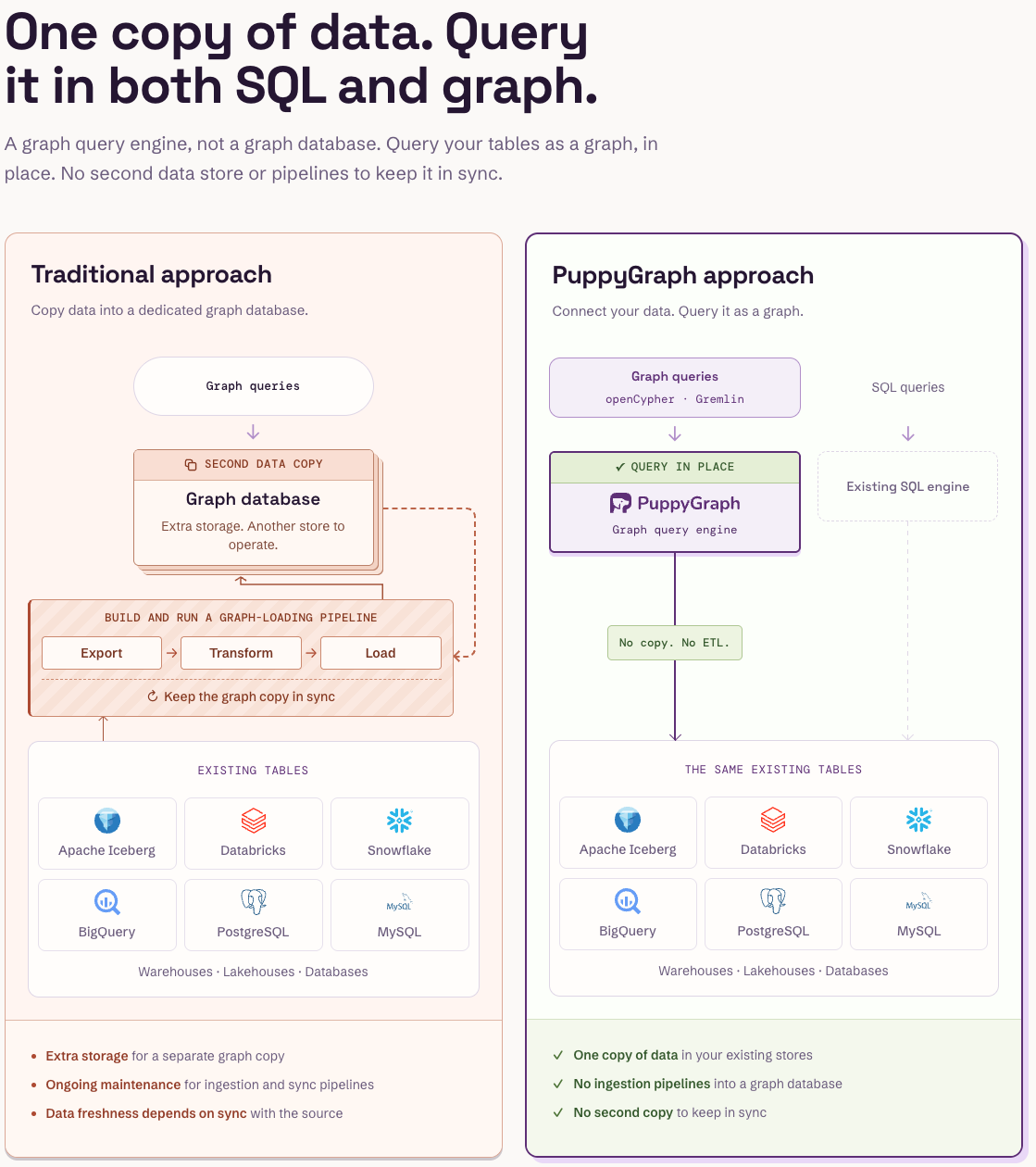
The graph schema works as an ontology for the governed data: it names the business entities, their properties, and the relationships between them, and maps each one to the tables underneath. When its names follow the business glossary in the catalog, analysts and AI agents work from the same definitions as every other consumer, without needing to know the table layout. Ontology enforcement checks each query against the schema before it runs, rejects references to entities or relationships the model does not define, and returns feedback in domain terms that an agent can use to correct its query. PuppyGraph's built-in AI assistant uses this check-and-correct loop when it answers natural-language questions, and it also proposes the graph schema itself by inspecting the connected tables; customer-built agents reach the same model through an open-source MCP server.
How to implement unified data management
Most of the work in UDM is organizational, and it is easier to finish for one domain than for a whole enterprise at once, so the sequence below starts with one domain.
1. Start with one domain and one pain point. Pick a domain where inconsistent data is already costly, such as customer reporting that disagrees across regions or a compliance request that takes weeks to answer. A measurable starting problem keeps the program grounded.
2. Agree on ownership and definitions. Name data owners and stewards for the domain, write down the definitions of its key entities and metrics, and decide which decisions are central and which are federated to domain teams.
3. Choose the catalog and table formats first. These are the hardest decisions to reverse, because every engine, policy, and lineage record will depend on them. Favor open formats and a catalog interface that the engines you run today and expect to run later can use.
4. Register, classify, and move policy into the catalog. Bring the domain's datasets into the catalog, run classification, and replace per-engine grants with catalog-level policies. Expect this step to surface datasets nobody knew existed.
5. Retire copies and expand. Point consumers at the governed tables, decommission redundant extracts, and track a few indicators: the share of assets with an owner, quality checks passing, and the number of duplicate copies. Add the next domain once the first is stable.
Each domain that joins reuses the catalog, policies, and definitions the earlier ones established, which is why the second and third domains tend to move faster than the first.
Conclusion
Unified data management is an old idea with a new implementation path. The goal Russom described in 2010, coordinating data disciplines under shared goals, used to depend mostly on process and integration between tools. Open table formats, shared catalogs, and the separation of storage from compute now let much of that coordination live in the architecture: one governed copy of the data, described once, governed in one place, and read by every engine that needs it. The organizational work of ownership and definitions remains, but the platform no longer works against it.
Try the forever-free PuppyGraph Developer Edition and book a demo with the team to see how openCypher and Gremlin queries traverse warehouse and lakehouse tables, with no graph-specific ETL, so relationship questions are answered from the same governed copy as every other workload.

Sa Wang is a Software Engineer with exceptional mathematical ability and strong coding skills. He holds a Bachelor's degree in Computer Science and a Master's degree in Philosophy from Fudan University, where he specialized in Mathematical Logic.


