The article

Query your table as a graph.Petabytes. Subsecond. No data movement.
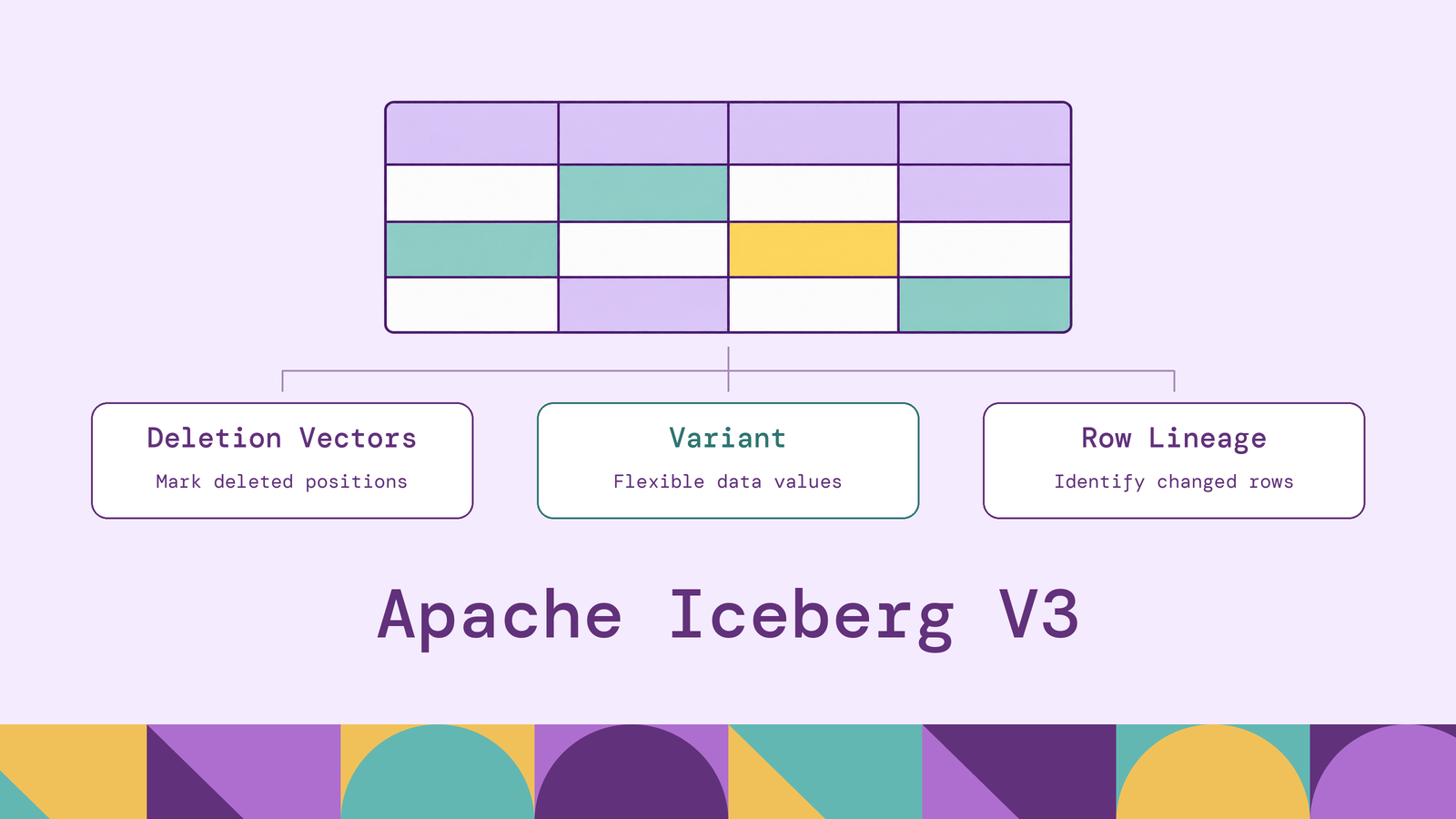
Apache Iceberg V3 expands what analytical tables can represent and how engines track changes within them. Deletion vectors change the representation of positional deletes, variant accommodates heterogeneous payloads, and row lineage adds identifiers that help consumers distinguish logical changes from physical file rewrites. These capabilities matter most when lakehouse workloads involve frequent corrections, evolving event data, or incremental processing.
Adopting them requires coordination across the engines sharing a table. This guide explains the V3 architecture, its major features, the differences from V2, and the checks that should precede an upgrade.
What is Apache Iceberg V3?
Apache Iceberg V3 is version 3 of the Iceberg table-format specification. It defines how compatible implementations represent table schemas, metadata, data files, and row-level changes. Apache lists V3 as a completed, community-adopted specification. The version belongs to the table format, independently of the version numbers used by Iceberg libraries, Spark, or a managed analytics service. See Apache's format-version definitions.
Iceberg organizes files into transactional tables. A processing engine executes queries and writes changes; the format supplies the metadata and rules through which engines agree on the table's contents. V3 extends those rules while retaining the snapshot-based model familiar from V2.
For example, a fleet operator might keep vehicle telemetry in fleet.telemetry_events. Corrections change individual events, manufacturers send different sensor payloads, and analysts need to identify records modified since an earlier processing run. V3 provides mechanisms relevant to each requirement. Whether a particular engine exposes those mechanisms through SQL, a streaming connector, or an API remains an implementation question.
Apache Iceberg V3 architecture
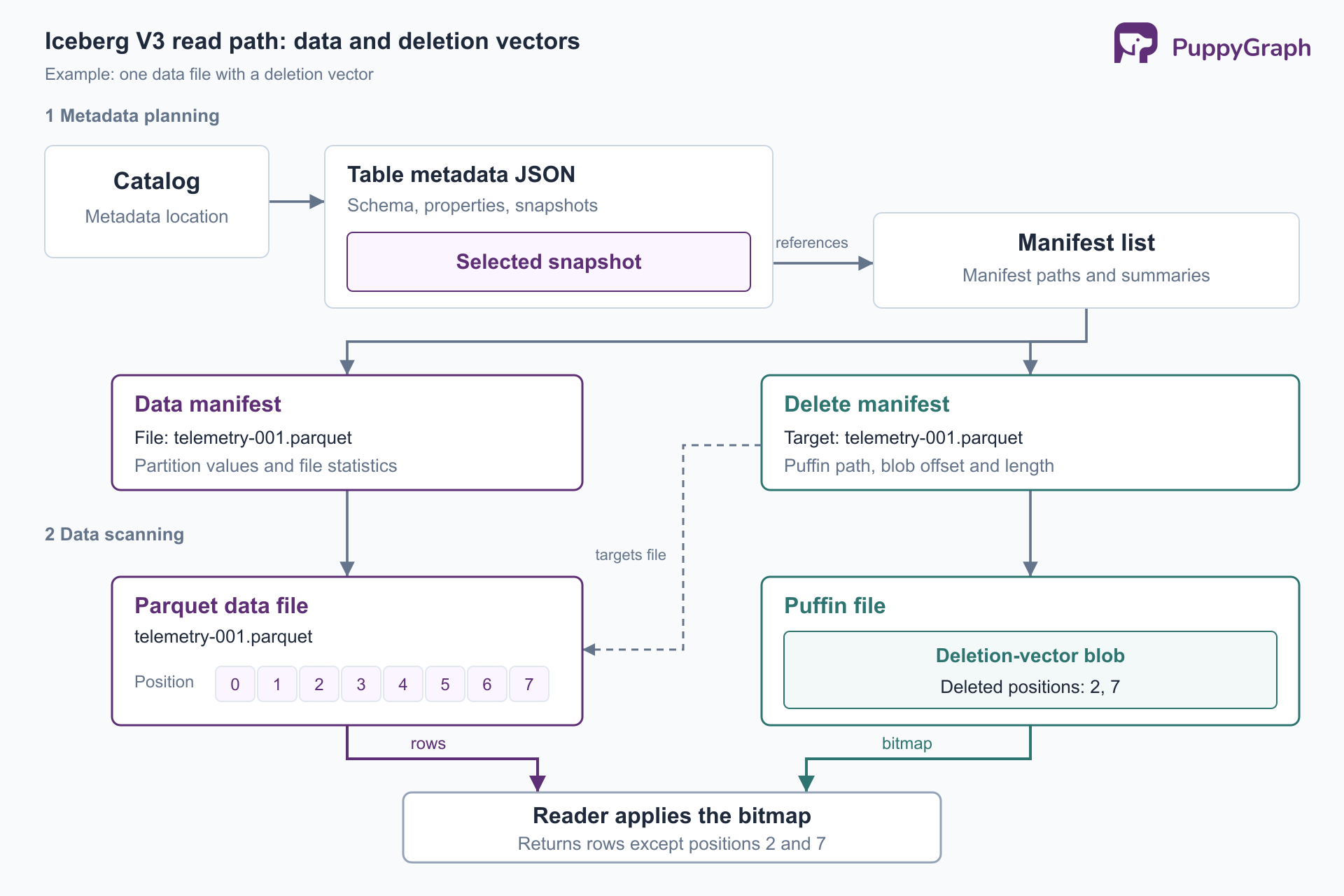
For a catalog-backed V3 table, reading begins by resolving the table's current metadata location. The resulting hierarchy separates finding the relevant files from scanning their contents:
- Table metadata records the format version, schema, partition specifications, properties, and snapshots.
- A snapshot identifies a committed table state and references a manifest list.
- The manifest list identifies manifests and carries summaries that help prune unnecessary metadata reads.
- Manifests describe data files and delete artifacts, including partition information and file-level statistics.
- The referenced files contain the records and the information needed to exclude deleted rows.
This hierarchy is documented in the Iceberg specification's overview. V3 retains separate data and delete manifests. A deletion-vector entry identifies its target data file and the vector's location within a Puffin file. The format therefore tells a reader both which data to scan and which positions to suppress.
Writers create new files and metadata before committing an updated table state. Iceberg uses optimistic concurrency: a writer validates its change against the current state, and a conflicting commit can require a retry or fail validation. Readers continue against a committed snapshot instead of observing a partially published update. Apache's reliability documentation explains this commit model.
V3 changes the information carried through the architecture, including row identifiers and richer types. It does not make object-storage files mutable or move query execution into the catalog.
Key improvements in Iceberg V3
The V3 specification groups changes around extended types and metadata capabilities. Their practical value depends on the workload.
More efficient positional-delete representation. Binary deletion vectors represent deleted row positions without a separate file-and-position record for every deletion. Row lineage complements this by recording row identity and the sequence of its latest modification. The following sections explain their different responsibilities.
Semi-structured event data. The variant type represents values whose internal structure varies between rows. This fits telemetry from vehicle models that expose different sensor fields, while keeping stable identifiers in ordinary typed columns.
Geospatial types. V3 defines geometry and geography, giving spatial values meaning beyond an opaque binary or text column. Geometry uses planar edge interpolation. Geography supports geographic interpretations, with a specified coordinate reference system and edge-interpolation algorithm. For fleet data, that distinction matters when interpreting service-area boundaries or distances across the Earth's surface. The geospatial type definitions establish storage semantics; spatial functions, indexes, and query optimizations still depend on the engine. Adding a spatial column alone does not supply those capabilities.
Higher timestamp precision. Nanosecond timestamp types preserve finer timestamp resolution where the source and consuming engines support it. More digits preserve recorded precision; they do not establish that device clocks are accurate or synchronized.
Column defaults. V3 distinguishes an initial-default, used for records written before a field existed, from a write-default, used when a subsequent write does not supply the field. For example, an added processing-status column can give older telemetry a defined value without rewriting every data file. Changing the write default later affects future writes, not the initial interpretation of old records. These behaviors follow the default-value rules.
Together, these additions address mutable analytical data and richer records. They supplement existing Iceberg capabilities such as schema evolution and snapshots, which were already available before V3.
Deletion vectors in Apache Iceberg V3
A deletion vector is a bitmap identifying deleted positions within one data file. If positions 2 and 7 are marked, a reader excludes those positions when scanning that file. The positions refer to physical row locations, not application keys such as event_id.
Iceberg stores these vectors as deletion-vector-v1 blobs in Puffin files. The encoding uses Roaring bitmaps to represent sets of positions compactly. One Puffin file can contain vectors for multiple data files; each individual vector still targets exactly one data file. Apache's Puffin specification defines the encoding and its metadata.
V2 position-delete files store file paths and row positions as records. Over successive writes, multiple delete files can apply to the same data file. V3 instead permits at most one deletion vector per data file in a given snapshot. A writer adding positional deletes must merge them with the existing vector, or with relevant older position deletes, to produce the complete set.
That consolidation gives readers one positional bitmap to consult for a file. It also gives writers consolidation work: a new deletion cannot simply add an independent second vector for the same file in the same snapshot. The benefit is a more direct read-time representation, not the elimination of all delete-processing costs.
The delete-format rules preserve an important migration distinction. V3 writers cannot add new position-delete files, but existing V2 position-delete files remain valid after an upgrade. When a vector is created for a file, it must incorporate the applicable older positional deletes. Equality-delete files, which identify rows by column values, remain permitted in V3.
For scattered corrections in a large telemetry file, a vector can hide obsolete rows while leaving the base file intact. The file still occupies storage, and scans still need to apply its deletes. Compaction remains useful when the cost of carrying deleted data becomes significant.
Variant data type support in Iceberg V3
Variant lets one column contain differently shaped values while the surrounding table retains a defined schema. A telemetry table can keep event_id, vehicle_id, and event_time as ordinary columns and put manufacturer-specific measurements in a variant payload.
For illustration, two payloads might look like this in JSON notation:
{"battery_temperature_c": 31.4, "charging": true}
{"tire_pressure_kpa": [241, 240, 243, 242], "sensor_revision": "B"}
These are example values, not query results. They show why defining every possible sensor attribute as a top-level column can be cumbersome. Variant can represent nested objects, arrays, and typed scalar values without requiring every row to share the same internal fields.
The storage representation differs from storing JSON text in a string column. Apache Parquet defines a typed binary variant encoding with metadata and value components. Readers can interpret the encoded types rather than repeatedly parsing an entire textual JSON document.
Parquet also defines optional variant shredding: selected values are stored in typed columns alongside the remaining variant representation. This can enable column projection and statistics-based skipping for frequently accessed fields. The writer must produce that layout and the reader must exploit it; switching a table to V3 does not automatically optimize every nested field.
Keep fields that define stable joins and recurring filters explicit when their semantics are known. Variant is useful for the changing payload around those fields. It does not remove the need to validate units, distinguish missing values from nulls, or agree on how engines extract and cast a value.
Row lineage and row-level tracking
V3 introduces two row metadata fields: _row_id, an identifier unique within the table, and _last_updated_sequence_number, the sequence number of the commit that most recently inserted or modified the row. The latter is a commit-order marker, not a wall-clock timestamp. Apache defines these in its row-lineage specification.
These fields help separate a logical change from a storage rewrite. If compaction moves an unchanged telemetry event into another file, its existing row ID and last-updated sequence number are preserved. If an engine updates the event while preserving its identity, the ID remains and the update sequence advances.
Writers do not have to materialize both values in every newly written row. Iceberg uses inheritance from file and manifest metadata, including allocated row-ID ranges. That allows files to be prepared before a successful commit establishes the final sequence number and ID allocation.
There are limits to what identity means. Engines can represent changes as modifications that retain row IDs or as deletion followed by insertion. In particular, updates implemented with equality deletes do not preserve the original row's lineage: the writer need not read that row and therefore cannot carry its ID into the replacement. An application-level event_id remains useful independently of Iceberg's row ID.
Row lineage supplies building blocks for incremental processing, but it is not a complete change-data-capture feed. A deleted row is excluded from queries of the current snapshot. Recovering its previous values, pairing changes, and maintaining a durable change stream require additional engine behavior and retained history. Nor do these fields describe which upstream system or transformation produced an event.
An upgrade also does not reconstruct past row histories. Pre-upgrade snapshots lack row IDs; new snapshots after the upgrade assign IDs to existing and newly added data through the specified inheritance rules. Consumers need an explicit starting point for their tracking.
How Apache Iceberg V3 handles updates and deletes
Consider correcting a vehicle identifier on an existing telemetry event. The engine first locates the affected data, then writes a new representation of the table state. The SQL operation and its physical execution strategy are separate decisions.
Copy-on-write rewrites affected data files, keeping unchanged rows and incorporating the correction. The current snapshot then references the replacement files. This puts more work into the write, while readers of the new files do not need to apply a separate delete artifact for that correction.
Merge-on-read can leave the original data file in place, record the obsolete row position in a deletion vector, and write the corrected row into a new data file. Readers combine the base data, applicable deletes, and new records to produce the visible table contents.
V3 does not force every operation into merge-on-read. Iceberg exposes separate settings for delete, update, and merge modes, and the implementation must support the chosen behavior. The write configuration reference documents those choices. A whole-file deletion or a whole-partition deletion in Spark can also avoid producing row-level delete information when the engine can remove the matching files through metadata.
The commit publishes the new state atomically. A reader using an earlier retained snapshot can still see the earlier contents, while a reader using the new snapshot sees the correction. Concurrent writers must satisfy the engine's conflict-validation rules.
Logical deletion also differs from reclaiming storage. A vector suppresses rows without erasing their bytes from the data file. Rewriting files can eliminate those rows from the current representation, but old files may remain referenced by historical snapshots. Snapshot expiration and file maintenance determine when unneeded files can be removed. Plan write modes, compaction, and retention together.
Iceberg V3 vs Iceberg V2: key differences
The differences concern the table contract. They do not imply that every V3-capable engine implements every feature identically. The following comparison follows Apache's format-version changes.
| Dimension | Iceberg V2 | Iceberg V3 |
|---|---|---|
| New positional deletes | Position-delete files containing file paths and positions | Deletion vectors stored in Puffin; at most one per data file per snapshot |
| Existing delete compatibility | Reads its position and equality deletes | Retains existing V2 position-delete and equality-delete files |
| Row-level identity | No V3 row-lineage fields | Row IDs and last-updated sequence numbers, subject to update semantics |
| Semi-structured type | No standardized Iceberg variant type | Adds variant, with implementation-dependent query support |
| Spatial and timestamp types | No V3 geometry/geography types; microsecond timestamp precision | Adds geometry, geography, and nanosecond timestamp types |
| Column defaults | No V3 initial/write-default mechanism | Distinguishes defaults for pre-existing records and subsequent writes |
| Reader compatibility | Requires V2-capable readers | Requires V3-capable readers and support for the features actually used |
Both versions support snapshot-based tables and row-level changes. V3 changes how some of those changes are represented and adds richer data semantics. An append-heavy table with a stable schema may have little immediate reason to migrate. A correction-heavy event table may benefit from deletion vectors, while a heterogeneous telemetry table may justify adoption through variant. Choose the feature first, then establish that the complete reader and writer set can support it.
How to upgrade from Iceberg V2 to V3
Start with the table's consumers, including scheduled jobs and maintenance utilities. A successful query from the main SQL engine is insufficient if an older ingestion connector or occasional export job cannot read the upgraded metadata.
Inventory feature-level support. Record which engines read and write the table, their deployed versions, and the V3 features each supports. Check deletion-vector handling, new types, lineage behavior, and compaction separately. Generic Iceberg connectivity is not evidence of complete V3 support.
Rehearse with representative data. Use a separate test table containing the schemas and delete artifacts that matter to the workload. Test updates, merges, deletes, historical reads, and maintenance through the actual consumers. For lineage-dependent jobs, check whether each writer preserves IDs across updates and compaction.
Upgrade through the owning engine or catalog integration. In a compatible Spark deployment with the Iceberg catalog configured, the upgrade uses a table property:
ALTER TABLE lakehouse.fleet.telemetry_events
SET TBLPROPERTIES ('format-version' = '3');
Here, lakehouse is the configured catalog. Apache documents setting table properties through Spark, and AWS's V3 upgrade instructions show this format-version change. The upgrade is a metadata operation; it does not require rewriting all existing data files or converting every old delete file immediately.
Validate subsequent writes and recovery. Check the committed format version, then exercise the V3 features the workload needs. Compare business-level results across readers. Treat recovery as platform-specific: changing the property back to 2 is not a general downgrade procedure, and restoring an earlier data snapshot is not equivalent to restoring the table's earlier format. Establish the platform's supported recovery path before upgrading.
The consumer inventory can also include relationship analysis. In the fleet example, tracing vehicles connected through successive battery-pack swaps requires following the recorded installation relationships across tables.
PuppyGraph is a real-time, zero-ETL graph query engine that queries existing SQL databases, data warehouses, and lakehouses, including supported Iceberg tables, with no data movement into a separate graph database. A graph schema maps the existing tables to nodes and edges for openCypher and Gremlin queries, supporting graph models for agents across 3,000 tables while the same tables remain available to SQL. Its distributed engine compiles graph queries into a plan of node and edge operators and executes them in parallel across compute nodes, so compute scales independently of source storage over petabytes of data. It can deliver subsecond graph queries, with latency depending on the workload and deployment.
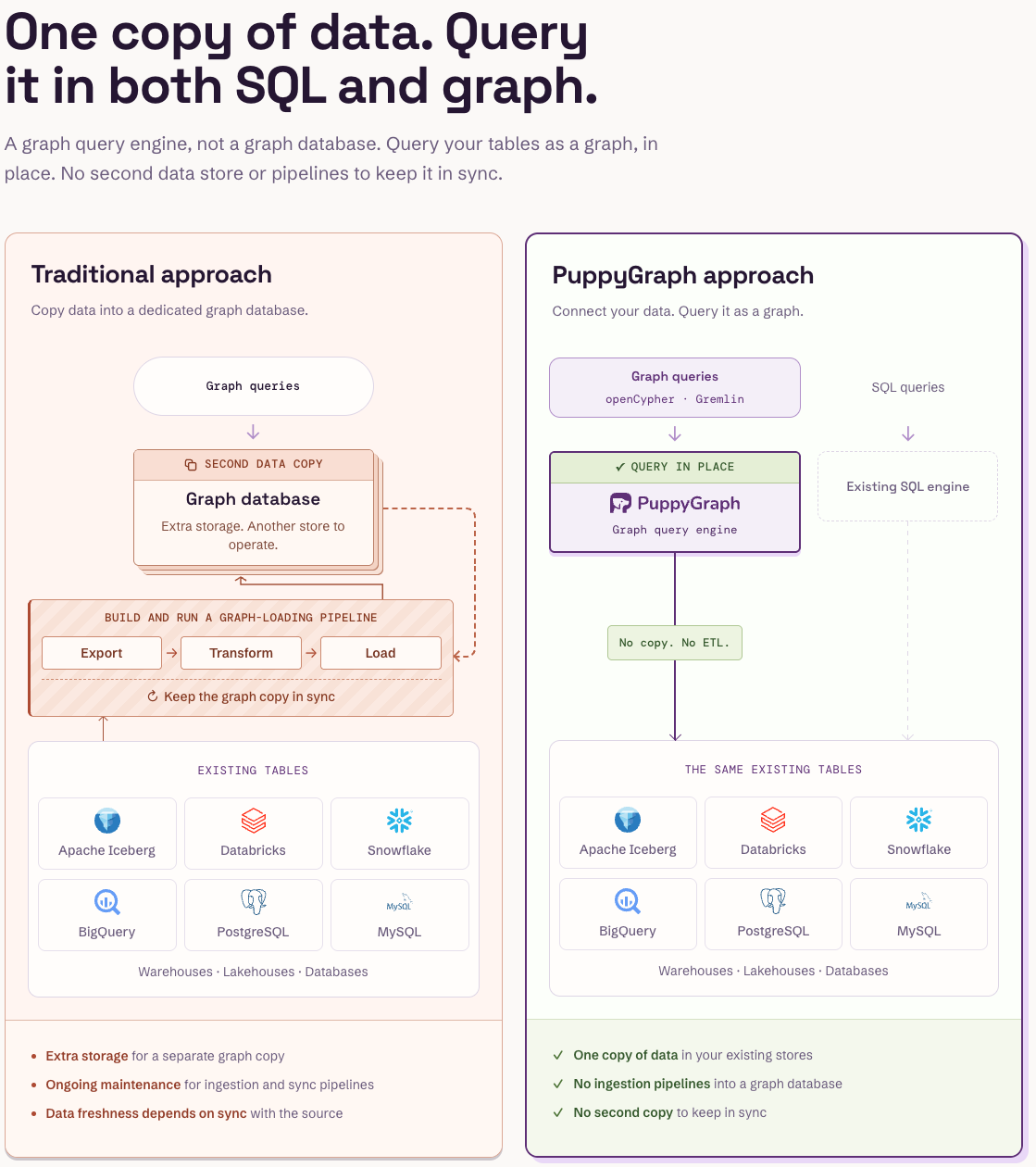
Use the Iceberg connection documentation for catalog and storage setup, and validate the selected PuppyGraph release against the V3 features in the table before migration. The graph model describes domain relationships; Iceberg's row-lineage fields do not create those relationships automatically.
Conclusion
Iceberg V3 extends the lakehouse table contract with deletion vectors, richer types, and row-level tracking. Those additions address concrete needs, but their value depends on how engines write, read, and maintain the table. Upgrade when a feature solves a workload problem and every required consumer has been tested against it.
Try the forever-free PuppyGraph Developer Edition and book a demo with the team to see how openCypher and Gremlin queries trace relationships across warehouse and lakehouse tables, with no graph-specific ETL, alongside your existing Iceberg analytics.