The article

Query your table as a graph.Petabytes. Subsecond. No data movement.
An AI agent can produce valid SQL and still answer the wrong business question. It might calculate throughput using a different shift boundary, select an experimental dashboard's definition, or join records that refer to different assets. Reliable analysis requires agreement about what the data means, alongside access to the data itself.
Genie Ontology addresses that context problem within Databricks. This guide explains how its components work together, where it fits in an architecture, and how to evaluate it against relational models, semantic layers, and knowledge graphs.
What Is Genie Ontology?
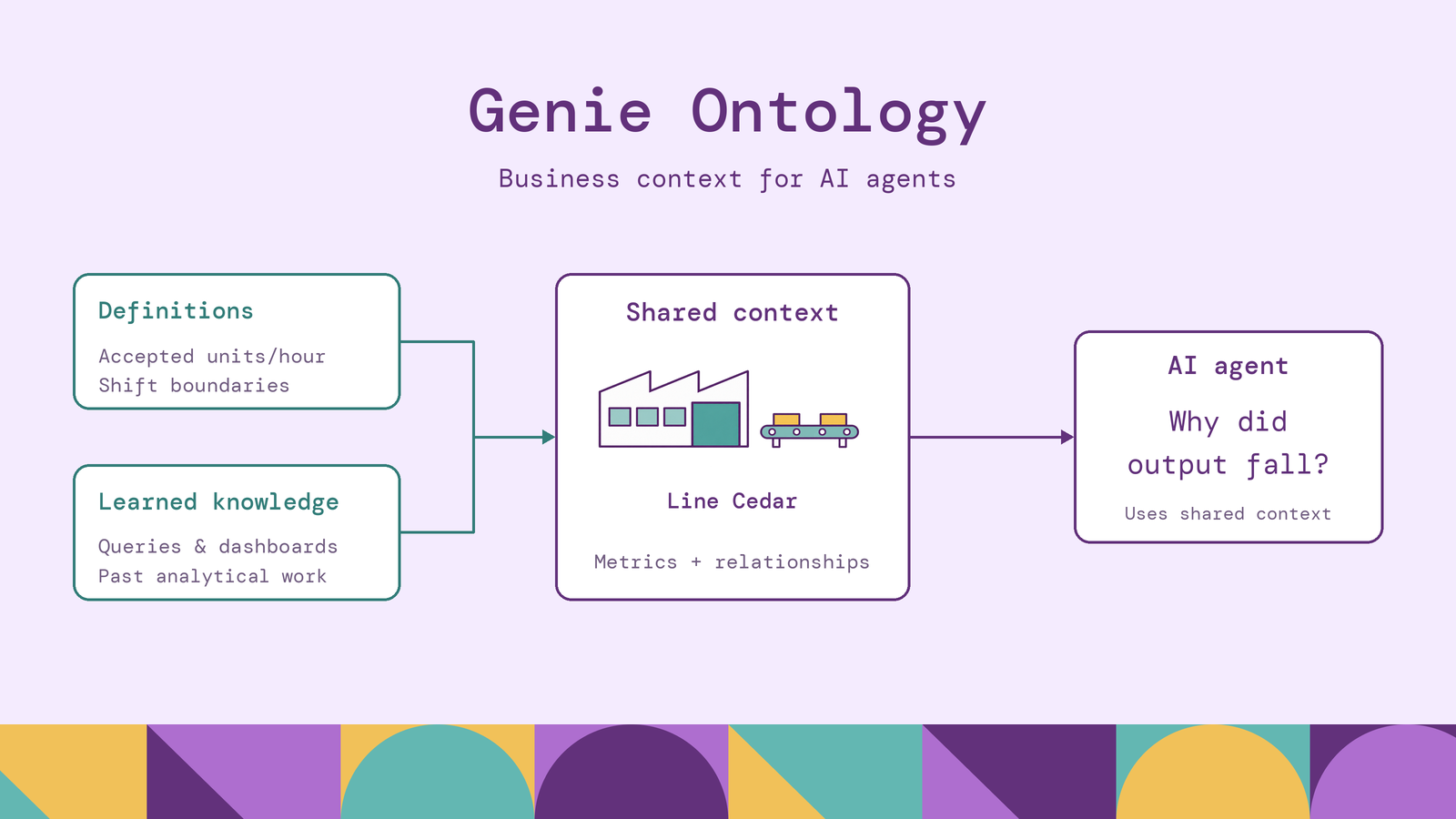
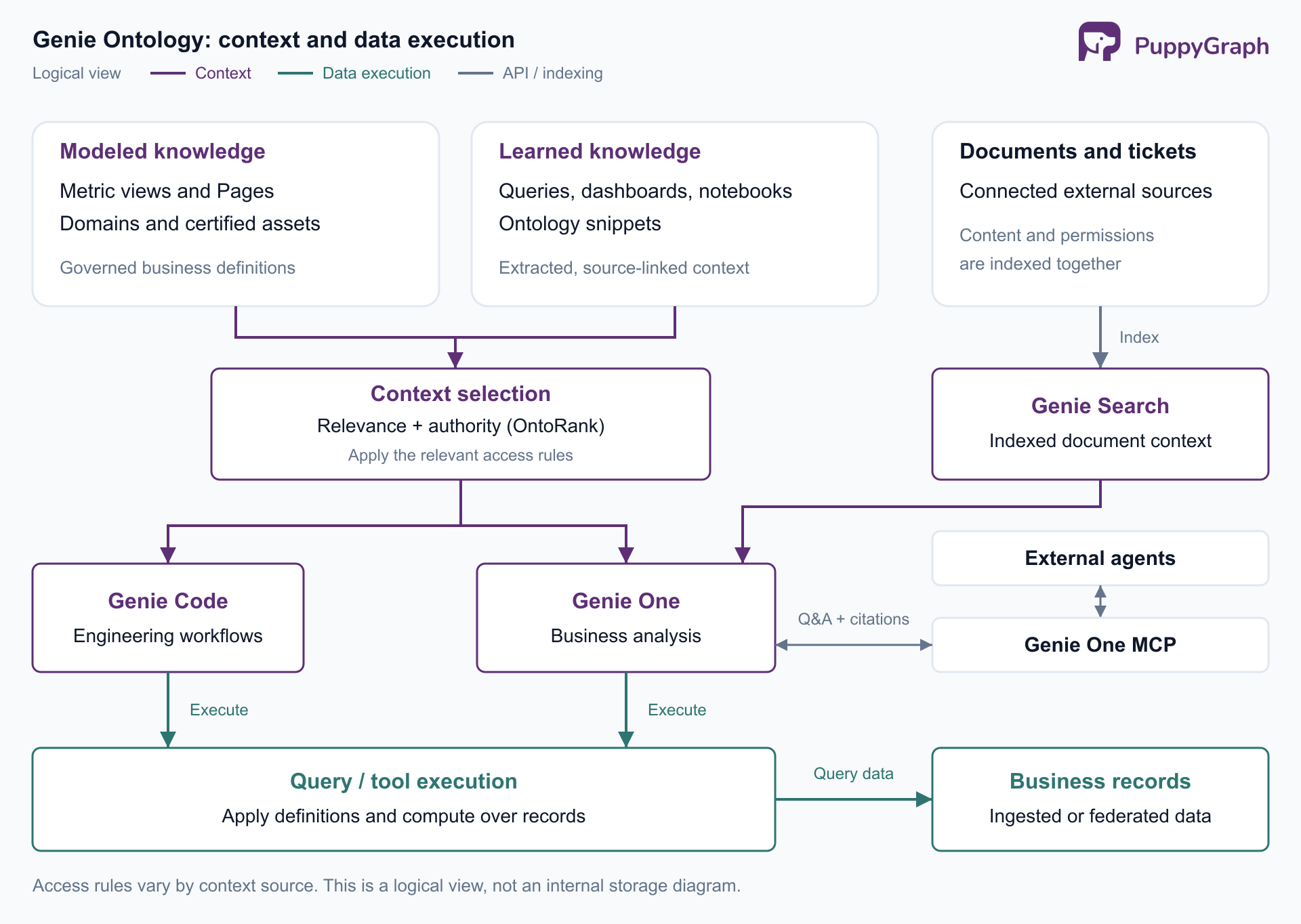
Genie Ontology is Databricks' shared business-context layer for AI agents. It combines definitions that teams explicitly govern with knowledge extracted from existing assets and usage. Genie One and Genie Code use this context to interpret questions, identify relevant sources, and apply business meaning. External agents can access Genie's capabilities through the Genie One MCP server. Databricks' documentation describes this as the combination of modeled and learned knowledge.
Consider a hypothetical manufacturer investigating why Assembly Line Cedar missed its weekly throughput target. A production table records completed units, but the business must also define whether throughput includes rework, which timezone determines a shift, and which asset identifier represents the line. Those decisions determine whether the answer is useful.
The ontology supplies that interpretive context. The agent still needs to retrieve records, execute calculations, and assess the evidence. Databricks lists Genie Ontology as generally available in its November 2026 release notes.
How Does Genie Ontology Work?
The process connects knowledge acquisition with context selection at question time.
Extract business knowledge. Genie identifies reusable definitions and relationships in supported assets, including queries, dashboards, and notebooks. A saved production query might reveal that the operations team excludes reworked units from its throughput calculation. That logic becomes evidence about the business definition, alongside the asset it came from.
Assess relevance and authority. Several assets may describe the same concept differently. Databricks describes a ranking approach that considers source authorship, usage, freshness, and relationships to trusted assets. A frequently copied query is therefore part of the evidence, but popularity alone does not establish the correct definition. The launch explanation describes how these signals help select context.
Use the context during analysis. In the manufacturing example, an agent should establish the approved throughput definition and reporting interval before comparing output across shifts. It can then examine the relevant records and explain its calculation. This separates two questions an evaluation should test: did the agent choose the right meaning, and did it compute the answer correctly?
Expose the basis for the answer. Response citations let users inspect the snippets and source assets Genie used. When learned knowledge is wrong, update the originating asset or add an authoritative modeled definition; the current interface does not support editing learned snippets directly. That feedback path is documented under learned knowledge.
Key Components of Genie Ontology
Metric views define calculations. Unity Catalog metric views separate measures from the dimensions used to group and filter them. A throughput measure can retain one calculation while analysts examine it by production line, shift, or product. The query engine computes the measure for the requested grouping. Metric views provide the executable part of a governed metric definition.
Pages explain business concepts. A Page records an authoritative definition of a term, entity, or acronym, with an owner, synonyms, sources, and related assets. For Cedar, a Page could explain the difference between accepted production and total machine output, then point to the relevant metric view. Pages carry the explanation that a formula alone cannot provide.
Domains organize context. Domains and subdomains group assets by business purpose using governed tags. A manufacturer might separate Plant Operations from Maintenance while associating shared assets with both. Domains provide business organization without requiring the physical catalog hierarchy to mirror every team's vocabulary.
Ontology snippets capture learned knowledge. These are reusable pieces of context linked to their originating assets. They let work already recorded in queries and dashboards contribute to later questions. The general-availability announcement describes their ongoing extraction and refresh as source assets change.
Certification identifies trusted assets. Teams can mark supported assets as certified or deprecated. These signals help distinguish an approved production metric from a retired calculation. Certification records an organization's judgment; it still needs an owner who checks whether that judgment remains justified.
Genie Ontology Architecture
A useful logical architecture separates source access, context management, and agent execution. These are responsibilities, not a claim about Databricks' internal storage services.
At the source layer, structured data is available through the Databricks platform's ingestion and federation paths. External documents and tickets can enter the context through Genie Search, which indexes content together with its access permissions. This matters architecturally: document search, querying live records, and taking an action are distinct operations. The Genie Search documentation describes the indexed-content path.
The context layer combines governed semantics with extracted knowledge. Databricks calls its relevance-and-authority ranking approach OntoRank. Context selection connects a business term to useful definitions and sources; it does not itself calculate the latest throughput figure. The product's architecture description places modeled semantics and continuously learned knowledge in this shared layer.
At the consumption layer, Genie uses the selected context while answering the question. For external applications, the Genie One MCP server accepts natural-language questions and returns answers with source links. This is an interface to Genie's analysis, rather than evidence of a general-purpose graph traversal endpoint.
Genie Ontology Use Cases
Conversational operational analysis. A plant manager asks why Cedar missed its target. Useful context identifies the approved output metric, shift calendar, and production records. The investigation can compare changes over time without silently switching between total output and accepted units. Any causal explanation still requires evidence beyond a correlated change.
Context-aware engineering. An engineer building a production dashboard needs the same definitions. Genie Code can use business context when selecting data and developing analysis. The documented use cases include this technical workflow alongside business-facing analysis. In the example, the engineer should reuse the governed calculation rather than recreate a subtly different formula.
Knowledge discovery. An analyst investigating an unfamiliar stoppage code may need a maintenance document before querying observations. Genie Search can retrieve relevant documents from connected sources within the user's access. The useful outcome is a source-backed explanation that helps the analyst choose the next investigation step.
Shared context for external agents. A custom operations assistant can ask Genie business questions through MCP and receive results grounded in the same organizational context. The Genie One MCP announcement describes this access across agent workflows. Teams still need to design how the calling agent checks the answer and handles uncertainty before acting on it.
Genie Ontology vs Traditional Data Models
These approaches solve overlapping problems at different levels. Relational models organize records and constraints. Semantic layers define reusable business logic. Knowledge graphs represent entities and their relationships. Genie Ontology combines governed semantics and learned context for agent consumption.
| Approach | Main responsibility | Manufacturing example | Failure to test for |
|---|---|---|---|
| Relational model | Structure records, keys, and relationships for querying | Production observations linked to asset and shift tables | Duplicate identifiers or joins that multiply observations |
| Semantic layer | Define reusable measures, dimensions, and business logic | Accepted units per scheduled production hour | An agreed formula applied to the wrong reporting scope |
| Knowledge graph | Represent and query connected entities and relationships | A line depends on equipment supplied by shared utilities | Missing or incorrectly directed dependencies |
| Genie Ontology | Select business context from governed and learned knowledge | Identify which throughput definition and sources fit the question | Relevant-looking context drawn from an unsuitable business definition |
The knowledge-graph category is broader than any one product. Hogan and colleagues' Knowledge Graphs survey covers different graph models, query languages, and approaches to schema and context. A graph representation alone does not imply a particular storage engine or inference capability.
Unity Catalog Semantics supplies the modeled foundation within Genie Ontology, so the two are complementary layers rather than competing replacements. Its semantic-layer description centers on reusable business definitions. For an architecture decision, ask whether the immediate problem is inconsistent calculations, discovering the right context, or following dependency paths. One system may contribute to several of these tasks, but each task needs its own evaluation.
Benefits of Using Genie Ontology
Less repeated definition work. Shared business meaning can reduce the need to explain the same metric separately in every assistant. The benefit is especially tangible when a definition changes: teams have a governed place to maintain the calculation and its explanation. Databricks' study of curated agents and governed context illustrates this relationship, although its measured results belong to its specific test environment. Formulas duplicated in individual agents' instructions still need maintenance when the governed definition changes.
More inspectable answers. A calculation is easier to assess when reviewers can identify the definition and source behind it. For Cedar, citing the approved throughput definition makes a disagreement actionable: reviewers can distinguish a definition problem from a data-quality or arithmetic problem.
Reuse of existing analytical knowledge. Queries and dashboards often encode decisions that never reached a glossary. Learning from those assets broadens the available context. This is valuable when teams also maintain a trusted core of definitions and retire obsolete assets.
Evaluate these benefits through practical outcomes: fewer definition disputes, less manual source hunting, and answers that remain consistent when questions are paraphrased. An ontology's size alone says little about those outcomes.
Challenges and Limitations of Genie Ontology
Source quality limits answer quality. Conflicting identifiers, undocumented exceptions, and obsolete calculations remain engineering problems. Databricks' operational guidance treats data quality and entity resolution as foundational practices for progressively improving answer quality. Ranking context cannot repair duplicated production observations.
Permission behavior depends on the context path. Ordinary learned snippets are gated by access to their source assets. Published Pages inherit read access from their domain or subdomain. However, the current external knowledge sources documentation says imported BI snippets are available to all users in the account. Review that scope before enabling the feature; do not assume every connector preserves identical visibility rules.
Capabilities differ between consumers. Genie Code does not use Genie Search content, and ontology snippets currently do not support customer-managed keys. Both limitations appear in the Genie Ontology documentation. Validate requirements against the exact surface the application will use.
Product availability is component-specific. Genie Ontology is generally available, while external BI knowledge sources remain in Beta. The announcement distinguishes those statuses.
Genie Ontology Best Practices
Start with one decision. For the manufacturing scenario, define what a successful weekly throughput investigation must return: the reporting interval, accepted-output calculation, comparison baseline, and supporting records. Use those requirements to scope the initial domain.
Assign definitions to maintained assets. Put the calculation in a metric view and its business interpretation in a Page. Give each an owner. Document exceptions, such as how a shift spanning midnight is assigned to a reporting day. Databricks recommends keeping governed calculations and explanatory context together in its guidance on curated agents.
Test the full answer path. Include ambiguous questions, missing-data cases, and users with different access. Check the chosen definition, underlying records, calculation, and citations. Repeat those questions after changing a source or definition. For Cedar, an acceptable answer may be that the available records cannot establish why throughput fell.
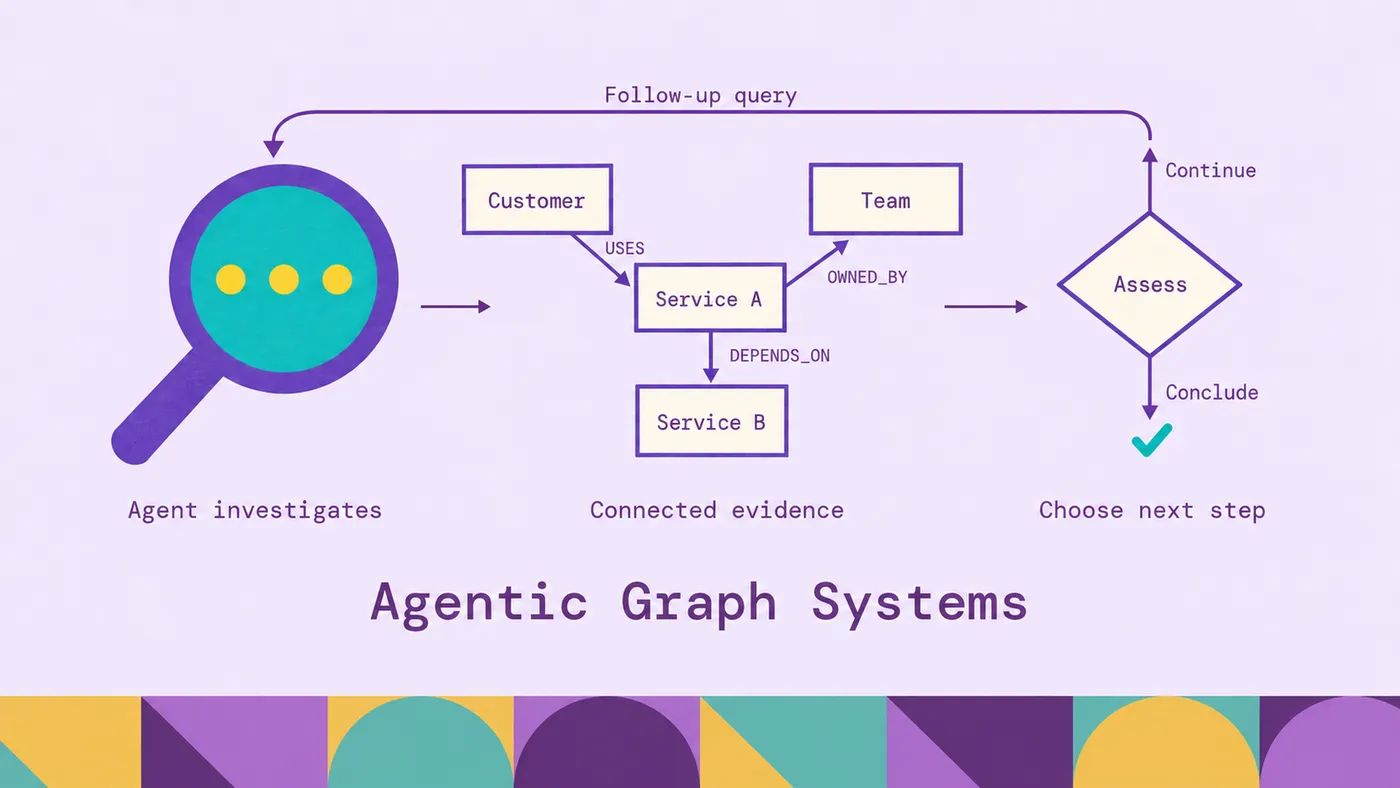
Choose execution tools for the investigation. Once throughput is defined, the next question may follow relationships: which production assets share an upstream utility dependency with Cedar, and which maintenance work overlaps the affected interval? This suggests an additional graph-query path over the organization's asset and work-order tables.
PuppyGraph is a real-time, zero-ETL graph query engine for querying existing tables as a graph, with published support for agents working across 3,000 tables, datasets measured in petabytes, and subsecond graph queries. It reads SQL databases, warehouses, and lakehouses, including Iceberg and Delta Lake tables, with no data movement into a separate graph store; query latency depends on the workload and deployment. Teams connect their sources and use the built-in AI assistant to propose nodes and edges for approval, then query with openCypher or Gremlin. Agents can connect through MCP. Ontology enforcement rejects references outside the approved model and returns feedback for correction.
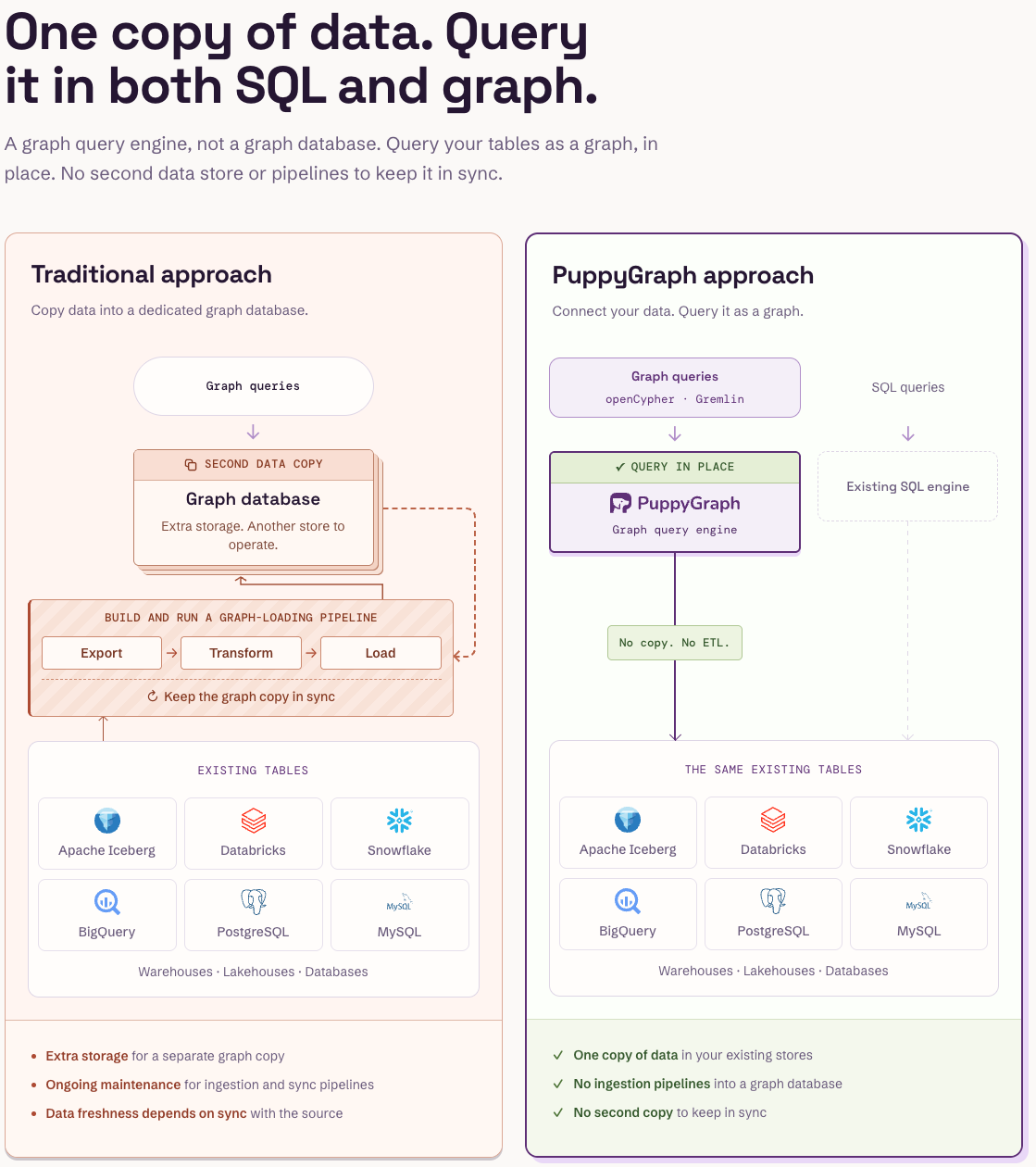
For the manufacturing investigation, that model could expose asset dependencies as traversable relationships while the existing semantic definitions govern the throughput calculation. This is a complementary architecture pattern: the team would configure the agent's context and query tools, rather than assume an automatic integration between the products.
Conclusion
Genie Ontology connects business definitions with knowledge learned from an organization's analytical work. Its value depends on the quality of that knowledge, appropriate access, and whether agents apply it correctly. Start with a bounded domain, maintain its critical definitions, and evaluate complete answers against known business questions.
Try the forever-free PuppyGraph Developer Edition and book a demo with the team to see how openCypher and Gremlin queries follow dependencies across warehouse and lakehouse tables, with no graph-specific ETL, for investigations that need connected evidence alongside governed metrics.