

MLOps: Definition, Lifecycle, Tools, Benefits
%20(1).png)
MLOps turns machine learning from a sequence of experiments into an operational system. It gives teams a repeatable way to move a model from data and code to a monitored production service, while retaining the evidence needed to reproduce, approve, update, or retire it.
The difficult part is not deploying one model once. Data changes, dependencies move, requirements evolve, and a model can continue returning technically valid predictions after its real-world performance has deteriorated. This guide explains the practices, architecture, tools, lifecycle, and controls that keep those changes manageable, then shows how the same discipline extends to generative AI and large language model applications.
What is MLOps?
Machine learning operations, or MLOps, combines people, processes, and technology to build, release, monitor, and maintain machine learning systems. It applies version control, testing, automation, and observability to data, experiments, features, models, and statistical behavior. The AWS MLOps checklist similarly frames MLOps around consistently delivering ML solutions.
MLOps is therefore broader than model deployment. A deployment mechanism can put a serialized model behind an API. An MLOps system records which code, data, parameters, and environment produced that model; checks whether it meets release criteria; controls how it reaches production; monitors the service and its predictions; and connects production evidence to the next training cycle.
Three continuous practices sit at its center. Continuous integration tests changes to pipeline code, training code, feature logic, and infrastructure. Continuous delivery packages and promotes a validated model or pipeline through environments. Continuous training runs the training workflow again when an approved trigger occurs, such as new labeled data or evidence of degradation. Continuous training does not require automatic promotion. High-risk systems may retrain automatically while still requiring a person to approve deployment.
Why is MLOps important?
A production ML system contains much more than its learned parameters. It depends on upstream data producers, transformation logic, labels, feature definitions, serving infrastructure, application code, and monitoring. Google's paper on hidden technical debt in machine learning systems describes how these dependencies create failure modes beyond ordinary application code. A small upstream change can alter a feature distribution without breaking an interface or raising an exception.
MLOps makes these dependencies explicit. A versioned run identifies the dataset, commit, image, parameters, and evaluation that produced a deployed model. Automated gates can reject malformed data, regression, or an incompatible artifact. Monitoring can distinguish an unhealthy endpoint from a healthy endpoint serving a stale model.
This discipline matters even for a small model portfolio. A fraud classifier may need fresh labels before its performance can be measured, while a demand forecast may change after a pricing decision. Without a connected lifecycle, each change becomes a manual investigation. MLOps retains enough lineage and telemetry to make that investigation bounded and repeatable.
MLOps vs. DevOps
MLOps inherits many DevOps practices, but the deliverable is different. Traditional software behavior is primarily determined by code and configuration. ML behavior is determined by code, configuration, data, learned parameters, and the environment in which predictions are consumed. Tests can assert exactly what a deterministic function returns for a given input. They usually cannot specify every acceptable output of a probabilistic model.
The two practices share infrastructure-as-code, review, access control, artifact management, staged rollout, and incident response. MLOps adds controls where learned behavior enters the system. A service can be operationally healthy while its predictions are no longer useful, so model and data telemetry must inform release and response.
MLOps vs. machine learning engineering
Machine learning engineering is an engineering role and discipline. MLOps is the operating system around the work. An ML engineer might design features, train models, optimize inference, or integrate predictions into an application. MLOps defines how that work becomes reproducible, reviewable, deployable, and observable across a team.
The boundary varies by organization. One ML engineer may own training, deployment, and monitoring, or a platform team may build shared infrastructure while product-aligned engineers own model logic and evaluation. Data engineers, reliability engineers, security teams, and domain reviewers also contribute.
Treating the terms as synonyms hides ownership gaps. A capable model still needs an operational path, and a platform cannot decide whether its metric reflects the product outcome that matters.
Key components of MLOps
An MLOps architecture connects several controls around a training and serving path. Products differ, but the responsibilities remain stable.
Artifacts and evidence. Code belongs in version control. Larger datasets, model weights, and outputs need immutable identifiers in object or artifact storage, so a run points to exact inputs rather than a mutable path such as latest.csv. Training runs also record parameters, metrics, code versions, data references, environments, and outputs. This supports evidence-based comparison and provides lineage from a deployed version to its producing run.
Pipeline inputs and execution. A pipeline defines dependencies across validation, transformation, training, evaluation, packaging, and deployment. It handles retries, scheduling, caching, and execution metadata, while each component retains explicit inputs, outputs, and a failure policy. A feature store can define, discover, and serve reusable features. Its offline path supplies point-in-time-correct training data, while its online path serves current values for inference. Shared definitions help control training-serving skew.
Release and operations. A model registry stores versions and their metadata, and promotion should reflect approval and evaluation evidence rather than merely a file location. MLflow Model Registry supports versioning, lineage, aliases, tags, and APIs. Batch jobs, streaming consumers, online endpoints, and edge packages need different deployment patterns. Their serving layers enforce the expected interfaces and may support shadow, canary, or A/B releases. In production, infrastructure metrics cover availability, latency, errors, and saturation, while ML telemetry covers input quality, drift, prediction behavior, delayed ground-truth performance, and business impact. Governance adds ownership, access, approval records, risk review, and retirement.
Teams can assemble focused components or use a managed platform that integrates several responsibilities.
Tool selection should follow the operating model. A team with a few batch models may need versioned pipelines and reliable monitoring, not a large internal platform. A platform earns its cost when it removes repeated integration work while preserving clear ownership.
The MLOps lifecycle
The MLOps lifecycle is a loop because production evidence changes what the team builds next. Google's MLOps architecture guide separates the flow into data extraction, analysis, preparation, training, evaluation, validation, serving, and monitoring. In practice, teams also place problem definition and retirement around those technical stages.
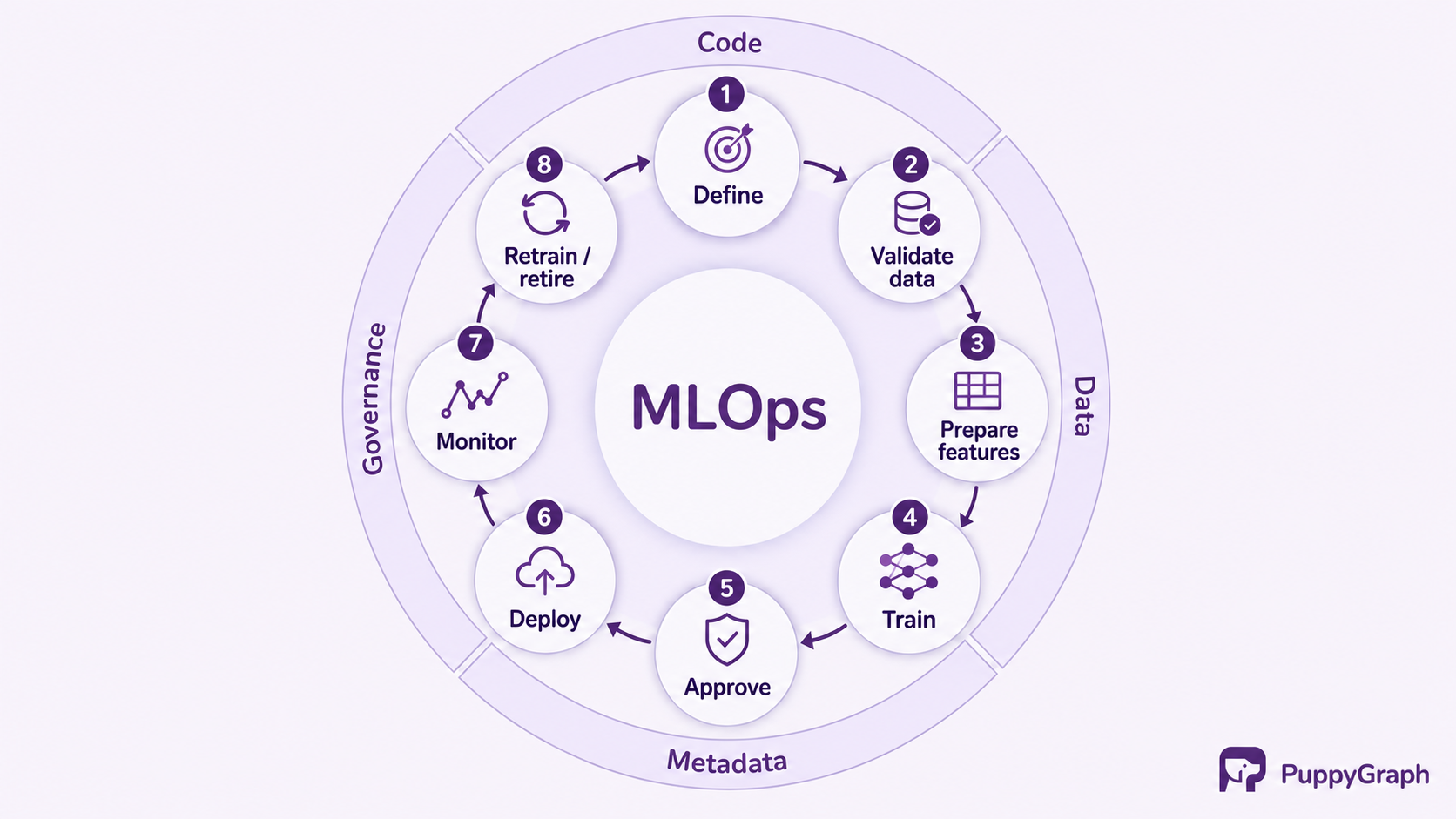
1. Define the objective. Specify the decision, users, baseline, success metrics, constraints, and unacceptable failure modes. Connect offline metrics to the operational outcome.
2. Collect and validate data. Identify sources, labels, permissions, retention requirements, and coverage gaps. Validate schemas, ranges, relationships, and freshness before training.
3. Prepare features and splits. Clean and transform the data, create features, and split examples without leaking future or target information. Store the transformation logic with the same rigor as model code.
4. Experiment and train. Compare model families and parameters against reproducible datasets. Track failed and successful runs so discarded approaches are not repeated without new evidence.
5. Evaluate and approve. Test on held-out data, compare with the current model and a baseline, inspect important slices, and check operational constraints. Declare approval criteria before scoring.
6. Package and deploy. Bundle the model with its runtime and interface contract. Verify feature compatibility and use a staged rollout where exposure carries material risk.
7. Monitor and respond. Watch service health, input validity, drift, prediction behavior, and ground-truth outcomes. Give every alert an owner and response action.
8. Retrain or retire. Retrain on an approved schedule or trigger. Remove models that no longer serve a valid objective, along with unused endpoints, credentials, and pipelines.
Each stage should produce inspectable artifacts and metadata. That evidence is what lets a team reproduce a decision months later and what turns the lifecycle from a diagram into an operating practice.
Data collection and data preparation
Most model behavior originates upstream of the training algorithm. Collection begins with provenance: who produced the data, for what purpose, under which permissions, when, and through which sampling process. A large dataset remains unsuitable if its labels encode an obsolete policy or exclude production cases.
A dependable pipeline keeps raw inputs recoverable and applies versioned, deterministic transformations. It validates types, required fields, values, uniqueness, relationships, and distributions. Invalid records may be rejected, quarantined, or corrected under an explicit rule. Quiet coercion erases diagnostic evidence.
Training, validation, and test splits must reflect how the system will be used. Random splitting can leak future information in time-dependent problems or place records from the same customer in both training and test sets. Feature calculations must also respect event time. A fraud model trained with a chargeback status that became known weeks after the transaction has learned from the future, even if the SQL ran correctly.
Best practices for this stage include versioning dataset definitions rather than relying on mutable exports, testing transformations in CI, documenting label construction, measuring coverage across relevant groups, and recording lineage from raw sources to features. When online inference uses a separate feature path, compare its values with the offline path. Data validation should fail early enough to prevent a bad batch from producing a plausible model artifact.
Benefits of MLOps
The value of MLOps comes from shorter, safer feedback loops rather than from automation alone.
Reproducible delivery. Versioned inputs and run metadata let another engineer recreate a result, compare candidates fairly, and trace a production prediction to the system state that produced it. Reusable pipelines then remove manual handoffs and apply the same checks to each candidate, leaving more time to improve model and product behavior.
Earlier failure detection. Data contracts, component tests, evaluation gates, and staged rollouts catch different classes of defects before full production exposure. Monitoring then shortens the interval between degradation and response.
Clearer governance. Registries, lineage, approvals, access controls, and model documentation create an audit trail. The NIST AI Risk Management Framework treats governance as a cross-cutting function and calls for testing before deployment and regularly during operation, which maps naturally to lifecycle controls.
Reuse across teams. Standard components for training, validation, deployment, and telemetry reduce duplicated infrastructure. Shared features and evaluation templates can also align definitions, provided a named owner remains responsible for their semantics.
More deliberate cost control. Recorded resource use makes expensive experiments visible. Pipeline caching, scheduled capacity, model right-sizing, and retirement of unused endpoints become engineering decisions backed by evidence.
These benefits compound when traceability crosses tools. Dashboards are less useful when a model version, dataset snapshot, deployment, and incident cannot be connected.
Challenges of implementing MLOps
The first challenge is organizational. Different teams often control data, models, infrastructure, applications, and review. A platform cannot repair an undefined approval boundary. Each area and the decision consuming a prediction need a named owner.
Platform complexity. Every component creates integration and maintenance work. Start with repeated failure modes, standardize the smallest path that solves them, and add components when use cases demand them.
Weak reproducibility. Code versioning is insufficient if datasets, base images, packages, parameters, and feature definitions can change independently. Use immutable artifact identifiers, lock environments, and make the producing run the unit of lineage.
Delayed or missing ground truth. Drift metrics can show that inputs changed, but they do not prove that model quality fell. Many applications receive labels weeks later or never receive them. Define proxy signals carefully, join delayed outcomes back to predictions, and keep human review for ambiguous cases.
Testing statistical behavior. Exact-output assertions do not capture every ML failure. Combine conventional software tests with schema checks, invariants, baseline comparisons, slice evaluation, robustness tests, and deployment tests. Google's ML Test Score provides a useful rubric for production-readiness tests and monitoring.
Governance without paralysis. Controls must reflect impact. Risk tiers, documented thresholds, and automated evidence collection make review stricter where consequences justify it.
Monitoring without action. A detector that produces unactionable alerts adds noise. Every alert should state which assumption failed, which version is affected, who owns the response, and what safe fallback exists.
The practical goal is progressive maturity. A reliable manual approval backed by complete evidence is better than an automatic deployment whose quality gate nobody understands.
MLOps for generative AI and LLMs
Generative AI operations, often called GenAIOps or LLMOps, extends MLOps from a model artifact to an application assembled from models, prompts, retrieval, tools, policies, and runtime context. Microsoft describes GenAIOps as a specialized subset of MLOps. The inherited requirements remain: version inputs, test changes, control releases, observe production behavior, and connect failures to a new iteration.
The evaluation target changes. An LLM application can produce several acceptable answers. Teams maintain representative sets and score task completion, groundedness, relevance, refusal behavior, tool selection, latency, and cost. Automated metrics can scale evaluation, while model-based judges should be calibrated against human ratings. Google's guidance on generative AI evaluation recommends combining metrics with human review because automated scores can miss context.
Versioning also expands. A release may include the model and provider version, prompts, retrieval corpus and index settings, tool schemas, orchestration code, safety policies, and evaluation data. Traces should connect outputs to those components without retaining sensitive data beyond policy.
Monitoring needs signals that ordinary model endpoints do not expose: retrieval quality, unsupported claims, tool-call errors, policy violations, user feedback, token consumption, and end-to-end task outcomes. Red-team tests and abuse monitoring belong alongside quality checks. The NIST Generative AI Profile calls for ongoing monitoring and periodic review of risk-management processes across the AI lifecycle.
Grounding is another application-level concern. An agent that queries enterprise data needs an explicit model of the entities and relationships it may use, not just access to tables. PuppyGraph defines a graph schema over existing data in SQL databases, data warehouses, and data lakes or lakehouses as an ontology layer, with no graph-specific ETL on the default direct-query path. Every generated query is validated against that ontology before execution. Invalid entity or relationship references return structured feedback that an agent can use to correct its query. This complements the MLOps stack: experiment tracking and release controls manage how the application changes, while ontology enforcement grounds one of its runtime data-access paths in the organization's domain model.
LLMOps retains conventional MLOps. Fine-tuned models still need training lineage, and retrieval applications still depend on data quality. Teams must also evaluate the complete application because a prompt, corpus, tool, or model change can alter its behavior.
Conclusion
MLOps is the operating discipline that connects data, experiments, models, releases, and production evidence. Its core practices are straightforward: version every load-bearing input, automate repeatable work, validate data and models separately, promote artifacts through explicit gates, monitor both service health and learned behavior, and assign an owner to every response path.
The architecture should grow from those responsibilities rather than from a tool checklist. A small, traceable pipeline with reliable evaluation is a stronger foundation than a broad platform whose components cannot explain which model is running or why it was approved. For generative AI, apply the same discipline to prompts, retrieval, tools, policies, and application-level outcomes.
Try the forever-free PuppyGraph Developer Edition and book a demo with the team to see how openCypher and Gremlin queries traverse connected context in warehouse and lakehouse tables, with no graph-specific ETL, while an enforced ontology keeps agent-generated queries aligned with the domain model.

Hao Wu is a Software Engineer with a strong foundation in computer science and algorithms. He earned his Bachelor’s degree in Computer Science from Fudan University and a Master’s degree from George Washington University, where he focused on graph databases.


