

What Is a Multi-Model Database? Benefits, Types & Use Cases
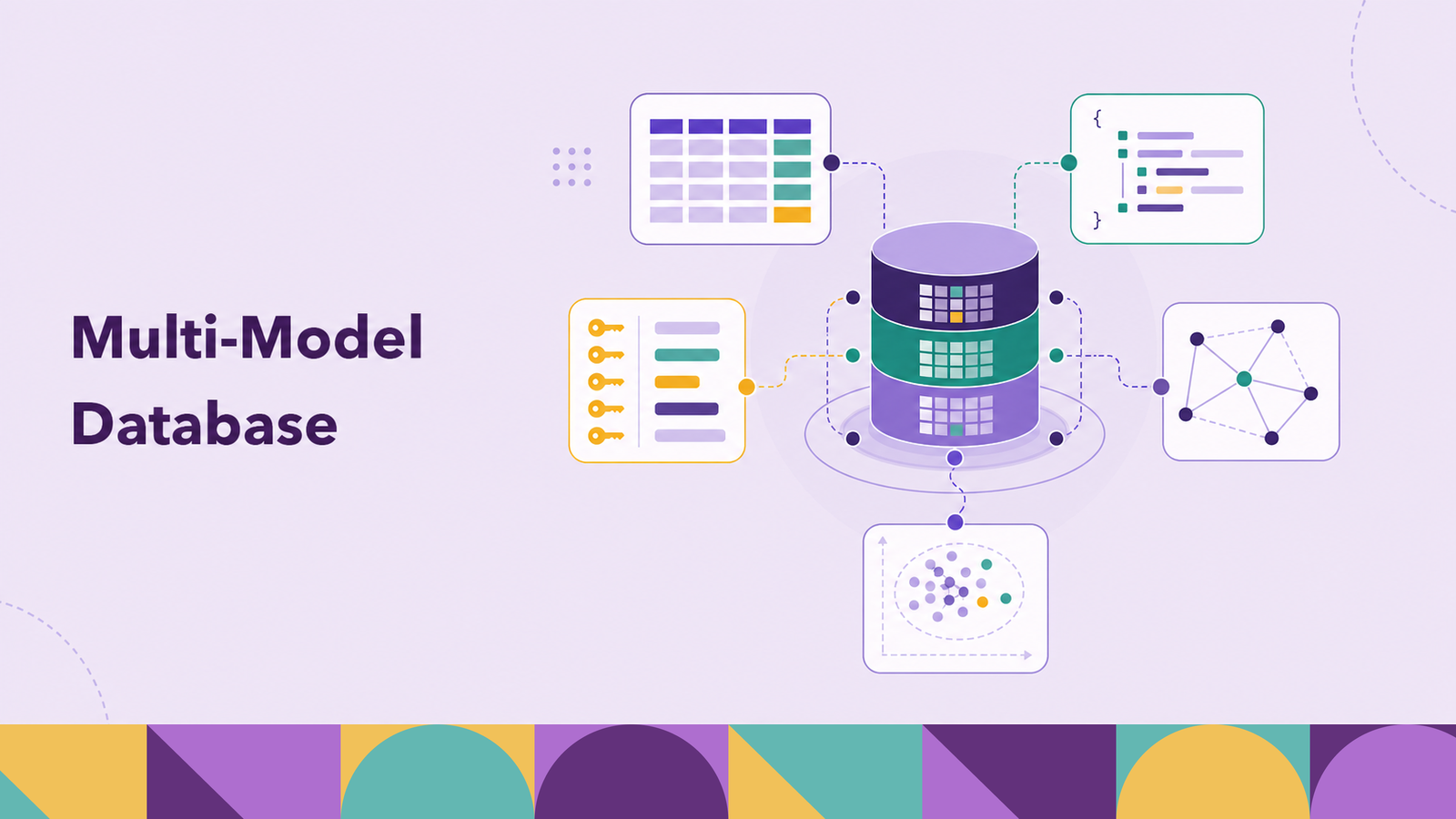
Applications that need several data shapes at once, documents, key-value, graph, search, have long paid an operational tax to keep each shape in its own specialized engine, a pattern Martin Fowler called polyglot persistence in 2011. Multi-model databases exist because that tax grows faster than the feature set that justified it: more systems to operate, more copies of the same records, and more code to keep them consistent. The category’s answer is to hold several models under one engine and expose each through its own query interface, absorbing the coordination cost the polyglot stack pushes onto the application.
This post walks through what a multi-model database is, why the category exists, how a multi-model engine is put together, the data models it typically covers, the architectural patterns and their trade-offs, and practical guidance for teams evaluating it against the alternatives.
What is a multi-model database?
A multi-model database is a database management system that natively supports more than one data model within a single, integrated backend and lets applications interact with each model through its own query language or API. The same instance can hold documents queried in a JSON path language, key-value entries fetched by key, and graph vertices and edges traversed in Cypher or Gremlin, without maintaining separate storage systems or synchronizing between them.
The distinction that defines the category is coverage within a single system. Running MongoDB alongside Neo4j alongside Redis is polyglot persistence, not multi-model. Running one engine that stores documents, graphs, and key-value pairs and treats them as first-class citizens of a shared storage and transaction layer is multi-model. Cross-model queries, a single transaction that reads a graph edge and updates a document, are the clearest signal that the models genuinely live together rather than being co-hosted APIs over separate stores.
Vendor examples that recur in this space include ArangoDB (document, graph, key-value), MarkLogic (document, semantic/RDF graph, geospatial, relational), OrientDB (document, graph, key-value), Azure Cosmos DB (multiple API surfaces including API for NoSQL, MongoDB, Cassandra, Gremlin, and Table), and converged systems like Oracle Database, which layer document, graph, spatial, and JSON support onto a relational core. The spread runs from ground-up designs where every model is a first-class citizen of one storage engine to relational cores extended with additional model types, so the category label alone does not tell a reader which architectural bet a given product has made, which is what the next sections are for.
Why multi-model databases matter
Polyglot persistence emerged because no single database was good at every workload, and specializing paid off. It still does, when the specialties are far apart. What changed is the number of moving parts a mid-sized product now carries. An e-commerce backend can legitimately need a relational database for orders, a document store for product content, a key-value cache for sessions, a search index for the catalog, and a graph store for recommendations. Each is well justified in isolation; together they define a system where the operational surface grows faster than the feature surface.
The tax that accrues has three shapes. First, the same record often lives in several places at once, kept in sync through change data capture, custom pipelines, or dual writes, and consistency between those copies is a permanent low-grade problem rather than something a schema can enforce. Second, cross-cutting concerns like security, encryption, access control, backups, and audit have to be re-implemented per system, and any gap becomes a compliance risk. Third, the engineering cost of transactions that touch more than one store is high enough that most teams give up on strong guarantees at the boundary and settle for eventual consistency, whether or not that fits the domain.
Multi-model databases matter because they attack all three costs at once. Records live once, security and operations are configured once, and transactions crossing models stay inside a single engine’s guarantees. The specialist advantages of a dedicated store still stand where they always did, and plenty of workloads remain difficult inside a single engine; what changes is the default answer for a several-shape application, which moves from stitching several specialized systems together to running one system that speaks several shapes.
How a multi-model database works
Every multi-model database resolves the same three design questions: how the different models share storage, how each model is queried, and how transactions and consistency cross model boundaries. The answers vary, and the choices largely determine what the system is good at.
Shared storage. Most native multi-model engines settle on one physical storage format and derive the other models from it. ArangoDB, for example, stores everything as JSON-like documents; vertices and edges are documents with special fields, and its graph engine reads them through indexes tuned for traversal. Other systems keep model-specific storage engines internally and unify them at the query layer. Either shape can work; each has failure modes. A single-format store keeps operations simple but forces one physical layout to serve all workloads. Separate engines under one roof retain per-model efficiency but reintroduce coordination inside the database.
Per-model query interfaces. The user-visible contract of a multi-model database is that each model looks like the system that made it popular. Document access uses JSON path or MongoDB-style queries; graph access uses Cypher, Gremlin, or SPARQL; relational access uses SQL. This shapes adoption: a team that already knows one of these languages should be able to point it at the multi-model database and have it work. The value of the multi-model design lands only when queries can also cross models, joining a document to a graph traversal in a single request, and vendors differ substantially in how deeply that composition is supported.
Transactions across models. ACID transactions that span multiple models are the feature that most clearly separates a real multi-model system from a bundle of co-hosted engines. Native multi-model systems typically support them because the models share a transactional substrate; multi-API stacks over separate engines often cannot, and their transactional guarantees are per-model. When evaluating a system, the transaction scope is worth checking early, because a domain that spans models often depends on it.
The three questions rise or fall together. A system that shares storage but not transactions loses most of the value of the unification; a system that shares transactions but treats each model as an isolated interface loses the cross-model queries that make the shared storage worth the trade. What multi-model delivers in practice is the answer to all three at once; how each one is answered is what separates the products in the category.
Types of data models supported by multi-model databases
The set of models a multi-model database covers is what determines the workloads it can absorb. The list below covers the models that appear most often; no single product supports all of them, and most cover three or four.
Relational. Tables of typed rows queried in SQL. Still the default for transactional workloads and reporting; its strength is a mature optimizer and decades of tooling, its limits appear when data is deeply nested or when relationships need traversal rather than joins. Many converged databases keep a relational core and add other models around it.
Document. Semi-structured records, usually JSON or BSON, that carry their own schema per instance. Well suited to product catalogs, content management, user profiles, and any domain where fields legitimately vary between records. Query languages range from MongoDB’s find and aggregate syntax to JSON path and SQL extensions that read JSON columns.
Key-value. The simplest model: an opaque value retrieved by a key. Its virtue is speed and predictability, which makes it the default for session stores, caches, feature flags, and any workload where a single key is the natural access path. Some multi-model engines expose key-value as a byproduct of another storage format rather than a separately optimized store.
Wide-column. Rows with a flexible set of columns grouped into families, originated by Google Bigtable and popularized through Apache HBase and Apache Cassandra. Good for large, sparse tables read by row key and column range, common in time-series and telemetry workloads. Multi-model systems that expose a wide-column surface usually target the same operational profile.
Graph. Vertices, edges, and their properties, queried by traversal. Native to problems where the answer depends on relationships (recommendations, fraud rings, permission graphs, dependency chains) rather than on filters over independent rows. Most multi-model graph interfaces speak either the property graph model (Cypher, Gremlin) or RDF (SPARQL).
Beyond these five, some multi-model systems also expose specialized additions: search and full-text (inverted indexes over text with scoring and tokenization, which avoids running Elasticsearch beside a primary store), time-series (compressed storage and windowed queries for metrics and events), and spatial (geometric types and indexes for location queries). These usually ship as capabilities layered on top of one of the five core models rather than as standalone stores of their own.
The set of models a product covers is a stronger predictor of which workloads it can absorb than its architecture or query language. A three-model system whose coverage lines up with an application’s data shapes will fit that application; a five-model system whose coverage misses one of them will not. Coverage is the first filter when evaluating the category.
Multi-model database architecture
Three architectural patterns account for most of the multi-model market, and the pattern chosen is a stronger predictor of a system’s behavior than the vendor’s marketing category.
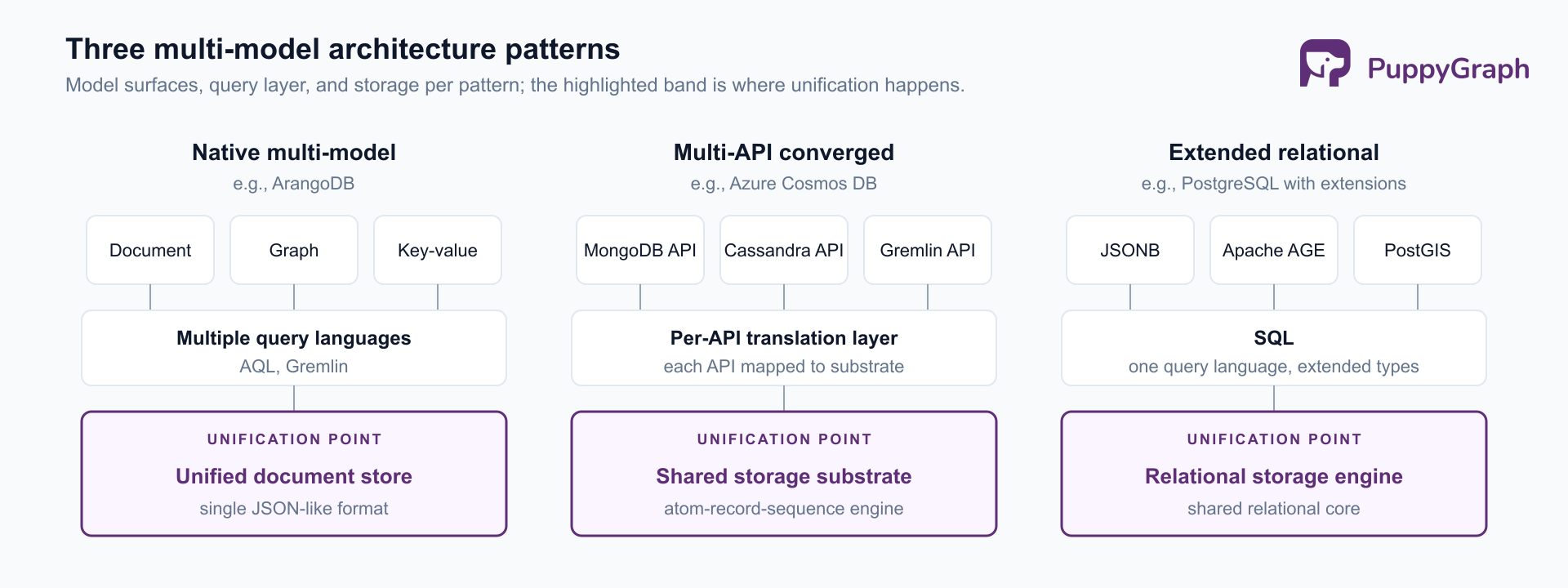
Native multi-model. One storage engine, one transactional core, multiple model interfaces on top. Records are physically stored once, in one format, and each model is a view or index over that substrate. ArangoDB is the canonical example, storing everything as documents and exposing graph and key-value as first-class layers over that store. The advantage is genuinely unified transactions and a single operational surface; the trade-off is that one physical layout must serve every workload, so a native multi-model store rarely matches a best-of-breed system on any single model.
Multi-API converged. A vendor-owned storage substrate exposed through several wire-compatible API surfaces that emulate established databases, unified under one deployment, one billing surface, and one governance layer. Azure Cosmos DB is the most visible example, exposing API for NoSQL, MongoDB, Cassandra, Gremlin, and Table APIs against a single atom-record-sequence storage engine, with each API implemented as a translation layer over that shared substrate. The distinction from a native multi-model system lies in the API design: native systems present the vendor’s own coherent query languages, while multi-API converged systems present the wire protocols of existing databases so applications can address them through familiar drivers. The trade-off is that emulation is rarely complete: each API supports the subset of its source database’s semantics the substrate can express, and cross-model transactions or queries are usually weaker or absent.
Extended relational. A mature relational database extended with document, graph, spatial, JSON, or vector types. PostgreSQL has taken this shape informally, natively for JSON via JSONB and through its extension ecosystem for the rest (PostGIS for spatial, pgvector for embeddings, Apache AGE for graph); Oracle Database and SQL Server have done it through vendor-supplied features. The advantage is that the transactional core, the optimizer, and the operational tooling are already in place, and adding a model rarely means adopting a new system. The trade-off is that each added model rides on relational storage semantics, which can be a poor fit for workloads (deep graph traversals, high-fanout document access) that specialized engines were built to serve.
Each pattern makes a different bet about what multi-model should optimize for. Native systems bet on unification; multi-API systems bet on operational consolidation; extended-relational systems bet on incrementally growing a system teams already know. The right bet depends on how much the models need to interact and how much specialization each model actually needs.
Challenges of multi-model databases
The category comes with a set of trade-offs that show up predictably once systems are in production.
Specialization ceiling. A single engine that serves several models rarely matches a dedicated engine on its home ground. A native multi-model store’s graph traversal is usually not as fast as a purpose-built graph database’s; its full-text scoring is usually not as rich as a search engine’s. Whether that gap matters depends on the workload’s demands, and honest evaluation, at representative scale, matters more than category-level comparisons.
Modeling ambiguity. When the same information can be represented as documents, key-value, or graph within one system, modeling decisions get harder rather than easier. Teams new to multi-model often end up with duplicate representations across models and quietly drift toward inconsistency, defeating the point of consolidation. A clear rule for which model owns which piece of state pays for itself early.
Operational shifts, not savings. Multi-model reduces the number of systems, not the amount of work. Backup, tuning, capacity planning, and version upgrades still have to account for every model in use, and a single system with several access patterns can be harder to reason about under load than several systems each doing one thing well.
Query maturity varies. Vendors advertise a language surface long before every operator behaves the way an experienced user of that language expects. A Cypher interface on top of a document store may not support every clause an application uses; a SQL interface on top of a document store may not push predicates in the way an analytical query needs. Compatibility should be treated as a spectrum, tested against the queries the team actually runs.
Lock-in through interfaces. The unification story is easiest to tell when queries stay inside the system’s proprietary composition points. Cross-model joins, stored procedures, or vendor-specific extensions bind the application to the multi-model system in ways that pure per-model interfaces do not.
None of these trade-offs is a reason on its own to avoid the category; they are the price of consolidation, and each one is worth paying when the alternative (a polyglot stack with its own operational and consistency taxes) is worse. Multi-model rearranges the trade-offs; the mistake is expecting it to remove them. A team that goes in expecting fewer decisions ends up with the same decisions in different clothes, and often surprised.
How to implement a multi-model database
Adopting a multi-model database is more a selection and migration problem than a technology problem, and getting the sequence right saves rework.
Start from the data shapes the application actually needs. List the models in use today and the ones planned within a foreseeable horizon. If the count is one or two and the shapes are stable, a specialized system with the right native type or extension (JSONB for documents, pgvector for embeddings, PostGIS for spatial) may be enough, and multi-model is overkill. If the count is three or more and cross-model queries are common, multi-model earns its place.
Prototype the load-bearing workloads. Pick the two or three queries whose performance shape will define the system in production, and run them against a candidate on representative data. Category comparisons and benchmarks are only a starting point; the workloads that matter most tend to be exactly the ones the vendor’s demo does not exercise.
Plan the migration in slices, not cutovers. Moving off a polyglot stack in one motion is risky and rarely necessary. Migrate one model at a time, keep the old system in place for read-through until confidence is established, and leave cross-model queries for the last step.
Evaluate the operational envelope, not just the features. Backup and restore, upgrade cadence, security and audit surface, monitoring, and multi-tenant boundaries decide whether a multi-model database is livable at scale. These properties are less exciting than the query language surface but more predictive of long-run cost.
Behind these four moves is the same underlying decision: pick a system whose model coverage lines up with the primary workload, and whose specialization on the secondary models is still adequate for what those workloads demand. Coverage that matches the primary access pattern and depth that is livable on the rest is the shape of a good multi-model fit, and a system that inverts either half tends to look attractive in evaluation and painful under production load.
Future of multi-model databases
Two trends are shaping the near-term direction of the category.
AI workloads are pulling more models into the same system. Retrieval-augmented generation added vector search to the required feature set for many applications, and ontology-driven agents are doing the same for graph. Systems that already speak several models are natural landing places for these additions, and the category’s boundary with vector databases and graph databases is blurring accordingly. The counter-pressure is that specialized vector and graph engines still lead on their home turf, so the practical question for each workload is whether the multi-model interface is good enough for what the application needs.
The unifying layer is moving toward open storage. Lakehouses built on open table formats like Apache Iceberg and Delta Lake are becoming a common substrate for analytical data, and increasingly for operational data as well. That shifts the multi-model conversation from a single database that holds several models toward several engines that expose several models over the same governed tables. The unification moves down to the storage layer, and the query languages (SQL, graph query, full-text) become surfaces on top of it. These surfaces are at different maturity levels today: SQL analytics on Iceberg and Delta is well established; graph engines that read the tables directly are more recent; full-text search over the tables themselves remains experimental. For the graph surface specifically, PuppyGraph takes this shape: users define a graph schema over existing warehouse and lakehouse tables, and the engine compiles graph queries into a plan of node and edge operators that reads directly from the source with no graph-specific ETL. This is a friendlier design for teams that value best-of-breed engines per workload without paying the polyglot copy tax.
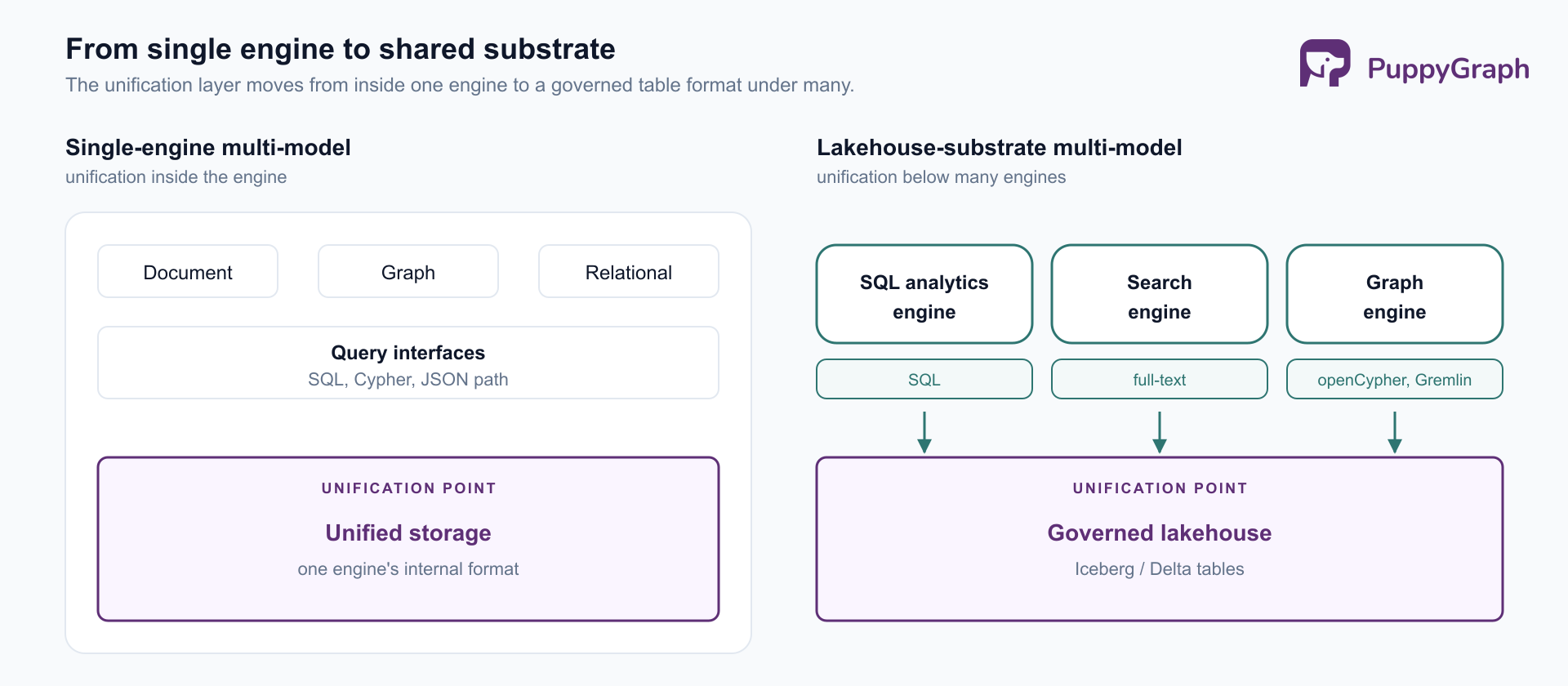
Both trends favor systems that expose multiple models cleanly. Whether that comes from a single multi-model database or from a set of engines sharing a lakehouse depends on how much a team values consolidation versus specialization, and that trade-off is unlikely to resolve in one direction.
Conclusion
Multi-model databases exist because the polyglot cost of running one specialized store per data shape adds up faster than most teams expect, and because a growing share of applications need more than one shape to work. The category consolidates data models, transactions, and operations into a single engine at some cost in per-model specialization, and its architectural patterns (native, multi-API converged, extended relational) each make different trade-offs between unification and depth. The right choice depends on how many models are truly required, how much they need to interact, and how much specialization each model needs to hit its performance and correctness targets.
Try the forever-free PuppyGraph Developer Edition and book a demo with the team to see how openCypher and Gremlin queries run over warehouse and lakehouse tables, with no graph-specific ETL, so the graph model in a multi-model conversation can be added to the data you already have instead of a system you have to adopt.

Sa Wang is a Software Engineer with exceptional mathematical ability and strong coding skills. He holds a Bachelor's degree in Computer Science and a Master's degree in Philosophy from Fudan University, where he specialized in Mathematical Logic.


