Schema Drift: Detection, Causes, and Management
- Hao WuSoftware Engineer
The guide

Query your table as a graph.Petabytes. Subsecond. No data movement.
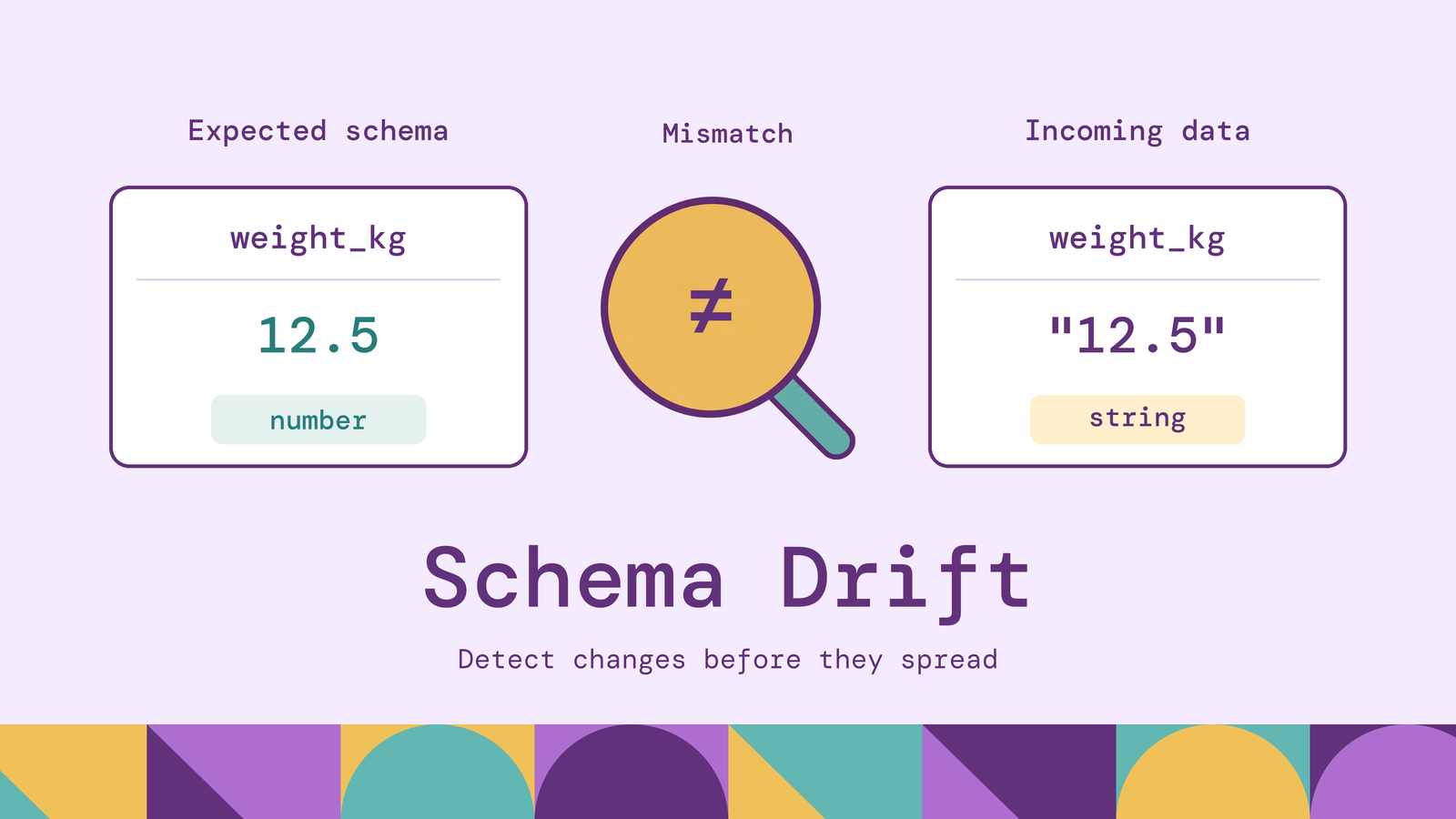
A successful pipeline run does not guarantee that its output still means what consumers expect. An upstream field can disappear, become a string, or move inside a nested object while ingestion continues. The failure may surface later as missing records, incorrect calculations, or a report that quietly stops updating.
Managing schema drift requires knowing what changed, which consumers depend on it, and where incompatible data should stop. This guide explains the mechanisms, detection methods, and management practices behind those decisions.
What is schema drift in data engineering?
Schema drift is a divergence between the structure of incoming data and the schema a pipeline or consumer expects. It includes fields being added, removed, renamed, or retyped. Azure Data Factory's schema drift documentation describes sources whose metadata changes and the resulting vulnerability of transformations tied to particular fields.
The reference point matters. A producer may intentionally rename a field while a downstream transformation still expects the old name. The change is planned for the producer but unexpected for that consumer. Drift can therefore arise without an unauthorized database migration or a faulty deployment.
Schema evolution is the process of changing a schema over time. Managed evolution makes compatibility and migration explicit; drift describes a mismatch encountered along that path. Adding a nullable field may be harmless for one consumer and incompatible with another consumer's exact output contract.
Keep structural drift separate from changes in values or meaning. A larger share of delayed shipments changes the data distribution. Changing a numeric weight from kilograms to pounds without changing its name or type changes its meaning. A structural comparison alone cannot detect either reliably, so schema monitoring needs complementary data-quality checks.
How does schema drift occur in data pipelines?
Consider an illustrative carrier feed called carrier_events. Each event includes shipment_id, delivery_status, and numeric weight_kg. An ingestion job retains the original payload, a normalization job produces shipment_facts, and an aggregate supplies a delivery_performance report.
The carrier replaces delivery_status with status and starts sending weight_kg as text. Raw JSON storage can preserve both payload versions. The mismatch becomes operational when the normalization job extracts the old field or expects a number. Depending on its implementation, the job may fail, emit nulls, discard records, or coerce values.
That boundary determines how far the change travels. Strict validation can stop promotion into the curated table. Permissive handling may keep ingestion available while passing unexpected shapes downstream. A transformation that silently substitutes defaults can conceal the mismatch until someone questions the report.
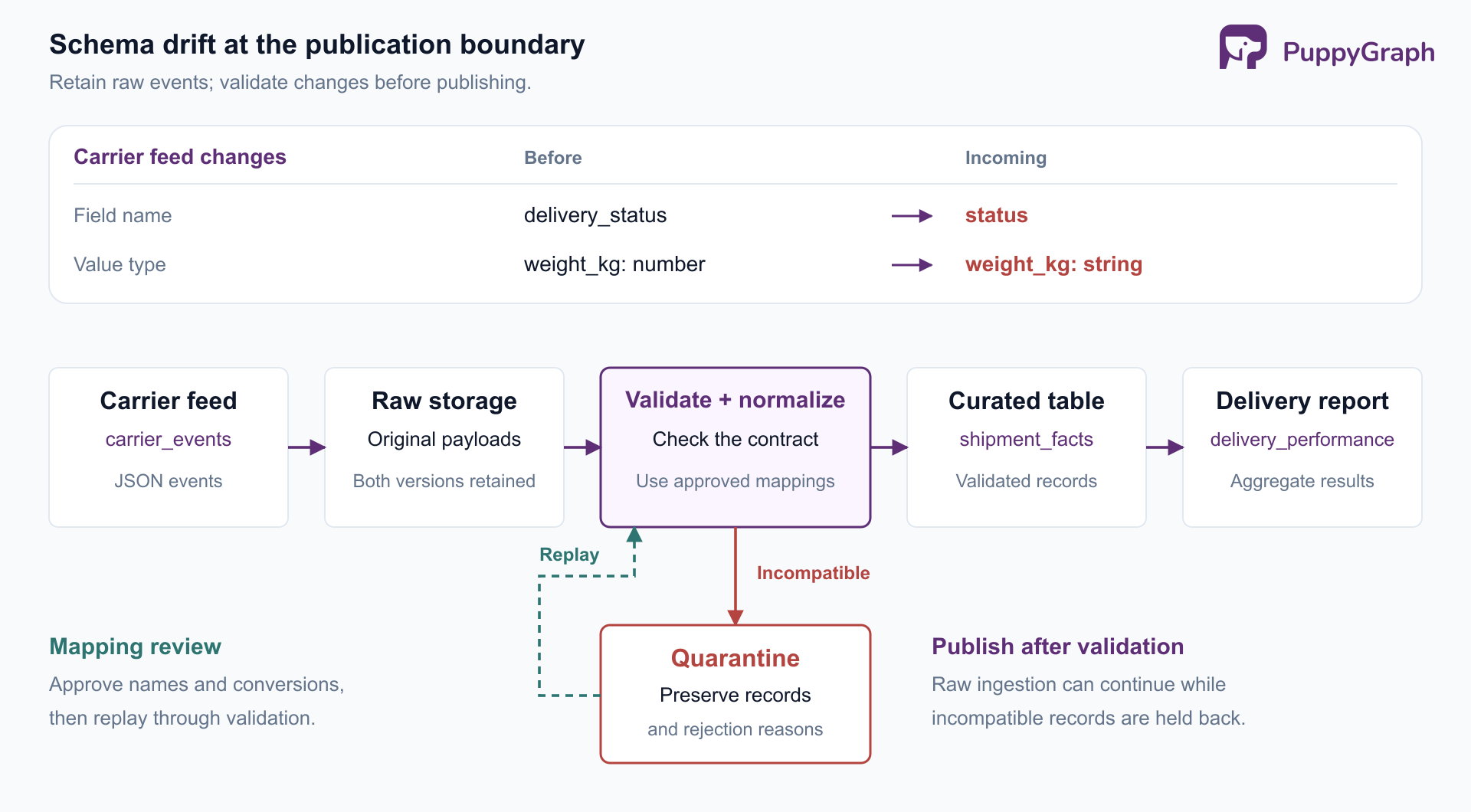
Figure: Retaining raw events preserves a recovery path; validating and normalizing them before publication keeps incompatible records out of curated tables and reports.
Check each interface independently: source payload, parsed record, transformed output, and published table. A successful write at one boundary says little about the assumptions enforced at the next.
Common types of schema drift
Classifying the change helps determine the response. The same apparent change can have different consequences depending on how consumers bind fields and validate records.
| Change | Example | Potential consumer failure |
|---|---|---|
| Field addition | carrier_events gains delivery_attempts | A strict contract rejects the extra field, or a wildcard projection changes its output shape. |
| Field removal | delivery_status disappears | A required extraction fails or produces missing values. |
| Field rename | delivery_status becomes status | Name-based mappings continue looking for the previous key. |
| Type change | weight_kg changes from number to string | Arithmetic requires conversion; malformed strings may fail parsing. |
| Nested-shape change | destination changes from an object to an array | Existing paths fail, or flattening changes the number of output rows. |
| Constraint or positional change | A required identifier becomes nullable, or CSV columns change order | Joins lose matches, or positional readers assign values to the wrong fields. |
A rename can appear to a name-based detector as one deletion and one addition. Confirm a suspected rename against producer metadata or an approved mapping; similar names and overlapping values alone do not establish equivalence.
Compatibility also has direction. A reader capable of accepting a wider numeric range does not establish that an older, narrower reader can process the new values. Assess the producer and consumer together, including historical records that may be replayed.
Real-world examples of schema drift
Published migrations show how these mismatches arise. The changes below are documented; the downstream failure scenarios illustrate what an unprepared consumer could encounter.
Payment integration changes. Stripe's Go SDK v74 migration guide, dated November 2022, records removal of the Charges field from PaymentIntent and its replacement with LatestCharge. An extractor written against the earlier field needs an explicit migration. The replacement's meaning also needs review: changing a field mapping is not enough to establish that an old analytical calculation remains valid.
Telemetry convention changes. The OpenTelemetry HTTP migration guide documents the rename from http.status_code to http.response.status_code. It also documents duration metric changes, including a move from milliseconds to seconds. Filters tied to the old attribute need updating, while duration calculations need units checked alongside names. A staggered instrumentation rollout can require handling both conventions.
Different schemas across lake files. Spark's Parquet documentation demonstrates writing partitions with different compatible columns and combining them through schema merging. Merging is disabled by default because of its cost. This illustrates why a directory of individually readable files does not automatically provide a consistent table schema to every reader.
These examples involve supported evolution paths. They become drift problems when the data crossing an interface no longer matches that interface's expectations.
How schema drift affects data quality
Schema drift can damage several quality dimensions even when an orchestration dashboard shows completed jobs.
Completeness. If the shipment normalizer interprets a missing delivery_status as null, a report filtering for delivered shipments may exclude those records. Total ingestion volume can remain stable while the population used by the report shrinks.
Accuracy. Suppose the pipeline converts invalid weight_kg strings to zero. The transformation completes, but averages and weight-based cost estimates become biased. Recording conversion failures separately preserves the distinction between an unknown weight and an actual zero.
Consistency. Historical partitions may retain one representation while recent partitions use another. Two reports covering different date ranges can then apply different parsing or filtering behavior to what users consider the same field.
Freshness. A strict consumer may reject changed records or stop processing a batch. This protects its output from incompatible data, but it can leave a dashboard serving older results. Freshness monitoring should make that condition visible.
Choose the failure behavior deliberately. Rejected data creates a recovery obligation; accepted data creates a validation obligation. Neither a low error count nor an unchanged row count establishes that the resulting dataset is trustworthy.
What causes unexpected schema changes?
The immediate trigger is a changed producer or transformation. The deeper causes explain why consumers encounter it without preparation.
Independent release schedules. Application developers may treat a database column as an internal implementation detail while analytics jobs already depend on it. Without a documented contract and consumer inventory, the release review misses those dependencies.
External source changes. Carrier feeds, SaaS exports, and partner APIs evolve outside the receiving team's control. Version pinning can make migrations more deliberate where the interface supports it, but teams still need to monitor deprecations and test replacement versions.
Inference from incomplete samples. A sample containing only whole numbers may suggest an integer even though later records contain decimals. Rare fields may be absent entirely. The apparent drift can reflect an incomplete inferred baseline rather than a recent producer change.
Mixed producers and replays. Several application versions may write to one stream during a rollout. Historical reprocessing can reintroduce older payload shapes after the main producer has migrated. Comparing only yesterday's schema with today's misses that coexistence.
Transformation changes. A new cast, flattening rule, or wildcard selection can alter a downstream schema without any upstream modification. Treat transformation outputs as interfaces with owners, just as source datasets have owners.
The common weakness is an assumption that a local change has only local consequences. Recording consumers and testing interfaces makes those consequences visible before deployment.
How to identify schema drift in data
Detection works best when it combines structural comparison, compatibility checks, and evidence from actual values.
Establish a versioned baseline. Record field paths, types, nullability, and relevant precision or length constraints. For relational tables, metadata such as PostgreSQL's information_schema.columns provides column names, types, nullability, and numeric precision and scale. Nested payloads need recursive inspection or a schema format that describes their internal structure.
Keep the approved contract separate from the latest observed schema. Automatically replacing the baseline after every observation would make an unexpected change disappear from subsequent comparisons without resolving it.
Compare at the right boundaries. Compare incoming payloads with the source contract, then compare transformation outputs with their own contracts. For the carrier example, a detector should report delivery_status missing, status added, and weight_kg changing from number to string. Those are observations; declaring the new field an approved replacement is a separate decision.
Cover producer versions and representative partitions. Sampling helps discover unexpected shapes, but it can miss rare fields or malformed records; validation of every promoted record provides a stronger boundary where correctness requires it.
Evaluate compatibility explicitly. In Confluent Schema Registry's terminology, backward compatibility lets a new reader consume data written with the previous schema; forward compatibility lets the previous reader consume new data. Transitive checks extend the comparison across earlier versions. Choose checks that match deployment order and replay requirements. An event-schema check does not establish that a report's SQL or business logic remains correct.
Monitor values and outputs. Track missing-field rates, explicit nulls, conversion failures, unmatched identifiers, record counts, and freshness. Add domain checks such as accepted delivery statuses and weight units. A name-and-type comparison cannot establish that a string identifier still identifies the same kind of entity.
Make the alert actionable. Include the dataset, changed field path, old and new definitions, first observed batch or offset, owning team, and candidate downstream consumers. Group repeated observations of the same change so the owner can investigate one incident instead of hundreds of identical notifications.
Schema drift management across data lakes
Data lakes can retain multiple representations over long periods. Managing drift requires a policy for raw capture, curated tables, and the consumers above them.
Preserve inputs and control promotion. Retain original payloads with source version and ingestion metadata so approved mappings can be applied later. Quarantine incompatible records or batches before they update trusted outputs. Record the reason and the affected interval. If partial processing would make a report misleading, hold the affected publication until the missing records are reconciled.
For carrier_events, the migration might map the new status field into the established delivery_status output after confirming equivalent meanings. Define what happens when both fields appear or disagree. Validate numeric strings explicitly, preserving failed conversions for repair rather than silently turning them into zero.
Evolve curated schemas deliberately. Apache Iceberg's schema evolution uses field IDs to preserve field identity through supported changes such as renaming and reordering. That protects storage interpretation; queries referring to a removed name still need migration. Delta Lake's schema validation checks writes against table schemas and provides explicit and automatic evolution mechanisms. Enable permitted changes according to the dataset's contract rather than treating all detected changes as acceptable.
Keep consumer interfaces explicit too. dbt model contracts can check output column names and data types before a model is built. Pair structural checks with tests for the output's meaning and completeness.
Plan migration and recovery together. Introduce a compatible intermediate representation or a separately versioned dataset when necessary. Test old and new consumers against the payload versions they will encounter. After repairing a mapping, replay the affected inputs with duplicate prevention, rebuild dependent outputs, and reconcile business totals before resuming publication. Assign an owner and retirement date to temporary compatibility mappings.
Trace downstream dependencies. A field change can propagate through successive transformations before reaching a carrier service-level report. Recorded column-level lineage helps identify which reports may depend on carrier_events.delivery_status and which intervening jobs need review. Table-level lineage gives a broader candidate set when field-level detail is unavailable; a dependency path alone does not prove that a report is wrong.
PuppyGraph is the first and only zero-ETL graph query engine that lets teams query existing tables as a graph without loading them into a separate graph database. It is a distributed graph query engine that reads tables in place in SQL databases, data warehouses, and data lakes or lakehouses, including direct reads of open table formats such as Iceberg and Delta Lake. Teams connect their sources, define a graph schema mapping tables to nodes and edges, and query with openCypher and Gremlin while the same tables remain queryable with SQL.
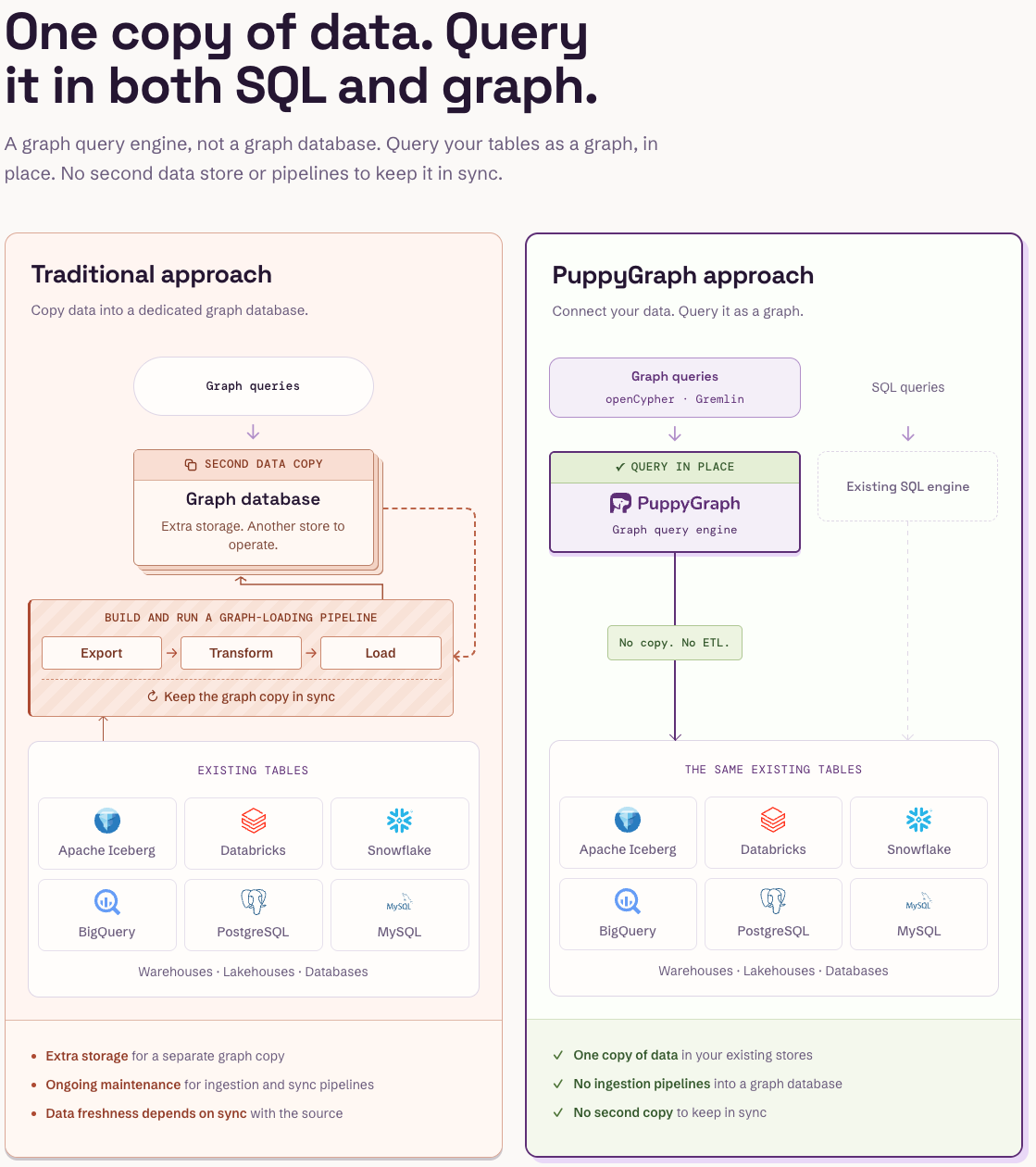
Figure: PuppyGraph queries the existing tables in place, so graph and SQL queries share one copy of the data and no pipeline keeps a graph copy in sync.
Here, the graph schema supplies a semantic model of fields, transformations, and reports over existing lineage tables. Engineers can follow recorded dependency paths to prioritize migration work. Teams still need to collect lineage and maintain pipeline and graph-to-table mappings; zero-ETL graph access does not make those mappings immune to schema drift.
Figure: Companies that use PuppyGraph.
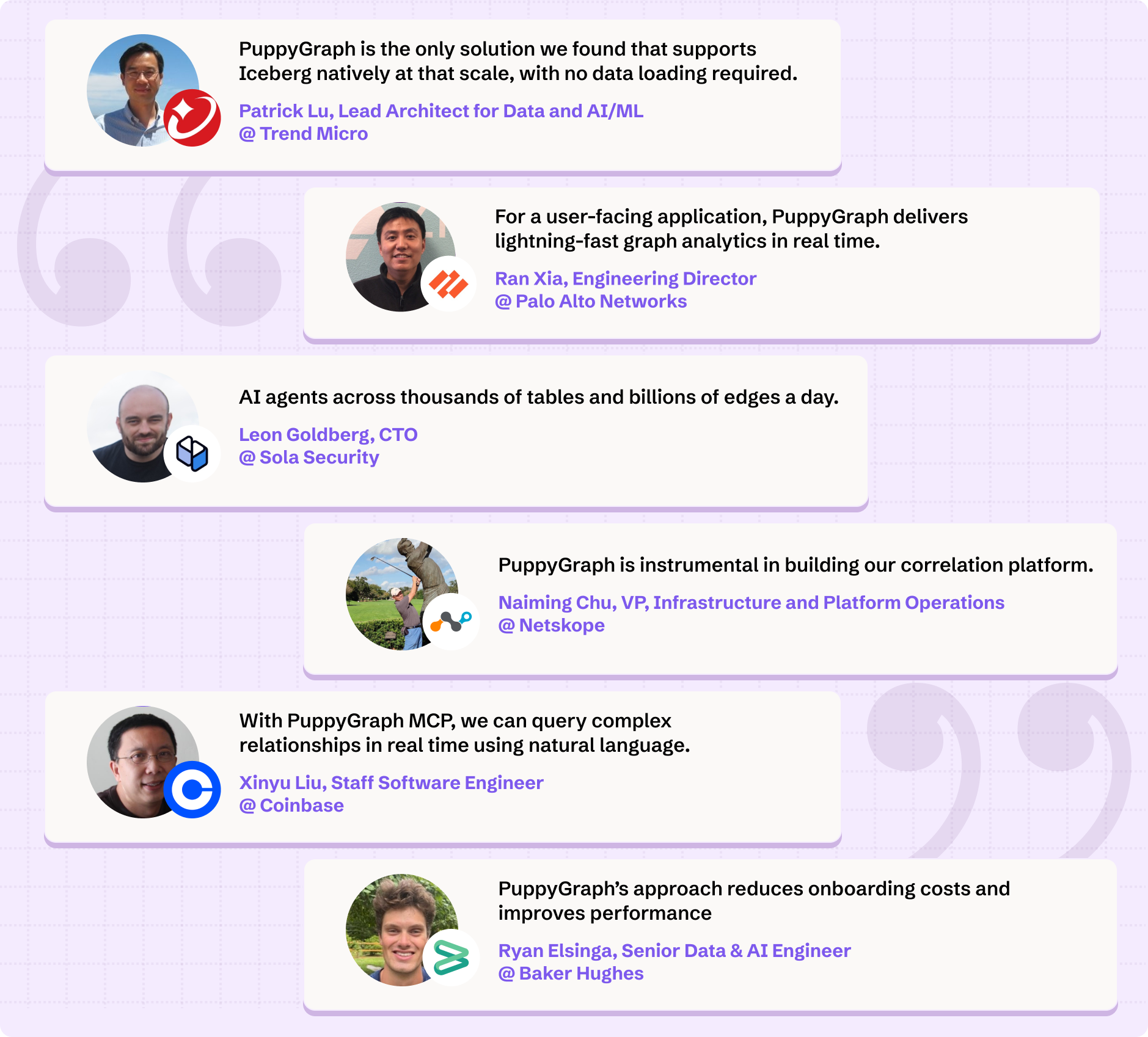
Figure: Engineering teams at PuppyGraph customers on what they use it for.
Conclusion
Schema drift becomes manageable when each interface has an explicit contract, changes have owners, and incompatible records have a recovery path. Compare structure, validate meaning, and trace dependencies before promoting a changed representation. Successful storage evolution and successful consumer migration are separate checks.
Try the forever-free PuppyGraph Developer Edition and book a demo with the team to see how openCypher and Gremlin queries trace recorded dependencies across warehouse and lakehouse tables, with no graph-specific ETL, helping identify downstream consumers that need review after a schema change.

Keep learning
Database Concept
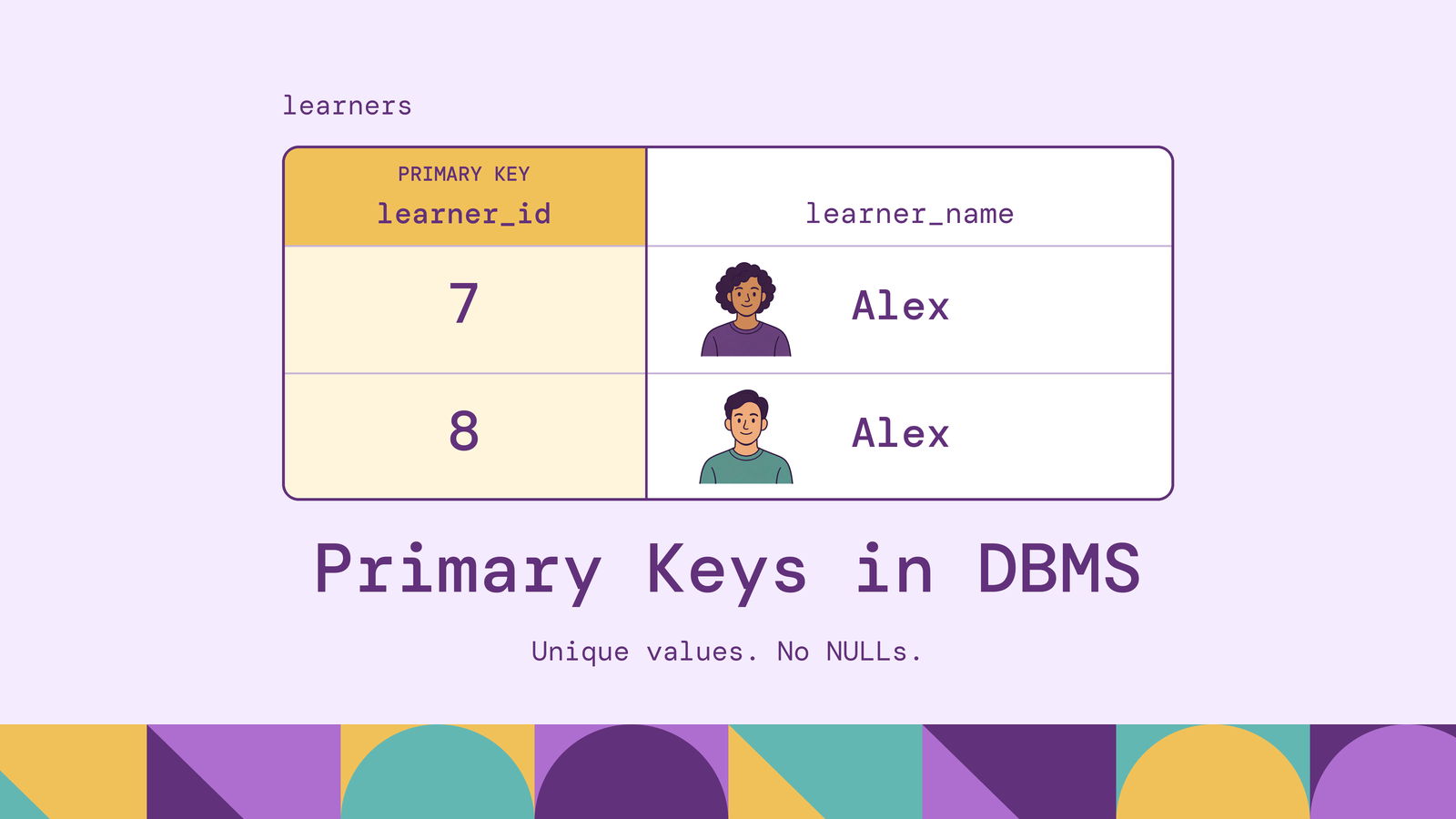
Primary Key in DBMS: Definition & Types
Learn what a primary key is in DBMS, how primary key constraints work, SQL syntax, examples, types, and differences between primary keys and other database keys.
Database Concept
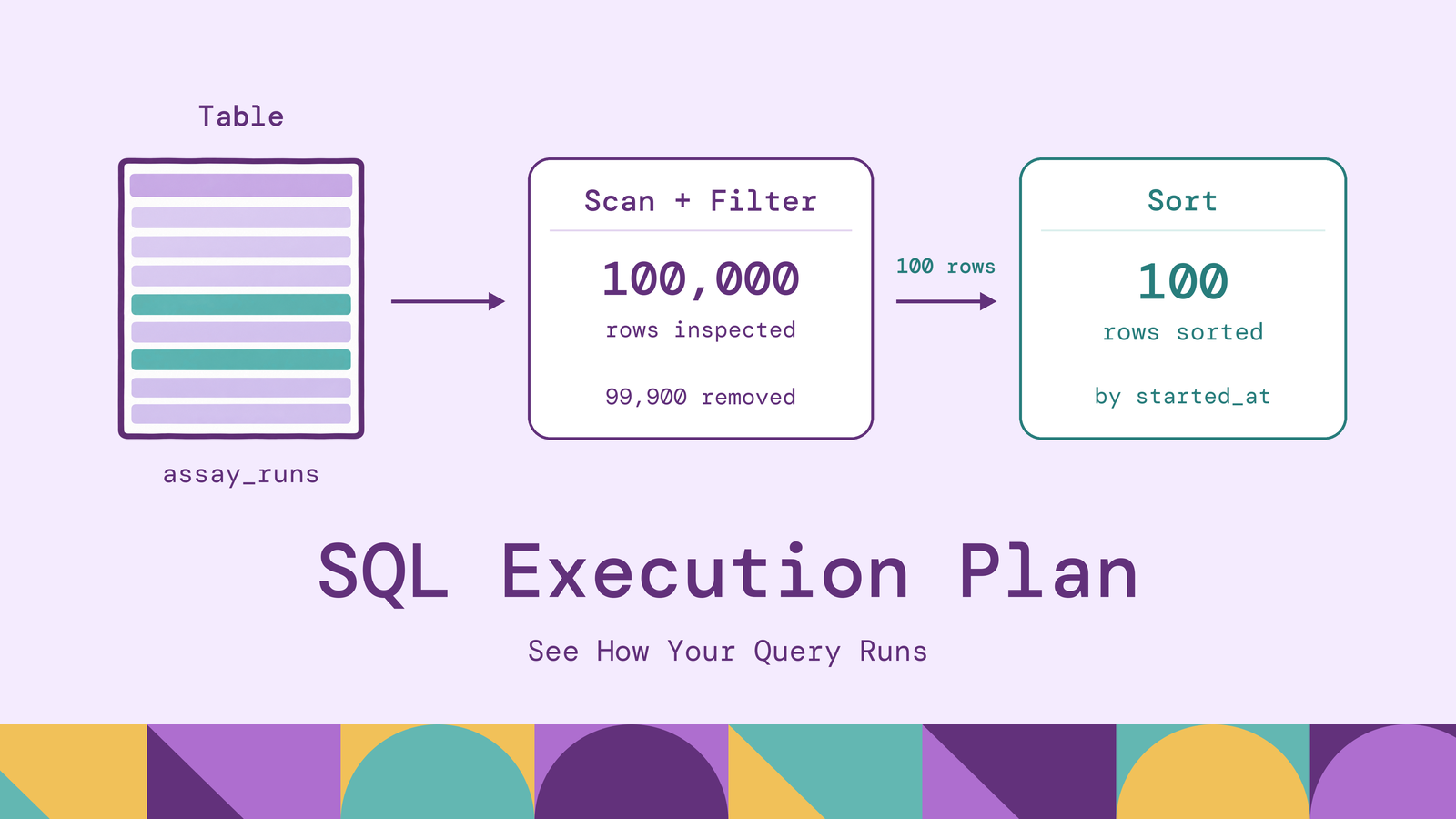
SQL Execution Plan: How It Works and How to Read It
Learn what a SQL execution plan is, how to generate and read execution plans, understand query operators, identify performance bottlenecks, and optimize SQL queries.
Database Concept
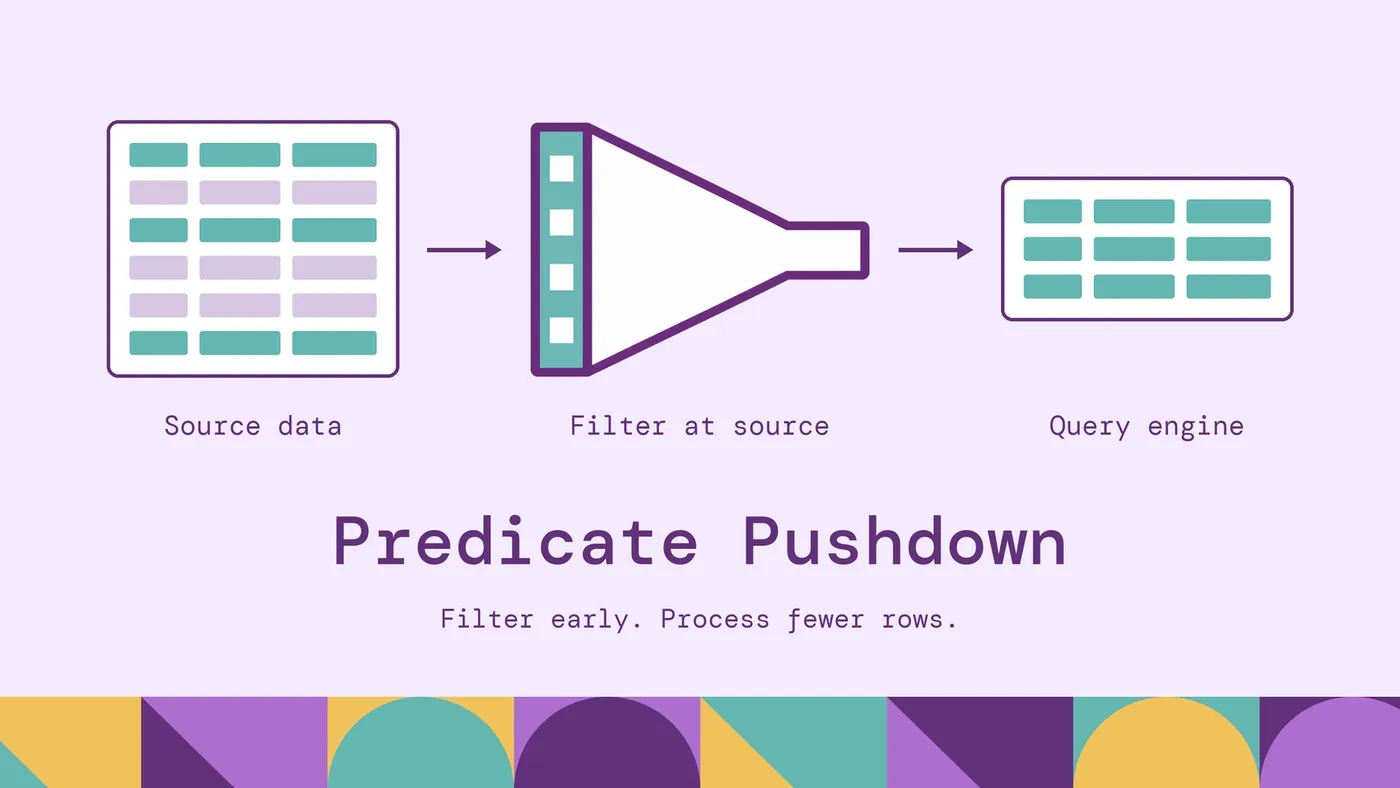
Predicate Pushdown: How It Works?
Learn what predicate pushdown is, how it works in SQL, Spark, and data lakes, with practical examples, performance benefits, and query optimization tips.
Start free. Pay when it goes to production.
Contact us for any questions about capabilities, sizing and support.
* No payment required to start either one.
$ docker run -p 8081:8081 \
  -p 8182:8182 -p 7687:7687 \
  puppygraph/puppygraph:latestPulling puppygraph/puppygraph:latestStarting PuppyGraphWeb console listening on 0.0.0.0:8081Gremlin endpoint listening on 0.0.0.0:8182PuppyGraph is running# no pipelines · no second database · no data movement