Threat Hunting Maturity Model: 5 Levels Explained
- Hao WuSoftware Engineer
The guide

Query your table as a graph.Petabytes. Subsecond. No data movement.
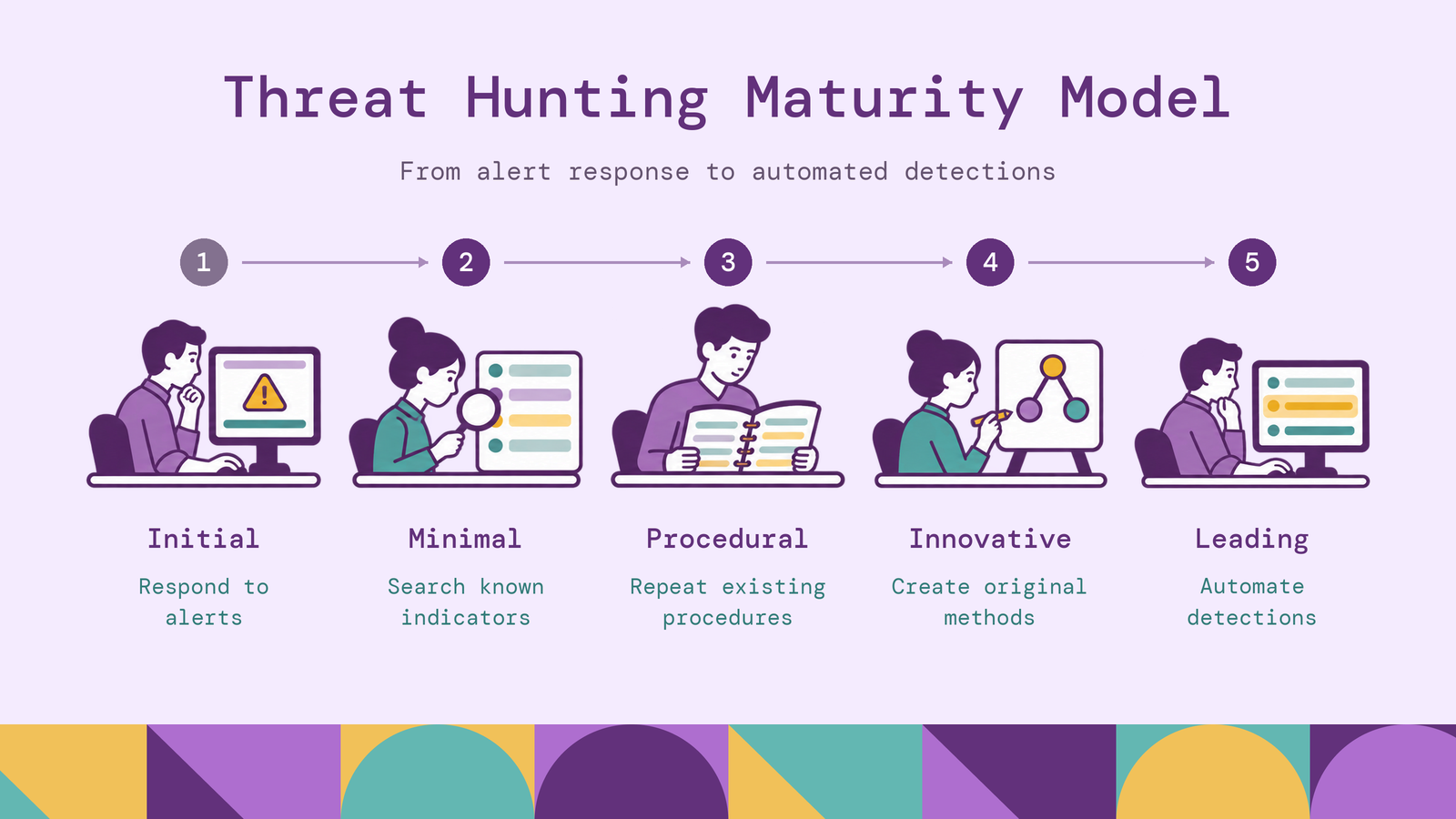
A threat hunting program matures when it can investigate increasingly difficult questions and turn what it learns into repeatable security improvements. Buying another analytics platform does not establish that capability. The evidence is in the work: questions tested, conclusions supported, collection gaps repaired, and useful methods maintained after their original authors move on.
The threat hunting maturity model provides a way to assess that progress. This article explains its five levels, the evidence to examine at each stage, and practical steps for improving a program without confusing activity with effectiveness.
What is a threat hunting maturity model?
A threat hunting maturity model is a framework for evaluating an organization's ability to proactively investigate threats that existing controls may have missed. It helps teams describe their current capabilities and choose their next development priorities.
David Bianco introduced the Hunting Maturity Model in 2015. Levels 1–5 in this article correspond to his original HMM0–HMM4: Initial, Minimal, Procedural, Innovative, and Leading. Initial is the baseline before an active hunting capability exists.
Use this framework to evaluate hunting within a defined environment. It does not measure every security function or certify that an organization is secure. A team might have established endpoint investigation methods while still assembling the evidence needed for cloud hunts. Record that difference explicitly; a single organization-wide label can conceal the area most in need of investment.
Why is threat hunting maturity important?
Hunting consumes analyst time, data engineering capacity, and attention from system owners. An assessment helps connect those investments to questions the team needs to answer.
Consider an illustrative cloud investigation: could automation identity build-publisher be used outside its intended release workflow to read objects in finance-exports through successive assumed-role sessions? The identity and resource names are fictional. AWS's CloudTrail documentation describes audit records for role assumptions, including role chaining, that can support such an investigation.
The team needs to establish which records exist, reconstruct session transitions, and check legitimate deployment activity.
Maturity assessment makes the missing capability actionable. Missing object-access records call for a collection change. Inconsistent interpretation calls for a documented procedure and peer review. A reliable method that nobody maintains calls for an operational owner. Each problem demands a different investment, even when all three appear as an unresolved hunt.
What are the five levels of threat hunting maturity?
The table summarizes Bianco's model. The recommendations that follow apply those distinctions to program management; they are not a formal scoring rubric supplied by the model.
| Article level | Original level | Defining capability |
|---|---|---|
| 1: Initial | HMM0 | Responds to automated alerts; no active hunting capability |
| 2: Minimal | HMM1 | Searches retained data for indicators from threat reporting |
| 3: Procedural | HMM2 | Regularly applies hunting procedures developed by others |
| 4: Innovative | HMM3 | Creates original, repeatable hunting procedures |
| 5: Leading | HMM4 | Operationalizes successful hunting methods as automated detections |
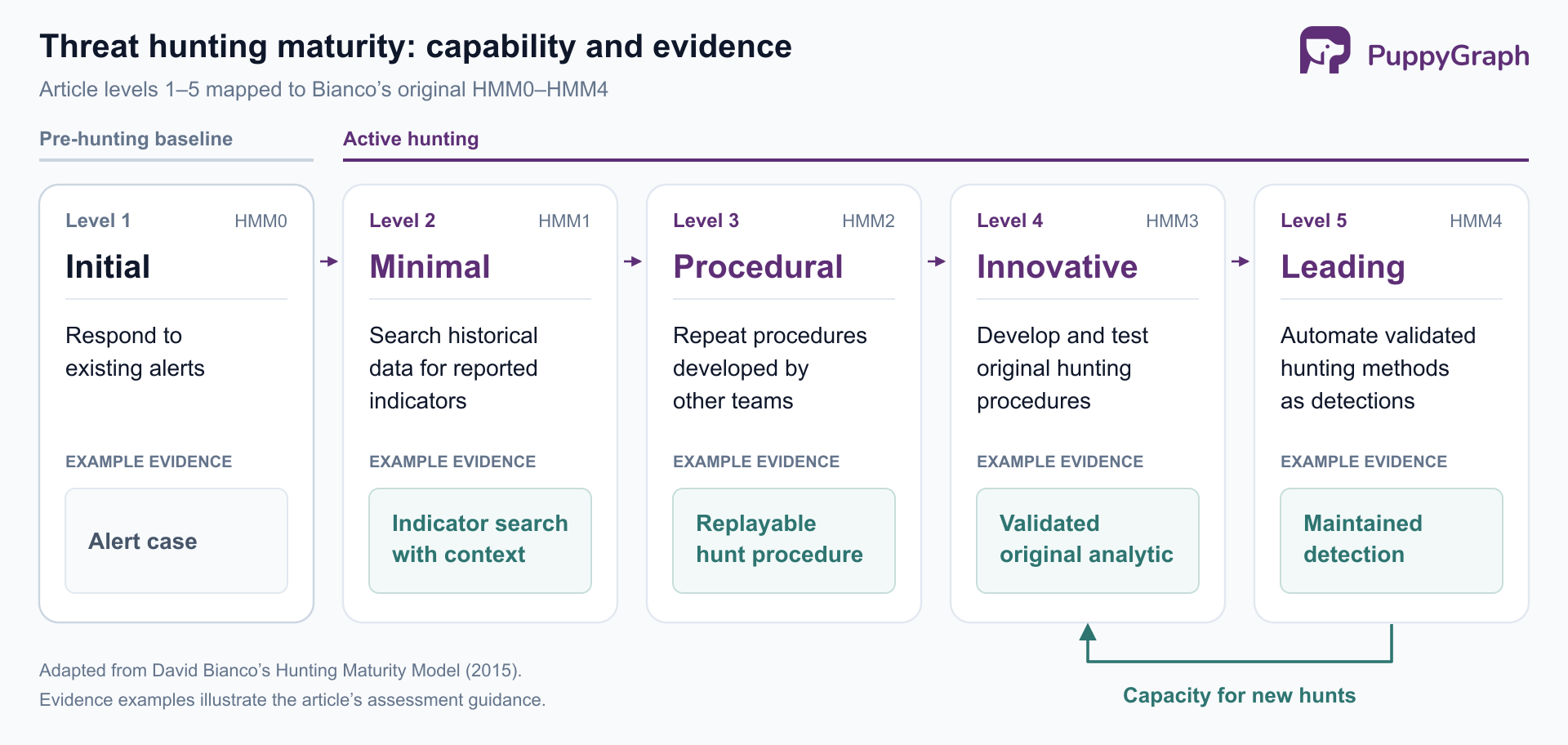
Figure: Hunting maturity is demonstrated through repeatable investigative work and maintained detections. Initial is the pre-hunting baseline; automation at Leading creates capacity to develop new hunting methods.
Use the distinctions to identify the next capability worth developing. Keep useful existing practices as the program expands.
Level 1: Initial threat hunting
At Initial, work centers on resolving alerts. The first improvement is to create the conditions for a question-driven investigation.
Start with a narrow asset scope and a named owner. For the cloud example, list the accounts that hold the build workflow and finance storage, identify the available audit records, and check whether analysts can retrieve them for the proposed period. Record missing sources before attempting to infer what happened.
This matters because collection settings determine what evidence is available. AWS documents that CloudTrail trails and event data stores do not log data events by default; S3 object reads are data events. Role-assumption records alone cannot establish which objects were read.
A useful initial deliverable is a small investigation brief: question, scope, required evidence, access arrangements, and escalation contact. Treat successful retrieval of the necessary records as an enabling milestone.
Level 2: Minimal threat hunting
At Minimal, analysts can search historical records for reported indicators. Make those searches reviewable before increasing their volume.
Suppose relevant reporting identifies infrastructure associated with credential abuse. An analyst could search cloud audit records for the reported source address, then examine any matching activity. Preserve the report's observation dates, the searched period, affected accounts, query, and limitations. A shared address or an old association may have a legitimate explanation.
In the running example, a match involving build-publisher would raise questions about the requested role, the resulting session, and subsequent actions. It would not establish that finance data was accessed or that the actor named in the report controlled the session.
The next development step is to turn the lead into a testable behavioral question. Define what evidence would support unauthorized use and what would support an approved deployment. An empty search should also have a scoped conclusion: no matching activity was found in the records examined. Keep uncertainty visible when coverage or retention is incomplete.
Level 3: Procedural threat hunting
At Procedural, teams repeatedly apply established methods. The practical priority is making a hunt executable by someone other than its usual author.
A hunt package should explain its hypothesis, required fields, query steps, expected benign activity, escalation criteria, and known blind spots. MITRE's Cyber Analytics Repository offers a useful reference: its analytics describe hypotheses, relevant adversary behaviors, pseudocode, and tests. Adopted content still needs validation against local systems and data.
For the cloud investigation, document how to review role-assumption activity, identify unfamiliar session origins, and obtain release context from the platform team. Specify how to distinguish a failed request from a successful transition. Record what the analyst should do when a necessary identifier is absent.
Ask another hunter to replay the procedure against the same retained evidence. Differences in findings can expose ambiguous instructions or undocumented assumptions. Store the revised procedure with its queries and review history. The practical milestone is a repeatable investigation whose limitations another analyst can explain, even when the result contains no suspicious activity.
Preserve the evidence set used for that review, subject to the organization's handling rules. A later query against live data may return different results because records arrived late or expired. Recording the query version, collection boundaries, and relevant source events makes those differences explainable.
Level 4: Innovative threat hunting
At Innovative, the team develops its own repeatable investigative methods. Focus that work on unresolved questions specific to the environment.
For build-publisher, an original hunt could investigate whether successive assumed-role sessions lead to sensitive object reads outside expected release activity. The analyst would connect each transition to its supporting event, preserve event order, and compare the resulting sequence with authorized workflows. Similar role names or nearby timestamps are insufficient evidence that two events belong to the same chain.
Test the method against both an authorized deployment and an agreed simulation of misuse. MITRE's TTP-Based Hunting methodology emphasizes identifying collection gaps and testing analytics before interpreting hunt results. If the expected test activity is invisible, repair the evidence or query before drawing conclusions.
Save the method's assumptions alongside its logic: which transitions it can reconstruct, which accounts it covers, and which missing fields make a result inconclusive. That documentation lets colleagues challenge and reuse the work. A complex visualization is useful only if its connections survive that scrutiny.
Level 5: Leading threat hunting
At Leading, validated methods become automated detections, freeing capacity for further investigation. The operational work continues after the query is scheduled.
For the role-chain hunt, define the conditions worth monitoring continuously and the evidence an alert must carry. Include the initiating identity, relevant sessions, destination resource, and supporting event references. Give responders enough context to investigate without reconstructing the hunt from scratch.
Assign an owner for data dependencies, query changes, testing, tuning, and retirement. A parser change or a new release workflow can alter what the analytic sees. Monitor whether its source records still arrive and whether known test activity still produces the expected result. Document an escalation path when either check fails.
Keep exploratory questions in the backlog. Some investigations depend on context that cannot be reduced to a reliable alert, and some hypotheses will be rejected. Those outcomes can still improve the program. Leadership should be able to trace a useful finding through validation, deployment, and later review, while showing that hunters retain time to investigate questions the existing detections cannot answer.
How to assess your threat hunting maturity level
Choose an assessment scope before assigning a level. Define the team, environment, and review period, then collect completed hunt records, queries, data inventories, detection changes, and examples of inconclusive work. Include routine investigations, not just the team's strongest presentation.
Use the following questions to organize the review:
| Capability | Evidence to inspect | Assessment question |
|---|---|---|
| Telemetry | Collection settings, sample events, retention and parsing checks | Can the available records answer the stated hunt questions? |
| Analyst practice | Investigation notes and peer reviews | Can analysts test competing explanations and state limitations? |
| Repeatability | Procedures, saved queries, replay results | Can a colleague reproduce the work without its author? |
| Original analysis | Locally developed methods and validation records | Can the team investigate an unfamiliar behavior in its environment? |
| Operational follow-through | Detection owners, tests, tuning history, gap tickets | Do useful findings produce maintained changes? |
Match the demonstrated work to the level definitions. Treat the assessment as a description of sustained capability. One successful original hunt should not conceal that most investigations depend on undocumented knowledge. Likewise, a reliable endpoint program does not establish equivalent coverage of cloud identities.
Record both the supported level and the limiting evidence. For example: the team regularly replays adopted cloud hunts, but its original role-chain method cannot yet be validated because object-access records are missing. That statement gives management a concrete next action.
Separate the reviewed hunts by outcome: evidence supporting the hypothesis, no supporting evidence within the tested scope, or an inconclusive investigation. For each, record what changed afterward. An inconclusive hunt becomes useful when it identifies a specific missing field and prompts a collection fix; repeating the same blocked investigation adds little. This review also shows whether analysts distinguish a technical query failure from a defensible investigative conclusion.
Track a small set of measures alongside the level: priority questions investigated, hunts blocked by missing evidence, detection candidates validated and maintained, and time spent preparing data. Define the denominator and review period for every percentage. Avoid treating incident yield as the sole measure; finding nothing can be a defensible outcome, while finding many incidents may reflect a badly exposed environment.
Reassess after material changes in staffing, collection, or architecture. Compare the supporting evidence with the previous review so apparent progress reflects improved capability rather than a changed scoring interpretation.
How to improve your threat hunting maturity
Build the improvement plan around the most consequential question your team cannot yet answer reliably. Assign an owner, a deliverable, and a review date to the obstacle blocking it.
Prioritize by exposure and relevance. Select a behavior that could affect an important business service and explain why existing detections leave uncertainty. For the running example, the concern is whether a release identity can be misused to reach finance data. Keep the initial scope small enough to investigate thoroughly.
Validate the evidence first. Confirm that the required events, identifiers, and timestamps survive collection and parsing. The joint 2024 guidance on event logging and threat detection emphasizes logging policy, centralized access and correlation, log integrity, and a detection strategy. Choose retention and coverage around investigative needs, with explicit records of remaining gaps.
Make analytical knowledge reusable. Pair hunters with identity administrators and service owners. Capture legitimate workflow explanations in the procedure, and review queries with another analyst. Include a known benign case and an agreed test case so later changes can be evaluated against something concrete.
Close the handoff. Give each actionable outcome a destination: incident response for credible compromise evidence, data engineering for collection defects, or detection engineering for validated logic. Track whether the receiving team completes the work. A ticket count alone does not show that visibility or detection improved.
Add relationship analysis when the question requires paths. The cloud investigation asks which observed role-session chain connects build-publisher to object reads in finance-exports. When those records already reside in supported warehouse or lakehouse tables, a graph model can represent the identities, sessions, and resources together. Preserve the events supporting each link; a permission to access a resource and an observed access are different relationships.
PuppyGraph is the first and only zero-ETL graph query engine that lets hunters query those existing tables as a graph without loading them into a separate graph database. Its distributed engine reads tables in place in SQL databases, data warehouses, and data lakes or lakehouses, including direct reads of open table formats such as Iceberg and Delta Lake. Teams connect their sources, define a graph schema mapping tables to nodes and edges, and query with openCypher and Gremlin while the same tables remain available to SQL.
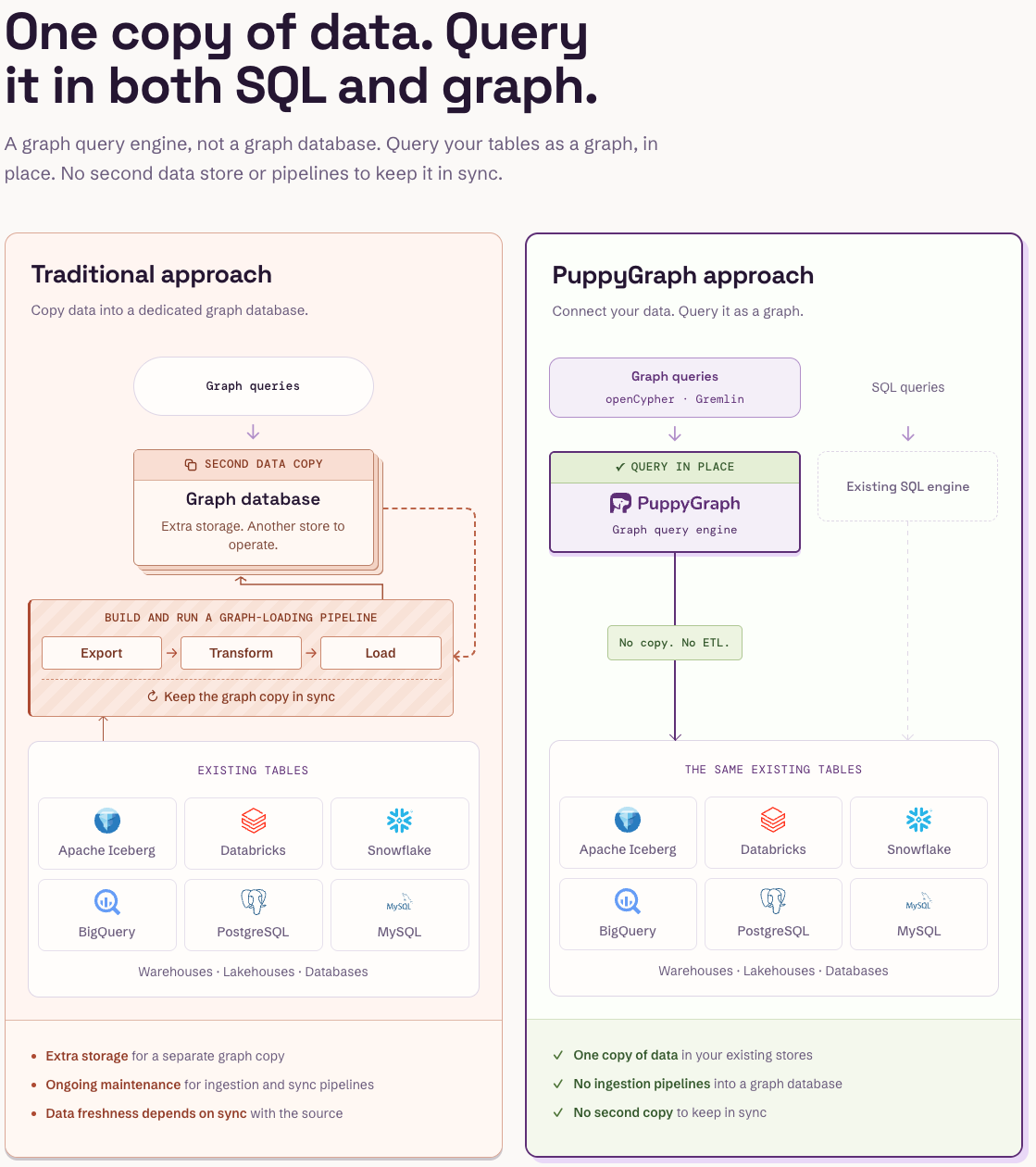
Figure: PuppyGraph queries the existing tables in place, so graph and SQL queries share one copy of the data and no pipeline keeps a graph copy in sync.
This supplies a way to investigate modeled paths across the retained records. The security team still owns collection, identity resolution, and interpretation; graph queries complement the SIEM and the hunting process.
Figure: Companies that use PuppyGraph.
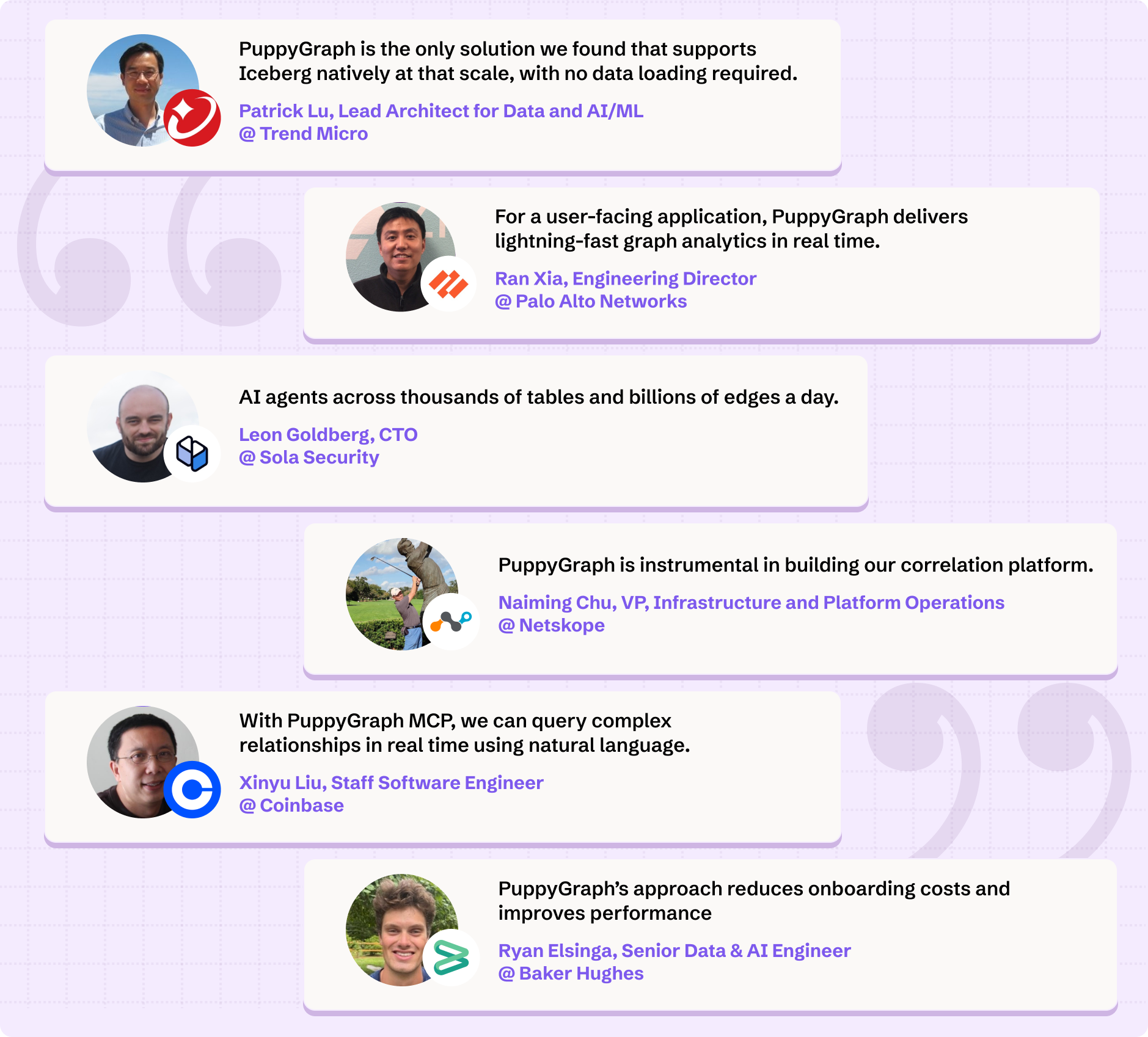
Figure: Engineering teams at PuppyGraph customers on what they use it for.
Common challenges in threat hunting maturity
Collection gaps can resemble reassuring results. A query returning nothing may indicate absent telemetry, broken parsing, or a scope mismatch. Check source health and known test events before interpreting silence. In the cloud example, explicitly establish whether the relevant object reads were logged during the period being investigated.
Urgent work displaces exploration. If every alert surge cancels hunting, reduce the scope of the next investigation and protect a realistic block of analyst time. Pairing a hunter with a service owner can resolve context questions without expanding the hunting team. Preserve notes so interruptions do not require restarting the work.
Coverage measures can overstate assurance. Mapping a query to an ATT&CK technique does not show that it detects every implementation of that behavior. Record the tested procedure, environment, data dependencies, and blind spots. Report those boundaries with the coverage claim instead of presenting a colored matrix as proof of protection.
Disconnected identifiers weaken correlation. Reused account names, short-lived sessions, and missing resource ownership can make unrelated events appear connected. Keep source identifiers and event provenance, document matching rules, and route unresolved identities to a data-quality backlog. More elaborate analysis will not repair an unsupported link.
The response to each challenge should leave a reviewable improvement: restored evidence, a replayable method, a validated detection, or an explicit limit on the conclusion.
Conclusion
The five maturity levels help teams decide which hunting capability to develop next. Assess the evidence behind the work, choose a consequential gap, and verify that closing it improves what analysts can investigate. Repeatability and maintained outcomes give that progress substance.
Try the forever-free PuppyGraph Developer Edition and book a demo to explore how graph queries over existing security tables can support investigations across identities, sessions, and resources without a graph-specific ETL pipeline.

Keep learning
Cybersecurity Graph Data Model
Relationship-Based Access Control (ReBAC): Complete Guide
Learn how relationship-based access control (ReBAC) works, its graph-based authorization model, use cases, benefits, implementation, and differences from RBAC and ABAC.
Cybersecurity
Unity Catalog Row-Level Security: Complete Guide
Learn how Unity Catalog row-level security works, including row filters, SQL UDFs, ABAC, dynamic views, implementation, use cases, and best practices.
Cybersecurity
XDR vs SIEM: Key Differences
Compare XDR vs SIEM to understand their differences, capabilities, use cases, benefits, and when to use each for modern cybersecurity operations.
Start free. Pay when it goes to production.
Contact us for any questions about capabilities, sizing and support.
* No payment required to start either one.
$ docker run -p 8081:8081 \
  -p 8182:8182 -p 7687:7687 \
  puppygraph/puppygraph:latestPulling puppygraph/puppygraph:latestStarting PuppyGraphWeb console listening on 0.0.0.0:8081Gremlin endpoint listening on 0.0.0.0:8182PuppyGraph is running# no pipelines · no second database · no data movement