The article

Query your table as a graph.Petabytes. Subsecond. No data movement.
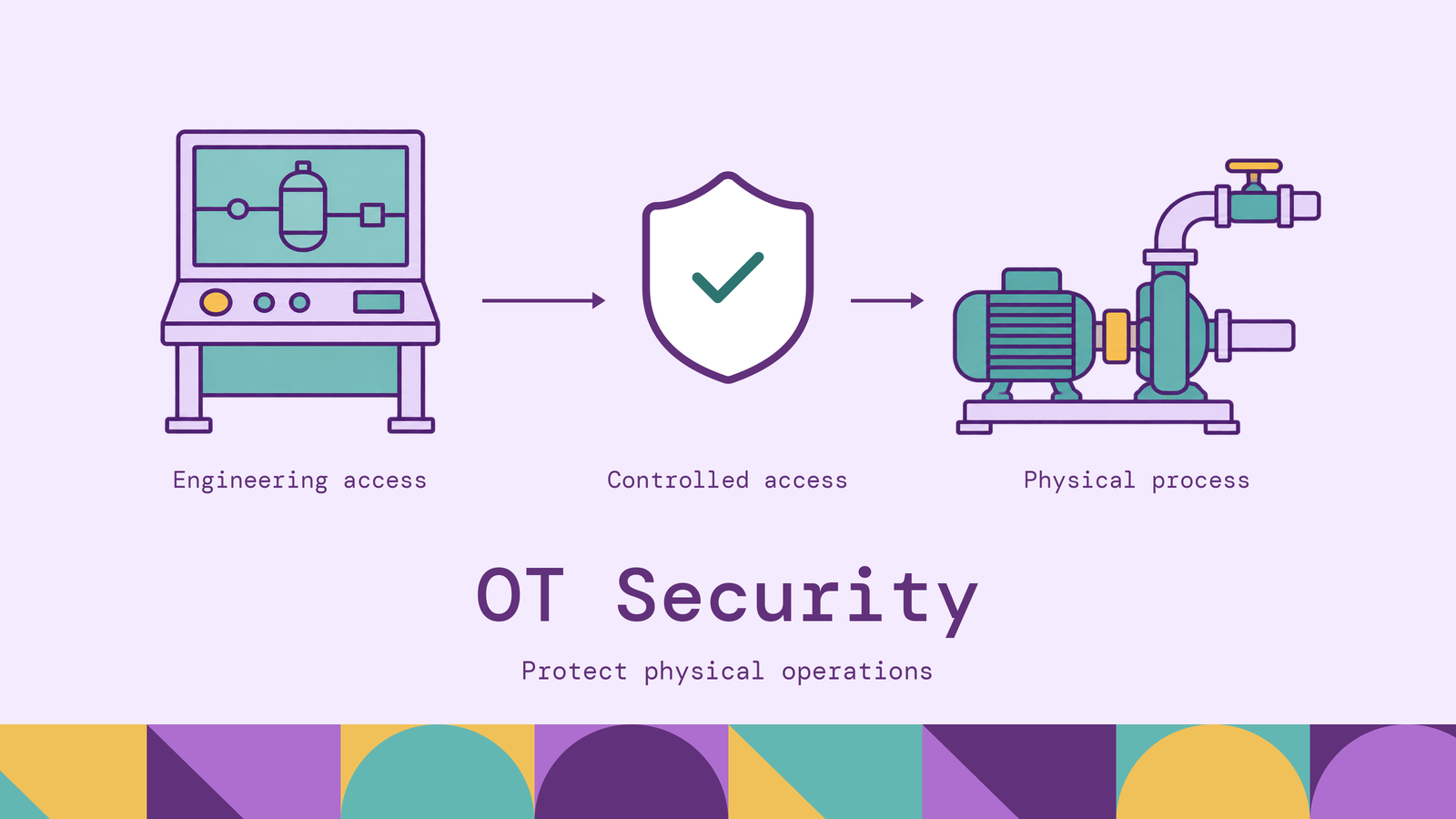
An industrial security control must protect the process while allowing operators to run it safely. Blocking a suspicious connection can prevent an intrusion, but blocking the wrong connection can also interrupt supervision or control. OT security requires understanding both consequences before taking action.
This guide explains how operational technology security works, where industrial control systems and SCADA fit, and how architecture, risk assessment, and AI-assisted investigation support a defensible security program.
What Is OT Security?
OT security protects the systems that monitor or control physical equipment and processes. Its scope includes industrial machinery, building automation, transportation systems, and other technologies that interact with the physical environment. NIST SP 800-82 Rev. 3 defines this scope and explains the safety, reliability, and performance constraints that shape protection.
The protected asset is more than a device. It includes the process the device supports, the instructions it executes, and the information operators use to make decisions. A controller can remain online while running an unauthorized program. An operator display can remain available while showing misleading measurements.
Consider a hypothetical water operator whose vendor maintains a remote pumping station. A vendor account, maintenance jump host, engineering workstation, and pump controller form an access chain. Securing each component matters, but the operator also needs to understand what that chain permits and which water-delivery functions depend on it.
Safety provides the governing context. The international Principles of Operational Technology Cyber Security place safety first, alongside knowledge of vital systems, protection of OT data, network separation, supply-chain security, and staff preparedness. Security decisions should therefore involve the people accountable for the physical process.
How Does OT Security Work?
OT security combines visibility, access restrictions, monitoring, and operational response. These activities form a continuing process because equipment, maintenance arrangements, and production requirements change.
Establish an asset and dependency inventory. Record device roles, locations, software or firmware, owners, communications, and process criticality. Include engineering laptops, remote-access gateways, and supporting network infrastructure. The joint 2025 OT asset inventory guidance recommends defining scope, collecting attributes, organizing assets, and maintaining the inventory throughout its lifecycle. A useful record identifies who can confirm whether an asset is still required.
Discover safely and reconcile evidence. Compare drawings and configuration records with operator knowledge and passive network observations. Passive monitoring reveals communications visible at its collection points; it cannot establish that every disconnected or silent asset has been found. Joint OT architecture guidance recommends this combination and cautions that active scanning can disrupt legacy equipment. For active scanning, use native ICS/OT protocols and tools, with methods tested and validated by each asset's original equipment manufacturer (OEM).
Control access and detect changes. Give maintenance personnel individual identities and access limited to approved tasks and systems. Collect remote-session records, network events, and available controller-change logs. Compare activity with maintenance approvals: an engineering connection may be legitimate during an authorized change and require investigation outside that window. CISA's ICS cybersecurity best practices connect access control, segmentation, monitoring, and organizational coordination.
Prepare response and recovery. Define who can terminate remote access, isolate a workstation, or request a controlled shutdown. Preserve known-good configurations and the software needed to restore them. NIST's OT Backup Quick Start Guide connects backup planning with asset criticality, recovery objectives, compatible hardware, and legacy constraints. Exercise restoration and operational handover so that a successful file restore is followed by confirmation that the process behaves correctly.
IT Security vs OT Security: Key Differences
IT and OT share requirements for confidentiality, integrity, and availability. The practical differences concern what failure means and how safely a system can be changed. The following comparison reflects typical patterns described in NIST's OT security guide, rather than rules that apply to every deployment.
| Dimension | Typical enterprise IT | Typical industrial OT |
|---|---|---|
| Failure consequences | Data exposure and service interruption | Process disruption, equipment damage, and safety consequences |
| Timing | Application-dependent latency requirements | Control functions may require predictable timing |
| Change management | Updates fit established service windows | Changes need process and equipment validation |
| Device lifecycle | Regular platform replacement | Long-lived equipment and legacy dependencies |
| Security software | Broad endpoint-tool support | Device and vendor compatibility constrain deployment |
| Containment | Isolate affected services or endpoints | Coordinate isolation with process operators |
These differences change the questions a security team asks. Before deploying an endpoint agent on an engineering workstation, determine whether the supplier supports it, whether resource consumption affects engineering software, and how the team will reverse the change. Before disconnecting that workstation, establish whether operators depend on it for an active task.
Avoid reducing the distinction to “IT protects data; OT protects uptime.” Process integrity may require stopping equipment, and stolen engineering files can expose sensitive designs or access information. The appropriate response follows the asset's role and failure consequences.
OT Security Threats and Vulnerabilities
OT incidents can begin with familiar weaknesses and end with physical consequences. Prioritize the routes that connect an initial compromise to important processes.
Exposed devices and weak credentials. Internet-facing controllers, remote desktop services, and maintenance gateways can provide entry points. The joint Unitronics advisory, first issued in 2023 and updated in 2024, documents compromises of internet-connected PLCs using default or absent passwords. The practical lesson is to remove unnecessary exposure and control remote access.
Legacy communications and unsupported software. Some installed protocols and devices lack the authentication or integrity protections expected on contemporary networks. Check the actual implementation: the Modbus Security specification adds TLS and certificate-based authentication, so describing every form of Modbus as inherently unauthenticated would be inaccurate. Older equipment still requires isolation, restricted communications, and a replacement plan when it cannot support appropriate protections.
Malware and unauthorized engineering changes. Ransomware can disrupt workstations and supporting services; other activity may alter programs, parameters, or operator visibility. MITRE ATT&CK for ICS distinguishes behaviors such as program modification, alarm suppression, and interference with process control. Detection should examine these actions alongside conventional malware indicators.
Third-party and temporary access. Vendor laptops, removable media, and support connections cross organizational boundaries. A maintenance arrangement should specify account ownership, approved software, connection approval, session records, and revocation. The same scrutiny applies to internal shortcuts, such as leaving a temporary access rule enabled after commissioning.
For the pumping-station example, an account with a weak password is only the starting point of assessment. The consequential questions concern which hosts accept that identity, what engineering actions those hosts permit, and whether the resulting activity is visible to operators.
OT Security Architecture and Frameworks
An OT security architecture makes trust boundaries explicit. It identifies which systems may communicate, for what purpose, and through which enforcement points.
The Purdue model helps organize industrial functions into levels, from the physical process and control equipment through supervisory systems, site operations, and enterprise functions. Industrial network designs use this functional hierarchy alongside security zoning; Cisco's industrial architecture guidance illustrates that relationship. A level on a diagram does not enforce a boundary by itself.
For security design, group assets into zones with compatible protection needs and define the permitted communications between them through conduits. IEC 62443-3-2 ties this partitioning to risk assessment and target security levels. Different production cells may need separate zones even when their equipment performs similar functions.
An industrial demilitarized zone, or IDMZ, provides an intermediary area for approved exchanges between enterprise and industrial networks. Broker data access and remote maintenance there instead of allowing unrestricted enterprise connections into control networks. CISA's defense-in-depth guidance describes restricted DMZ access and separation of enterprise-facing and control-system communications.
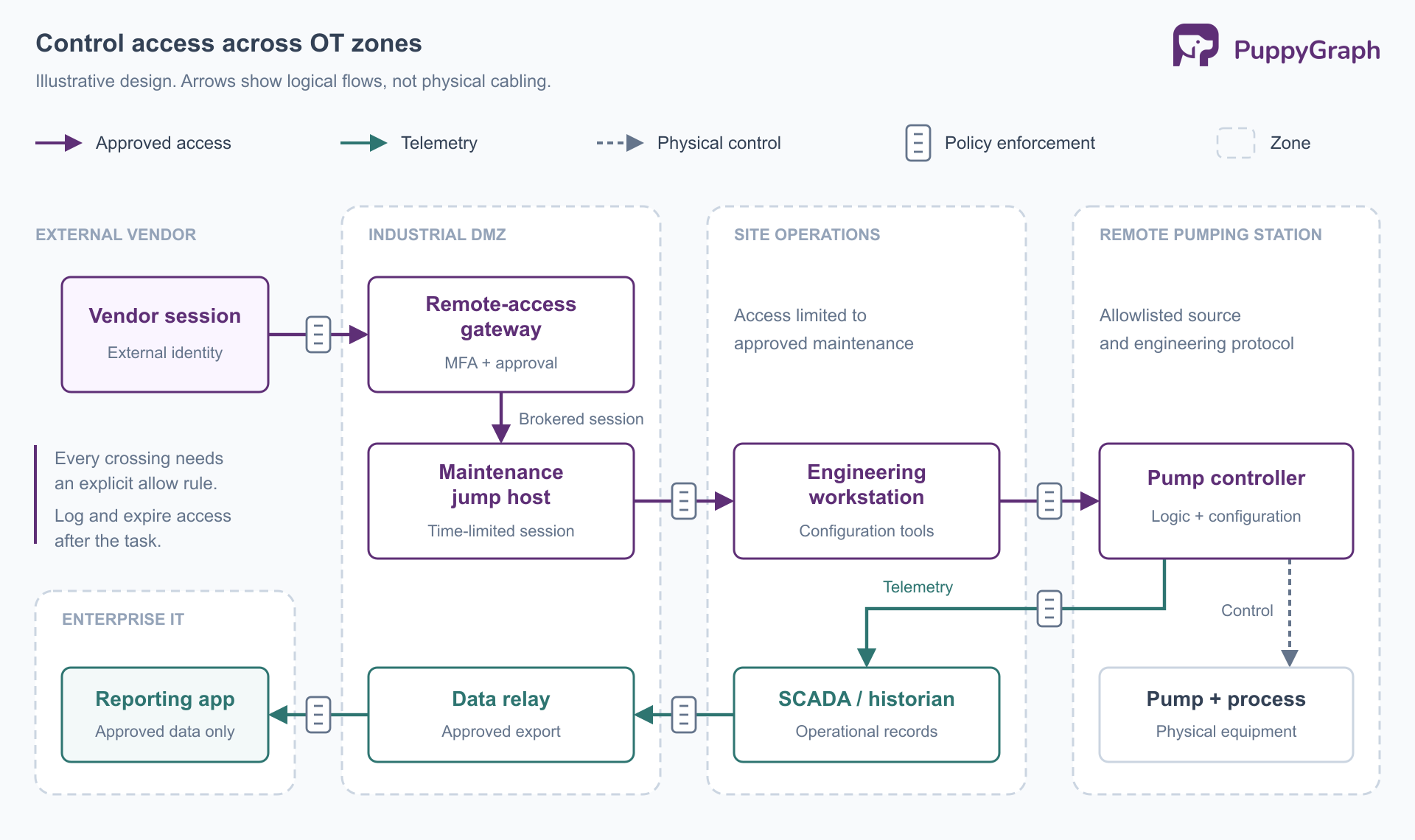
In the pumping-station scenario, require the vendor to use an approved gateway and maintenance host, then permit only the engineering connection needed for the task. Treat access expiration, session visibility, and emergency disconnection as design requirements. Validate the implemented firewall rules and routes against this design, including exceptions introduced during maintenance.
Industrial Control Systems (ICS) and OT Security
Industrial control systems are the industrial subset of OT. Their components monitor and regulate physical processes: sensors supply measurements, controllers execute logic, and actuators change equipment behavior. Human-machine interfaces, or HMIs, let operators observe conditions and issue authorized commands. Engineering workstations configure the systems.
ICS includes several architectures. A programmable logic controller, or PLC, runs control logic for equipment or a process. A distributed control system, or DCS, distributes control functions across the process. SCADA provides supervisory control across distributed assets. NIST's OT security guide explains these categories and their roles.
Security must protect both execution and engineering. Restrict who can download controller programs, preserve approved project files, review parameter changes, and monitor unexpected changes to operating modes. On compatible workstations, application allowlisting and file-integrity monitoring can help control unauthorized software and configuration changes. NIST SP 1800-10 demonstrates these capabilities in manufacturing test environments.
For the pump controller, an approved maintenance session should have an identifiable purpose and expected change. Afterward, compare the installed configuration with the approved record and verify operation with the responsible engineer. A successful login does not establish that every action taken during the session was authorized.
Where safety systems are present, include their dependencies in the review. Control and safety functions can share components or networks. Confirm the actual separation before assuming that a compromise of ordinary process control cannot affect a protective function.
SCADA Security and OT Environments
SCADA stands for supervisory control and data acquisition. It combines central supervision with communications to remote equipment, commonly across water systems, pipelines, and electricity networks. NIST's SCADA definition emphasizes the challenges of collecting data and applying operational controls over long distances.
A remote station may continue local control during a communications outage while the control center loses visibility, depending on its design and configuration. The security design must account for both conditions. Specify how operators recognize stale telemetry, which local protections remain active, and what procedures apply when remote commands cannot be confirmed.
Protect the remote-access route. Inventory communications gateways and maintenance connections as well as controllers. Use authenticated, restricted access through managed infrastructure, and apply multifactor authentication at access points that support it. NIST's OT remote-access guidance recommends limiting access to justified business needs. Apply authentication and authorization checks on private links too; network location alone does not establish trust.
Preserve trust in telemetry and commands. Monitor unexpected sources, changes in reporting behavior, and discrepancies between displayed values and available independent measurements. Review the security of field cabinets and communications equipment alongside network settings.
For the pumping station, rehearse a loss of supervisory communication with operations staff. Identify who checks the local state, how water-delivery decisions are made, and how remote supervision is restored. Recovery criteria should cover accurate visibility and appropriate control authority, not simply the return of network connectivity.
Common OT Security Standards and Frameworks
Different references answer different questions. Use them together while preserving their distinct purposes.
NIST Cybersecurity Framework 2.0 organizes a security program around Govern, Identify, Protect, Detect, Respond, and Recover. Its outcome-based structure helps teams assign responsibilities, identify gaps, and communicate priorities. It does not prescribe a particular network layout.
NIST SP 800-82 provides OT-specific implementation guidance. Use it to evaluate controls against operational constraints and develop protections suited to the environment. It is a practical reference for applying security measures to systems with safety and reliability requirements.
ISA/IEC 62443 addresses industrial automation and control-system security across the lifecycle. The standards series assigns requirements to asset owners, service providers, integrators, and product suppliers. Use the relevant parts when specifying systems, evaluating suppliers, and defining responsibilities for operation and maintenance.
MITRE ATT&CK for ICS describes adversary behavior. Use it to develop threat scenarios and identify monitoring gaps, such as whether the team could detect an unauthorized program download. It is a threat knowledge base, not a certification standard.
For a maintenance-access improvement, these references can support different deliverables: a named risk owner, an access architecture, supplier requirements, and detection scenarios. Assess completion through evidence such as approved designs, tested restrictions, and reviewed session records. A framework mapping becomes useful when it points to controls that someone operates and verifies.
OT Security Risk Assessment and Management
Begin with the process consequence. Determine what an attacker, mistake, or equipment failure could cause: loss of supervision, unauthorized operation, damaged equipment, or interruption of an essential service. Involve operations and engineering in defining credible outcomes and existing safeguards.
Then trace the conditions needed to reach each outcome. For the hypothetical pumping station, ask whether a compromised vendor identity could access the maintenance host, reach an engineering workstation, and use its permissions to change the pump controller. Keep network reachability, authorization, and observed activity separate. A permitted network connection does not prove that an account can perform an engineering change.
Assess vulnerabilities in that context. Combine affected versions and vendor advice with exposure, exploitation evidence, process importance, and available compensating controls. CISA's Known Exploited Vulnerabilities catalog identifies vulnerabilities with evidence of exploitation; use it as a prioritization input. FIRST, which maintains CVSS, likewise cautions that base scores alone do not determine risk or patch priority.
Choose a treatment that can be implemented safely. Possible actions include removing unnecessary remote access, narrowing a permitted destination, changing credentials, patching during a validated maintenance window, or replacing unsupported equipment. When immediate patching is impractical, record the temporary protection, its limitations, its owner, and the date for reassessment.
A useful risk record for the pumping station would identify the vendor-access chain, the process consequence, the evidence for each link, and the restriction intended to break the chain. It would also specify how the team will verify the restriction without disrupting authorized maintenance.
Track whether these decisions change exposure. Useful measures include unowned assets, unnecessary access paths awaiting removal, overdue exceptions, and recovery exercises completed against operational criteria. Reassess after changes to network routes, vendor arrangements, controller configurations, or process dependencies. Reassessing risk as those conditions change keeps management decisions current.
How AI Improves OT Security
AI can support anomaly detection, investigation, and prioritization when its outputs remain connected to operational evidence. Behavioral models can flag unfamiliar communications or changes in activity; language models can help summarize incident records and timelines. The joint guidance on secure AI integration in OT discusses behavioral analysis alongside human oversight, model drift, and safety risks.
An anomaly is a reason to investigate. Startup, maintenance, and process changes can alter normal behavior. Evaluate detections against these operating states, record the evidence behind recommendations, and measure false positives and missed events. For an initial deployment, keep AI analysis on collected records with read-only access and route proposed operational changes through existing engineering approval.
Connected context makes that investigation more useful. In the pumping-station example, an unusual vendor session raises a specific question: which critical processes sit downstream of this identity's recorded access relationships? Answering it requires relating identities, hosts, controller assignments, and process dependencies. A graph can represent those relationships while keeping configured permissions distinct from observed sessions.
PuppyGraph is a real-time, zero-ETL graph query engine that queries existing SQL databases, warehouses, and lakehouses in place, including direct reads of Iceberg and Delta Lake, with no data movement into a separate graph store. Its distributed architecture scales to petabytes and supports subsecond graph queries, giving investigators and AI agents a connected view across 3,000 tables. Teams connect supported sources, use the built-in AI assistant to propose a model of nodes and edges for approval, and query the resulting graph with openCypher or Gremlin.
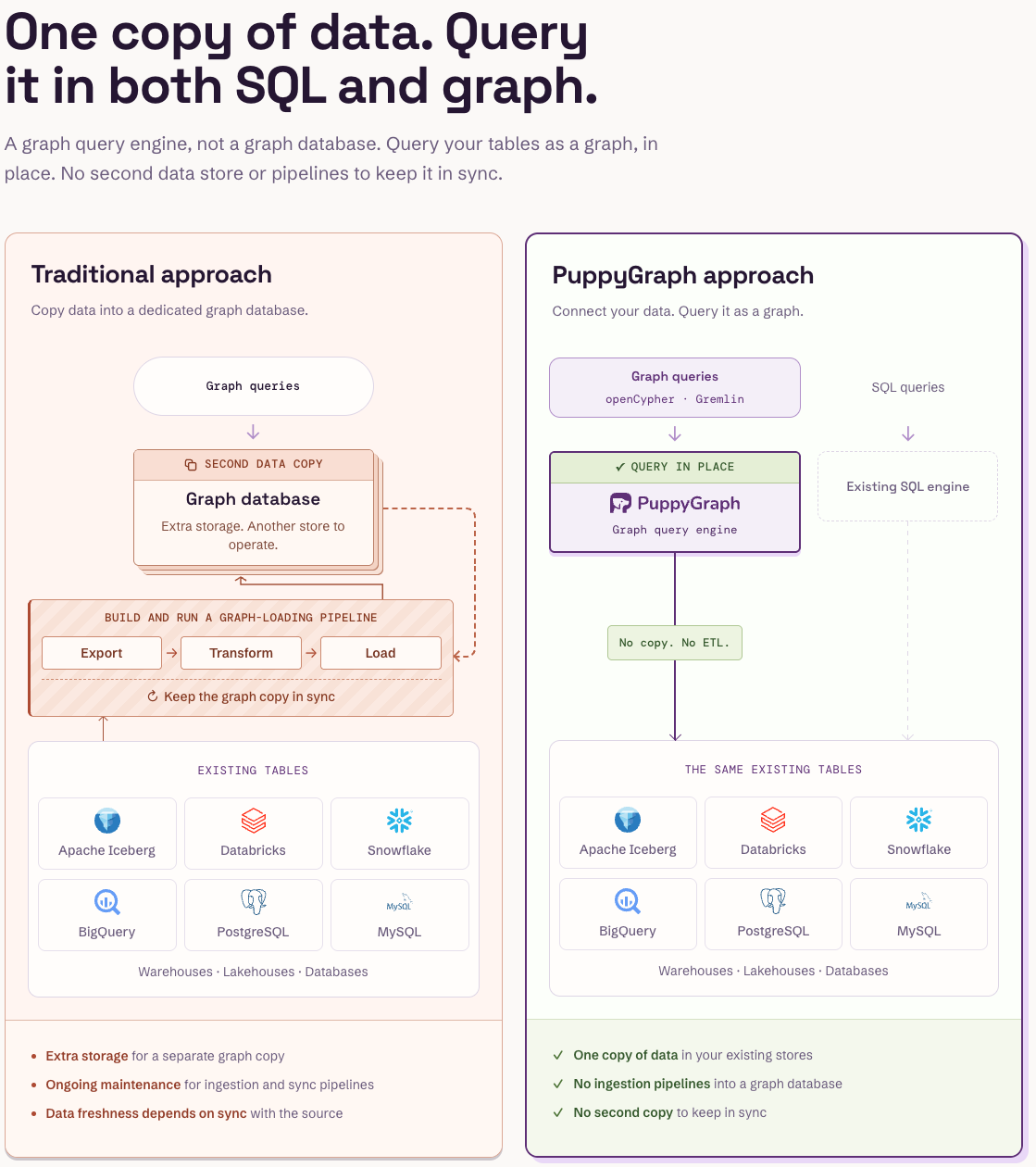
Analysts can query this model through the built-in assistant, while external AI agents can connect through the open-source MCP server. Graph queries that reference undefined entities or relationships are rejected with feedback for correction. This query-grounding mechanism supports investigation over security records already stored in supported data platforms. Record freshness depends on source updates and connector settings, including metadata caching. Engineers validate that freshness, the meaning of each relationship, and the physical consequences before changing access or control settings.

Conclusion
OT security starts with understanding the physical process and the systems it depends on. Maintain an accurate inventory, restrict and monitor access, protect engineering changes, and rehearse recovery with operations staff. Architecture and standards provide structure; evidence that controls work in the actual environment makes them useful.
AI and graph analysis can help teams investigate relationships across security records. Their value depends on reliable data and operational review of the findings.
Try the forever-free PuppyGraph Developer Edition and book a demo with the team to explore how your existing identity, asset, and connectivity records can support OT access-path investigations.