The article

Query your table as a graph.Petabytes. Subsecond. No data movement.
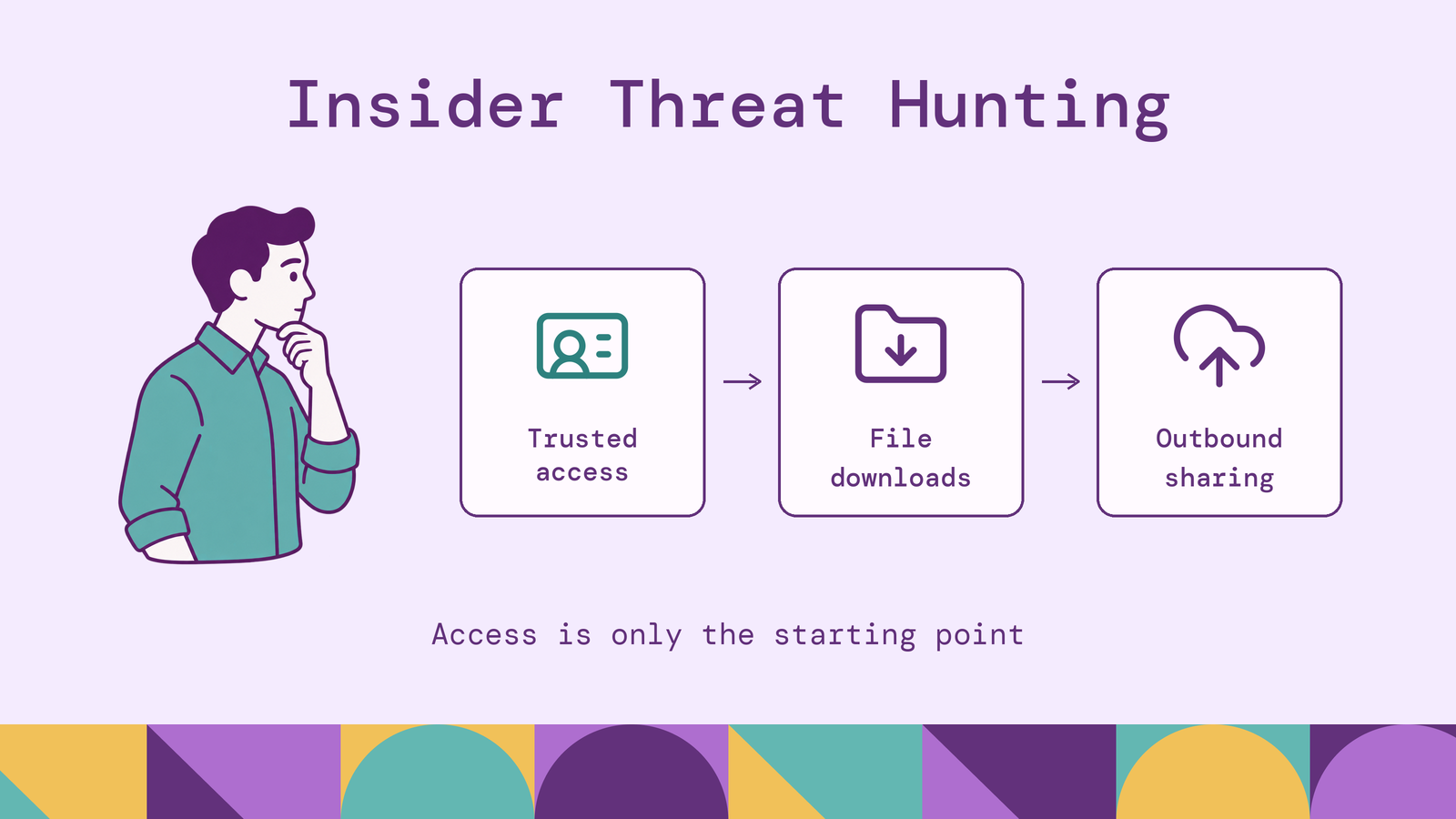
An account can pass authentication, hold the required permissions, and still be used to take sensitive information outside its intended business purpose. Insider threat hunting examines that gap between permitted access and justified activity. The difficult work is connecting events to the resources, responsibilities, and circumstances that make them meaningful.
This guide explains how to develop and test insider-threat hypotheses, combine SIEM and endpoint evidence, and build a repeatable hunting program. It also covers behavioral analytics and AI, with attention to what the evidence can establish about an account's activity and the person behind it.
What is insider threat hunting?
Insider threat hunting is a proactive search for evidence that trusted access is being misused or creating harm. Hunters test specific hypotheses against identity, endpoint, application, and data-access records, including activity that has not triggered an alert.
CISA's insider threat definition covers harm arising from authorized access or knowledge of an organization, whether intentional or unintentional. Employees, contractors, and trusted partners can fall within that scope. This article focuses on cyber activity involving organizational systems and data.
Routine monitoring continuously evaluates known conditions. A hunt starts with a question that existing detections may not answer, such as whether contractors retain access to confidential reporting folders after a project ends. An alert can supply the starting point, but the investigation should extend beyond checking the alert's immediate cause. Escalate credible compromise evidence into incident response under the organization's incident criteria. Hunting can continue during response to establish scope and inform containment and recovery.
The wider insider risk program also includes access governance, reporting channels, training, and organizational oversight. Hunting supplies evidence to that program. Its useful outputs include confirmed misuse, an explained anomaly, an access-control weakness, or a clearly documented visibility gap. A hunt can improve security without identifying a malicious employee.
How does insider threat hunting work?
Start with a hypothesis that evidence could disprove. Consider a hypothetical finance contractor account, fin-contractor-17, that still belongs to finance-projects after changing assignments. That group sits inside reporting-readers, which grants access to the quarter-close folder. The hunt asks whether retained access is being used for downloads outside the contractor's current assignment, followed by outbound sharing.
Set the boundaries. Identify the relevant resources, accounts, review period, and expected workflow. Confirm which tasks legitimately require bulk exports. A finance team's quarter-end close can produce a download pattern that would be unusual during the rest of the month.
Check the evidence before searching. Confirm that folder-download audits, identity-provider events, group changes, and relevant endpoint or transfer records are available. Inspect sample events for stable account and object identifiers. A connector reporting healthy status does not establish that it captures the operation the hypothesis requires.
Reconstruct the sequence. Correlate downloads with the originating session and device, then investigate subsequent transfers. Keep event time separate from ingestion time. Where available, use request identifiers, object identifiers, file hashes, and session identifiers to strengthen the connection. A shared IP address and nearby timestamps alone provide weak attribution.
Test competing explanations. Check project assignments, approved transfers, scheduled reporting jobs, and device ownership. Determine whether the account owner initiated the activity or whether stolen credentials are plausible. An approved export to an authorized recipient may explain the sequence; an unexplained destination requires further investigation.
Record the outcome. Preserve the query, time bounds, source records, and reasoning. Escalate supported findings through the response process. If the evidence is incomplete, name the missing source or field. If the behavior is legitimate, document the explanation and any narrowly scoped detection adjustment.
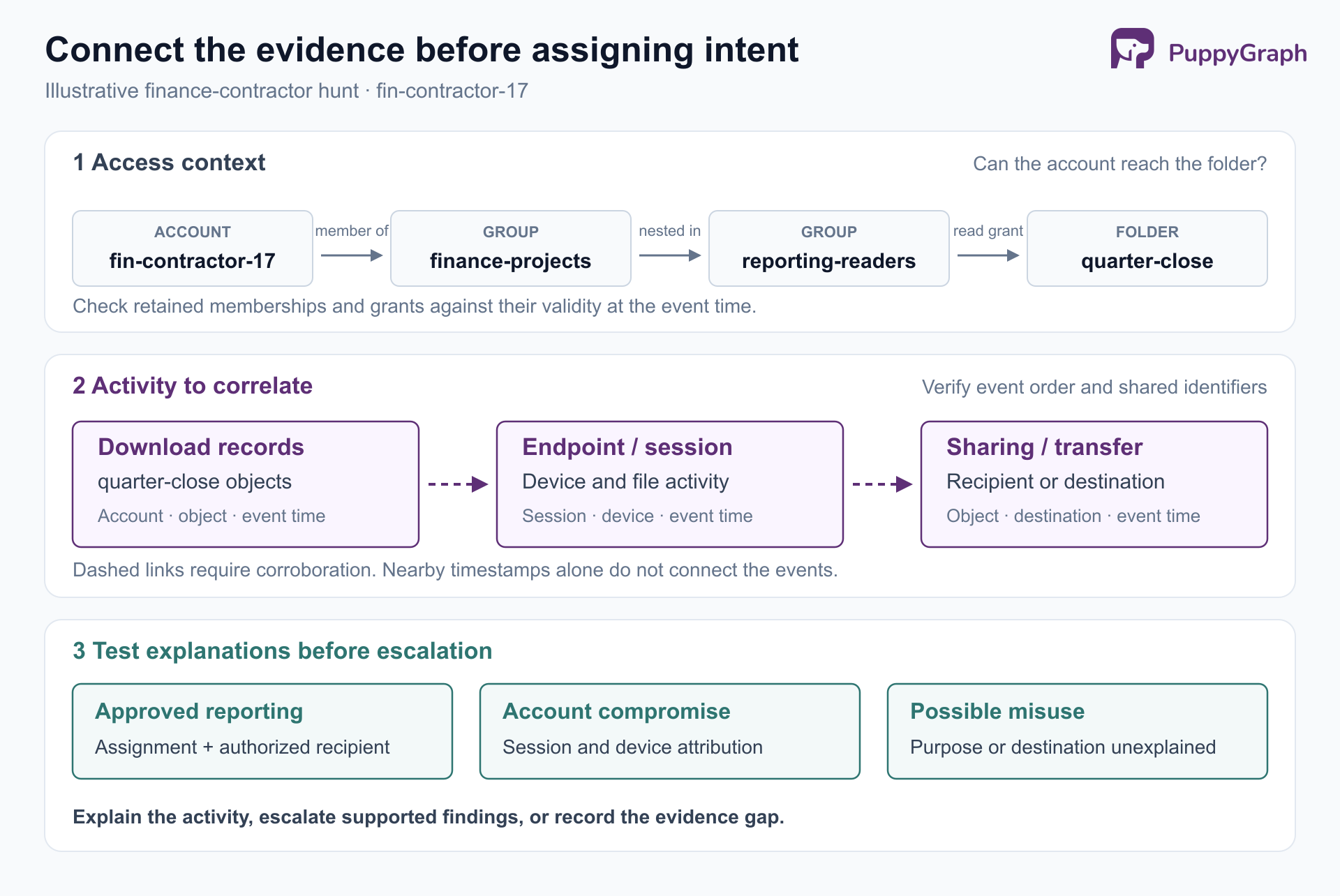
The sequence gives the hunt its meaning. Each event contributes evidence; the analyst determines whether those events belong to the same activity and whether that activity had a legitimate purpose.
Types of insider threats
The Canadian Centre for Cyber Security's insider-threat guidance distinguishes unintentional harm from malicious misuse. Keep intent, access level, and employment relationship separate when classifying a case.
Malicious misuse. An insider deliberately abuses access to steal information, alter records, facilitate fraud, or disrupt operations. A hunt might examine repeated exports of confidential pricing data or changes to payment details outside an approved workflow. Legitimate credentials can be sufficient; malware is not a prerequisite.
Unintentional harm. A person shares a folder too broadly, sends an export to the wrong recipient, or uses an unapproved storage service to finish a task. The investigation still needs to establish what data became exposed. Corrective action may involve permission changes, safer workflows, and training.
Collusion and recruitment. An external actor may seek an insider's help. In a 2021 Department of Justice account of an attempted recruitment, an attacker tried to pay a company employee to introduce malware. The employee reported the approach, the company contacted the FBI, and the scheme was thwarted. The case illustrates why employee reporting belongs alongside technical monitoring.
Account compromise as an alternative explanation. An external attacker using an employee's credentials can produce similar telemetry. MITRE ATT&CK's Valid Accounts technique describes this abuse. Investigate the behavior without automatically attributing the attacker's intent to the account owner.
Contractors and privileged administrators can appear in any relevant category. Their status changes the access and oversight questions, but it does not by itself determine whether their activity is malicious.
Common indicators of insider threat activity
Useful indicators describe observable changes in access or data handling. Their significance depends on the resource, the business process, and supporting evidence.
| Observed activity | Context to retrieve | Legitimate explanation to test |
|---|---|---|
| Bulk downloads from sensitive folders | Object identifiers, classification, session, prior activity | Approved reporting, migration, or audit preparation |
| Access to a new department's resources | Current assignment and permission history | A project transfer or temporary support task |
| New group membership or privilege changes | Requester, approver, change ticket, validity period | An authorized access request |
| Uploads or sharing to unfamiliar destinations | Recipient, tenant, destination ownership, transferred objects | An approved partner exchange |
| Logging changes or deletion of audit records | Initiating identity, change scope, maintenance record | Planned maintenance or retention processing |
Treat unusual hours, geography, or volume as reasons to retrieve context. On-call work, travel, shared infrastructure, and reporting cycles can explain them. Compare activity with the person's relevant history and suitable peers, accounting for role changes.
For outbound transfers, the service name alone is insufficient. A sanctioned collaboration platform can host both approved business work and an unauthorized destination. MITRE documents this problem in Exfiltration to Cloud Storage: ordinary use of the same services can help conceal data theft. Investigate the receiving account and the objects transferred where telemetry permits.
Combinations matter more than isolated anomalies. Retained access, downloads outside an assignment, and transfers to an unapproved recipient form a stronger lead than any one signal. Even then, a file download followed by an upload does not establish that the same content moved. Preserve that distinction until object-level evidence supports it.
Using SIEM and EDR for insider threat detection
A security information and event management platform, or SIEM, supports searches and correlation across collected sources. Endpoint detection and response, or EDR, adds device-level evidence about processes, files, network activity, and logged-on identities. Their usefulness depends on the telemetry actually enabled and retained.
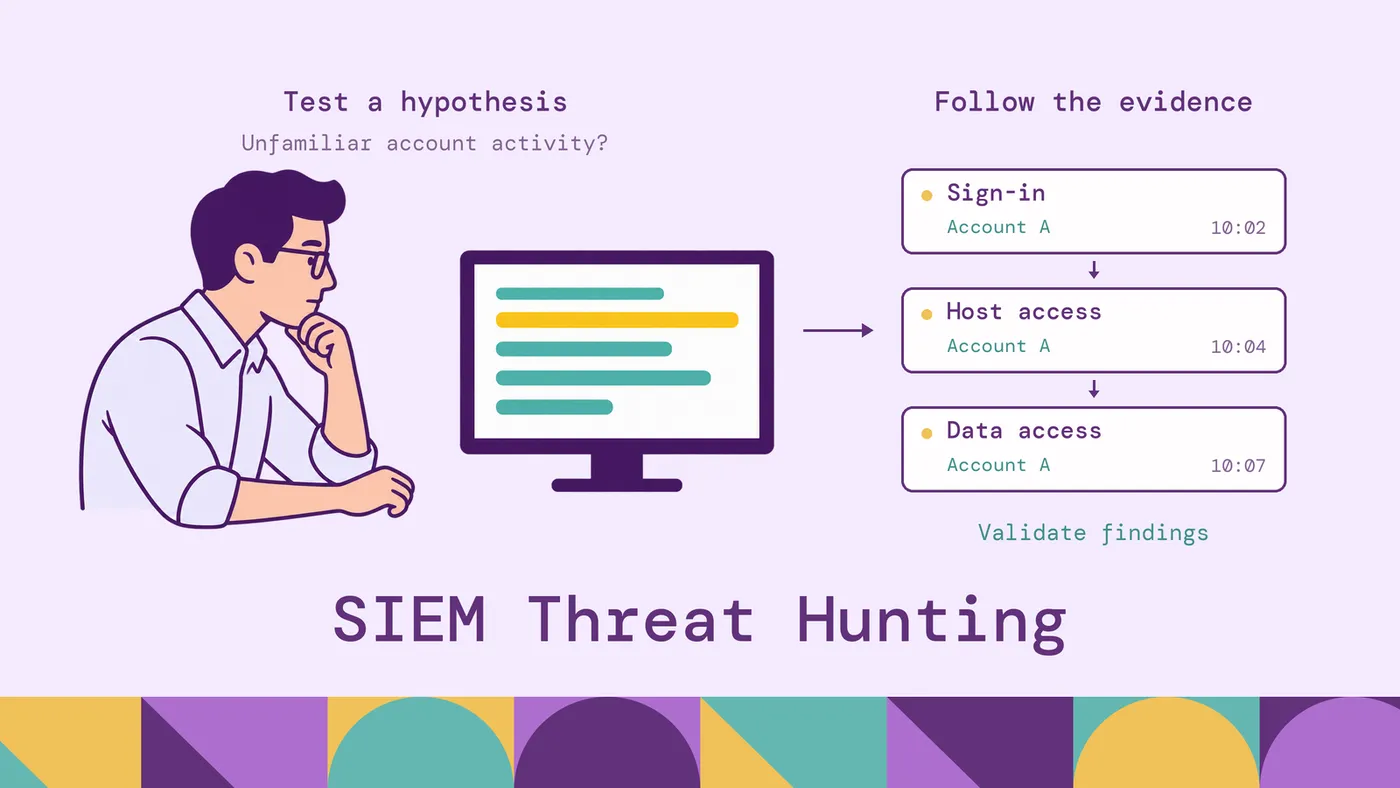
Use the SIEM to build the cross-source timeline. Start with the account and sensitive resource, then connect authentication, application audit, group-change, and outbound-transfer events. Security event correlation becomes more reliable when normalized identifiers preserve the original event references. A username shared across systems should not silently replace distinct tenant or account identifiers.
Behavioral analytics can prioritize where to look. Microsoft Sentinel's UEBA documentation describes profiles for users and other entities, comparisons with historical and peer activity, and anomaly scores. These scores help select investigative leads. They do not establish the business purpose of a download.
Use EDR to examine the endpoint sequence. In the contractor example, inspect activity on the originating device around the download: the initiating browser or client, subsequent file operations, and relevant outbound connections. Microsoft Defender for Endpoint documents collection of process, network, login, and file-system telemetry. It also explicitly states that its detection sensor does not record every endpoint operation. Absence of a recorded action therefore needs to be interpreted against actual coverage.
Add the sources that answer the remaining questions. Application audit logs can record actions within the application. DLP can contribute sensitive-content and transfer-policy signals. Identity governance and privileged-access records can explain entitlement changes. Dedicated insider-risk tools add policy and case workflows; for example, Microsoft Purview documents signal correlation, pseudonymization, role-based access controls, and investigator auditing.
For the contractor hunt, the useful outcome is a traceable account-session-device-resource timeline. Each tool contributes evidence to that timeline, with its collection limits recorded.
How to build an insider threat hunting program
Give the program a defined purpose, accountable owners, and an agreed response process. SEI's guidance on insider threat programs emphasizes organization-wide participation, oversight, confidential reporting, and incident handling. Technical monitoring is one component of that wider effort.
Establish authority and responsibilities. Agree with security, legal, HR, privacy, and relevant business owners on approved investigative purposes, access to case material, escalation criteria, and retention. Identify who can authorize containment and who handles employment-related decisions. Restrict sensitive employee information to the people whose responsibilities require it.
Choose critical assets and plausible misuse cases. Start with a bounded business process: financial reporting, source-code access, customer exports, or payment administration. Identify who normally uses the assets, what approved activity looks like, and which departures could cause material harm. Write hypotheses around those actions, rather than searching for broadly suspicious employees.
Validate the data contract. For every required source, record the owner, event types, identifiers, timestamp meaning, retention, and known omissions. Test a benign download or sharing action and confirm that investigators can retrieve it. Include historical entitlement changes so current permissions do not overwrite the explanation of earlier access.
Create a hunt and handoff playbook. Each hunt needs a hypothesis, scope, query approach, expected evidence, alternative explanations, and closure criteria. Specify how hunters preserve records and hand confirmed concerns to incident responders. Include procedures for urgent cases so the team can act without improvising authority during an incident.
Measure investigative usefulness. Track whether priority assets have usable telemetry, how long it takes to assemble a supported timeline, and which findings produce control improvements. Review benign outcomes to identify recurring sources of noise. Raw alert counts and the number of employees flagged provide little evidence that risk has decreased.
Run a small set of repeatable hunts before expanding coverage. The first cycle should expose gaps in the evidence and handoff process while the scope remains manageable.
Challenges in insider threat hunting
Legitimate activity changes. Role transitions, audits, migrations, and deadline-driven work can disrupt a behavioral baseline. A model trained on quiet periods may rank normal quarter-end exports as unusual. Baselines need business context and periodic review.
Identities fragment across systems. A person may have employee, contractor, administrative, and application accounts. Shared accounts weaken attribution, while reused usernames can connect unrelated people. Maintain explicit identity mappings and preserve uncertainty when a match is weak.
Historical context disappears. Today's group memberships cannot reliably explain last month's access. A useful investigation needs the grants and memberships that applied when the event occurred. Missing records should remain a stated limitation, rather than being filled with assumptions about current access.
Collection leaves blind spots. An application may log a download without recording the destination of a later transfer. An unmanaged device may provide no endpoint evidence. Short retention can remove the beginning of an activity sequence before a hunt starts. Separating long-term storage from operational alerting, as discussed in security data lakes and SIEMs, can help preserve investigation history, but only when the required events were collected.
Intent remains difficult to establish. Telemetry can show actions, relationships, and timing. Business owners and investigators may still need to establish purpose. A defensible case separates observations, supported inferences, and unanswered questions, particularly when its conclusions could affect an employee.
Insider threat hunting best practices
Prioritize sensitive data and consequential actions. Start with a small set of resources where unauthorized access or changes would matter. Pair the technical hunt with a business owner who can assess legitimate use. A generic download threshold should not carry the same weight for public documentation and confidential financial material.
Require corroboration and test benign explanations. Combine access context, actual resource activity, and destination or process evidence. Ask what would make the hypothesis wrong. For the contractor example, an approved assignment and authorized recipient could explain the export, while stale group membership might still deserve remediation.
Keep exceptions narrow. Attach an owner, reason, scope, and expiry to exceptions for recurring reporting jobs or approved transfers. Avoid permanently excluding an entire account because one investigation was benign. Review exceptions when responsibilities, destinations, or data classifications change.
Preserve evidence and limit its exposure. Save original event references alongside normalized records and analyst notes. Record collection time, query scope, and who handled case material. Use access controls and investigator auditing; keep unrelated personal information out of the case. The evidence should support review without spreading sensitive data unnecessarily.
Test visibility and close the loop. Re-run benign simulations after connector changes, endpoint-policy updates, or application migrations. Turn confirmed findings into proportionate improvements: remove stale access, fix a risky sharing workflow, add a detection, or improve a missing audit source. Establish a clear reporting route for employees who encounter mistakes or recruitment attempts.
Review these practices together. Better detection without reliable attribution creates more ambiguous cases; better attribution without an agreed response process leaves findings unresolved.
How AI improves insider threat hunting
AI can assist with prioritization and investigation, but those are different tasks. Behavioral models compare current activity with historical and peer patterns. They can surface unfamiliar combinations of access, devices, destinations, and volume for review. Their outputs depend on the telemetry available, the historical baseline, and how peer groups are defined.
Generative AI can help draft queries, summarize retrieved events, and propose follow-up questions. Require summaries to retain source-event references and distinguish observations from hypotheses. Validate generated filters and joins before relying on the result. NIST's Generative AI Profile (2024) identifies confabulation as a risk: fluent output can contain false information. That makes an unsupported assertion about a person's motive especially unsuitable for a case record.
Evaluate assistance against reviewed cases: whether it retrieves relevant evidence, preserves uncertainty, and helps analysts reach supported conclusions. Keep consequential decisions with authorized reviewers. Access restrictions and approved model-service settings should also govern which investigation data reaches an AI system.
The contractor example raises a relationship question: which nested groups gave the account access to the downloaded resources, and which observed events connect that access to an export? A graph model can represent permission paths alongside activity, provided the source tables retain the required identities and validity periods.
PuppyGraph is a real-time, zero-ETL graph query engine that queries existing SQL databases, warehouses, and lakehouses as a graph, including direct reads of Iceberg and Delta Lake tables. Its distributed engine supports petabytes of data, enables AI agents to work across 3,000 tables, and supports subsecond graph queries with no data movement into a separate graph database; actual latency depends on the query, source, and deployment. Teams connect their sources, map tables to nodes and edges, and query with openCypher or Gremlin while the same tables remain accessible through SQL.
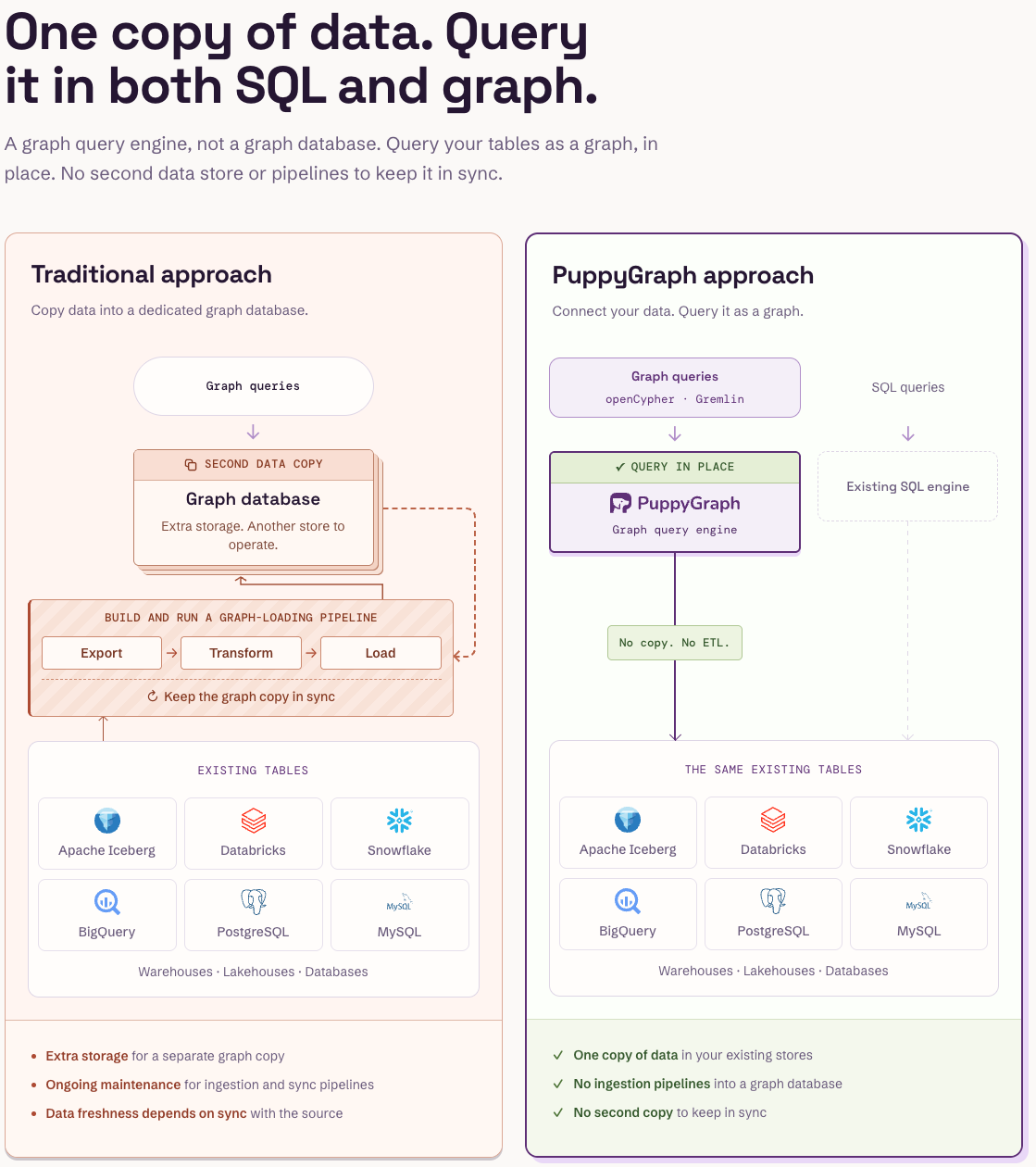
The built-in AI assistant can inspect connected tables, propose a graph model for approval, and translate natural-language questions into queries; it requires an LLM API key. For insider hunting, that model supplies relationship context alongside SIEM and EDR evidence. Data freshness still depends on source ingestion and availability, and the analyst remains responsible for deciding what a retrieved path proves.
Conclusion
Effective insider threat hunting connects a specific hypothesis to reliable evidence and a business explanation. Start with critical resources, verify collection coverage, and reconstruct activity across identities, sessions, devices, and data. Use anomalies to guide investigation, then let corroborated events and operational context determine the response.
Try the forever-free PuppyGraph Developer Edition and book a demo to explore how graph queries can connect identity, permission, and activity records for your insider-threat investigations.