Threat Hunting vs Threat Intelligence: Key Differences
- Hao WuSoftware Engineer
The guide

Query your table as a graph.Petabytes. Subsecond. No data movement.
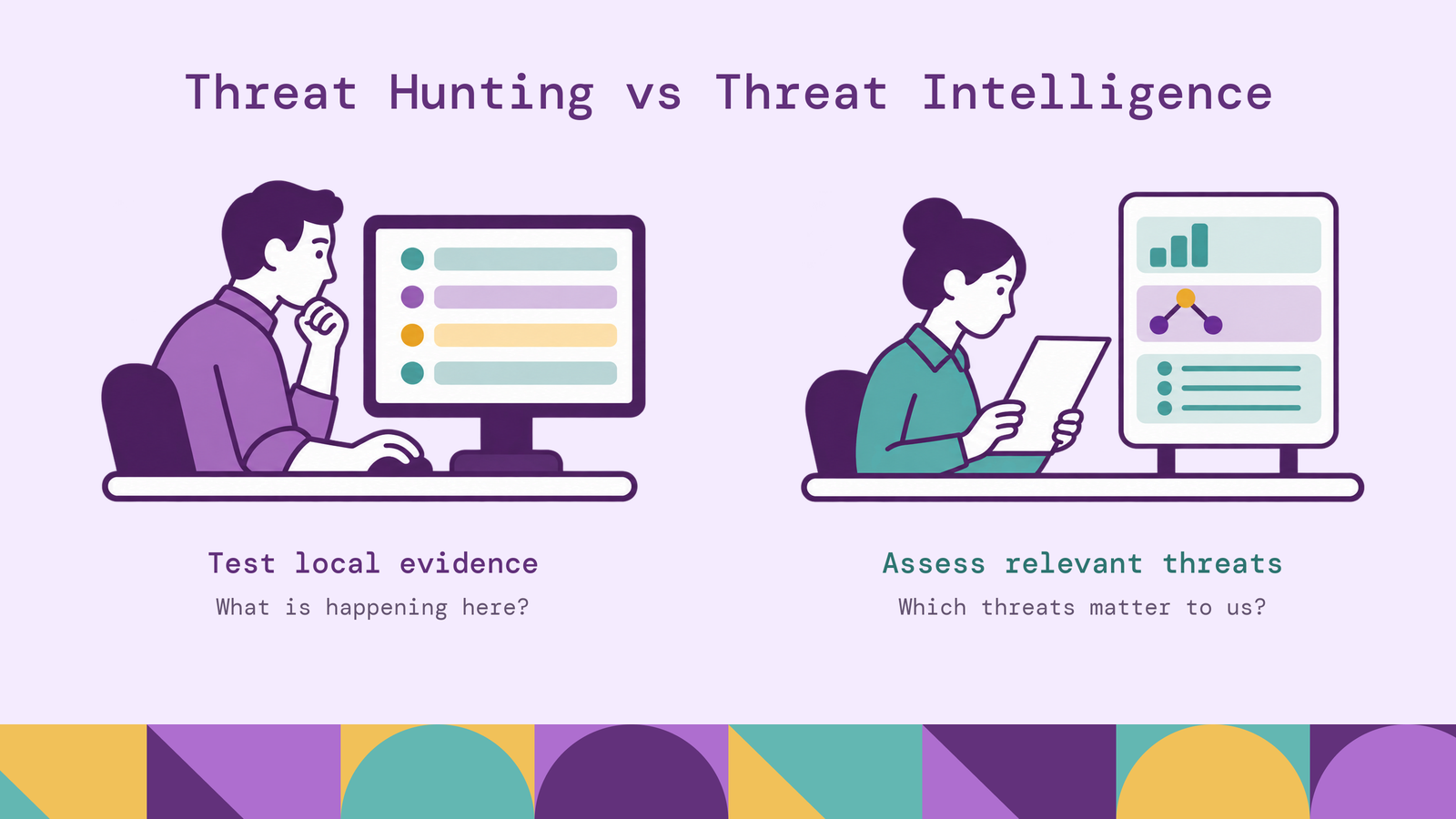
Threat intelligence helps a security team decide which threats deserve attention. Threat hunting tests whether relevant adversary activity is present in the organization's environment. A credible report can justify an investigation, but evidence from the environment must establish what happened there.
The distinction matters when assigning work, selecting tools, and evaluating results. This article compares threat hunting vs threat intelligence, explains their processes and benefits, and shows how to connect them through practical investigations.
What is threat hunting?
Threat hunting is a proactive search for malicious activity that may have escaped existing security controls. It investigates an environment with a question to resolve, often before an alert has established a compromise. NIST's threat-hunting control, RA-10, describes searching organizational systems for indicators of compromise and detecting, tracking, and disrupting threats that evade existing controls.
A hunt can begin with a reported technique, an unexplained anomaly, or a known gap in detection coverage. An indicator match can be a lead, but the investigation must establish its meaning. Repeatedly searching a list of known malicious addresses provides less assurance than investigating the activity surrounding a relevant match.
A practical hunt has four parts:
- Define the question and scope. State the suspected behavior, affected systems, and time window. For example, investigate whether a service account is being used for interactive access outside its normal backup workflow.
- Check that the evidence exists. Identify the authentication, endpoint, and network records needed to test the hypothesis. Check coverage and retention before interpreting an empty result.
- Investigate and challenge the hypothesis. Follow accounts, hosts, sessions, and processes across records. Test legitimate explanations, such as an approved maintenance task, alongside malicious ones.
- Record the outcome and act. Escalate credible compromise evidence into incident response. Preserve useful queries, document visibility gaps, and propose detection changes for validation.
The tools support different parts of this work. A security information and event management system (SIEM) helps search and correlate logs. Endpoint detection and response (EDR) provides host-level evidence; network telemetry and cloud audit logs add other views. Analysts also need asset ownership and administrative context to interpret those records.
The benefit extends beyond finding an intrusion. A hunt can expose a missing log source or produce a reusable detection. Its conclusion must stay within the evidence: no supporting activity found in the retained records is narrower than no compromise occurred.
What is threat intelligence?
Cyber threat intelligence is analyzed information about threats that supports a security decision. NIST's definition emphasizes adding the context needed for decision-making through analysis, interpretation, enrichment, or related processing.
That context gives a report or indicator operational meaning. A domain name alone tells an analyst little. Its reported role, observation dates, source reliability, associated behavior, and relevance to the organization determine what action it can support. Internal incident findings can contribute intelligence just as external advisories and research can, as NIST SP 800-150 (2016) describes.
The process starts with a requirement, such as deciding which credential-abuse techniques deserve investigation in a remote administration environment. The FIRST intelligence-cycle guidance describes planning and direction, collection, processing and exploitation, analysis and production, and dissemination and feedback. Applied to a security team, that means collecting relevant evidence, organizing it, assessing what it supports, and delivering an answer to the person who needs it. Their feedback shapes the next collection effort.
MWR InfoSecurity's Threat Intelligence: Collecting, Analysing, Evaluating groups the outputs into four categories by audience and use. Strategic intelligence informs decisions about business exposure and security investment. Tactical intelligence describes adversary tactics, techniques, and procedures (TTPs). Operational intelligence addresses particular campaigns or activity, while technical intelligence supplies artifacts such as domains and file hashes. These categories overlap; their value is in matching the detail to the decision.
Threat intelligence platforms help organize and share that material. For example, MISP supports collecting, correlating, and sharing indicators and related threat information. OpenCTI uses an entity-and-relationship model based on STIX 2.1 to organize threat knowledge. Such tools support analysis, but the team still has to evaluate sources and explain uncertainty.
The benefit is better prioritization: which behavior to hunt, which exposure to address, or which control to improve. Collecting more reports is useful only when it improves one of those decisions.
Threat hunting vs threat intelligence: key differences
The clearest comparison is between the question each practice answers and the evidence its answer requires.
| Dimension | Threat hunting | Threat intelligence |
|---|---|---|
| Primary question | Is relevant adversary activity present in this environment, and what evidence supports that conclusion? | Which threats matter to this organization, how do they operate, and what decisions should that inform? |
| Starting point | A hypothesis, anomaly, intelligence lead, or detection gap | An intelligence requirement or a decision-maker's information need |
| Main evidence | Environment-specific telemetry, supported by intelligence and operational context | Internal findings and external reporting, evaluated for relevance and reliability |
| Method | Iterative investigation that tests hypotheses against observed activity | Collection, processing, analysis, and communication of threat assessments |
| Typical output | Investigative findings, incident referrals, detection proposals, and visibility gaps | Assessments, campaign context, behavior descriptions, and contextualized indicators |
| Common tools | SIEM search, EDR investigation, network analysis, and log-query tools | Intelligence platforms, research and enrichment tools, and sharing systems |
| Prerequisites | Searchable telemetry, environmental knowledge, analyst time, and an escalation path | Clear requirements, access to relevant sources, analytical skills, and identified consumers |
| Cadence | Scoped investigations, run periodically or triggered by new information | Ongoing collection and analysis, with scheduled and event-driven delivery |
| Common failure modes | Confirmation bias, missing telemetry, and mistaking unusual behavior for malicious activity | Stale indicators, weak sourcing, and assessments that do not answer a relevant question |
| Useful measures | Questions resolved, detection gaps closed, and findings supported by evidence | Decisions informed, relevance to consumers, and timely delivery with clear confidence |
These are differences in emphasis, not rigid boundaries. Intelligence analysts use internal evidence, and hunters use external research. Both can be proactive, and both use automation. The same analyst may perform both roles; what changes is whether the immediate task is assessing a threat or testing for its presence in a particular environment.
How threat hunting and threat intelligence work together
The relationship runs in both directions. Intelligence helps focus a hunt, and a hunt supplies observations that can improve intelligence. NIST's RA-10 discussion explicitly recognizes that hunting teams consume existing intelligence and may produce new intelligence for sharing.
Consider the risk of valid-account abuse through legitimate administration tools. The joint 2024 guidance on identifying and mitigating living-off-the-land techniques describes adversaries abusing native tools and processes to blend into normal activity. It also emphasizes logging and behavioral baselines that help defenders distinguish misuse from expected administration.
Turn that general concern into a concrete workflow:
- Select relevant intelligence. Establish why the behavior matters to the organization. For a team that operates backup servers and administrative jump hosts, credential misuse across those systems is a more useful starting point than an unrelated malware report.
- Form a testable hypothesis. Suppose the team asks whether
svc-backuphas been used for interactive remote sessions outside its expected scheduled jobs. Define the systems, time range, and behavior that would support or weaken that hypothesis. - Connect the evidence. Compare authentication events with remote-session records, process activity, asset ownership, and change records. Preserve event identifiers and timestamps so another analyst can review how the conclusion was reached.
- Return findings to the right teams. Suspicious activity may require incident response. A benign explanation can refine the baseline. Missing session records require a collection improvement, while a useful behavioral pattern can become a detection candidate.
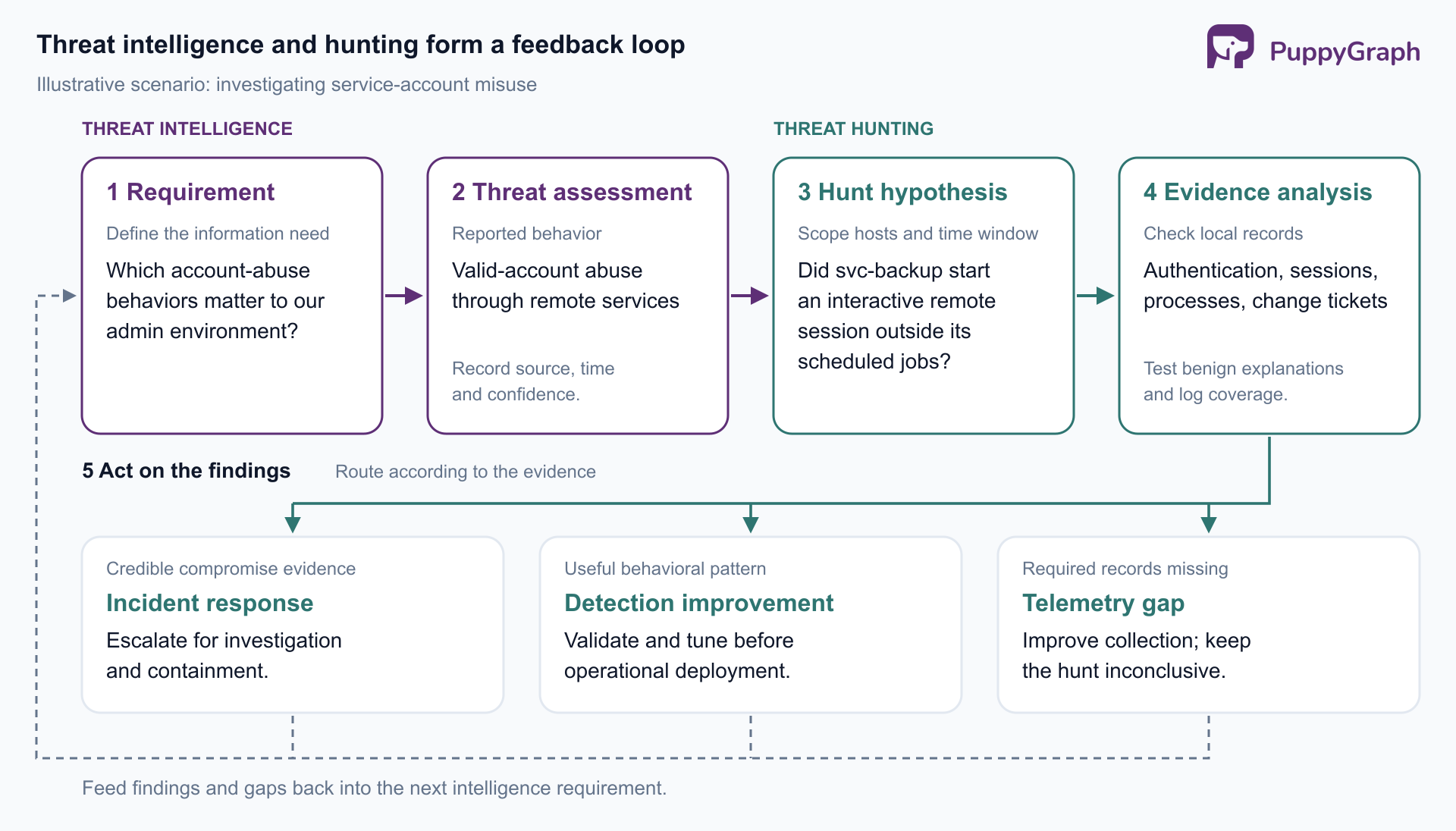
Figure: Intelligence selects a relevant question; local evidence determines the hunt's conclusion. Findings and visibility gaps then shape the next intelligence requirement.
This is where threat intelligence correlation connects external reporting with internal observations. The handoff should preserve source, time, and confidence. A local observation can support a reported technique without proving that the organization was targeted by the actor named in the report.
Examples of threat hunting vs threat intelligence
The following examples are illustrative investigations, not reports of an actual intrusion. They show how the same security concern produces different work for an intelligence analyst and a hunter.
A reported domain becomes an investigation lead. An intelligence analyst evaluates a report linking a domain to malicious infrastructure. The analyst records when the activity was observed, how the source supports the association, and whether the campaign is relevant to the organization. The output is a contextualized indicator with a reason to investigate it.
A hunter searches retained DNS and proxy records for the relevant period. If a match appears, the next questions concern the initiating host and process, the connection outcome, and related activity. A DNS query alone does not establish that a payload executed. The investigation may need to distinguish a user's browser session from a security scanner or another legitimate source of traffic.
The intelligence work establishes why the domain deserves attention. The hunting work tests what, if anything, its appearance means locally. A simple indicator lookup becomes a broader hunt when the analyst uses it to investigate a hypothesis about adversary activity.
Remote administration raises a credential-abuse hypothesis. MITRE ATT&CK documents how adversaries can abuse valid accounts, T1078, and use remote services, T1021, to access other systems. An intelligence assessment can use those behaviors to identify relevant investigative questions without needing a malware hash or a named threat actor.
In the illustrative environment, svc-backup normally runs scheduled jobs from backup-01. A hunter investigates whether that account also initiated an interactive session on jump-02 and whether activity from that host continued to files-07. The analyst would compare source and destination records, session identifiers, process execution, and event order, then check the explanation with the system owner and relevant change records.
An unusual sequence is a candidate for investigation. Shared account names or adjacent timestamps alone do not prove that the events belong to one intrusion. If approved maintenance explains the sequence, the result can refine the hunt. If evidence supports unauthorized activity, the team has a concrete basis for escalation. If the required records are absent, the outcome is inconclusive and identifies a collection gap.
When should you use threat hunting vs threat intelligence?
Use the unresolved question to decide where to put effort. Most security programs need both practices, but they do not need identical staffing or tooling for each.
Prioritize intelligence when the team lacks direction. If analysts cannot explain which threats matter to the organization's technologies and operations, begin with a specific intelligence requirement. Government advisories, sector-sharing communities, vendor research, and internal investigations can all contribute. Evaluate a source by the decisions it supports, rather than the volume it delivers.
Prioritize hunting when there is a relevant question and usable evidence. A credible technique report, unexplained activity, or an identified detection gap can justify a scoped hunt. Assign time, access to the necessary records, and an owner for the outcome. If logging cannot support the question, address that limitation or narrow the scope before drawing conclusions.
Use both when a threat changes investigative priorities. An assessment may establish that a behavior deserves attention; a hunt then tests for it locally. Validated findings can inform future assessments and detection engineering. Evidence of an active compromise should enter the incident-response process without waiting for a scheduled hunt to finish.
For hunts that span systems, add relationship analysis. In the service-account example, the difficult question is which sequence of accounts, hosts, and remote sessions connects the initial activity to later access. Where those records already reside in a warehouse or lakehouse, a graph model can make those relationships queryable. The model must preserve event context and distinguish an observed session from a permission that merely allows access.
PuppyGraph is the first and only zero-ETL graph query engine that queries existing relational data as a graph without loading it into a separate graph database. Its distributed engine reads tables in place in SQL databases, data warehouses, and data lakes or lakehouses, including direct reads of open table formats such as Iceberg and Delta Lake. Teams connect their sources, define a graph schema mapping tables to nodes and edges, and query with openCypher and Gremlin while the same tables remain available to SQL.
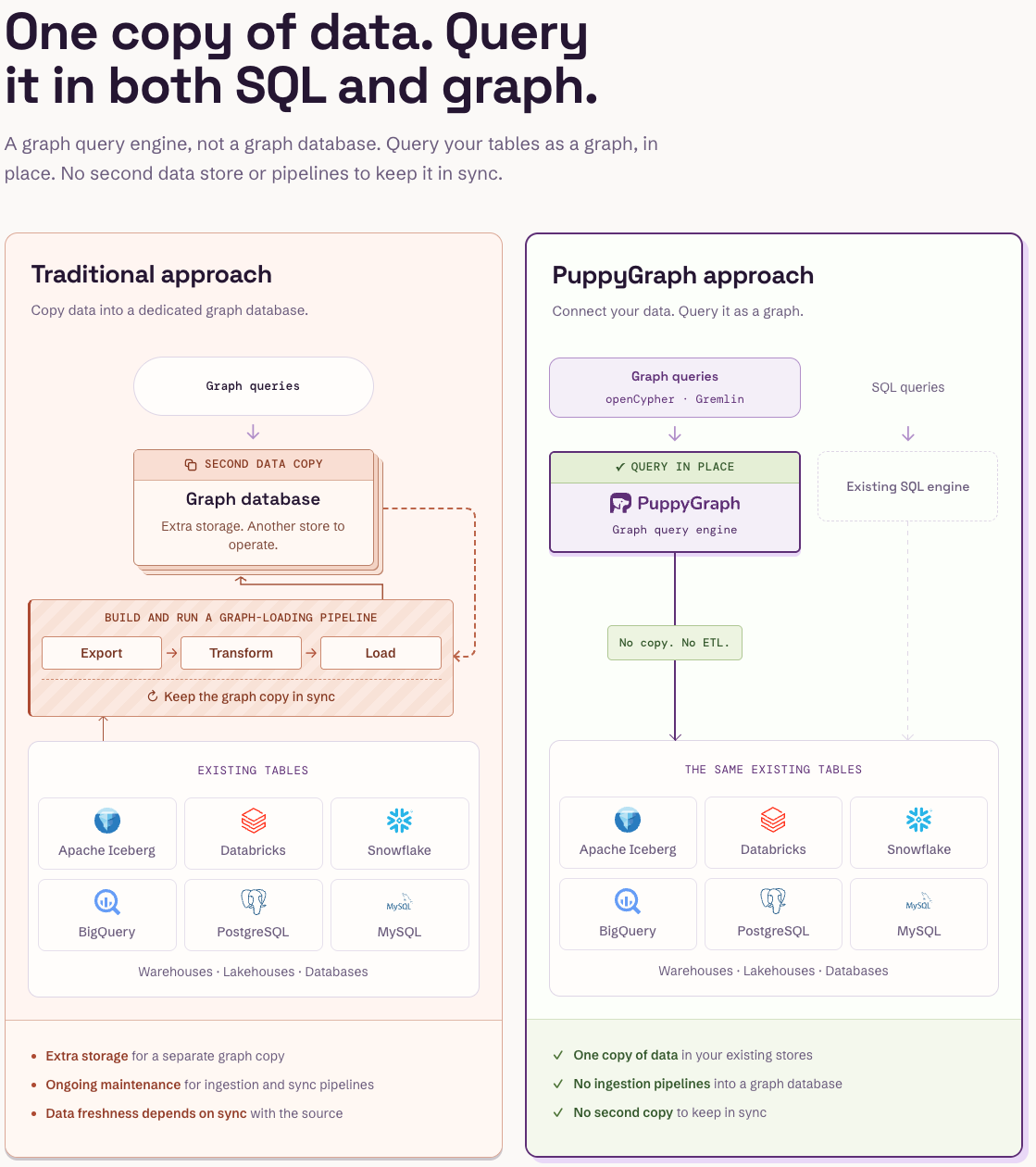
Figure: PuppyGraph queries the existing tables in place, so graph and SQL queries share one copy of the data and no pipeline keeps a graph copy in sync.
For this investigation, that supplies a way to follow modeled account, host, and session relationships across the existing records. The security team still owns telemetry collection, identity normalization, and interpretation of the evidence; the graph queries complement its SIEM and intelligence workflows.
Figure: Companies that use PuppyGraph.
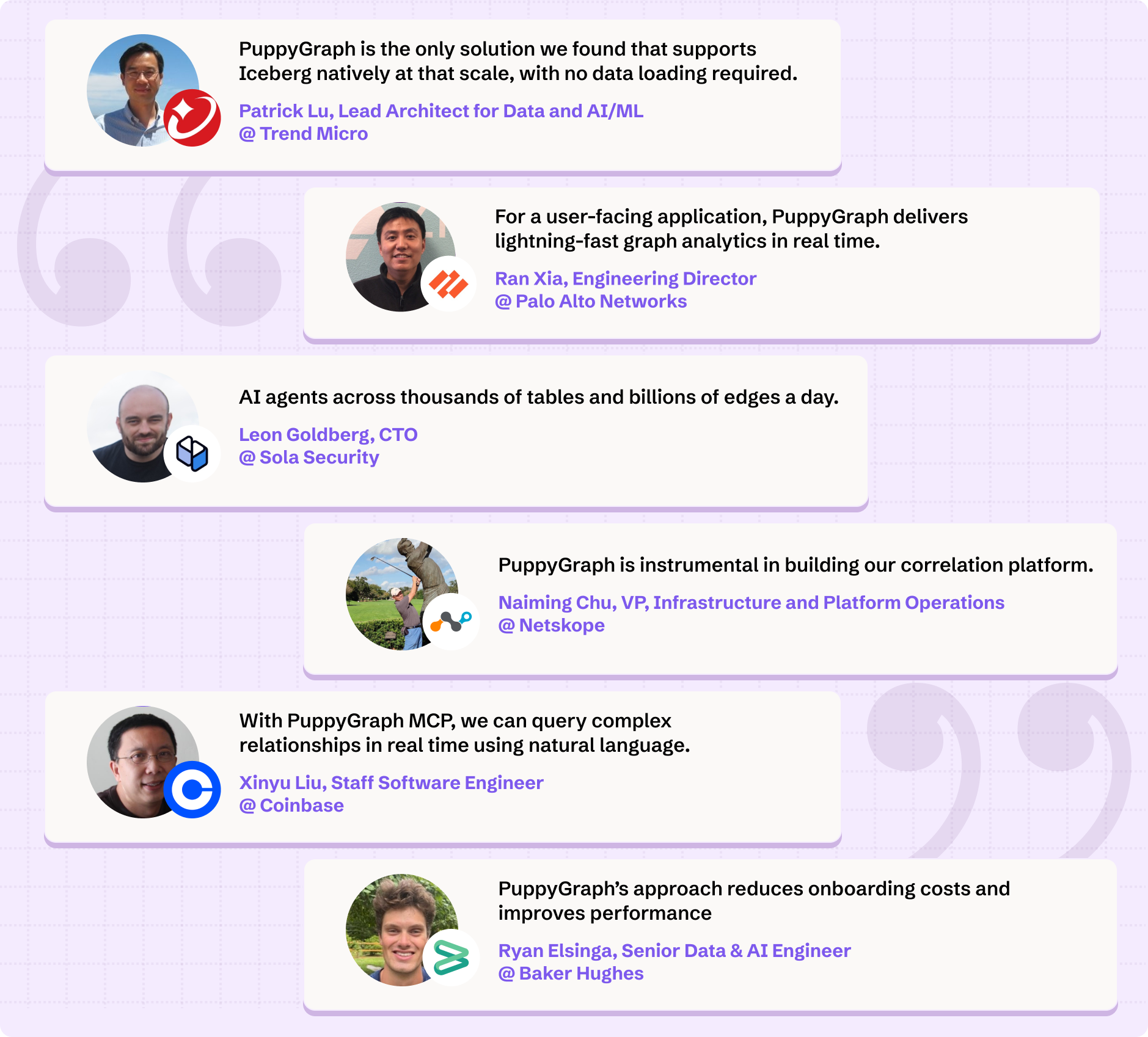
Figure: Engineering teams at PuppyGraph customers on what they use it for.
Conclusion
Threat intelligence gives security teams a reasoned basis for choosing what to investigate. Threat hunting tests those priorities against evidence from their own environment. Connecting the two requires clear questions, sufficient telemetry, and feedback that distinguishes confirmed findings from uncertainty.
Try the forever-free PuppyGraph Developer Edition and book a demo with the team to see how openCypher and Gremlin queries connect account, host, and session records across warehouse and lakehouse tables, with no graph-specific ETL, to support investigations that span systems.

Keep learning
Cybersecurity
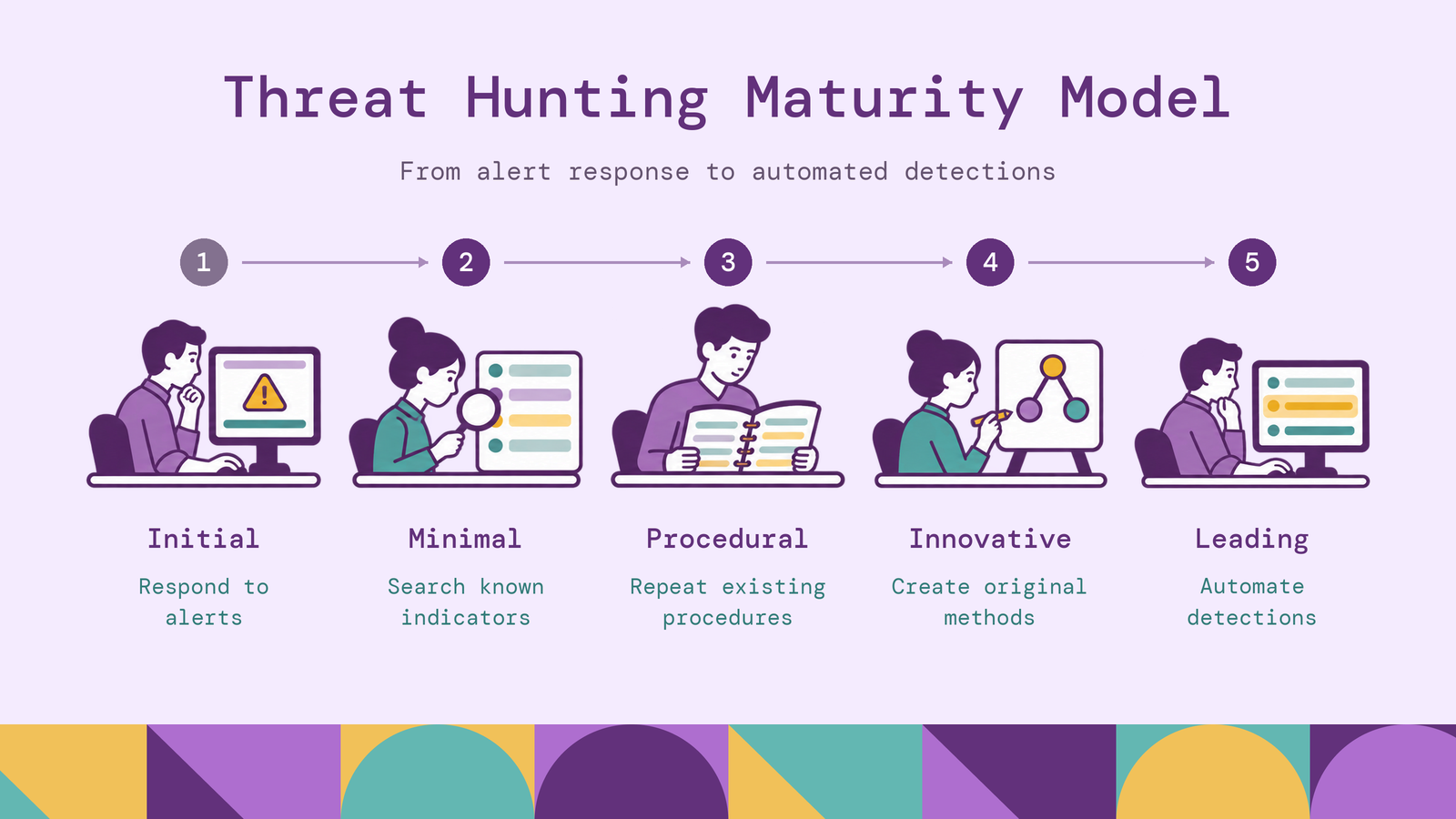
Threat Hunting Maturity Model: 5 Levels Explained
Explore the five levels of the threat hunting maturity model, assessment criteria, key capabilities, and best practices for building a mature threat hunting program.
Cybersecurity Graph Data Model
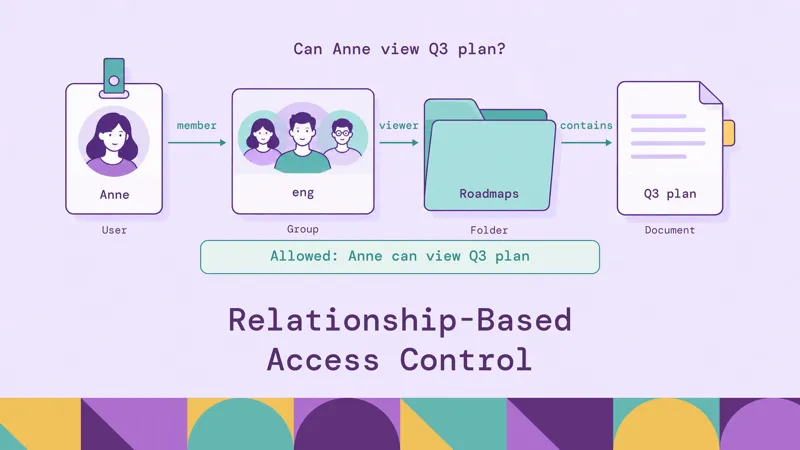
Relationship-Based Access Control (ReBAC): Complete Guide
Learn how relationship-based access control (ReBAC) works, its graph-based authorization model, use cases, benefits, implementation, and differences from RBAC and ABAC.
Cybersecurity
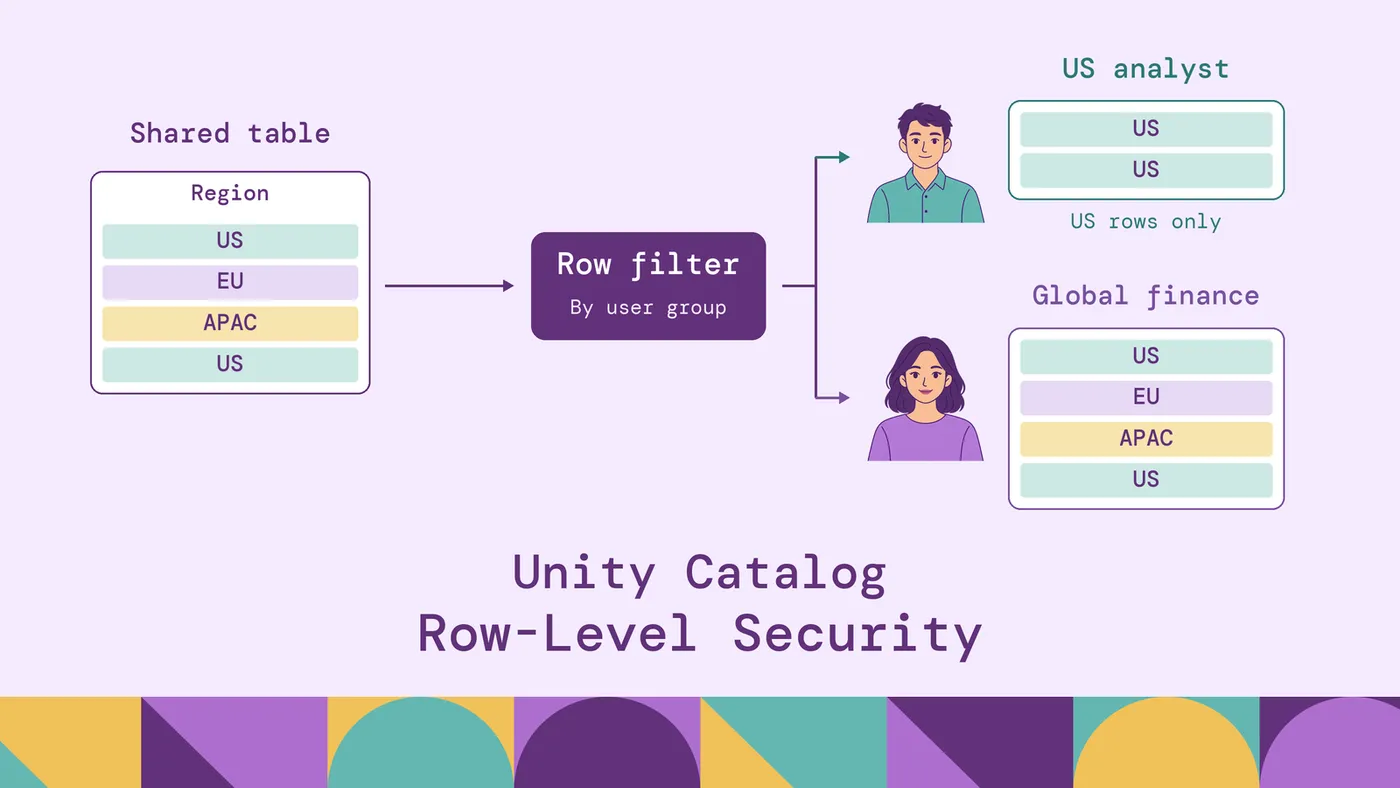
Unity Catalog Row-Level Security: Complete Guide
Learn how Unity Catalog row-level security works, including row filters, SQL UDFs, ABAC, dynamic views, implementation, use cases, and best practices.
Start free. Pay when it goes to production.
Contact us for any questions about capabilities, sizing and support.
* No payment required to start either one.
$ docker run -p 8081:8081 \
  -p 8182:8182 -p 7687:7687 \
  puppygraph/puppygraph:latestPulling puppygraph/puppygraph:latestStarting PuppyGraphWeb console listening on 0.0.0.0:8081Gremlin endpoint listening on 0.0.0.0:8182PuppyGraph is running# no pipelines · no second database · no data movement