

AI Infrastructure Solutions: Components, Benefits & Guide
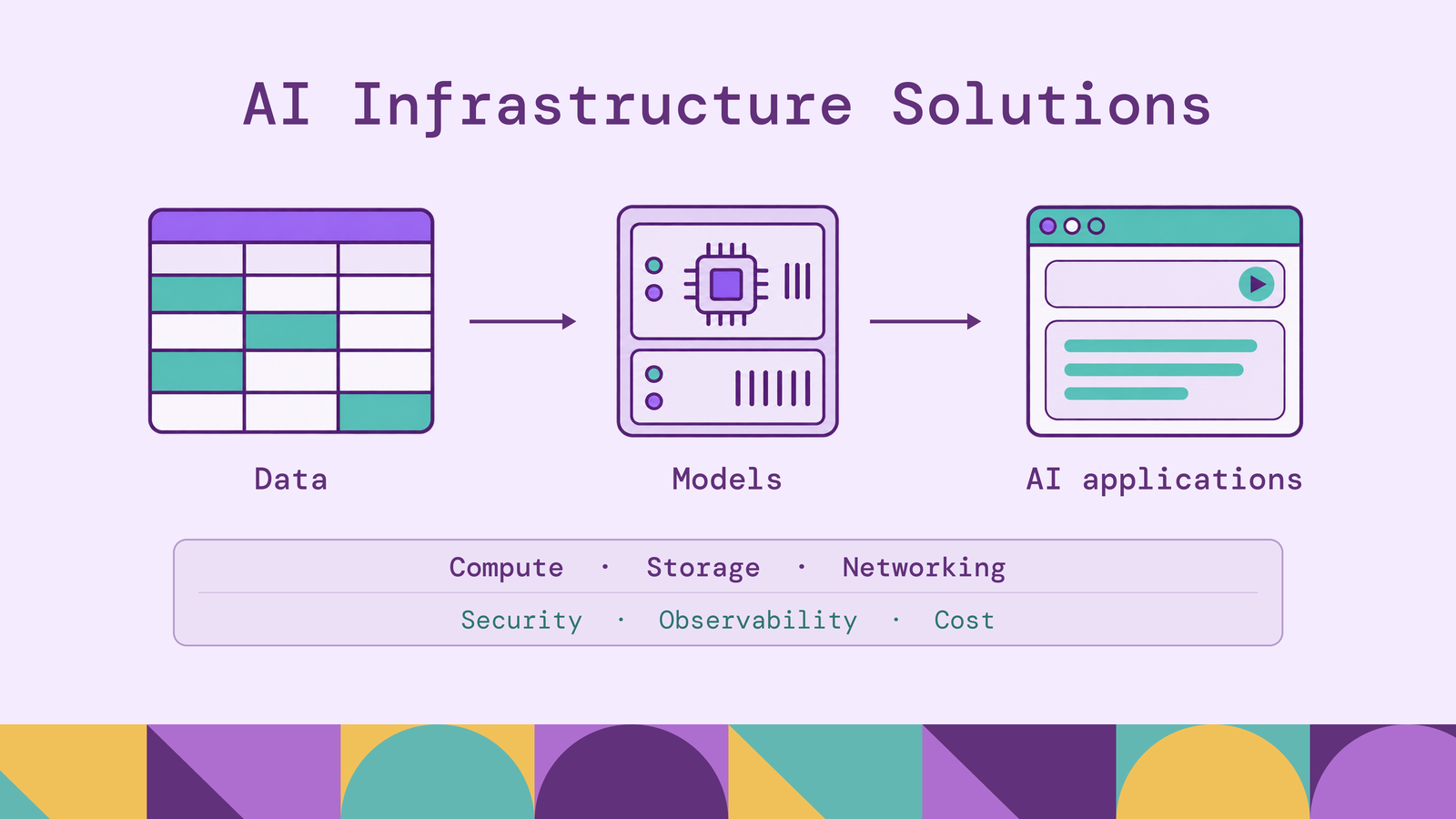
AI infrastructure decisions should start with the workload. Training a model, serving predictions, and giving an agent access to enterprise data place different demands on compute, storage, and operations. Buying accelerator capacity addresses only part of that design. The infrastructure must also deliver usable data, control access, and keep the application within its latency and cost targets.
This guide explains the components of AI infrastructure solutions, the trade-offs between cloud and on-premises deployment, and a practical selection process. It also examines five platforms and tools that address different parts of the stack.
What are AI infrastructure solutions?
AI infrastructure solutions are the hardware, software, and managed services used to develop, deploy, and operate AI systems. They include compute resources, storage, networking, data pipelines, model runtimes, and the controls that make those components reliable and observable.
The required combination depends on how an application uses AI. A team training its own model needs training environments, experiment tracking, evaluation, and a deployment path. A team consuming a hosted model API delegates model execution to a provider but still owns application orchestration, data retrieval, access controls, and output evaluation.
Consider a support assistant that answers questions about customer accounts. Its model endpoint generates text, while separate services retrieve account records, check the caller's permissions, and record the interaction. Each service contributes to the answer's correctness and response time.
Infrastructure therefore spans the full path from source data to application output. Google's MLOps architecture guidance makes the same distinction: production ML includes data verification, resource management, serving, monitoring, and automation around the model code.
Why is AI infrastructure important?
Infrastructure determines whether an AI application can sustain its intended behavior as traffic, data, and models change. Its benefits become concrete in three areas.
Reliable delivery. A deployed model needs predictable access to inputs and enough serving capacity to meet demand. Health checks, recovery procedures, and controlled deployments help teams contain failures. For an interactive assistant, a healthy model endpoint is insufficient if its retrieval service repeatedly times out.
Repeatable development. Shared environments, versioned artifacts, and automated pipelines give teams a consistent path from experiment to deployment. When quality falls after a release, engineers need to identify the model, preprocessing code, and data version involved. AWS's ML design principles explicitly include reproducibility across infrastructure, data, models, and code.
Accountable resource use. Workload-level measurement makes it possible to connect spending to useful results. Track training runs that reach an acceptable quality threshold and inference requests that meet service objectives. Those measures reveal whether additional capacity improves the application.
The operational benefit is a shorter path from detecting a problem to locating its cause. Infrastructure should make an unsuccessful request traceable across the services and data that produced it.
Key components of AI infrastructure
The physical resources establish how much work the system can perform and how quickly it can move inputs between stages.
Compute. CPUs handle application logic, data preparation, and many conventional ML workloads. GPUs and other accelerators support workloads that benefit from their execution model. AWS's model-hosting guidance recommends choosing resources against the model and traffic pattern. Test the actual runtime before selecting hardware. For language models, size memory for serving state as well as weights: the key-value cache stores attention information reused during generation and consumes additional memory.
Storage. Datasets, checkpoints, model artifacts, and application logs have different access patterns. Durable object storage can hold shared datasets and artifacts, while a measured training bottleneck may justify faster local storage or a parallel filesystem. Size for read throughput and checkpoint writes as well as capacity. Retention policies should distinguish reproducible intermediate files from records needed to investigate a deployment.
Networking. Training workers exchange data as well as read it. For example, PyTorch DistributedDataParallel synchronizes gradients across model replicas. Communication becomes part of training time, so additional accelerators do not guarantee proportional speedups. In serving systems, network design also covers calls between the application, model endpoint, and data services. Measure those paths separately.
The software layers determine which data reaches the model, how changes are released, and who can use the system.
Data pipelines and retrieval. Training requires validated datasets and consistent transformations. Retrieval-augmented generation (RAG) adds relevant information to a model's input at request time. Depending on the task, retrieval can use document search, vector similarity, SQL, or graph queries. A support assistant may need both policy documents and explicit relationships between customers, accounts, and subscriptions. Choose retrieval methods for the question being answered.
Models and orchestration. Training frameworks and inference runtimes execute models. Workflow orchestration coordinates preparation, training, evaluation, and deployment; resource scheduling allocates compute to those jobs. Keep model versions, runtime dependencies, and evaluation results together so a release can be reviewed and rolled back. Teams using hosted APIs still need to manage prompts, model selection, and application releases.
Security and observability. Apply service identities, least-privilege permissions, encryption, and audit logging across storage and execution. Define which retrieved records a caller may access before including them in a prompt. Observe both system health and application quality: queue time, errors, data freshness, and task success answer different questions. Review what request traces retain because prompts and retrieved context may contain sensitive data.
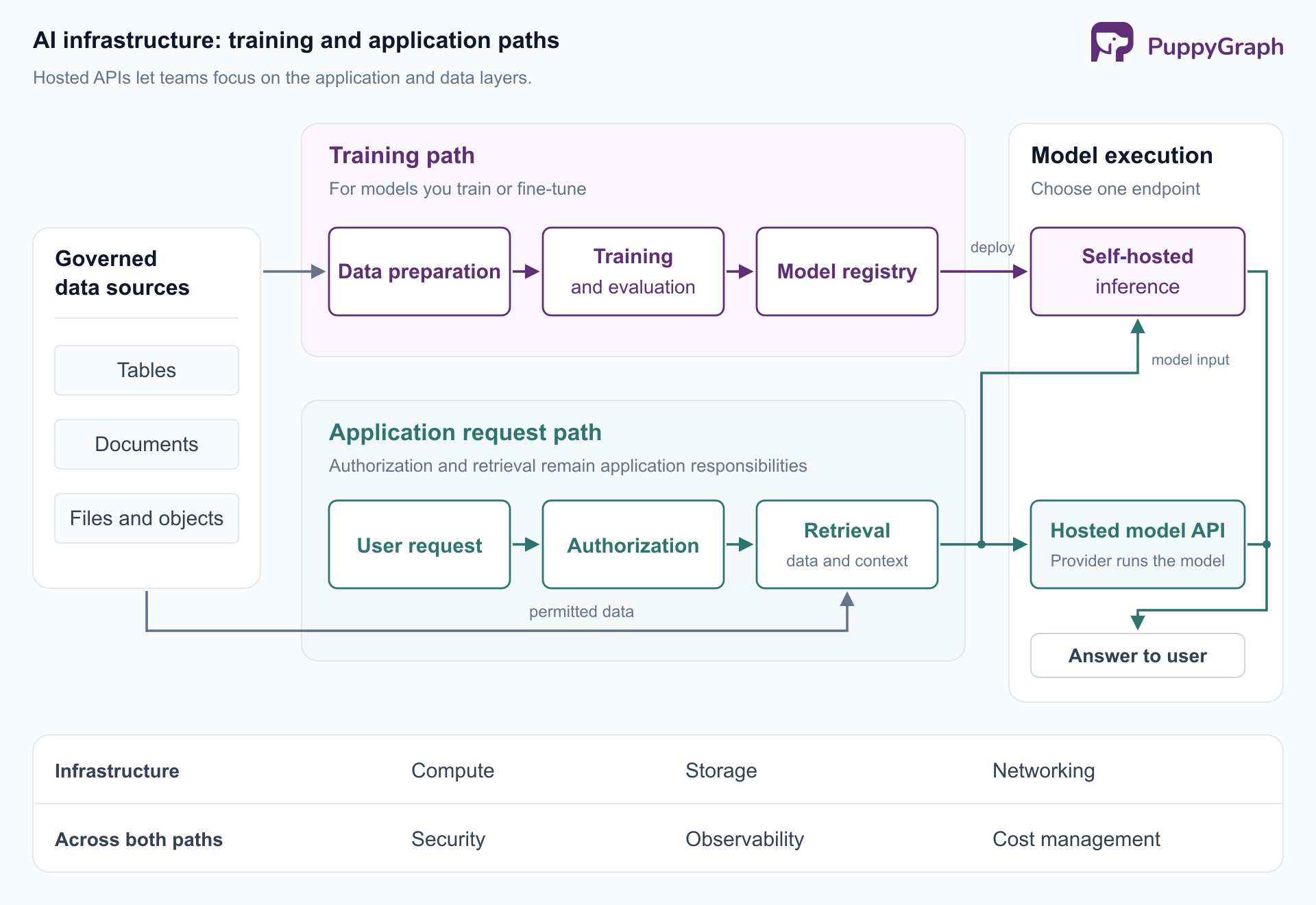
These components form a dependency chain. Serving optimizations can reduce inference latency and resource use, but slow retrieval, insufficient permissions, or stale inputs require changes elsewhere.
Cloud vs. on-premises AI infrastructure
Cloud and on-premises deployment differ in capacity acquisition, operational responsibility, and where data moves. Compare them against a specific workload and planning horizon.
Cloud services are worth evaluating when demand is uncertain or the team benefits from managed training and serving. Owned infrastructure is worth evaluating when sustained utilization, specialized hardware requirements, or local data processing justify its operating burden. Neither location determines security by itself; identity, configuration, monitoring, and maintenance still matter.
A hybrid design can train centrally and serve close to users or equipment. Its cost depends partly on what must cross the boundary. AWS's data-and-compute proximity guidance identifies repeated transfers between regions as a source of latency and expense. Apply the same placement analysis to connections between facilities and cloud services.
Choose locations for individual workloads, then validate the resulting data paths. A hybrid diagram is useful only when the team can explain how updates, credentials, and failures cross its boundaries.
AI infrastructure challenges
Capacity and utilization. An accelerator can be allocated while waiting for data, communication, or another stage of the pipeline. Diagnose the bottleneck before adding nodes. Training also competes with serving for resources unless scheduling policies or separate capacity pools protect interactive traffic.
Latency under load. A successful request in a notebook says little about concurrent production traffic. Serving performance depends on input size, output length, queueing, and runtime configuration. Batching illustrates the trade-off: Triton's dynamic batcher can combine requests to increase throughput, but deliberately waiting to form larger batches adds latency. Test the intended request mix.
Changing data. Pipelines can remain available while delivering unsuitable inputs. An upstream schema change may break a transformation; a document deletion may leave a stale retrieval entry. Assign ownership for freshness, deletions, and failed updates. Monitor quality separately from endpoint availability.
Costs beyond execution. Storage, data transfer, retrieval, evaluation, idle capacity, and engineering work all contribute to the bill. For an assistant, retries and repeated tool calls can increase the cost of completing one task. Compare cost per successful task alongside resource utilization, and include the cost of meeting peak demand.
Operational complexity. Drivers, runtimes, model artifacts, and platform services must remain compatible. Each additional dependency adds an upgrade and recovery responsibility. Keep an inventory of these dependencies and test changes against a representative application before rollout.
These challenges interact. A batching change can improve utilization while missing the response-time target; a retrieval cache can reduce latency while requiring a new freshness policy. Evaluate improvements against the whole service objective.
AI infrastructure best practices
Define measurable service objectives. Specify acceptable quality, response time, throughput, and input freshness before choosing capacity. For a language-model application, distinguish time to first token from total response time. Set objectives for representative tasks, including difficult requests and bursts, so an average does not hide failures that matter to users.
Version the deployed system. Record model identifiers, prompts, preprocessing code, retrieval configuration, and runtime dependencies. Preserve enough data lineage to explain the inputs used in an evaluation or training run. Build deployment and rollback procedures around this complete configuration. A model rollback alone may not restore behavior after a retrieval change.
Test recovery and overload. Interrupt a training job and verify that it can resume from a checkpoint. Exercise endpoint failure, an unavailable data source, and exhausted serving capacity. Set queue limits, timeouts, and retry budgets. Define when the application should return a clear failure instead of continuing to consume resources on repeated attempts.
Optimize from measurements. Profile preparation, retrieval, model execution, and response assembly separately. Adjust batching, caching, model size, and scaling policies against the observed bottleneck. Verify output quality after each optimization. Use cost attribution and idle-resource controls to make ongoing operation visible to the team responsible for it.
Make access controls part of evaluation. Test requests from users with different permissions, including users who should receive no results. Check that retrieval, caches, logs, and tool calls preserve those boundaries. Give each service only the permissions its task requires, and keep secrets outside prompts and model context.
Start with one complete application path and automate its deployment, evaluation, and recovery. Expand the shared platform as repeated needs emerge across workloads; each addition should have an owner and a measurable purpose.
How to choose an AI infrastructure solution
Use a written workload specification to narrow the shortlist, then test candidates against the same acceptance criteria.
- Describe the workload. Identify whether you need training, fine-tuning, batch inference, interactive serving, or API-based application development. Record expected concurrency, input sizes, quality requirements, and growth assumptions. Include the data services the application calls.
- Map constraints. Document data locations, permitted processing locations, identity requirements, and existing systems. Establish whether the team can operate a cluster or needs managed services. Separate mandatory constraints from preferences so a convenient integration does not outweigh a required capability.
- Price the complete path. Include compute, storage, data movement, model access, retrieval, support, and engineering operations. Compare normal demand, peak demand, and underutilization. For owned hardware, account for maintenance and replacement over the same period used for cloud estimates.
- Run a representative pilot. Use realistic data volumes, permissions, and request distributions. Measure quality and latency together. Include deployment, rollback, failure recovery, and a burst beyond expected capacity. A pilot should reveal operating effort as well as benchmark results.
- Test replacement costs. Identify what you can export: datasets, models where available, evaluation records, and application configuration. Check how tightly workflows depend on provider-specific APIs. Require a concrete account of what would change if one component were replaced.
Choose the smallest combination that satisfies the acceptance criteria and can be operated by the available team. A platform's feature breadth matters only when those features remove work that the application actually requires.
AI infrastructure solutions and platforms
The following five options address different layers: managed ML platforms, an accelerated software stack, and a graph-based data-access layer. They can be combined in one architecture. The fit assessments below follow from those roles and should be validated in a pilot.
Amazon SageMaker AI
Amazon SageMaker AI provides managed tools for building, training, and deploying ML models. It supports custom algorithms and frameworks, including distributed training workflows. SageMaker AI is the ML service within the broader Amazon SageMaker data, analytics, and AI platform.
Evaluate it when your team needs managed model development and serving on AWS. The useful comparison is how much provisioning and workflow management it removes from your own platform backlog. In a pilot, include data access, endpoint scaling, permissions, and cleanup of unused resources. Managed execution still requires application-specific decisions about quality, capacity, and cost.
Google Cloud Gemini Enterprise Agent Platform
Google Cloud now uses Gemini Enterprise Agent Platform as the name for the platform previously called Vertex AI. Its machine-learning services include managed training, AutoML, and a model registry for version management, evaluation, and deployment.
Evaluate it when you want managed ML workflows on Google Cloud, particularly when that is already where the required data resides. Test the complete workflow from data preparation to serving, including the relevant region and networking configuration. The decision should account for integration work saved within Google Cloud and the work required to move provider-specific workflows elsewhere.
Azure Machine Learning
Azure Machine Learning supports training, deployment, and MLOps, with MLflow integration, pipeline scheduling, and job artifacts that support auditing. It also integrates with Azure networking and secret-management services.
Evaluate it when Azure is already part of your operating environment and you need a managed lifecycle for custom models. Test how model releases fit existing delivery and access-control procedures. Include both batch and online serving requirements where relevant. A managed workspace provides platform capabilities, while your team remains responsible for the data, evaluation criteria, and release decisions that make a deployment acceptable.
NVIDIA AI Enterprise
NVIDIA AI Enterprise packages AI frameworks, inference microservices, and infrastructure software with enterprise support. Its software spans cloud, data center, and edge environments, including drivers, Kubernetes operators, and cluster-management tooling.
Evaluate it when operating an NVIDIA-based stack and vendor support for the software is a significant requirement. It serves a different purchasing need from a managed model endpoint: you must establish which infrastructure and operational responsibilities remain with your team or hosting partner. Validate the supported hardware and software combination, licensing, upgrade process, and application performance as part of the evaluation.
PuppyGraph
An enterprise assistant may need to follow relationships across customer, account, subscription, and support records. PuppyGraph lets teams define that domain model over existing data as a graph schema, exposing entities, relationships, and properties as an ontology for agents and analysts.
Teams map source tables to nodes and edges and query the graph using openCypher and Gremlin. The default direct-query path reads existing SQL databases, warehouses, and lakehouses without graph-specific ETL or a required persistent duplicate dataset. Supported lakehouse access includes direct reads of open table formats such as Iceberg and Delta Lake. Teams still define the graph schema and ensure that source identifiers and relationships are meaningful.
PuppyGraph compiles graph queries into a plan of node and edge operators that runs in its own distributed engine. Because the query is represented as graph operators end to end, the engine can optimize specifically for multi-hop traversals. Ontology enforcement validates queries before execution and returns structured feedback for invalid entity or relationship references, enabling agents to correct those queries.
Evaluate it when the application needs structured relationship context from existing enterprise data. It complements model hosting and ML platforms at the data-access layer. Include schema quality, traversal behavior, and agent responses to validation errors in the pilot; valid references alone do not guarantee a correct answer.
Conclusion
AI infrastructure solutions should be evaluated as a working path from data to application output. Compute capacity, data access, model execution, security, and operations each impose constraints. Define the workload first, then measure the complete path against quality, latency, recovery, and cost requirements.
Try the forever-free PuppyGraph Developer Edition and book a demo with the team to see how openCypher and Gremlin queries connect warehouse and lakehouse tables, with no graph-specific ETL, to supply structured context for AI applications.

Hao Wu is a Software Engineer with a strong foundation in computer science and algorithms. He earned his Bachelor’s degree in Computer Science from Fudan University and a Master’s degree from George Washington University, where he focused on graph databases.


