

What Is a Modern Data Stack?
The modern data stack was assembled to answer business questions: land data in a cloud warehouse, model it, and serve dashboards. Over the past few years AI has become the stack’s most demanding consumer, and it is exposing weaknesses that dashboards tolerated for a decade. The adoption pressure is real; McKinsey’s State of AI survey (November 2025) finds that 88 percent of organizations now report regularly using AI in at least one business function, up from 78 percent a year earlier. Whether those initiatives deliver anything depends less on the models than on the data infrastructure underneath them.
This guide covers what a modern data stack is, why AI raises the bar on it, how it compares to the traditional analytics stack and to legacy architecture, how it has evolved to serve AI and ML workloads, and how to build, govern, and staff one.
What is a modern data stack?
A modern data stack is a set of modular, cloud-native, managed tools organized around a central cloud data platform, a data warehouse or lakehouse, and connected through SQL and open interfaces. It is an architecture pattern, not a product: each layer is a separate best-of-breed service, chosen and replaced independently, rather than one vendor’s integrated suite.
The recognizable layers are ingestion (managed connectors and event streams that land source data with minimal engineering), storage and compute (the cloud warehouse or lakehouse, with storage and compute separated and billed independently), transformation (SQL models managed in version control, the practice dbt made standard), orchestration, business intelligence, and a governance layer of catalogs, lineage, and access control that spans the rest.
Three properties distinguish the pattern from what preceded it. Everything is a managed service, so the operating burden of running databases and pipelines shifts to vendors. Transformation happens after loading rather than before (ELT rather than ETL), because cloud platforms made it cheaper to land raw data first and transform it in place. And the components are modular, communicating through SQL and open formats, so swapping one does not mean re-platforming the rest.
The pattern has a datable origin. As dbt Labs’ Tristan Handy traces in The Modern Data Stack: Past, Present, and Future (2020), the launch of Amazon Redshift in 2012 made an elastic, affordable cloud warehouse the center of gravity, and an ecosystem of connectors, transformation tooling, and BI grew around it. What has changed since is who consumes the output; that shift is the subject of this post.
Why AI needs a modern data stack
A model’s ceiling is set by its data. Training, fine-tuning, retrieval, and agent workflows all inherit the quality, freshness, and accessibility of whatever infrastructure feeds them, and the failure statistics land squarely on that dependency: Gartner predicted (February 2025) that through 2026, organizations will abandon 60% of AI projects unsupported by AI-ready data, and the same release reports that 63% of organizations either do not have or are unsure they have the right data management practices for AI.
AI workloads stress the stack differently than dashboards do. A dashboard reads a few modeled tables on a schedule; AI consumes far more of the estate, including the raw text, logs, and documents that BI never touched. A dashboard tolerates yesterday’s data; a fraud model scoring a live transaction does not. A wrong dashboard gets caught by a human who knows the business; a wrong answer from an AI system flows straight into a decision or a customer interaction. And where BI needed governance mostly for compliance, AI needs it for basic correctness: knowing which data trained a model, what an agent is allowed to read, and where a generated answer came from.
The modern data stack matters for AI because these demands (breadth, freshness, reproducibility, governed access) are properties of infrastructure, not of models. An organization that cannot produce clean, current, well-governed data for a dashboard will not produce it for a model either, and the model will fail less visibly and more expensively.
Modern data stack vs. traditional analytics stack
The traditional analytics stack, the pattern that preceded the cloud warehouse era, solved the same problem with different economics: an on-premises warehouse or OLAP server, a dedicated ETL tool transforming data before load, and a tightly coupled BI suite on top.
The table understates the deepest difference, which is organizational. In the traditional stack, every new source, metric, or report queued behind a central IT team, because the tooling demanded specialists and the capacity was fixed. The modern stack moved transformation into SQL under version control and made capacity elastic, which let analytics teams self-serve. That same property is what makes it the viable substrate for AI: model-building teams iterate on data far faster than report-building teams ever did, and a stack that meters out changes through a request queue cannot keep up with either.
How the modern data stack has evolved for AI
The first decade of the modern data stack was BI-centric. Batch ELT landed data nightly, transformations produced modeled tables, and the terminal consumer was a dashboard. That design is still the core, but four additions have reshaped it as AI became a first-class consumer.
From warehouse-centric to lakehouse and open table formats. Training data and retrieval corpora include documents, logs, images, and events, which the classic modeled warehouse never held. The stack has shifted toward data lakes and lakehouses built on open table formats like Apache Iceberg and Delta Lake, where one governed copy of the data serves SQL engines, Python ML frameworks, and everything in between, without per-engine exports.
From batch to streaming freshness. Nightly batch was fine when the consumer was a morning dashboard. Models that score transactions, personalize sessions, or watch infrastructure need features computed on data that is seconds or minutes old, so event streaming (most commonly Apache Kafka) and incremental processing moved from exotic to standard components.
New storage primitives for AI workloads. Two components with no BI ancestor are now common: vector stores, which index embeddings for similarity search in retrieval-augmented generation (RAG), and feature stores, which keep the features a model was trained on consistent with the features it sees at inference time.
From dashboards to models and agents as consumers. The most consequential change is at the top of the stack. Dashboards are read by people who bring their own context; models and agents bring none. That has pushed the stack toward explicit semantic layers, metric definitions, and ontologies that encode what the data means in a form software can consume, rather than leaving meaning in analysts’ heads.
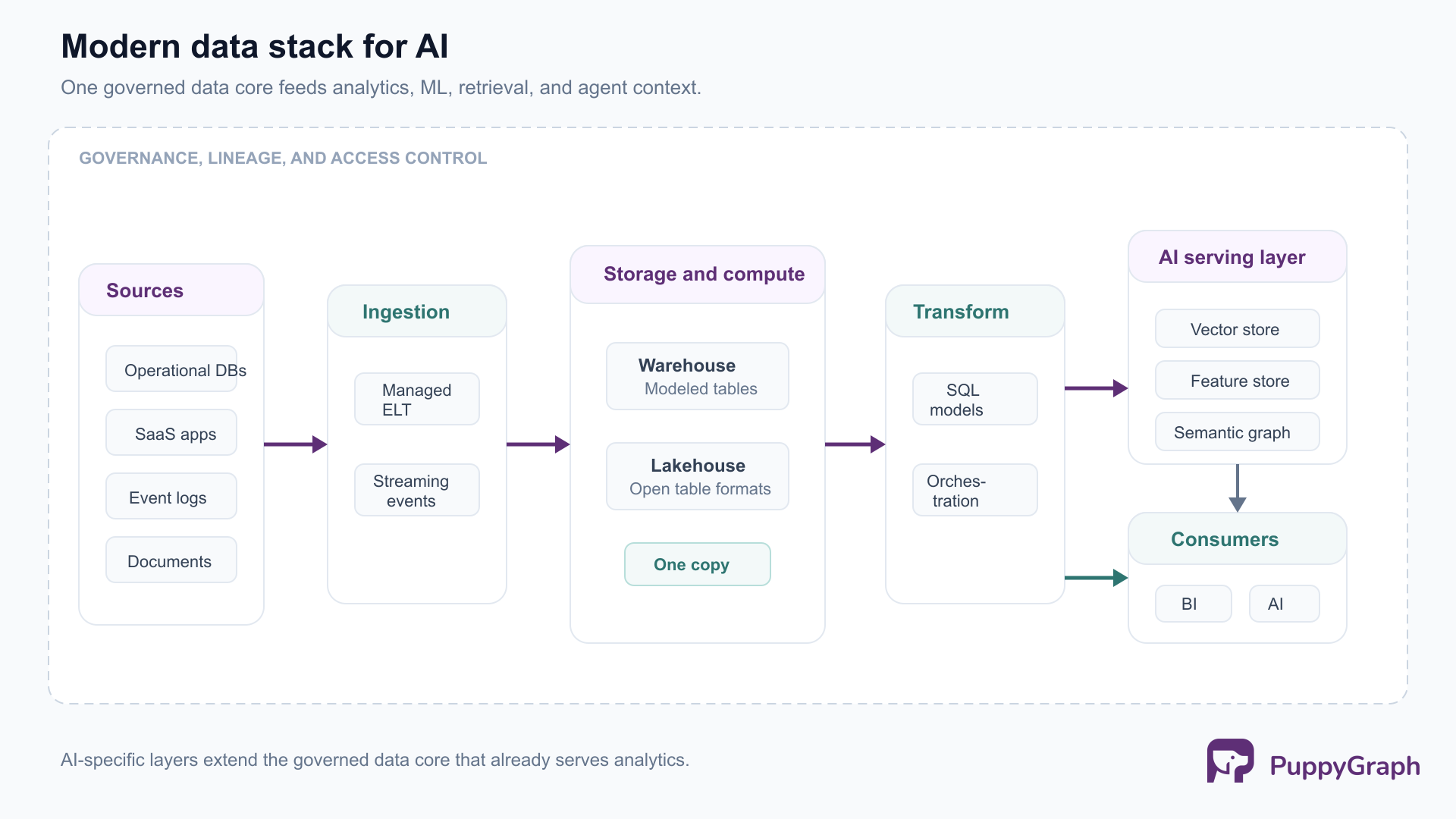
These additions extend the BI-era core. The stack that serves AI well is the BI stack plus freshness, unstructured breadth, AI-specific serving layers, and machine-readable semantics.
How modern data stacks support AI and ML
Mapped against the lifecycle of an AI system, each layer of the stack carries a specific load.
Training data and features. The warehouse or lakehouse holds the integrated history that training sets are cut from, and the transformation layer turns raw records into features with the same rigor it applies to metrics: versioned SQL, tests, and lineage. A feature store then serves those features both offline for training and online for inference, closing the train/serve skew that quietly degrades models when the two paths compute features differently.
Retrieval and grounding. RAG systems are pipelines before they are prompts: documents are ingested, cleaned, chunked, embedded, and indexed in a vector store, and the answer quality of the system downstream is bounded by the hygiene of that pipeline. Stale corpus, bad chunking, or leaked access-restricted documents are data engineering failures, not model failures.
Inference-time freshness. Streaming ingestion and incremental transformation keep the features and context an AI system reads current. The stack’s job is to make the freshness requirement a configuration choice per use case, rather than an architectural rewrite.
Evaluation and observability. Model quality drifts as data drifts. Because the stack already centralizes the data that feeds models, it is also the natural place to monitor distributions, track lineage from source to prediction, and reproduce the exact inputs behind a past output when something goes wrong.
Structured context for agents. Much of what an enterprise knows is not in documents at all; it is in the relationships across tables: which customer holds which accounts, which services depend on which components, which supplier feeds which product line. Vector search cannot answer these questions, because they are questions about connections rather than about similar text, and an agent assembling context by joining tables freehand will hallucinate relationships that do not exist. The emerging pattern is a graph layer over the stack that exposes those entities and relationships as an explicit, queryable model, an ontology the agent is grounded in rather than a pile of tables it must guess about. PuppyGraph, a graph query engine used by Coinbase, eBay, and AMD, adds that layer without new infrastructure for it: a graph schema is defined over the warehouse and lakehouse tables the stack already maintains (including direct reads of open table formats like Iceberg and Delta Lake), and analysts and AI agents query it in openCypher and Gremlin with no ETL and no second copy of the data. Queries are validated against that schema before execution, so an agent that references an entity or relationship that does not exist gets structured, domain-language feedback it can use to correct itself instead of a plausible-looking wrong answer. AMD builds a graph layer of this shape over Apache Iceberg, spanning tickets, code, logs, and telemetry.
Across the lifecycle, the stack’s role is to keep AI systems attached to governed inputs instead of ad hoc extracts. Training features, retrieval corpora, fresh inference context, evaluation traces, and graph-based agent context all depend on the same underlying discipline: the data layer has to make inputs reproducible, current, and meaningful before the model consumes them.
Building AI data products with a modern data stack
A data product is a dataset, feature set, embedding index, or API treated with product discipline: it has an owner, a documented contract, quality guarantees, and consumers who can rely on it not to change out from under them. The term matters for AI because AI consumers cannot compensate for broken inputs the way a human dashboard reader can; a model retrained on a silently changed table or an agent reading a stale index fails without anyone noticing at the moment of failure.
The modern data stack supplies the mechanics that make product discipline enforceable rather than aspirational. Transformation code lives in version control with tests and CI, so a change that breaks a contract fails before deployment. Catalogs and lineage make each product discoverable and its dependencies inspectable. The semantic layer gives products a consumption interface defined in business terms rather than physical columns.
Typical AI data products built this way include a churn-score table refreshed on a schedule and consumed by both a dashboard and a marketing automation system; a governed document corpus with its embedding index, serving RAG applications; a feature set with offline and online serving paths; and an entity graph exposing customers, accounts, and their relationships as a queryable product for agents.
The common thread is that each is an artifact with guarantees rather than a pipeline someone once wrote. That reframing, more than any individual tool, is what separates stacks that support production AI from stacks that support demos.
Modern data stack vs. legacy data architecture
The comparison earlier in this post was about the analytics toolchain; legacy data architecture is the broader estate that toolchain lived in. It typically means on-premises warehouse appliances, Hadoop clusters built in the 2010s big-data era, point-to-point integrations grown over decades, nightly batch windows, and infrastructure operated by hand.
Legacy architecture persists for reasons that deserve respect rather than dismissal. The systems work, and the businesses on top of them depend on that. Migration cost is real and the sunk investment is large. Data residency and regulatory constraints genuinely rule out public cloud for some estates. And a Hadoop cluster at steady utilization can be cheaper than the elastic bill for the same fixed workload.
The practical posture is therefore coexistence and incremental migration rather than a replacement project. The common sequence offloads analytical workloads first, replicating data out of operational and legacy systems through change data capture into a cloud platform, while the systems of record stay put. Each migrated workload retires load from the legacy estate without betting the business on a cutover.
One trap is worth naming: lift-and-shift, reproducing the legacy warehouse’s rigid modeling and batch cadence on cloud infrastructure, recreates the old constraints at new prices. The value of the modern pattern for AI is in the properties (elasticity, raw-data retention, code-based transformation, machine-readable semantics), not in the hosting. A migration that does not carry the properties across has moved the problem, not solved it.
Benefits of a modern data stack for AI
The payoff of the pattern, for AI specifically, comes down to a handful of properties.
Elastic experimentation. Training runs, embedding backfills, and large evaluations are bursty. Separated, elastic compute means an experiment spins up capacity for an afternoon and releases it, with no procurement gate between an idea and a test.
One governed copy serving BI and AI. When dashboards and training pipelines read the same modeled tables, the number the executive sees and the data the model learned from cannot silently diverge. Every quality fix and definition change propagates to all consumers at once.
Speed onto new sources. Managed connectors and ELT reduce the work required to put a new source’s raw data in the platform, which matters because AI use cases routinely need data that BI never modeled.
Freshness as a dial. With streaming and incremental processing in the stack, each use case chooses its latency, from nightly batch for a training set to seconds for a scoring feature, without separate architectures per tier.
Composability under churn. AI infrastructure is evolving faster than any other layer of the stack. A modular stack lets a team swap a vector store or add a feature store without re-platforming, which is insurance the integrated-suite alternative does not offer.
These benefits compound because they are shared infrastructure: a lineage system bought for compliance also debugs models, and a streaming pipeline built for fraud also freshens an agent’s context. The stack turns AI from a sequence of one-off integration projects into marginal additions to a platform.
How to build a modern data stack for AI
Sequence matters more than tool choice. Most tool decisions are reversible in a modular stack; skipped foundations are not.
Start with the shared platform foundations before adding AI-specific serving layers.
Start from use cases, not tools. Pick the two or three AI and analytics outcomes that matter this year and work backwards to the data they need. A stack assembled from a reference architecture without a driving use case becomes shelfware with a monthly bill.
Choose the platform core. The central decision is warehouse, lakehouse, or both. If unstructured data, model training, or engine diversity matters, weight toward a lakehouse on open table formats; if the near-term work is SQL analytics and modest ML, a warehouse is simpler to run. Our guides to data warehouses and data lakes cover the trade-off in depth.
Land raw, transform in code. Use managed connectors and streams to land raw data, then build all transformation as versioned, tested SQL. This is the step that turns pipelines into reviewable software, and it is the foundation the data-product discipline above stands on.
Put governance in early. Catalog, lineage, and access control are cheap to adopt when the stack is small and painful to retrofit. For AI they are functional requirements rather than compliance overhead: they are how you will answer what a model was trained on and what an agent may read.
Then add specialized layers only when a concrete workload needs them.
Add AI-specific components when a use case demands them. A vector store earns its place when a retrieval application ships; a feature store, when online inference needs features consistent with training; a graph layer, when agents need relationship context. Adding them speculatively adds integration surface without adding capability.
Prove a thin slice end to end. Before scaling anything, take one use case from raw source to served model or agent and run it in production. The thin slice surfaces the real integration problems that architecture diagrams hide.
That order keeps the stack honest. The early choices establish ownership, contracts, and a governed core; the later choices prove that the AI layers can consume that core without turning every model or agent into a bespoke integration project.
Governance and trust in AI data stacks
Governance in a BI-era stack answered auditors. In an AI stack it answers operational questions that determine whether the system can be trusted at all.
Lineage becomes explainability. When a model misbehaves or an agent gives a wrong answer, the first question is what data produced this, and the answer must be reconstructable: which sources, which transformation versions, which snapshot in time. Lineage tracked through the transformation layer is what makes that question answerable after the fact.
Access control must survive the hop into AI. A model trained on restricted rows will happily surface them to unrestricted users, and an agent with broad read access is a bypass of every row-level policy in the platform. Access control has to be enforced at the layer where AI consumes data, not just where humans do. Exposing data to agents through a governed access layer, one that presents only defined entities and relationships, bounds what an agent can reach to what the layer deliberately exposes.
Quality moves upstream of training. Data contracts and tests in the transformation layer catch schema drift and distribution anomalies before they reach a training set or a retrieval corpus, where they would otherwise surface weeks later as unexplained model degradation.
Semantics are part of governance. Agreed definitions, maintained in a semantic layer or ontology, are what keep an AI system’s answers consistent with the organization’s own numbers. A model that computes “active customer” differently than the finance dashboard does is a governance failure, even if every pipeline ran green.
The common principle is that trust in AI outputs is inherited from the data layer. No amount of model evaluation compensates for not knowing what the model read.
Challenges of implementing a modern AI data stack
The pattern’s weaknesses are real, and most of them are the shadow side of its strengths.
Integration tax. Modularity means every component boundary is an integration to build and operate. A best-of-breed stack brings multiple vendor relationships, upgrade cadences, and debugging surfaces that have to be managed as one system.
Cost management. Elastic pricing removes the capacity ceiling and, with it, the natural spending brake. Runaway queries, always-on compute, and per-row connector pricing produce bill surprises; cost observability and ownership need to be someone’s job from the start.
Skills and ownership. The stack assumes analytics engineers who treat SQL as software and, for the AI layers, ML engineering skills that many data teams are still building. Tooling does not substitute for the operating model.
Data quality at AI scale. ELT lands everything, including what is wrong. Without contracts and tests, the lake becomes the swamp the warehouse era warned about, and AI consumes the swamp indiscriminately where dashboards would have exposed it slowly.
Churn in the AI layer. Vector stores, embedding models, and agent frameworks are consolidating fast, and this year’s component choice may not be next year’s. Modularity mitigates this, but only for teams disciplined about keeping interfaces clean.
These weaknesses argue for deliberate adoption, with the thin-slice sequencing above rather than a big-bang platform program.
Who should adopt a modern data stack?
Startups and scale-ups are the default adopters: no legacy estate, managed services in place of a platform team they do not have, and consumption pricing that keeps initial commitment low. For this profile there is no serious competing pattern.
Mid-size and enterprise organizations with AI ambitions are where the decision carries stakes. The signals that adoption is due: long analytics queues, AI pilots stalling on data access, per-project ad-hoc pipelines multiplying, or a legacy estate whose maintenance crowds out new work. The incremental path in the legacy section above is the standard route in.
Organizations that can reasonably defer exist too. A small operation whose analytics fit in a replica of the production database and a BI tool does not need a stack. Estates under hard data-residency constraints may be limited to on-prem variants of the pattern. And an organization with no analytical or AI ambitions beyond operational reporting will pay the pattern’s integration tax without collecting its returns.
The honest framing is that the modern data stack is infrastructure for organizations that intend to compound data work over time, and its AI extensions are for those that intend some of that work to be models and agents rather than dashboards alone. Both intents are choices, and the stack should follow them, not precede them.
Conclusion
A modern data stack is the current answer to a durable problem: getting an organization’s data into one governed, current, queryable place, at a cost and pace that survive contact with reality. AI raises the price of failing at that problem. Models and agents consume more of the data, tolerate less staleness, and fail less visibly than the dashboards the stack was built for, which is why the stack has grown lakehouse breadth, streaming freshness, AI-specific serving layers, and machine-readable semantics. Teams that treat those as extensions of one governed platform, rather than as a parallel AI infrastructure, end up with AI systems whose answers they can trace, reproduce, and trust.
Try the forever-free PuppyGraph Developer Edition and book a demo with the team to see how openCypher and Gremlin queries run over warehouse and lakehouse tables, with no graph-specific ETL, turning the entities and relationships your stack already models into context an AI agent can query.

Sa Wang is a Software Engineer with exceptional mathematical ability and strong coding skills. He holds a Bachelor's degree in Computer Science and a Master's degree in Philosophy from Fudan University, where he specialized in Mathematical Logic.


